
Top Hat Special (Hatchery Line)
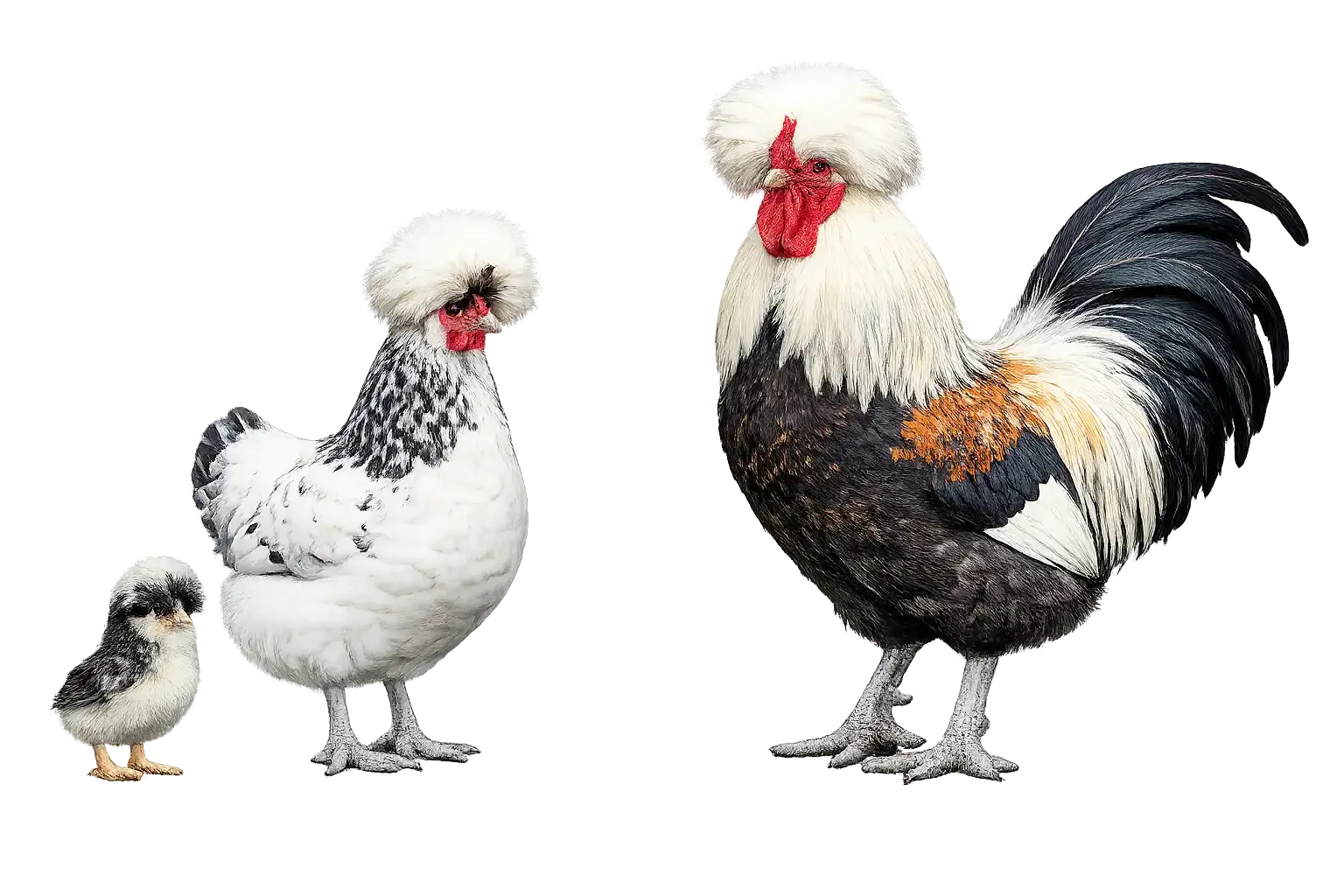
The Top Hat Special is not a breed. This is the most important thing to understand before ordering, before the chicks arrive, and before trying to identify what you received. It is a hatchery assortment product, a mixed order of crested chicken varieties sold straight run with no sex guarantee, no specific breed guarantee, and no specific color or variety guarantee. What the buyer receives is a collection of crested chickens drawn from whatever crested varieties the hatchery has available on the hatch date, with most hatcheries promising at least four different crested varieties per order but making no guarantee beyond the crested characteristic itself. The hatchery explicitly does not record which breeds or varieties were included in a given assortment, and the identification of individual birds is left to the buyer as what Murray McMurray Hatchery calls a fun project.
The pool of varieties that hatcheries draw from when filling Top Hat Special orders typically includes multiple Polish color varieties, Appenzeller Spitzhaubens, Mottled Houdans, and White Sultans, with some hatcheries also including Crevecoeurs and other crested breeds depending on their current breeding program. The specific mix varies between hatcheries and between order dates at the same hatchery. A buyer who receives three White Polish, one Golden Laced Polish, one Silver Laced Polish, and one White Sultan has received a legitimate Top Hat Special assortment. A buyer who receives only Polish varieties in multiple colors and no Houdans or Sultans has also received a legitimate Top Hat Special, as documented by Stromberg's buyer reviews. The assortment is inherently variable and that variability is the product's defining characteristic rather than a defect.
For the keeper who wants a collection of visually spectacular crested birds for backyard ornamental value, light egg production, exhibition preparation, or simply the entertainment of raising multiple crested varieties simultaneously, the Top Hat Special is a practical and economical entry point. For the keeper who wants specific breeds, specific sexes, specific colors, or predictable production metrics, the Top Hat Special is the wrong purchase and the individual breed pages in this directory for White Polish, White Sultan, and other crested varieties are the appropriate starting points instead.
Quick Facts
Type: Hatchery assortment product; mixed crested varieties; not a breed
Sex: Straight run only; no sex selection available; buyer can expect approximately 50 percent cockerels in any unsexed straight-run assortment
Breed Guarantee: None; at least 4 different crested varieties typically included; specific breeds not guaranteed or recorded by hatchery
Typical Varieties in Pool: Polish (multiple colors including White, Golden, Silver, Buff Laced, White Crested Black, White Crested Blue, Splash, Tolbunt); Appenzeller Spitzhauben (Silver Spangled, Golden Spangled, Chamois Spangled); Mottled Houdan; White Sultan; occasionally Crevecoeur and other crested breeds
Weight Range: Varies by variety; Polish and Sultans 4 to 6 lbs; Houdans 5 to 8 lbs; Spitzhaubens 3.5 to 5 lbs
Egg Production: Varies by variety; generally 150 to 200 medium white eggs per year from most crested varieties; Spitzhaubens may produce somewhat more; all lay white eggs
Egg Color: White across all typical varieties in the assortment
Primary Purpose: Ornamental; light egg production; exhibition preparation; flock visual diversity
Temperament: Varies by variety; generally gentle and quiet across all crested breeds in the pool; Polish specifically prone to startling from crest-obstructed vision; Spitzhaubens somewhat more active and alert; Sultans and Houdans calm and docile
Brooding: Low across all typical varieties; most crested breeds are non-broody
Flight Capability: Variable; Polish low to moderate; Spitzhaubens somewhat more capable; Sultans essentially none due to leg feathering and docile character
APA Recognition: Most varieties in the pool are APA recognized as individual breeds; the Top Hat Special assortment itself is a hatchery product with no APA standing
Available From: Murray McMurray Hatchery; Cackle Hatchery; The Chick Hatchery; Stromberg's; Chicken Coop Company; Valley Hatchery; most major hatcheries
Distinctive Characteristic: Every bird in the assortment carries a crest; the specific variety, color, sex, and breed composition of the order is unknown until the birds arrive and mature
Understanding the Top Hat Special
The Top Hat Special exists as a hatchery product because crested breeds occupy a specific and somewhat awkward commercial position in the poultry market. They are visually spectacular and genuinely popular among backyard keepers seeking ornamental flock diversity, but they represent a niche enough market that maintaining full breeding flocks of six or eight separate crested varieties requires hatchery infrastructure that only justifies itself if the combined crested category generates enough order volume. The assortment model solves this by allowing hatcheries to maintain crested breeding flocks at the level that their individual breed demand supports and then package surplus birds from those flocks into assortment orders that provide buyers with variety without requiring any single crested variety to generate stand-alone commercial volume.
The product is genuinely useful for certain keeper situations and genuinely mismatched for others. Understanding which situation applies before ordering prevents the most common Top Hat Special disappointment, which is not that the birds are unhealthy or that the hatcheries are dishonest, but that buyers who expected specific varieties or sexes receive a product that was never designed to provide them.
Murray McMurray Hatchery, one of the most widely used sources for the Top Hat Special, specifically describes the assortment as including at least four different crested varieties from a pool that includes White Crested Black Polish, Buff Laced Polish, Golden Polish, Silver Polish, White Polish, Mottled Houdans, and Sultans, with the note that assortments may contain additional chicks not listed. Cackle Hatchery's version draws from a similar pool and also sells straight run only. The Chick Hatchery specifically states that they do not record which breeds are included, making post-hatch variety identification entirely the buyer's responsibility.
The Varieties in the Pool
Understanding the individual varieties that appear in Top Hat Special orders helps buyers know what they might receive and prepare appropriate management for the range of crested breed requirements. Each variety in the typical pool is covered in greater depth in its own dedicated post in this directory.
The Polish varieties are the most commonly represented in Top Hat Special orders across all hatcheries, reflecting the Polish breed's widespread hatchery availability. Polish appear in multiple APA-recognized color varieties including White, Golden, Silver, Buff Laced, White Crested Black, White Crested Blue, and Splash. All Polish varieties share the breed's core management requirements: severely vision-limiting crest that requires trimming around the eyes for welfare, vulnerability to wet weather and ice formation on the crest, inability to free range safely due to predator exposure from limited vision, low position in mixed-flock pecking order making them vulnerable to bullying by assertive breeds, and 150 to 200 medium white eggs per year from laying-selected strains. The White Polish has a dedicated post in this directory; the other color varieties share these management characteristics.
The Appenzeller Spitzhauben is the most practically capable and most production-oriented bird likely to appear in a Top Hat Special assortment. A Swiss heritage breed developed in the Appenzell region, the Spitzhauben carries a forward-pointing crest that is smaller and less vision-obstructing than the Polish's full spherical crest, a V-shaped comb, and a more active, alert temperament than the Polish. Spitzhaubens are somewhat better foragers than Polish, somewhat more predator-aware despite their crest, and lay white eggs at production rates that some sources place above the Polish at 150 to 200 or more per year. They weigh approximately 3.5 to 5 pounds at maturity and carry APA recognition in Silver Spangled, Golden Spangled, and Chamois Spangled color varieties.
The Mottled Houdan is a French heritage breed combining a crest with a V-shaped comb, a beard, and the distinctive five-toed foot that distinguishes Houdans from Polish and Sultan. The Houdan is a more substantial bird than the Polish at 5 to 8 pounds at maturity, making it the most genuinely dual-purpose bird in the Top Hat Special pool with meaningful table bird utility alongside white egg production. Houdans are calm and docile, somewhat less vision-limited by their crest than the Polish, and carry APA recognition in Mottled and White varieties.
The White Sultan is the most extensively feathered bird in the pool, carrying leg feathering, vulture hocks, a full crest, V-shaped comb, beard, muffs, and five toes in a configuration that makes it one of the most visually complex ornamental birds in the APA standard. The White Sultan is essentially non-functional as a production or meat bird, essentially unable to free range safely, and requires more detailed feathering management than any other bird in the Top Hat Special pool. It is spectacularly beautiful and makes an exceptional exhibition bird for keepers who are prepared to provide appropriate management. The White Sultan has a dedicated post in this directory.
Egg Production
The Top Hat Special assortment's egg production is consistently white across all varieties in the pool, making it one of the few hatchery assortments that produces a predictable egg color despite unpredictable breed composition. Every breed typically included in Top Hat Special orders lays white eggs, which means a buyer who wants white egg production from a diverse, visually interesting flock gets consistent white eggs regardless of which specific varieties arrive.
Annual production per hen varies by variety but generally falls in the range of 150 to 200 medium white eggs per year from Polish and Sultan varieties, with Spitzhaubens potentially producing somewhat more and Houdans producing in a similar range to Polish. These figures are below high-production heritage layers and well below commercial hybrid production, consistent with breeds developed primarily for ornamental and exhibition purposes rather than egg volume.
The straight-run nature of the assortment means that approximately half the birds received will be cockerels, which do not contribute to egg production and which require management planning. Straight-run crested breed cockerels that are not needed for breeding programs are either processed as small table birds, rehomed to keepers seeking crested roosters for exhibition or breeding, or kept as flock roosters if the keeper's management situation accommodates them.
Temperament and Behavior
The temperament across the Top Hat Special pool is generally gentle and quiet, consistent with the ornamental breed character that all crested breeds share. Polish are the gentlest and most vision-limited, easily startled by unexpected approach from any direction their crest blocks, and benefiting from the practice of speaking before approaching that the White Polish post in this directory covers in detail. Spitzhaubens are more active, alert, and independent, foraging more purposefully and maintaining better predator awareness than Polish despite their crest. Houdans are calm and manageable, finding a comfortable middle ground between the Polish's gentle impracticality and the Spitzhauben's active independence. Sultans are exceptionally calm and people-oriented, among the most docile crested breeds available.
The mixed temperament character of the assortment means that a Top Hat Special flock will show a range of behaviors rather than the consistent flock character of a single-breed purchase. Keepers who observe one bird approaching calmly and another startling repeatedly are likely seeing the difference between Spitzhauben and Polish temperament within the same assortment rather than individual variation within a single breed.
Mixed-flock management considerations apply with particular force to Top Hat Special birds. All crested breeds are vulnerable to bullying from more assertive heritage breeds that peck at crest feathers, and the assortment's value is best realized in a dedicated crested flock or alongside consistently calm and docile companion breeds rather than in a mixed flock with Rhode Island Reds, Leghorns, or other assertive heritage layers.
Crest Management Across Varieties
The single most important shared management requirement across all varieties in the Top Hat Special pool is crest care, and the specific requirements vary meaningfully between varieties in ways that a buyer who receives an unknown assortment needs to understand for each bird they can identify.
Polish crest feathers regularly grow into the bird's field of vision and require trimming around the eyes to prevent the welfare problems that covered eyes create: inability to find food and water, increased predator vulnerability, eye infections from debris in the feathers, and chronic stress from navigation in a visually obstructed world. This trimming is a routine ongoing management task rather than a one-time intervention. The White Polish post in this directory covers crest care in detail.
Spitzhauben crests are forward-pointing rather than spherical, creating less severe vision obstruction than the Polish's full crest. Periodic inspection is appropriate but trimming is typically less urgent than for Polish.
Houdan crests are generally moderate in vision impact, again requiring periodic inspection but less aggressive trimming management than Polish.
Sultan crests are full and vision-limiting in a way comparable to Polish and require the same ongoing trimming attention.
All crested varieties share the wet-weather vulnerability that makes covered outdoor access essential: crest feathers that become waterlogged in rain create chilling risk, and frozen wet crests in winter create both cold injury and crest damage risk. Planning covered run access before acquiring any Top Hat Special order is appropriate management preparation regardless of which specific varieties arrive.
Housing and Management
Standard crested breed housing requirements apply across the Top Hat Special pool with variety-specific modifications for Sultan and Spitzhauben management.
For Polish and Houdan in the assortment: standard indoor space of 4 square feet per bird minimum, standard roost heights appropriate for the breed's light weight and moderate flight capability, covered outdoor access during wet weather, crest trimming as needed for eye clearance, and companion breed selection restricted to calm and non-assertive breeds.
For Spitzhauben in the assortment: similar indoor requirements to Polish, somewhat more foraging range benefit given the Spitzhauben's active character, and slightly better tolerance for mixed-flock environments with moderately active companions given the breed's better predator awareness.
For Sultan in the assortment: the Sultan's feathered legs and vulture hocks require the same dry litter management as any feather-footed breed, with wet or muddy conditions creating foot hygiene problems. The Sultan's low flight capability and extreme docility make it the most confinement-appropriate bird in the pool but also the most vulnerable to outdoor predator exposure.
Free-ranging is not recommended as a management approach for Top Hat Special assortments, both because Polish and Sultan cannot free range safely due to vision and mobility limitations, and because the mixed management requirements of the assortment make a single free-range approach appropriate to some birds and inappropriate for others. Secure covered runs with adequate space are the management infrastructure that works best across all varieties in the pool simultaneously.
Sourcing and Order Planning
The Top Hat Special is available from Murray McMurray Hatchery, Cackle Hatchery, The Chick Hatchery, Stromberg's, Chicken Coop Company, Valley Hatchery, and most other mainstream American hatcheries that carry crested breeds. Pricing is generally lower than ordering individual crested breeds separately, reflecting the hatchery's ability to package surplus birds from existing breeding flocks rather than maintaining specific assortment production programs.
Buyer reviews across hatcheries consistently note two primary sources of dissatisfaction with Top Hat Special orders: receiving predominantly or exclusively Polish rather than a diverse range of crested varieties, and receiving an unexpected proportion of cockerels. Both outcomes are within the explicit terms of the assortment product, which guarantees neither breed diversity beyond at least four varieties nor any specific sex ratio. Buyers who find Polish variety concentration problematic should consider whether individual variety orders of Spitzhauben or Houdan better serve their goals than the assortment format.
The straight-run sex composition requires pre-order planning for cockerel management. A buyer who orders 10 Top Hat Special chicks should realistically plan for 4 to 6 cockerels in the assortment and have a clear plan for how those cockerels will be managed before placing the order. Crested breed cockerels are harder to rehome than production breed cockerels given their more limited market, and processing as small table birds is the most practical management approach for surplus crested cockerels in most homestead situations.
Hatchery reputation matters specifically for the Top Hat Special because the variety diversity of the assortment depends entirely on which crested breeds the hatchery actively maintains. Hatcheries with broader crested breed programs produce more diverse assortments; hatcheries whose crested program is primarily Polish produce predominantly Polish assortments. Reading buyer reviews specifically for breed diversity rather than chick health provides the most useful sourcing guidance for buyers who want maximum variety from their Top Hat Special order.
Pros and Cons
Pros
The most economical entry point for acquiring multiple crested varieties simultaneously; lower per-bird cost than ordering individual varieties separately
Every bird in the assortment carries a crest; the one guaranteed characteristic is also the most visually spectacular
All varieties in the typical pool lay white eggs; consistent egg color despite unpredictable breed composition
Gentle and quiet temperament across all typical crested varieties; suitable for calm backyard settings
Visually diverse flock from a single order; different colors, crests, and breeds create visual interest that single-variety orders cannot match
Available from virtually every mainstream hatchery without specialty sourcing
The breed identification challenge is genuinely engaging for keepers who enjoy the puzzle of variety recognition
Suitable for keepers who want crested breed experience across multiple varieties before committing to individual breed purchases
Cons
Not a breed; no breed guarantee, no sex guarantee, no specific variety guarantee
Straight run only; approximately 50 percent cockerels require pre-order management planning
Breed composition entirely at hatchery discretion; some orders arrive predominantly or exclusively Polish
Mixed management requirements across varieties make single-approach care planning difficult
Cannot be shown as a breed at APA-sanctioned events; individual identified birds of recognized varieties may be exhibitable if they meet breed standard
Free-ranging not appropriate for the most vision-limited varieties in the pool
Crested breed management requirements including crest trimming, wet-weather protection, and companion breed selection apply to all birds in the assortment regardless of variety
Egg production per hen is lower than production heritage breeds; ornamental character rather than production volume is the primary value
Some varieties in the pool including Sultan are essentially non-functional as practical laying or meat birds and require more intensive management than their production contribution justifies in a production-focused homestead
Profitability
The Top Hat Special assortment's profitability is limited in direct production terms and strong in indirect marketing and visual appeal terms. The white egg production from crested breed hens at 150 to 200 eggs per hen per year does not generate meaningful revenue premium in direct-sale markets compared to standard heritage breed eggs.
The assortment's profitability contribution to a homestead or backyard flock operation comes from the visual character it adds to farm social media, direct-sale marketing, and agritourism contexts where the dramatic crests generate customer attention and engagement that production breeds cannot replicate. A flock that includes Polish, Spitzhauben, and Houdan alongside heritage production breeds creates a visual diversity that photographs compellingly and creates the kind of memorable customer experience that supports direct-sale loyalty.
For keepers who develop identification expertise across the crested varieties in the pool and establish sourcing relationships with individual crested breed hatcheries and breeders, the Top Hat Special serves as a practical introduction to the crested breed market that can lead to more focused single-variety breeding programs with stronger exhibition and specialty sale potential than the assortment format itself provides.
Comparison With Related Breeds
White Polish: The most likely dominant variety in most Top Hat Special orders and the one with the most thoroughly documented management requirements in this directory. The White Polish post covers crest care, vision management, wet-weather vulnerability, free-range limitations, and mixed-flock companion selection in detail that applies to all Polish varieties in the Top Hat Special pool. Keepers who receive predominantly Polish in their assortment should read the White Polish post as their primary management reference.
White Sultan: The most extensively feathered and most management-intensive variety likely to appear in a Top Hat Special assortment. The White Sultan post in this directory covers the Sultan's specific feathered leg, vulture hock, and five-toed management requirements that distinguish it from the Polish and Spitzhauben in the pool. Buyers who receive a Sultan should read this post for management guidance specific to that variety's unique characteristics.
Appenzeller Spitzhauben: Not currently covered in a dedicated post in this directory but the most practically capable and most production-oriented bird in the typical Top Hat Special pool. Keepers who receive Spitzhaubens in their assortment will find them the most active, most alert, and most self-sufficient crested birds in the order, requiring less vision-related management intervention than Polish while still benefiting from covered wet-weather access.
Mottled Houdan: The most genuinely dual-purpose bird in the Top Hat Special pool at 5 to 8 pounds, producing the most meaningful table bird yield of any variety likely to appear in the assortment. Keepers who specifically want the dual-purpose character from their crested birds should note when Houdans appear in their assortment and consider building toward a single-variety Houdan flock if that dual-purpose character is the primary practical value they seek from crested breeds.
Final Verdict
The Top Hat Special is exactly what it says it is: a mixed assortment of crested chickens in an unknown variety and sex composition that provides maximum visual diversity at minimum per-bird cost from a single order. It is the right product for keepers who want the crested breed experience across multiple varieties, who enjoy the breed identification puzzle, who are prepared for the straight-run cockerel management reality, and who value ornamental flock character and light white egg production rather than consistent production metrics. It is the wrong product for keepers who need specific varieties, specific sexes, specific production figures, or APA exhibition eligibility from their order. The individual breed posts for White Polish, White Sultan, and other crested varieties in this directory are the appropriate starting points for keepers whose goals require those specific guarantees. The dual purpose and homestead category accommodates the Top Hat Special's practical value as a white egg-producing ornamental flock addition while acknowledging that its primary character is ornamental rather than production.
Frequently Asked Questions
What breeds might I receive in a Top Hat Special order? The pool varies by hatchery but typically includes multiple Polish color varieties (White, Golden, Silver, Buff Laced, White Crested Black, White Crested Blue, Splash), Appenzeller Spitzhaubens (Silver Spangled, Golden Spangled, Chamois Spangled), Mottled Houdans, and White Sultans. Some hatcheries include Crevecoeurs or other crested breeds. The specific mix is determined by hatchery availability on the hatch date and is not guaranteed or recorded.
Can I find out which breeds I received? The hatcheries explicitly do not record which breeds were included in a given assortment. Breed identification is left to the buyer and is described by Murray McMurray as a fun project. The most reliable identification approach is to photograph each bird at multiple growth stages and compare against detailed variety descriptions for Polish, Spitzhauben, Houdan, and Sultan. The five-toed foot immediately identifies a Houdan or Sultan. The forward-pointing crest identifies a Spitzhauben. The spherical pom-pom crest identifies a Polish. The Sultan's leg feathering and vulture hocks distinguish it from the Polish if both are present.
Will I get an equal number of males and females? No. The Top Hat Special is sold straight run, meaning unsexed, and the sex ratio reflects the natural hatch distribution of approximately 50 percent males and 50 percent females with normal variation in either direction. Buyers should plan for approximately half the order to be cockerels and have a management approach planned for those birds before ordering.
Can I show Top Hat Special birds at poultry exhibitions? The Top Hat Special assortment itself has no APA standing. However, individual birds from the assortment that can be correctly identified as recognized breeds and that meet the APA breed standard for their variety are eligible for exhibition in their variety class. A correctly typed White Polish hen received in a Top Hat Special order is eligible for exhibition as a White Polish if she meets the breed standard, regardless of how she was purchased.
Are all Top Hat Special varieties suitable for mixed flocks with other breeds? With appropriate companion selection, most crested varieties can coexist in mixed flocks. All crested breeds are vulnerable to crest-pecking from assertive breeds. Pairing Top Hat Special birds with consistently calm and docile companions including Silkies, Cochins, Orpingtons, and other gentle breeds produces the most harmonious mixed-flock experience. Pairing with Rhode Island Reds, Leghorns, or other assertive heritage breeds typically results in crest feather loss and ongoing stress for the crested birds.
Related Breeds
White Polish
White Sultan
Mottled Houdan
Appenzeller Spitzhauben
Crevecoeur
White Silkie Bantam