
White Faced Black Spanish Bantam
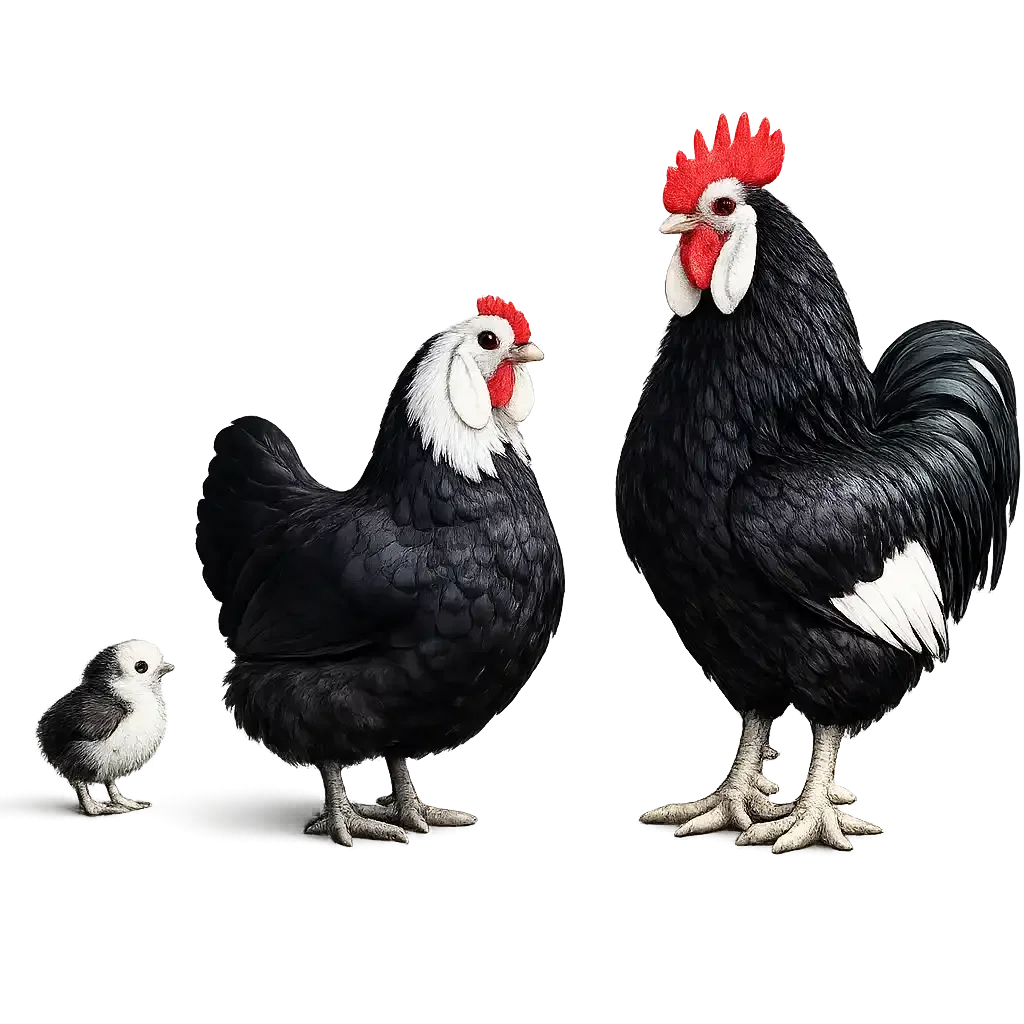
The White Faced Black Spanish is the most dramatically marked chicken in this directory and one of the most genuinely endangered heritage breeds in the American poultry world. The Critical listing from the Livestock Conservancy, the most serious conservation designation applied to a living breed, reflects a population of fewer than 500 breeding birds remaining in the United States and fewer than 1,000 globally as of 2025, making every keeper who maintains this breed a meaningful participant in its survival. What those few remaining birds look like is extraordinary: lustrous greenish-black plumage covering the entire body contrasted with brilliant red comb and wattles, and then the face and earlobes, which are a large, pendulous, pure white that extends downward from the ear region and spreads across the face in a way that the Livestock Conservancy compares to something Salvador Dali might have painted, as if the face has melted and extended downward. The breed predates Dali by centuries, which means, as the Livestock Conservancy specifically notes, it is more likely that the Spanish chicken's appearance influenced surrealism than the reverse.
The bantam White Faced Black Spanish carries this full breed identity in a compact package. Bantam cocks weigh approximately 30 ounces and bantam hens approximately 26 ounces, with the same glossy black plumage, the same white face and earlobes, the same red comb and wattles, and the same 160 to 180 large chalk-white eggs per year from an active, alert, non-broody Mediterranean heritage hen. The bantam variety was created in Arkansas by Joe Templeton using a combination of Black Minorca and Rosecomb bantams, carrying the same visual identity and egg production character as the large fowl in a size accessible to small-space keepers and backyard operations where the large fowl's full size would be impractical.
This post covers the full breed including the bantam. The White Faced Black Spanish is placed in the Backyard Chickens category rather than Dual Purpose and Homestead because the breed's fragile chick character, poor cold hardiness, declining hardiness from exhibition breeding, poor meat production, and Critical conservation status make it specifically the breed of the dedicated conservation keeper, the exhibition enthusiast, and the backyard flock keeper who wants the most visually distinctive white egg layer available in any size class, rather than the standard homestead production bird.
Quick Facts
Class: Mediterranean (APA); single comb, clean legged
Weight (Large Fowl): Roosters approximately 8 lbs; hens approximately 6.5 lbs; cockerels approximately 6.5 lbs; pullets approximately 5.5 lbs
Weight (Bantam): Roosters approximately 30 oz; hens approximately 26 oz; cockerels approximately 26 oz; pullets approximately 22 oz
Egg Production: Approximately 160 to 180 large chalk-white eggs per year; approximately 3 eggs per week; egg weight approximately 80 grams, among the largest eggs produced by any heritage breed relative to body size; production reduces significantly in cold weather
Egg Color: Chalk-white; among the purest white eggs produced by any heritage breed
Egg Size: Large; notably large for the hen's body weight
Primary Purpose: Eggs; exhibition; conservation breeding; the breed is specifically not a dual-purpose bird; meat production is poor
Temperament: Active, noisy, curious; personality ranges from aloof to friendly depending on individual and socialization; not a lap bird and not aggressive toward humans; flock-oriented rather than people-seeking; chicks more flighty than adult birds
Brooding: Non-sitter; essentially never broody; incubator or surrogate broody hen from another breed required for hatching
Flight Capability: Good; can fly well despite Mediterranean body size; higher fencing or covered runs required for containment
APA Recognition: 1874; Mediterranean Class; White Faced Black is the only variety recognized by the APA in large fowl; bantam White Faced Black recognized by both APA and ABA; ABA adds bantam White Faced Blue
Country of Origin: Spain; ancient Mediterranean origin possibly tracing to Phoenician trade networks and Roman-era Iberia; refined to present type in England and Holland in the 18th century; came to America from Holland, first documented in America in 1825; possibly the oldest chicken breed continuously kept in the United States
Comb Type: Single comb; large and upright in roosters; large and flopping over in hens; frostbite risk is severe for this breed given the large pendulous white face and earlobes alongside the large comb; cold weather can cause dark spots to form permanently on the white face
Distinctive Trait: Large pendulous pure white earlobes and white facial skin contrasting with lustrous greenish-black plumage, brilliant red comb, and red wattles; the Livestock Conservancy compares the white face to a Salvador Dali painting; dark slate shanks and toes; tight-fitting feathers; moderately flowing tail; white face slow to develop, requiring one full molt for full expression; nicknames include "Clown Chicken," "Fowls of Seville," and "Black Spanish"; chicks hatch black with white or yellow patches and are more delicate than Mediterranean breed chicks generally; bantam variety created in Arkansas by Joe Templeton from Black Minorca and Rosecomb crosses
Conservation Status: Critical (Livestock Conservancy); fewer than 500 breeding birds in the US and fewer than 1,000 globally as of 2025; the most serious conservation listing applied to any breed in this directory; population largely inbred with diminishing genetic diversity
Lifespan: 5 to 8 years
Breed Overview
The White Faced Black Spanish has a history deep enough to make most heritage breeds look recent. The Heritage Poultry Conservancy specifically documents that it seems certain the breed dates back to at least the Roman conquest of the Iberian Peninsula, likely earlier, with Phoenician traders potentially responsible for distributing the foundational Mediterranean stock from which the Spanish chicken developed. It is thought to be the oldest breed in the Mediterranean class and possibly the oldest chicken breed continuously kept in the United States, brought to the American colonies via the Caribbean during the Spanish colonial period before arriving in formal American poultry history with John Oldbird's 1825 documentation of first seeing them.
The breed's development to its present distinctive type occurred primarily in England and Holland rather than in Spain, which is one of the more counterintuitive facts about a breed named Spanish. The breed is actually rare in Spain today. British and Dutch poultry keepers in the 18th century encountered birds that had traveled north from Iberia through trade channels and set about selecting specifically for the characteristic that defines the breed visually: the large, pendulous, pure white earlobes and extended white facial skin. The white face, initially of moderate size, was progressively enlarged through deliberate selection until it reached the extraordinary extended, almost melted appearance that the Livestock Conservancy compares to Dali's surrealist art.
That white face enlargement, however celebrated in the exhibition world, carries the entire explanation for the breed's conservation crisis. As the Heritage Poultry Conservancy documents explicitly, as breeders paid more attention to increasing the size of the white faces in the Spanish chickens, a great loss of hardiness was observed. The correlation between white face development and reduced constitutional hardiness reflects the specific trade-off of selecting intensely for a single ornamental feature at the expense of the vigorous Mediterranean breed character that originally made the Spanish one of the most productive and widely kept farm breeds in America from 1825 to 1895.
The breed contributed to the development of the Blue Andalusian, documented in the Andalusian post in this directory. The Spanish chicken was well established in England and contributing to Mediterranean breed genetics before the Andalusian's distinctive blue lacing type was developed by English breeders, and the shared Mediterranean class character, white earlobes, large single comb, white egg production, and upright angular body type, reflects the foundational breeding pool that both breeds drew from.
By 1895 the White Faced Black Spanish had lost its commercial position to more productive, more hardy breeds and retreated to the exhibition world. The 20th century arrival of commercial hybrid layers completed its displacement from farm use, and the increasingly exhibition-focused selection for ever-larger white faces reduced the breed's hardiness to the point where the chicks became more fragile, the adults became less tolerant of environmental variation, and the keeper base required to maintain them became steadily more specialized. The bantam variety's creation in Arkansas by Joe Templeton from Black Minorca and Rosecomb cross matings extended the breed's accessibility to small-space keepers but did not reverse the fundamental population trajectory.
Plumage and Appearance
The White Faced Black Spanish's plumage is among the most dramatically contrasted in any APA-recognized breed. The body is covered in lustrous greenish-black feathers that lie tight and close to the bird, producing a smooth, sleek silhouette that emphasizes the bird's angular Mediterranean body type rather than softening and rounding it the way loose feathering does. In direct sunlight the black plumage shows the beetle-green iridescence that all high-quality black-plumaged birds display, creating a shimmering quality that deepens the visual contrast with the white face.
Against that lustrous black, the brilliant red single comb and long, thin, bright red wattles provide the second color element. In roosters the comb stands upright in the classic Mediterranean fashion; in hens the comb is large but flops over to one side, the characteristic Mediterranean hen comb droop that is a standard feature rather than a defect. The wattles in males are particularly long and thin, with white on the upper inside surface.
The white face and earlobes are the defining and most extraordinary visual element. The earlobes are extremely long, thin, and pure white, hanging low from the ear region. The white skin extends beyond the earlobes across the face itself, covering the facial area in the same pendulous, extended white that gives the bird its "melted face" appearance. The Livestock Conservancy's description of the face as something Salvador Dali might have painted is the most evocative characterization in their entire breed database, and it is accurate: the extended downward-flowing white against the black plumage and red comb creates an appearance that is genuinely surreal by the standards of conventional poultry aesthetics.
The white face is slow to develop and requires patience before judging either the bird or a breeding program's success. The Heritage Poultry Conservancy and multiple breed sources specifically state that the white facial coloring requires one full molt, approximately one year of age, before reaching full expression. Birds shown before their first molt will not display the full white face that the breed standard specifies, and breeding assessments based on pre-molt birds will systematically underestimate which individuals are producing the best white face expression.
The shanks and toes are dark slate, consistent with the Mediterranean class dark-legged character. The skin is white. Eyes are dark brown.
Chicks hatch black with white or yellow patches, primarily on the belly and chest, and are immediately identifiable as Spanish chicks by this coloring. The chicks are specifically documented as more delicate than most Mediterranean breed chicks generally, a fragility that reflects the reduced constitutional hardiness produced by generations of intense white face selection.
Egg Production
The White Faced Black Spanish's egg production is the breed's most practically valuable characteristic and its most historically consequential one. The Livestock Conservancy documents that Spanish chickens were widely known and recognized for their ability to lay a large number of white eggs, gaining recognition for this even before 1816 in England. The eggs were specifically record-documented in weight from 2.75 ounces to 4.25 ounces per egg in 1852, representing among the largest eggs documented from any heritage breed in that period relative to the hen's body size.
The current production figure of 160 to 180 chalk-white eggs per year from a 6.5-pound hen represents genuinely competitive white egg production from a heritage breed, with each egg averaging approximately 80 grams, larger per egg than most Mediterranean heritage breeds produce relative to body weight. This production was sufficient to make the breed one of the most widely kept commercial egg laying breeds in the northeastern United States from 1825 to 1895, with farmers specifically keeping large flocks of Spanish chickens for market egg production as late as 1892 to 1895.
The egg color is chalk-white, a specific and highly pure white that the Livestock Conservancy distinguishes from the cream or off-white of some "white" heritage eggs. In a mixed-breed egg basket, Spanish eggs are among the most purely white available from any heritage breed, comparable to the White Leghorn and the Blue Andalusian in egg color purity.
Cold weather reduces production significantly, which is a meaningful limitation for four-season operations in northern climates. The breed's Mediterranean climate origin produces excellent summer production but reduced winter output, and the breed's fragility in cold conditions reinforces the management guidance to keep Spanish chickens in consistently warm, draft-free housing year-round.
Broodiness is essentially absent. The White Faced Black Spanish is one of the most reliably non-broody heritage breeds, consistent with the Mediterranean class production orientation. Incubator hatching is required for any breeding program; surrogate broody hens from other breeds can substitute for incubators but the Spanish hen will not reliably hatch her own eggs.
The White Face
The white face deserves its own section because it is the most unusual, most visually demanding, and most conservation-historically consequential characteristic of the breed, and understanding its development, its care requirements, and its breeding history explains both the breed's visual identity and its conservation crisis.
The white earlobes and extended white facial skin are not simply color patterns. The earlobes are specifically described in Wikipedia as overdeveloped, reflecting that they have been selectively enlarged beyond functional proportions through generations of exhibition-focused breeding that prioritized size over the bird's constitution. The white skin extends across the face in the pendulous, drooping manner that produces the "melted" appearance: it is genuinely unusual poultry anatomy produced by deliberate selection, not a standard earlobe color variant.
This white face development came at a documented cost. The Heritage Poultry Conservancy, the Livestock Conservancy, multiple breed sources, and Chicken Fans all document the same correlation: as breeders increased the white face size through selection, the breed's hardiness declined proportionally. The chickens that produced the most dramatic, most extended, most prize-winning white faces were the birds selected for breeding, and those birds were also the most constitutionally fragile, least cold-tolerant, and most delicate to raise. Over generations of this selection pressure, the breed's chick viability decreased, its tolerance for environmental variation narrowed, and its keeper base contracted to specialists who could provide the specific management conditions the progressively more fragile birds required.
The white face's cold vulnerability is specific and consequential. Cold weather causes dark spots to form on the white facial skin, permanently blemishing the face that the breed is specifically named for and exhibited on. Frostbite on the white face and pendulous white earlobes, given their large exposed surface area and pendulous hanging position that exposes them on all sides, is among the most serious frostbite risks of any standard breed in the APA catalog. This is not merely a cosmetic concern for exhibition birds: frostbitten facial tissue in a breed whose entire health trajectory is already compromised by generations of intense selection for that tissue's expansion represents genuine welfare and viability risk.
Temperament and Behavior
The White Faced Black Spanish's temperament is one of its more misunderstood characteristics, because the breed carries a reputation for flightiness that is accurate in some individuals and contexts but significantly overstated as a blanket characterization.
The Livestock Conservancy describes the temperament as active, noisy, and curious, which is the accurate characterization of the breed's general character. The breed is alert and investigative, responding to novel stimuli with interest rather than alarm in well-socialized adult birds, and backyard keeper accounts consistently describe adult Spanish chickens as people-curious, food-seeking, and willing to follow their keeper around the yard in the manner of Mediterranean breeds generally. The BackYard Chickens forum documents a keeper specifically noting that her Spanish chickens are very curious, tend to follow you around, and do a lot of food begging, the opposite of the flighty, hands-off characterization that the breed's reputation would suggest.
The qualification is that flightiness is more characteristic of chicks and young birds than of adults, more characteristic of inadequately socialized birds than of birds raised with regular human contact, and more variable between individuals and strains than the breed's reputation implies. Chicks in particular can be more nervous than adult birds and benefit from regular gentle handling from young to develop the adult temperament that keeper accounts describe positively.
The breed is not aggressive toward humans in any systematic way, and the aloof characterization reflects independence and preference for flock activity over human interaction rather than active avoidance or aggressive defensiveness. These are birds that will run with their flock, investigate their range, and engage with their keeper on their own terms rather than seeking human contact actively. For keepers who want a people-seeking lap bird, the Spanish is not the appropriate choice; for keepers who want an active, self-sufficient, visually spectacular white egg layer that tolerates its keeper with friendly indifference, the Spanish delivers exactly that character.
Climate Adaptability
The White Faced Black Spanish's climate adaptability is severely asymmetric: exceptional heat tolerance and genuinely dangerous cold vulnerability, with the cold vulnerability made more acute specifically by the large white face and pendulous earlobes that are the breed's defining characteristic.
Heat tolerance is documented by multiple sources as exceptional even by Mediterranean breed standards. The Featherbrain documents a Floridian keeper who reports her Spanish chickens not just tolerating high temperatures but seeming to relish the heat, and multiple sources specifically recommend the breed for warm-climate keepers as one of the best large-fowl choices for sustained high-temperature performance. This heat tolerance reflects the breed's genuine Mediterranean climate origin in a way that the cold sensitivity also reflects: a breed developed over centuries in warm Iberian conditions without the cold-hardening selection pressure that British and northern European breeds experienced.
Cold vulnerability is severe and has two components. The first is constitutional cold sensitivity, documented as having been worsened by generations of exhibition breeding selecting for white face development at the expense of the vigorous cold-tolerant Mediterranean constitution the breed once possessed. The second is the specific cold vulnerability of the white face and pendulous earlobes, which present the largest cold-exposed facial surface area of any heritage breed, have lost the insulating cover of feathering, and are specifically documented to develop permanent dark spots in cold weather and serious frostbite injury in freezing conditions. Cold weather management for Spanish chickens requires maintaining warm, draft-free housing that prevents face and earlobe exposure to freezing temperatures, which is a higher standard of cold management than any other breed in this directory requires.
Keepers in cold northern climates should assess their winter housing honestly before acquiring the breed. The white face cannot be modified; its cold vulnerability is the structural consequence of its visual character.
Housing and Management
The White Faced Black Spanish's housing requirements are driven by two primary considerations: preventing cold damage to the white face and earlobes, and providing adequate space for an active, alert breed that tolerates confinement poorly.
Cold protection for the face is the highest-priority infrastructure requirement unique to this breed. The housing must maintain temperatures above freezing at roost level throughout the coldest winter nights, must prevent drafts that would directly expose the face and earlobes to cold air movement, and must provide the birds access to warm indoor space continuously during cold snaps rather than intermittently. Supplemental heating in the coop during hard freezes, either from a safe ceramic heater or from a sweeter heater panel, is the most reliable way to maintain face-safe temperatures in northern climates without requiring the birds to generate all the necessary warmth themselves.
Space requirements reflect the breed's activity level and confinement intolerance. The Featherbrain rates Spanish chickens as low to moderate for confinement tolerance, and multiple sources describe them as birds that would not be happy about confinement and prefer to roam. Generous outdoor run space, adequate to allow genuine active movement and foraging expression rather than minimum confinement standards, produces better health outcomes and better temperament expression in Spanish chickens than tight confinement produces.
The flight capability of Spanish chickens requires fencing planning beyond standard low heritage breed standards. The breed can fly well, consistent with its active Mediterranean heritage, and standard 4 to 5 foot fencing that adequately contains heavy dual-purpose breeds does not reliably contain Spanish chickens motivated to range beyond their enclosure. Covered runs or 6 to 7 foot fencing provides more reliable containment.
The white face's slow development requires patience and management discipline around exhibition timing. Birds should complete their first molt before exhibition, and breeding assessment of white face quality should be deferred until that first molt is complete. Show preparation guidance from other Spanish keepers and from APA judges familiar with the breed is the most reliable source for exhibition-specific grooming and presentation guidance.
Chick brooding requires more careful attention than most heritage breed chicks need. The Spanish chick's documented fragility, reflecting the breed's reduced constitutional hardiness from exhibition selection, means that standard brooding protocols for hardy heritage breeds should be supplemented with closer temperature monitoring, more careful prevention of chilling events, and avoidance of shipping in cold weather. Picking up chicks directly from a hatchery or breeder rather than shipping in winter, which Thefeatherbrain specifically recommends, reduces the mortality risk that cold shipping events create for chicks of an already fragile breed.
Conservation Significance
The White Faced Black Spanish's Critical conservation status is the most serious in this directory and deserves honest, direct discussion for any keeper considering acquiring the breed.
Fewer than 500 breeding birds remain in the United States as of 2025. Fewer than 1,000 exist globally. The population is largely inbred, with diminishing genetic diversity that increases the risk of genetic bottlenecks compounding the population decline. The breed that was one of the most widely kept commercial egg layers in the northeastern United States for seventy years, that competed in the first American poultry shows in 1854, that was possibly the first chicken breed brought to the American colonies, now sits at the edge of extinction from the combined effects of exhibition-selection-driven hardiness loss, commercial layer displacement, and small keeper population.
Every keeper who maintains a White Faced Black Spanish flock with attention to both the breed's visual standard and its constitutional hardiness, who breeds to correct type while selecting for birds that are vigorous, cold-tolerant within the breed's limitations, and reliably productive, contributes meaningfully to the breed's survival. The specific conservation guidance from the Livestock Conservancy for the Spanish breed emphasizes selecting breeding stock that balances the breed's distinctive aesthetic traits with improved hardiness, which is a direct acknowledgment that the white face selection that created the breed's crisis requires reversal or balance through active selection pressure toward hardiness alongside appearance.
The bantam variety's relative accessibility, in terms of space requirements and feed cost, makes it a particularly important conservation vehicle for keepers who cannot maintain the large fowl in adequate numbers. A dedicated bantam White Faced Black Spanish keeper maintaining a genetically diverse bantam flock with selection attention to both type and hardiness is doing conservation work that the breed specifically needs more of.
Comparison With Related Mediterranean Breeds
Blue Andalusian: The most direct Mediterranean class comparison covered in a dedicated post in this directory. Both breeds are large-combed, white-egg-laying, active Mediterranean heritage breeds with APA recognition since 1874 and conservation concern. The Andalusian is Watch-listed rather than Critical, carries the distinctive blue lacing rather than the Spanish's white face, and is somewhat more widely available. The Spanish chicken likely contributed to Andalusian development in England while the Andalusian type was being established. Both breeds are poor cold-climate choices with large comb frostbite risks; the Spanish's white face adds a specific cold vulnerability the Andalusian does not share.
Ancona: Another Watch-listed Mediterranean white egg layer covered in a dedicated post in this directory. The Ancona is mottled black and white, similarly active and heat-tolerant, and not as severely cold-vulnerable as the Spanish. The Ancona is significantly more available than the Spanish and does not carry the Critical conservation urgency that makes the Spanish a specific conservation priority.
White Leghorn: The most commercially successful Mediterranean white egg layer, covered in a dedicated post in this directory. The White Leghorn produces 280 to 320 white eggs per year versus the Spanish's 160 to 180, in a hardier, more cold-tolerant, more widely available bird without conservation concern. For keepers who want maximum white egg production from a Mediterranean heritage breed without the conservation management requirements, the White Leghorn wins on pure production; for keepers who want the most visually extraordinary white egg layer in any heritage breed category with the opportunity to contribute to Critical conservation work, the Spanish is irreplaceable.
Pros and Cons
Pros
The most visually extraordinary white egg layer in any size class; the white face, black plumage, and red comb combination is genuinely unique in heritage poultry
160 to 180 large chalk-white eggs per year with egg weights among the largest produced by any heritage breed relative to body size
Exceptional heat tolerance; specifically recommended for warm and humid southern climates
APA recognized since 1874 in both large fowl and bantam; active exhibition community in both size classes
Ancient breed history possibly tracing to Phoenician trade networks and Roman-era Iberia; possibly the oldest chicken breed continuously kept in the United States
Conservation significance; keeping White Faced Black Spanish actively supports one of the most critically endangered breeds in American poultry
Non-broody; consistent egg production without broodiness interruptions
Bantam variety created in Arkansas by Joe Templeton is accessible to small-space keepers
The most visually compelling individual bird in a mixed flock by a significant margin; generates consistent conversation and visitor interest
Active, alert, curious temperament that adult birds well-socialized from young express as genuinely engaging flock character
Cons
Critical conservation status; fewer than 500 breeding birds in the US; requires dedicated conservation-minded keeper commitment not routine production management
White face and pendulous earlobes are severely cold-vulnerable; cold weather causes permanent dark spots and serious frostbite risk; unsuitable for cold northern climates without significant supplemental heating
Fragile chicks resulting from generations of exhibition breeding; higher chick mortality risk than hardy heritage breeds; avoid winter shipping
White face requires one full molt before reaching full exhibition expression; patience required before assessing or showing birds
The same exhibition breeding that produced the dramatic white face reduced constitutional hardiness; breed requires more careful management than a naturally hardy Mediterranean breed
Poor meat production; specifically not a dual-purpose breed
Non-broody; incubator or surrogate broody hen from another breed required for all hatching
Population largely inbred; sourcing from the limited available breeding flocks requires active research and connection to the conservation community
Confinement intolerant; requires genuine range or large run space
Can fly well; higher fencing or covered runs required
Final Verdict
The White Faced Black Spanish Bantam and its large fowl counterpart are among the most historically significant and most visually extraordinary breeds in the APA standard, carrying a conservation urgency that no other breed in this directory can match and an origin story that traces through Phoenician trade routes, Roman Iberia, 18th-century Dutch and English exhibition breeding, and American Colonial poultry keeping to the first formal poultry shows in the nation's history. The Critical listing is not a footnote; it is the central practical reality of working with this breed in 2025, and keepers who acquire Spanish chickens carry a genuine responsibility to the breed's survival that casual ornamental keeping does not fulfill. The cold vulnerability is severe, the chick fragility is real, the white face requires a full year to express, and the conservation work requires dedication beyond what most heritage breed keeping demands. For the keeper who brings all of that understanding, who lives in a warm climate or provides adequate cold protection, and who approaches the breed as a conservation steward rather than a production bird, the White Faced Black Spanish offers a combination of visual magnificence, genuine egg production, ancient historical depth, and conservation purpose that no other breed in this directory approaches.
Frequently Asked Questions
Why is the White Faced Black Spanish so rare when it was once so common? The decline has two compounding causes. First, the breed's exhibition community progressively selected for ever-larger white faces at the expense of the vigorous, hardy Mediterranean constitution that originally made the Spanish one of the most widely kept commercial egg breeds in America. As white face size increased through selection, constitutional hardiness decreased, chick fragility increased, and the keeper base contracted to specialists who could provide increasingly specific management conditions. Second, the arrival of commercial hybrid layers in the 20th century displaced all heritage egg breeds from commercial use, and the Spanish's reduced hardiness made it less competitive than hardier heritage breeds in the hobbyist market that remained.
When does the white face reach full development? The white facial skin and earlobes develop slowly and require approximately one full molt, which occurs at roughly one year of age, before reaching the full expression that the breed standard specifies. Birds assessed or shown before their first molt will not display the complete white face extension, and any breeding assessment based on pre-molt birds will systematically underestimate which individuals are producing the best white face quality. This slow development is a documented breed characteristic that breeders and keepers must account for in their timelines.
Can I keep White Faced Black Spanish chickens in a cold climate? With significant supplemental heating infrastructure, but it is genuinely not the appropriate breed for cold northern climates. The large single comb, pendulous white earlobes, and extended white facial skin represent the highest frostbite risk surface area of any standard heritage breed, and cold exposure causes permanent dark spots on the white face even at temperatures above freezing. In sustained freezes the risk of permanent face and earlobe damage is severe. Keepers in cold climates who want to work with the breed should provide heated, draft-free housing that maintains temperatures above freezing continuously through winter, not just during the coldest nights.
What is the bantam White Faced Black Spanish and how does it differ from the large fowl? The bantam White Faced Black Spanish was created in Arkansas by breeder Joe Templeton using a combination of Black Minorca and Rosecomb bantams to produce a miniature version carrying the same black plumage, white face, and red comb of the large fowl. Bantam roosters weigh approximately 30 ounces and bantam hens approximately 26 ounces. The APA recognizes the bantam White Faced Black in the single comb clean legged bantam class; the ABA additionally recognizes a bantam White Faced Blue variety. The bantam's smaller size makes it accessible to keepers with limited space while carrying the same visual identity and conservation significance as the large fowl.
How do I connect with the White Faced Black Spanish conservation community? The American Poultry Association, the Livestock Conservancy's breeder directory and Heritage Breed Finder, and the Heritage Poultry Conservancy are the primary resources for connecting with dedicated White Faced Black Spanish breeders and conservation programs. Given the population's limited size and significant inbreeding concerns, sourcing from multiple unrelated lines and actively maintaining genetic diversity within a breeding program is the most meaningful conservation contribution an individual keeper can make.
Related Breeds
Blue Andalusian
Ancona
White Leghorn
Minorca
Exchequer Leghorn