
White Frizzle Cochin Bantam
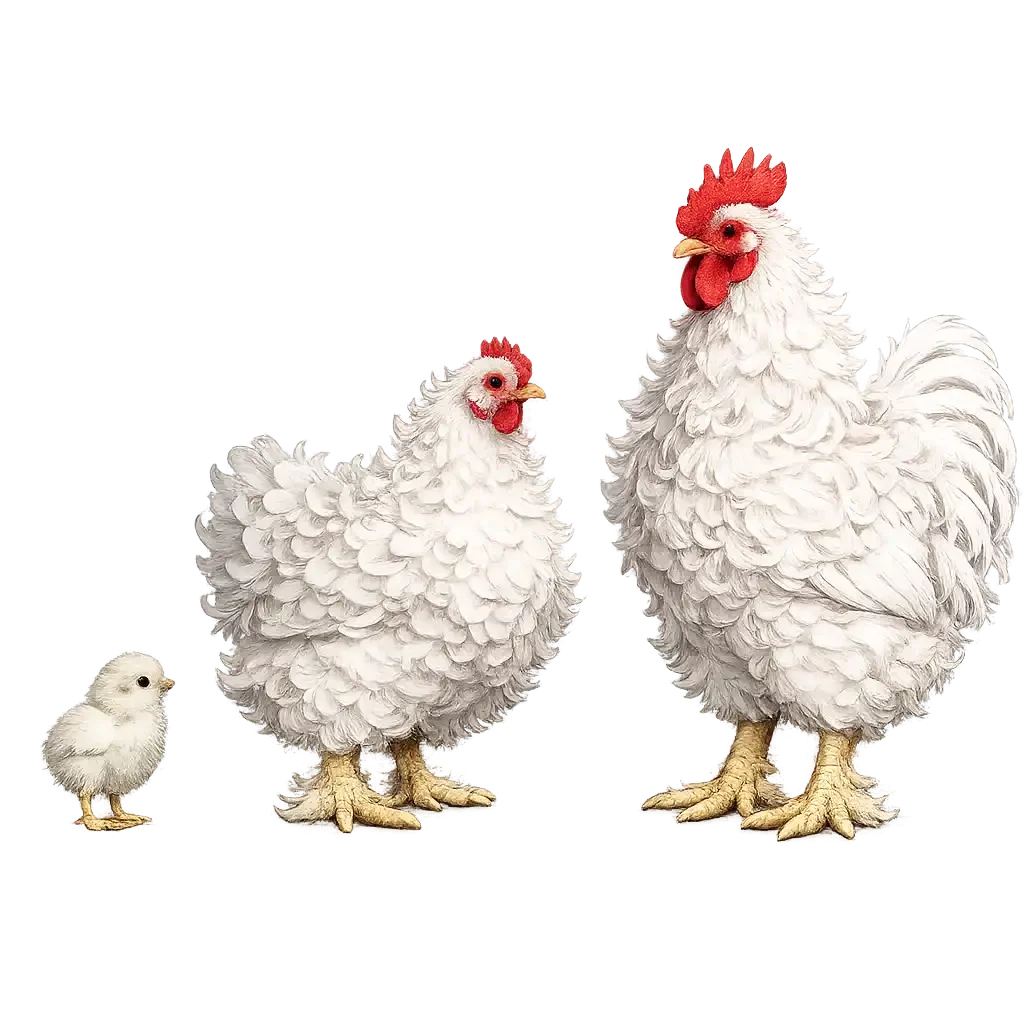
The White Frizzle Cochin Bantam is the intersection of two distinct things: a breed and a feather type, neither of which exists alone in this bird. The breed is the Cochin Bantam, a small feather-footed Chinese-heritage chicken of extraordinary docility, intense broodiness, and rounded, almost spherical silhouette that has been one of the most beloved ornamental bantam breeds in American and British poultry since the 1870s. The feather type is the frizzle, a genetically produced curl that causes every feather on the bird to grow outward and upward rather than lying flat against the body, producing the visual effect of a bird that has been caught in a sustained upward wind and frozen there permanently. In pure white, with every curling feather the same clean white as its neighbors, the White Frizzle Cochin Bantam creates one of the most visually extravagant and immediately arresting silhouettes of any APA-recognized variety in the bantam class.
Understanding the White Frizzle Cochin Bantam requires understanding both components separately, because each carries its own practical management implications that the combined bird inherits fully. The Cochin Bantam's management considerations, the feathered feet requiring dry conditions, the intense broodiness requiring active management if sustained laying is the goal, the extreme predator vulnerability from slow mobility and poor alertness, and the wet-weather sensitivity from dense feathering getting saturated, are all present in the frizzle variety alongside the frizzle feather's specific additional consideration: the curled feathers provide significantly less thermal insulation than flat feathers, because they cannot trap warm air against the bird's body the way smooth feathers do. The White Frizzle Cochin Bantam is genuinely a more cold and weather-sensitive bird than even the standard smooth-feathered Cochin Bantam.
For the keeper who wants the most visually spectacular small bantam available from a major American hatchery, who understands both the Cochin Bantam's specific care needs and the frizzle feather's additional climate sensitivity, and who either wants a dedicated ornamental flock bird or specifically values the Cochin Bantam's extraordinary broodiness as a surrogate incubator for other poultry eggs, the White Frizzle Cochin Bantam delivers precisely what its appearance promises: pure visual extravagance in a calm, people-oriented, manageable package.
Quick Facts
Class: Asiatic Bantam (APA); judged in the US as a Cochin Bantam with frizzle feathering rather than as a separate breed
Weight: Bantam roosters approximately 30 oz; bantam hens approximately 26 oz; significantly lighter than standard Cochins (roosters 11 lbs, hens 8.5 lbs)
Egg Production: Approximately 2 to 4 small light brown eggs per week; 100 to 180 eggs per year depending on strain and broodiness interruptions; bantam eggs are smaller than standard chicken eggs
Egg Color: Light brown to cream
Egg Size: Small; consistent with bantam body size
Primary Purpose: Ornamental; exhibition; surrogate brooding of other poultry eggs; companion and pet chicken; egg production secondary
Temperament: Exceptionally docile and calm; among the most people-tolerant bantam breeds available; frequently becomes a lap chicken with regular handling; good with children; roosters generally calm but bantam Cochin roosters can be more assertive than large fowl Cochin roosters
Brooding: Intense and reliable; one of the most consistently and persistently broody breeds in any size class; will hatch eggs of other species including duck, turkey, and game bird eggs; may go broody repeatedly throughout the season; broodiness interrupts laying and must be broken if sustained production is the goal
Flight Capability: None; frizzle feathers further reduce already minimal Cochin bantam flight capability; cannot clear any meaningful obstacle; lowest fencing adequate for containment
APA Recognition: Cochin Bantam recognized 1874; White Frizzle is a recognized variety color and feather type combination within the Cochin Bantam class; judged by Cochin bantam standards in the US
Country of Origin: China; imported to England and America in the 1840s and 1850s; frizzle gene thought to originate in Asia, reported in Far East since the 18th century
Comb Type: Small rounded single comb in hens; medium single comb in roosters; standard frostbite management in hard winters
Feather Type: Frizzle; each feather curls outward and upward from the body rather than lying flat; produced by a single incompletely dominant F gene; frizzle feathers cannot trap warm air against the body and provide significantly less cold insulation than smooth feathers
Distinctive Trait: Pure white frizzle feathers curling outward in all directions from the Cochin Bantam's characteristic rounded, low-stance body; one of the most visually extravagant ornamental bantam combinations available; frizzle feathers first detectable at 3 to 5 days old when wing feathers begin growing in curled; feathered legs and feet carry frizzle feathering as well; Charles Darwin mentioned frizzled chickens as far back as the 1600s under the name "Caffie Fowl"
Breeding Rule: Never breed frizzle to frizzle; always cross frizzle to smooth feathered; frizzle-to-frizzle produces frazzle offspring with two copies of the F gene, resulting in brittle sparse feathers, health problems, and shortened lifespan
Lifespan: 5 to 8 years with appropriate management
Breed and Feather Type: Two Separate Stories
The White Frizzle Cochin Bantam's identity requires understanding two separate histories that converged in this bird. Neither the Cochin Bantam's story nor the frizzle feather's story begins with the other, and each contributes equally to the bird's practical management profile.
The Cochin chicken originated in China, where large feather-footed chickens were kept in the Cochin-China region for many centuries. In the 1840s and 1850s these birds were exported to England and America, arriving with the dramatic feather-footed, heavily built, densely feathered body type that immediately distinguished them from any domestic breed Western poultry keepers had previously seen. The arrival of Cochins in England, particularly the 1843 importation, is often credited as the spark that ignited the Victorian poultry craze known as hen fever, a period of extraordinary enthusiasm for exotic breeds that transformed British and American poultry keeping. Queen Victoria herself received Cochins as a gift and was sufficiently charmed to contribute significantly to the hen fever phenomenon.
The bantam Cochin has an origin story that is interestingly separate from simply being a reduced-size version of the large Cochin. The Complete Encyclopedia of Chickens notes that Cochin bantams do not resemble Cochins enough to be regarded simply as dwarf forms, and some breed historians suggest the bantam variety may have derived from different Chinese stock entirely, possibly a small bird that was already compact in China rather than one bred down from the large Cochin. Whatever their exact derivation, Cochin bantams were recognized by the APA in 1874 alongside their large fowl counterparts, and they became among the most popular bantam breeds in American poultry showing. Backyard Poultry documents them as second only to the English Game bantam in American bantam show popularity.
The frizzle gene's story begins earlier and is geographically adjacent but not identical. Frizzled chickens have been reported from the Far East since at least the 18th century, and Charles Darwin mentioned them in his writings as "Caffie Fowl," describing them as originating from India, a geographic attribution that subsequent research has broadened to include China and the East Indies more generally. The first written records in English date to the 1600s. The frizzle gene is thought to have arisen in Asia and spread from there through trade and exhibition interest. In Europe and Australia, frizzled chickens are recognized as a distinct breed; in the United States, frizzling is treated as a feather type rather than a breed, and frizzled birds are judged by the standards of whatever breed they belong to. A frizzled Cochin bantam at an American show is judged as a Cochin bantam; its frizzle feathering must conform to the frizzle standard but the bird's type is evaluated against the Cochin bantam standard.
The combination of the Cochin bantam's body type, temperament, and broodiness with the frizzle gene's visual drama has made the Frizzle Cochin Bantam one of the most consistently popular ornamental bantam varieties in American hatchery catalogs and poultry shows, with the White variety representing the fullest visual expression of the combination because the clean white frizzled feathers curling outward in all directions create the most dramatic contrast against the breed's characteristic low, rounded body.
The Frizzle Gene
Understanding the frizzle gene before acquiring White Frizzle Cochin Bantams is not optional knowledge for keepers who plan to breed them, because the single most important rule of frizzle breeding, never breed frizzle to frizzle, directly determines whether the breeding program produces healthy frizzled offspring or damaged frazzle birds.
The F gene is incompletely dominant. A single copy of the F gene, the heterozygous state, produces the standard frizzle phenotype: feathers that curl outward and upward from the body in soft waves, giving the characteristic frizzle appearance that is the variety's entire visual identity. This is the bird that keepers want and that exhibition standards evaluate. Two copies of the F gene, the homozygous state produced when two frizzled birds are mated, produces the frazzle: a bird with brittle, sparse, pipe-cleaner-like feathers that break easily, may cause patchy baldness, provide essentially no thermal protection, and create a shortened lifespan from the combined health consequences of inadequate feathering. Frazzles are not healthy exhibition birds; they are the unavoidable consequence of a breeding decision that frizzle keepers must actively avoid.
The correct breeding approach is to always cross a frizzle bird with a smooth-feathered bird. This produces approximately 50 percent frizzled offspring and 50 percent smooth-feathered offspring in each hatch, following the standard Mendelian ratio for an incompletely dominant gene with one heterozygous parent. The smooth-feathered offspring from this cross carry no F gene and cannot produce frizzled offspring themselves unless bred back to a frizzle. These smooth-feathered offspring are not wasted birds: they are the breeding stock that future frizzle generations require. A keeper who maintains both frizzled and smooth-feathered Cochin bantams in their breeding program has the full genetic resources to produce healthy frizzled offspring indefinitely.
The frizzle gene first becomes visible within the first week of a chick's life. When a chick's initial wing feathers begin growing in, typically between day 3 and day 7, frizzled chicks' wing feathers will show the characteristic curl that identifies them as frizzle-gene carriers. This early visual identification is practically useful for keepers who want to track which chicks from a frizzle-to-smooth cross have inherited the frizzle gene.
A modifying gene called mf further complicates frizzle genetics in some populations. The mf gene, when homozygous, suppresses the expression of the F gene, potentially causing a frizzled bird to appear mostly smooth. This can lead to misidentification of the bird's genetic status and unintended frizzle-to-apparent-smooth crosses that are actually frizzle-to-frizzle when the suppressed frizzle gene is factored in. This complexity is relevant primarily for keepers who want precision in their exhibition breeding programs; for general management purposes, visual identification of frizzle feathering combined with the rule of never breeding visually frizzled birds together covers the essential breeding caution.
Plumage and Appearance
The White Frizzle Cochin Bantam's plumage is among the most visually extravagant in any APA-recognized bantam variety, and the specific combination of pure white frizzle feathers on the Cochin bantam's characteristic body shape creates a visual effect that no other variety replicates exactly.
The Cochin bantam body is itself already visually distinctive: short, broad, and carried very low to the ground, with the abundant feathering covering the legs completely and the tail forming what The Complete Encyclopedia of Chickens describes as a downy rotund mass of feathers. The overall impression of the smooth-feathered Cochin bantam is of a perfectly round, heavily feathered ball barely raised above the ground on feathered legs that are hardly visible beneath the body plumage. This body shape is the visual foundation of the White Frizzle Cochin Bantam.
On that foundation, every feather curls outward and upward rather than lying smooth. The neck feathers curve away from the neck. The body feathers curve away from the sides and back. The tail feathers curl outward in all directions. The feathers on the legs and feet, which the Cochin bantam carries as a breed characteristic, curl outward as well. The combined effect is of a bird that appears substantially larger than its 26 to 30-ounce actual weight, as the curling feathers add volume in all directions simultaneously. In pure white, with every one of those curling feathers the same clean white, the visual effect is sometimes described as a feather duster in chicken form, which is among the more accurate and more affectionate breed descriptions in the hobby.
The white plumage requires one specific maintenance consideration that is documented specifically for white Cochins: white feathers can go brassy or cream-toned if birds have access to certain pigment sources including maize in the feed and grass. Shaded outdoor runs prevent sun-bleaching of the white, and removing maize from the ration during molting periods helps the new white feathers grow in cleanly rather than with a yellow cast. This is a show-preparation consideration rather than a health one, but keepers who want the crisp white plumage of exhibition-quality birds should be aware of it.
The comb is small and rounded in hens, medium-sized and single in roosters, red alongside the red earlobes and wattles. Eyes are reddish bay. The beak and legs are yellow, visible beneath the feathered leg covering where the feather parting allows glimpses of the yellow leg skin beneath.
Egg Production
The White Frizzle Cochin Bantam's egg production is modest and should not be the primary motivation for acquiring the variety. The bantam body size produces small eggs at 2 to 4 per week when the hen is actively laying, and the intense broodiness of the Cochin Bantam interrupts laying periods reliably and repeatedly. A White Frizzle Cochin Bantam hen who goes broody, which most do and do so repeatedly, stops laying entirely for the duration of the brooding period and for a variable time afterward as she returns to reproductive cycling.
Production figures across sources range from approximately 100 to 180 small light brown eggs per year for the Frizzle Cochin generally, with the bantam's smaller body producing at the lower to middle end of that range and with broodiness interruptions reducing the practical annual total significantly. Keepers who want consistent year-round egg production from their bantam flock, with minimal broodiness interruption, should look elsewhere in the directory. Keepers who specifically value the Cochin bantam's broodiness for natural hatching of their own bantam eggs or other poultry eggs will find the White Frizzle Cochin Bantam's intermittent production a reasonable trade for the excellent brooding service the hen provides between laying periods.
The bantam eggs themselves are small enough to be inadequate as a standalone egg production purpose for most homestead operations, but they are genuine eggs with all the nutrition and cooking utility of standard eggs in proportionally smaller form. Some direct-sale operations that market specialty and novelty eggs find bantam eggs appealing to buyers who want the heritage breed story in a small-format egg, and White Frizzle Cochin Bantam eggs carry a breed story and visual bird identity that standard production breed bantams cannot approach.
Broodiness as a Practical Asset
The White Frizzle Cochin Bantam's most practically valuable characteristic for homestead operations that want to use it is not its egg production but its broodiness. The Cochin bantam is documented by the Livestock Conservancy as having no equal as a broody fowl, with hens inclined to broodiness who will hatch more than one batch per year if allowed. This broodiness is strong enough and reliable enough that Cochin bantams, including the frizzle varieties, are specifically used as surrogate incubators for the eggs of other species including ducks, turkeys, and game birds whose own hens are unreliable sitters or whose eggs need management beyond what the laying hens will provide.
The bantam Cochin's small body creates one specific limitation as a surrogate brooder for larger eggs: care must be taken when using bantam hens to sit thin-shelled or very large eggs, because the hen's body weight pressing on eggs she was not sized to incubate can crack them. Matching the egg size to the hen's body size, or supplementing natural incubation with incubator backup for the most fragile eggs, manages this risk appropriately.
The frizzle feathering adds one specific consideration to broodiness that smooth-feathered Cochin bantam keepers do not face: frizzle feathers cannot maintain the same tight contact with the eggs during incubation that smooth feathers provide, because the curling feathers do not lie flat and smooth over the clutch. Most frizzled Cochin bantam hens compensate for this adequately in practice, but fertility and hatch rates from frizzle-brooded eggs may be somewhat lower than from smooth-feathered Cochins brooding the same eggs under otherwise identical conditions. Keeper accounts generally describe frizzle Cochin bantam hens as capable and attentive brooders despite this limitation, with good hatch rates in normal conditions.
Temperament and Behavior
The White Frizzle Cochin Bantam's temperament is the breed's second most celebrated characteristic after its visual appearance, and the two characteristics together create the combination that makes the Cochin bantam consistently recommended as the most beginner-friendly, most child-accessible, and most reliably handleable bantam in American poultry keeping.
The docility is not passive or sluggish in the way that heavy-bodied lethargy might suggest; it is genuinely calm, people-oriented, and willing to engage. Cochin bantam hens and roosters approach their keepers with curiosity, accept handling with minimal stress response, and in many keeper accounts actively seek human contact, earning the "lap chicken" characterization that appears consistently in breed literature. The Livestock Conservancy specifically notes that males rarely become aggressive or even quarrel, though this characterization is somewhat more qualified for bantam roosters than for large fowl roosters; bantam Cochin roosters can be more assertive than their larger counterparts despite the generally calm breed temperament.
The combination of calm temperament and non-flight capability makes the White Frizzle Cochin Bantam one of the most easily managed bantam breeds for keepers with children who will regularly interact with the flock. The birds cannot escape, do not startle easily, and do not react to handling with the alarm-and-flight response that more active Mediterranean-heritage bantams display. This predictability in interaction is genuinely valuable for educational farm settings, visiting children, and beginners who are still developing their bird-handling confidence.
The frizzle feathers add one temperament-adjacent consideration: frizzle feathers are visually arresting and invite touching from people who encounter the birds. The frizzle feathers are not painful to handle but they are more fragile than smooth feathers, and rough handling or grabbing at individual curled feathers can break them. Frizzle Cochin bantams in settings with many hands-on visitors benefit from gentle handling guidance provided to those visitors before the birds are touched.
Climate and Weather Management
The White Frizzle Cochin Bantam's climate sensitivity is the most important practical management consideration beyond broodiness, and it compounds two separate climate sensitivities from the two components of the bird's identity.
The Cochin bantam generally has poor to moderate cold and heat tolerance from its dense feathering. The feathering insulates effectively when dry but becomes a liability when wet: saturated feathers lose their insulating capacity, become heavy, and create chilling risk in cold conditions. The breed requires covered outdoor access in wet weather and dry litter management in the coop at all times, with special attention during the coldest and wettest seasons. The feathered feet specifically are vulnerable to frostbite when wet and mud-caked in cold conditions, a risk the Livestock Conservancy specifically documents and that requires the same clean dry litter management that all feather-footed breeds need.
The frizzle feathering compounds both vulnerabilities. Frizzle feathers cannot trap warm air against the body because they curl away from the body surface rather than lying flat. This means the air layer between feather and skin, the primary insulating mechanism of feather covering, is substantially reduced in frizzled birds compared to smooth-feathered birds of the same breed. Multiple sources specifically note that frizzle varieties of any breed are less cold-hardy than smooth-feathered individuals of the same breed, and The Featherbrain specifically states that frizzled Cochin bantam varieties are less hardy than the regular-feathered varieties in hot, cold, windy, and wet conditions.
The practical management implication is a bird that needs more shelter infrastructure than its small size might suggest: genuinely draft-free, dry housing with insulation appropriate to the local winter climate, covered outdoor access to prevent rain saturation of the frizzle feathers, and monitoring during extreme weather events that would be adequately managed by more weather-resistant breeds without special attention. In hot climates or during heat events, the frizzle feathering also creates some heat retention difficulty because the curled feathers interfere with the normal heat dissipation mechanism that smooth feathers allow through feather-raising, so shade and cool water management during heat events is equally important.
Keepers in climates with harsh winters or extended wet seasons, or in fully outdoor settings without reliable covered access, should weigh the White Frizzle Cochin Bantam's weather sensitivity honestly before acquiring the variety.
Predator Vulnerability
The White Frizzle Cochin Bantam's predator vulnerability is the most serious management consideration for keepers who do not have secure, fully enclosed outdoor space, and it is considerably more acute than for most other breeds in this directory.
The Cochin bantam's vulnerability stems from three compounding physical characteristics: very slow movement due to the short legs and rounded heavy body on feathered feet, no flight capability, and poor alertness that reflects the breed's lack of the predator-avoidance instincts that more active and alert breeds maintain. The Featherbrain includes a specifically vivid illustration of this, describing video of various breeds running toward their keeper for treats, with the Cochin bantam rooster dawdling far behind as the only bird unable to maintain competitive pace.
The frizzle feathering adds no predator vulnerability beyond the Cochin bantam baseline, but it adds nothing that mitigates it either. The White Frizzle Cochin Bantam is a bird that cannot run effectively, cannot fly, and does not prioritize predator detection over other activities. In a secure covered run with hardware cloth rather than standard chicken wire, adequate to exclude the smallest predators that standard chicken wire permits, this vulnerability is manageable. In open free-range conditions with significant aerial or terrestrial predator pressure, the White Frizzle Cochin Bantam requires a level of supervision that most free-range management approaches do not provide as a matter of routine.
Most keepers who maintain White Frizzle Cochin Bantams confine them to secure covered runs rather than allowing unsupervised range access, which is the appropriate management approach for a bird whose predator vulnerability is this significant.
Housing and Management
Standard bantam housing sizing applies to the White Frizzle Cochin Bantam, with the specific additions and modifications that the Cochin bantam's feathered feet, low stance, and frizzle feathering require.
Roost height must be kept very low. The Livestock Conservancy specifically states that Cochins require low roosts due to their weight, and the bantam version shares this requirement in a smaller scale. Roost bars at 6 to 12 inches above the floor allow the birds to mount and dismount without the leg and foot stress that higher roosts create in heavy, short-legged breeds. Many Cochin bantam keepers find that their birds prefer to sleep in padded nest boxes at floor level rather than on roosts at all, and providing this option reduces the stress of roosting height entirely.
Nesting box sizing for bantam birds is smaller than for standard heritage breeds, with 10 by 10 inch to 12 by 12 inch box dimensions appropriate for 26-ounce hens. Multiple nesting boxes reduce competition among broody hens who will all attempt to claim the same nest simultaneously if only one is available.
Litter quality and drainage are more critical for this breed than for most, as the combination of feathered feet and frizzle feathers that both become problematic when wet creates higher sensitivity to litter moisture than clean-legged, smooth-feathered breeds experience. Deep litter management with frequent refresh, elevated coop floors where possible to reduce ground moisture infiltration, and covered outdoor areas to prevent rain exposure of the feathered legs and frizzle feathers are the three most important infrastructure investments for White Frizzle Cochin Bantam housing.
Feather hygiene requires periodic attention specific to the frizzle variety. Frizzle feathers can become tangled or matted, particularly around the vent area where the curling feathers contact fecal matter more readily than smooth feathers do. Regular vent-area inspection and occasional cleaning or trimming of feathers that accumulate soiling prevents hygiene problems specific to the feather type. Wet feathers from rain or damp conditions can become heavy and clumped, requiring drying in a warm indoor environment before the bird is returned to cold outdoor conditions.
Profitability
The White Frizzle Cochin Bantam's profitability for homestead operations is built almost entirely on ornamental, educational, and niche market value rather than on production output, and keepers who plan to generate meaningful revenue from the variety should orient their operations around those specific value channels.
Chick and hatching egg sales are the most reliable revenue channel for White Frizzle Cochin Bantam keepers with maintained breeding programs. The variety is visually distinctive enough to generate consistent buyer interest from new keepers and from established flock keepers who want to add visual variety, and the frizzle genetics' requirement of crossing frizzle to smooth creates a natural demand for both frizzled and smooth-feathered Cochin bantam breeding stock from keepers who want to maintain their own frizzle program. Pricing for frizzle bantam chicks at specialty hatcheries and breeders is meaningfully higher than commodity bantam pricing.
Surrogacy services for other poultry hatching programs represent a secondary revenue or cost-offset channel that is specific to the Cochin bantam's extreme broodiness. Keepers who maintain White Frizzle Cochin Bantam hens can offer surrogate incubation services for other keepers' hatching eggs from species whose own hens are unreliable sitters, with the Cochin bantam's reputation as a universal broody hen creating genuine demand in heritage poultry communities.
Farm social media and agritourism value from the White Frizzle Cochin Bantam's visual appeal is difficult to quantify but consistently documented in keeper accounts. A White Frizzle Cochin Bantam is among the most photographed and most commented-upon birds in any mixed flock setting, and its combination of extreme visual drama with gentle handleability makes it ideal for visitor interaction programming at farm stands, agritourism operations, and educational farm settings where the bird's approachability and visual impact combine for maximum visitor engagement.
Pros and Cons
Pros
Among the most visually extravagant bantam varieties available from any mainstream American hatchery; the combination of pure white frizzle feathers and the Cochin bantam's rounded low body creates a genuinely unique silhouette
Exceptionally docile and people-oriented; among the most beginner-friendly and child-accessible bantam breeds; frequently becomes a lap chicken
Reliable and intense broodiness makes the variety one of the most capable natural incubators available for other species' eggs including ducks, turkeys, and game birds
Cannot fly; lowest fencing adequate for containment; minimal escape risk
APA-recognized variety class with active exhibition community in bantam class
Frizzle feathers first visible within the first week of life, allowing early identification of frizzle-gene chicks from frizzle-to-smooth crosses
Small body size and modest feed requirements reduce operating cost relative to standard heritage breeds
Long history connecting to the 1870s Cochin bantam tradition and the Asian frizzle gene heritage documented to the 1600s
Cons
Frizzle feathers provide significantly less cold insulation than smooth feathers; more weather-sensitive than smooth-feathered Cochin bantams
Wet weather saturates both frizzle feathers and feathered feet, creating chilling risk and frostbite vulnerability on legs; covered outdoor access required
Extreme predator vulnerability from slow movement, no flight, and poor alertness; fully enclosed secure runs essential
Intense broodiness interrupts laying repeatedly; active broody-breaking required if sustained production is the goal
Small bantam eggs unsuitable as primary homestead egg supply
Never breed frizzle to frizzle; frazzle offspring are unhealthy and have shortened lifespans; keeper must maintain smooth-feathered breeding stock
Feathered feet require dry litter management and regular inspection year-round
Frizzle feathers require periodic hygiene attention especially around the vent area
White feathers go brassy with sun exposure and maize in the diet; shade management and seasonal feed adjustment needed for show-quality white plumage
Roosters can be more assertive than large fowl Cochin roosters despite overall calm breed character
Final Verdict
The White Frizzle Cochin Bantam belongs in the Dual Purpose and Homestead category for the same reason its smooth-feathered Cochin bantam counterpart does: the broodiness that makes it the most reliable small surrogate incubator for other poultry species in the heritage breed world, alongside the small but genuine egg production of a bantam-sized heritage laying hen, gives it genuine functional value beyond ornament. That functional value is specifically as a natural hatching tool rather than as a significant egg production contributor, and keepers who acquire White Frizzle Cochin Bantams expecting meaningful egg numbers will be disappointed on the same grounds that any Cochin bantam keeper focused on production would be disappointed. For the homestead keeper who values the broodiness, wants the visual spectacle of the frizzle on the Cochin bantam's rounded body in the purest possible white, understands the weather sensitivity and predator vulnerability that require adequate infrastructure before the birds arrive, and applies the single most important breeding rule of never mating frizzle to frizzle, the White Frizzle Cochin Bantam delivers an experience unlike anything else available from a mainstream American hatchery.
Frequently Asked Questions
What is the difference between a frizzle and a frazzle? A frizzle is a bird with one copy of the incompletely dominant F gene, producing the soft outward-curling feathers that are the variety's characteristic appearance. A frazzle is a bird with two copies of the F gene, produced when two frizzled birds are mated and their offspring inherits the gene from both parents. Frazzle birds have brittle, sparse, pipe-cleaner-like feathers that break easily, often creating patchy baldness, provide essentially no thermal insulation, and experience health problems and shortened lifespan from the combined consequences of inadequate feathering. The frazzle is the outcome of the one breeding decision frizzle keepers must actively avoid: always cross frizzle to smooth, never frizzle to frizzle.
Can I keep White Frizzle Cochin Bantams with other breeds? Yes, with companion breed selection focused on calm, similarly docile breeds. The Cochin bantam's extreme docility and slow movement make it vulnerable to bullying from more assertive or faster breeds that dominate feed access and physical space. Silkies, smooth-feathered Cochin bantams, and other gentle bantam breeds coexist with White Frizzle Cochin Bantams more successfully than Rhode Island Reds, production Leghorns, or other active and assertive breeds. The fully enclosed secure run that predator management requires for Cochin bantams also naturally limits the mixed-flock dynamic to whatever breeds are housed together in that secure space.
How do I tell which chicks are frizzled from a frizzle-to-smooth cross? Frizzle feathering becomes visible within the first 3 to 7 days of life when the initial wing feathers begin growing in. Frizzled chicks' wing feathers will show the characteristic curl from the moment they emerge, while smooth-feathered chicks' wing feathers lie flat. This early visual identification allows keepers to sort frizzled and smooth-feathered chicks from a frizzle-to-smooth cross while they are still in the brooder, which is useful for planning which birds to keep for breeding versus which to place in the laying flock or sell.
Why do White Frizzle Cochin Bantam hens sometimes go broody even when no rooster is present? Broodiness is a hormonal state triggered by factors including nest-sitting time, egg accumulation beneath the hen, and photoperiod changes, not by the presence of a rooster or the fertility of eggs. Cochin bantam hens go broody regardless of whether eggs they are sitting on are fertilized because the brooding instinct predates any knowledge of fertility in the individual hen's biology. A broody Cochin bantam hen in a rooster-free flock will sit on unfertilized eggs, empty nests, or golf balls placed as nest eggs with equal dedication. If sustained production rather than natural brooding is the goal, brooding must be broken using standard methods, including isolation in a wire-bottomed cage that prevents the body temperature elevation and nest contact that maintain the brooding hormonal state.
Are frizzle feathers more fragile than smooth feathers? Yes. The curling structure of frizzle feathers makes them more susceptible to breakage than smooth feathers, particularly at the point where the feather shaft curls most acutely. Rough handling, grabbing at individual feathers, and contact with abrasive surfaces break frizzle feathers more readily than smooth feathers would be broken under the same conditions. Frizzle feathers also become more clumped and tangled in wet conditions than smooth feathers, requiring drying and occasional careful separation after wet-weather exposure. These characteristics are manageable with appropriate handling guidance and weather management but are genuine considerations that smooth-feathered bird keepers do not face to the same degree.
Related Breeds
White Silkie Bantam
Black Silkie Bantam
White Sultan
White Polish
Top Hat Special