
White Laced Red Cornish
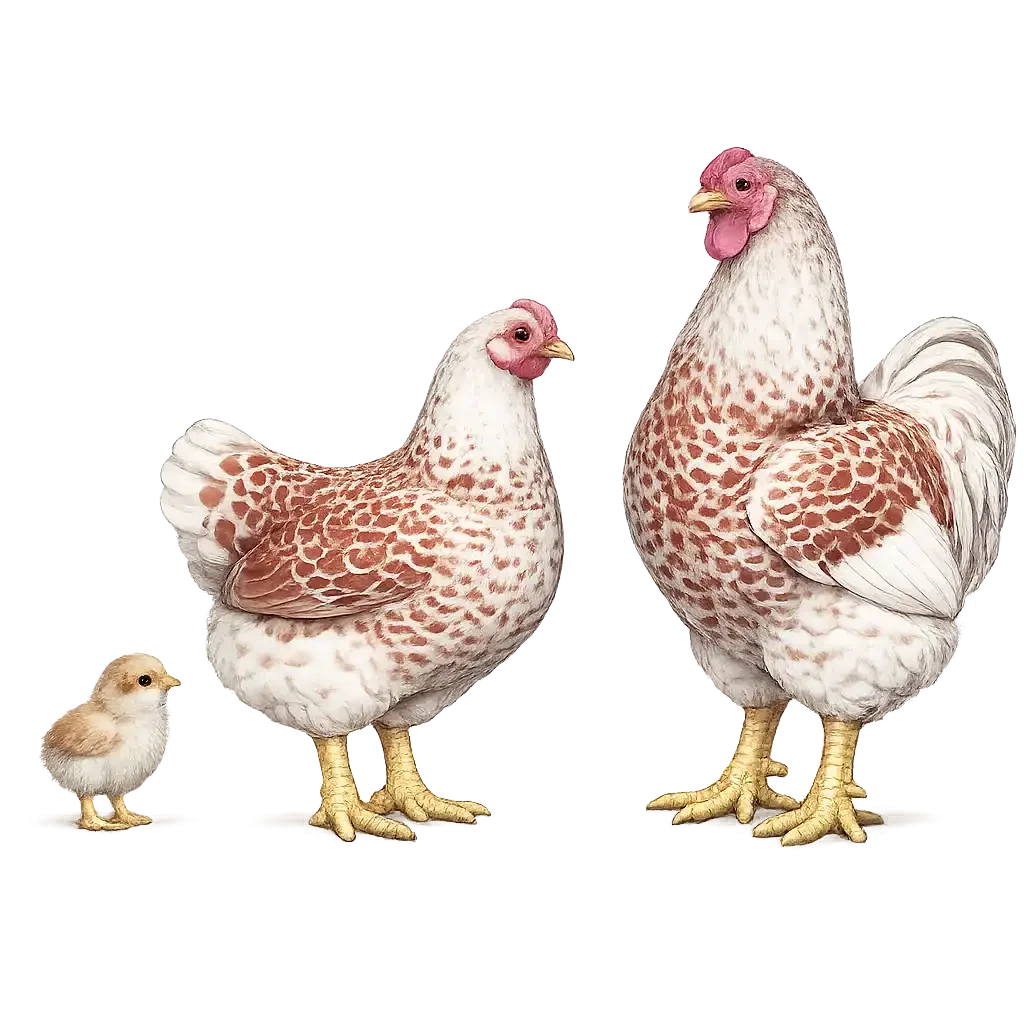
The White Laced Red Cornish is one of the rarest and most visually demanding varieties of the Cornish breed, recognized by the APA in 1909, and the variety that most clearly illustrates both the Cornish breed's extraordinary meat production character and the plumage challenge that makes the breed genuinely difficult to breed well. Murray McMurray's product description captures the variety's essential tension precisely: "The ideal plumage pattern in which each feather is a rich dark red narrowly laced with white is very difficult to achieve but tremendously impressive in those individuals which are marked that way. Even though others may not quite realize this perfection they are handsome birds in their red and white plumage and deep yellow skin color, and display to a high degree the square, blocky type of true Cornish."
That description contains every important truth about the White Laced Red Cornish: the beauty is real, the standard is demanding, and achieving it consistently is one of the harder plumage challenges in standard breed poultry. The birds that hit the mark are among the most striking heritage chickens available, with the rich chestnut red body feathering edged in crisp white lacing combined with the Cornish breed's distinctive blocky, muscle-packed body on wide-set short legs giving an overall impression of concentrated power dressed in jeweler's precision. The birds that fall short of the standard, which is the majority of hatchery birds in any laced variety, are still substantial, handsome dual-purpose heritage chickens that eat and perform like Cornish while looking like an honest approximation of the variety's visual ideal.
The Cornish breed behind the variety has the most commercially consequential history of any heritage breed in American poultry. The White Cornish variety is the male parent of the commercial Cornish Cross broiler that produces the overwhelming majority of chicken sold in American supermarkets. The heritage Cornish is the breed most buyers of Cornish Game Hens ate when they thought they were eating something exotic. And the Dark Cornish is the most widely kept variety that most keepers encounter first, with the White Laced Red and Buff varieties less commonly held but sharing the full Cornish breed character in different color expressions. The Watch listing from the Livestock Conservancy applies to the Cornish breed as a whole; the White Laced Red specifically is among the rarest varieties within an already Watch-listed breed.
Quick Facts
Class: English (APA)
Weight: Roosters approximately 10.5 lbs; hens approximately 8 lbs; cockerels approximately 8.5 lbs; pullets approximately 6.5 lbs; bantam White Laced Red also recognized
Egg Production: Approximately 50 to 160 tinted or light brown eggs per year depending on strain; exhibition strains at the lower end; hatchery-quality strains somewhat higher; heart-shaped body limits internal space for egg production regardless of strain
Egg Color: Tinted to light brown; firm, strong shells documented by McMurray
Egg Size: Medium to large
Primary Purpose: Dual purpose; heritage meat bird; exhibition; the same breed character as all Cornish varieties including the White Cornish male parent of the commercial Cornish Cross
Temperament: Generally calm and manageable in hens; roosters variable from manageable to assertive to aggressive; game bird heritage expresses most consistently in rooster behavior and in flock competition when birds are overcrowded; hens tend toward the top of the pecking order in mixed flocks; broodiness genuine but broody hens risk accidentally breaking eggs due to body weight and short leg proportions
Brooding: Moderate to high broodiness; hens are attentive mothers on the occasions they successfully hatch chicks; body weight and short leg proportions create egg-breaking risk during incubation; not reliable natural incubators for their own eggs
Flight Capability: Low to none; heavy body weight and short legs prevent sustained flight; standard fencing adequate
APA Recognition: 1909; English Class; one of four APA-recognized Cornish varieties alongside Dark (1893), White (1898), and Buff (1938)
Country of Origin: Cornwall, England; developed approximately 1820 by Sir Walter Gilbert of Bodmin, Cornwall from crosses of Old English Game, Aseel, and Malay chickens; originally called Indian Game; renamed Cornish by APA in 1910
Comb Type: Small pea comb; one of the most frostbite-resistant comb types available; the pea comb is one of the Cornish breed's specific cold management advantages
Feather Type: Hard, tight feathers lying close to the body; minimal down; game bird feather character distinctly different from the soft feathering of dual-purpose heritage breeds; the tight feathering reduces cold insulation significantly and is the breed's primary climate vulnerability
Distinctive Trait: Each feather is a rich dark red narrowly laced with white in correctly marked birds; ideal lacing is very difficult to achieve and produces one of the most visually impressive plumage patterns in APA-recognized breeds; heart-shaped body from above unique to the Cornish breed; male and female body type identical, another characteristic unique to the Cornish in major heritage breeds; thick short legs set wide apart; wide skull with prominent brow and deep-set eyes; yellow beak, shanks, and feet; chicks hatch in varying shades of reddish buff
Conservation Status: Watch (Livestock Conservancy) for the Cornish breed overall; White Laced Red is among the rarer varieties within the Watch-listed breed; FAO records approximately 2,825 birds in the United States as of 2015
Lifespan: 5 to 8 years; potentially longer in hens as lower egg production reduces reproductive system health burden
Breed Overview
The Cornish breed's history begins with a specific failed intention and a specific commercial success that neither the breeder nor his contemporaries anticipated. Sir Walter Gilbert of Bodmin in Cornwall set out around 1820 to create a superior fighting cock by crossing Old English Game chickens with Aseel and Malay breeds from Asia, selecting for the muscular intensity, game spirit, and physical power that cockfighting demanded. The resulting bird, which Gilbert called Indian Game, was an effective fighter but not an exceptional one, and the cockfighting community showed limited interest in it. What the Indian Game was, and what made it historically consequential, was the most muscle-packed, broad-breasted, meat-abundant chicken that had ever been intentionally developed in England or anywhere else.
The Indian Game Club formed in 1886 to support the breed's enthusiasts and develop a breed standard around the bird's extraordinary meat character rather than its cockfighting potential. British breeders immediately recognized that the wide breast giving abundant white meat made the Indian Game the most effective meat improvement cross available, and began using Indian Game roosters over other table breeds including the Dorking, the Orpington, and the Sussex to produce superior market birds. The breed was exported to the United States, where the APA accepted the Dark variety in 1893 as Indian Games.
The name caused two separate problems in America. First, the word Indian implied Asian origin for a breed that was actually from Cornwall, England. Second, the word Game was associated with cockfighting, which made the breed politically difficult to promote for the family farm and homestead market that American poultry sellers needed to reach. In 1905 the APA renamed the varieties Cornish Indian Game and White Indian Game. In 1910 the APA simplified this to simply Cornish and moved the breed from the Oriental class to the English class where it correctly belonged. The White Laced Red variety was recognized in 1909, one year before the final renaming, as Cornish Indian Game in its recognition documents.
The breed's commercial importance escalated dramatically in the mid-20th century when American poultry researchers crossed the White Cornish with the White Plymouth Rock to produce the commercial Cornish Cross hybrid that now dominates American meat chicken production. The Livestock Conservancy documents this specifically: the backbone of today's commercial poultry industry is the Cornish Rock broiler, a cross of White Cornish and White Plymouth Rock chickens that can be harvested in only six weeks. The heritage Cornish breed, including the White Laced Red, is the genetic ancestor of that commercial product but not the same bird, and the distinction between the heritage Cornish's slow, flavorful growth and the commercial Cornish Cross's rapid, mass-production trajectory is the central practical distinction for homestead keepers to understand when acquiring standard-bred Cornish.
Plumage and Appearance
The White Laced Red Cornish's plumage is the defining challenge and the defining reward of the variety. The standard calls for each feather to carry a ground color of rich, deep, warm chestnut red narrowly laced with a precise edge of clean white. The lacing must be even in width, consistently white rather than smudged or smoky, and present across the full plumage from head to tail. The red ground must be genuinely rich and warm rather than pale or faded. The contrast between the deep red center of each feather and the white lacing at its edge, multiplied across the full plumage of a 10.5-pound rooster, produces one of the most visually complex and most rewarding plumage patterns in APA-recognized large fowl.
The difficulty in achieving this standard is genuine and documented. The lacing pattern requires the specific combination of genetic factors that determine ground color intensity, lacing presence, lacing width, and lacing color purity to align simultaneously in a single bird. Any of these factors falling short of the standard, which the lacing genetics section of the breed literature specifically notes is more likely in heterozygous lacing than homozygous, produces birds that are attractive but not exhibition-correct. McMurray's product description explicitly acknowledges this, noting that the ideal is very difficult to achieve but tremendously impressive when achieved. This acknowledgment in the hatchery's own product copy is one of the more candid breed descriptions in the mainstream hatchery market.
The body under the plumage is unmistakably Cornish regardless of how well or poorly the lacing marks are expressed. The Cornish body type is among the most distinctive in any poultry breed: broad and deep across the chest, with the characteristic heart shape visible when the bird is viewed from directly above with the broad front of the heart being the breast and the pointed tip corresponding to the tail. The legs are short, thick, and set conspicuously wide apart, giving the bird a planted, immovable stance that communicates the concentrated muscle mass beneath the tight feathering. The skull is wide with a prominent brow and deep-set eyes that give the Cornish its characteristic hawk-like expression, a visual inheritance from the game bird heritage.
One anatomical characteristic unique to the Cornish among major heritage breeds is that the body type of males and females is essentially identical. In most chicken breeds, roosters carry dramatically different plumage, body proportions, and overall silhouette compared to hens, to the degree that males and females of the same breed can look like different animals. In the Cornish, both sexes carry the same blocky, wide-set, muscle-forward body type, differing primarily in size rather than shape. This identical body type in both sexes is a specific characteristic of the Cornish breed standard noted consistently in breed literature and is one of the more unusual characteristics in standard-bred poultry.
The feathers lie tight and hard against the body with minimal down, a game bird feather character inherited from the Aseel and Malay in the breed's foundation. This tight feathering accentuates the muscle mass beneath rather than softening and rounding the bird's outline the way the loose feathering of Orpingtons or Cochins does. The visual effect is of a bird that looks exactly as powerful as it actually is.
Chicks hatch in varying shades of reddish buff, consistent with the ground color genetics of the variety. The chick coloring reflects the red base that the adult feathering will express, making White Laced Red Cornish chicks visually distinct from the darker-hatching Dark Cornish and the lighter-hatching White Cornish chicks in the same brooder.
Meat Quality
The White Laced Red Cornish's meat quality is exceptional and is the primary practical value of all Cornish varieties for homestead dual-purpose production. The Livestock Conservancy documents the breed's wide breast giving abundant white meat, and Backyard Poultry notes that the breed provides a good quantity of fine, white meat despite slow growth. The Cornish specifically excels in breast meat volume relative to bone mass, with small bones for the breed's body weight producing a favorable meat-to-bone ratio that exceeds most other heritage breeds of comparable size.
The heritage Cornish is slow to mature, reaching harvesting weight at approximately 7 months for a full-sized heritage table bird, compared to the 6 to 8 weeks of the commercial Cornish Cross. This slow growth produces the developed muscle fiber, richer flavor, and firmer texture that characterize genuinely heritage-raised table birds and that direct-sale heritage poultry buyers specifically seek. The Cornish's game bird heritage contributes to a meat quality that multiple sources describe as distinctive and flavorful in a way that fast-grown commercial broilers cannot replicate.
The Cornish Game Hen market historically used young heritage Cornish birds specifically. The Livestock Conservancy documents that due to the breed's muscular nature, young birds harvested at 4 to 6 weeks produce the small, tender, flavorful, approximately one-pound birds sold commercially as Cornish Game Hens. Modern commercial practice has largely replaced genuine heritage Cornish chicks in the Cornish Game Hen market with early-harvested Cornish Cross birds, but heritage homestead operations that harvest genuine Cornish chicks at 4 to 6 weeks produce the authentic product that this market category was originally named for.
The deep yellow skin color that McMurray specifically notes in the White Laced Red variety is characteristic of Cornish birds generally and combines with the white laced plumage to produce a carcass presentation with the rich yellow-skin appearance that heritage poultry buyers associate with genuine pasture-raised production.
Egg Production
The White Laced Red Cornish's egg production is the most significant practical limitation of the breed for homestead operations that prioritize laying performance alongside meat utility. The heart-shaped body from above that is characteristic of the Cornish breed carries a practical consequence: the broad front of that heart shape is breast muscle, and the internal space available for the reproductive organs that produce eggs is correspondingly reduced compared to breeds with less muscle-forward body proportions. This anatomical limitation on egg capacity is structural rather than a product of breeding neglect, though breeding neglect in exhibition-focused strains has further reduced production in those lines.
Production figures documented across breed sources range from approximately 50 to 80 eggs per year in exhibition strains, 120 to 160 in hatchery strains, and occasionally higher in specifically production-selected lines. Backyard Poultry documents the hen's muscular body shape limiting fertility to about 50 to 80 eggs per year. The Morning Chores breed guide documents 160 to 180 small brown eggs per year. McMurray's description characterizes hens as fair layers. The truth across sources is that the White Laced Red Cornish lays less than any other breed in the Dual Purpose and Homestead category of this directory and should not be acquired primarily for egg production.
The eggs are tinted to light brown with firm, strong shells, described specifically by McMurray as having firm, strong shells that distinguish them from the thinner shells produced by some high-production breeds. Egg size is medium to large, reasonable for the breed's body weight. The laying season may be concentrated in spring in some exhibition strains, with year-round laying more consistent in hatchery-selected strains.
Broodiness is genuine and reliably expressed, but the broody Cornish hen's specific limitations are important to understand before planning natural incubation. The heavy body weight and short leg proportions make the Cornish poorly physically suited to incubation: the hen's weight can crack eggs beneath her, and the short legs reduce the precision of turning and settling that longer-legged breeds manage more easily. Keeper accounts consistently note that broody Cornish hens make attentive and protective mothers on the occasions they successfully hatch chicks, but that egg-breaking during incubation is a documented risk specific to the breed's body type. Incubator hatching or surrogate broody hens of more physically suited breeds generally produces better hatching results from Cornish eggs than natural incubation under a Cornish hen.
Temperament and Behavior
The White Laced Red Cornish's temperament reflects the breed's game bird ancestry in ways that are manageable with appropriate planning and that distinguish the breed from the fully domesticated docile heritage breeds that most of this directory covers.
Hens are generally calm, manageable, and able to be tamed through regular interaction, with the caveat that they naturally position themselves at the top of the pecking order in mixed flocks and will assert that position against calmer, more docile breeds. The Livestock Conservancy specifically notes that game bird heritage tends to show itself if you try to keep them with other more docile breeds and that Cornish hens will want to be at the top of the pecking order. In a pure Cornish flock where all birds carry the same temperament baseline, the flock hierarchy establishes itself without the same dominance issues that arise when Cornish are mixed with significantly more docile breeds like Orpingtons, Cochins, or Brahmas.
Roosters are the more variable and more challenging temperament consideration. The Cornish rooster's game bird heritage means that individual roosters range from perfectly manageable flock guardians with appropriate socialization from young to genuinely aggressive toward people and other birds without any apparent connection to management quality. The Livestock Conservancy and multiple breed sources specifically note that some roosters can be downright aggressive with both people and other chickens, and that multiple roosters together in insufficient space create serious conflict. Managing Cornish roosters successfully requires adequate space, avoidance of overcrowding, socialization from young, and honest assessment of individual rooster temperament rather than assuming that breed docility claims guarantee individual bird behavior.
Chick behavior carries a specific consideration: Cornish chicks are documented as prone to cannibalism when overcrowded or understimulated. This is a stress behavior rather than a fixed breed trait, and providing adequate space, appropriate environmental enrichment, and correctly formulated starter feed without the protein deficiencies that drive feather picking substantially reduces the incidence. Keepers who are not familiar with this tendency in game-heritage breeds and who house Cornish chicks at standard heritage breed densities may encounter more feather picking and toe pecking in the brooder than they experience with other heritage breeds.
Climate Adaptability
The White Laced Red Cornish's climate adaptability is its most specific practical limitation outside of egg production, and the tight hard feathering with minimal down that creates the breed's distinctive appearance is entirely responsible for it. Where the Orpington's dense fluffy feathering traps metabolic heat and insulates against cold, the Cornish's game bird feathering provides minimal insulation. The Featherbrain specifically notes that Cornish do not fare well in extreme heat or in cold, and the Livestock Conservancy notes that the close feathering of the breed prevented them from handling exposure to the elements well in the American market experience.
Cold climate management for Cornish requires attention that is disproportionate to the breed's pea comb advantage. The pea comb is one of the most frostbite-resistant comb types in poultry, meaning the common cold-management concern of comb frostbite is essentially a non-issue for Cornish keepers in all but the most extreme northern climates. However, the body's limited insulating capacity from tight feathering means that in sustained cold below freezing, Cornish without access to well-insulated draft-free housing may experience metabolic cold stress that affects both production and health. The breed should not be managed in open or drafty winter housing that many cold-hardy heritage breeds handle without supplemental heat.
Heat tolerance is similarly limited by the tight feathering that reduces the bird's ability to dissipate metabolic heat efficiently. Unlike the Naked Neck, whose reduced feathering provides exceptional heat dissipation, the Cornish's tight feathering with no down does not significantly reduce total feather coverage and does not provide the same heat-venting advantage. Standard shade access and cool water management in summer is adequate for temperate climates, but sustained heat above 90 degrees Fahrenheit in poorly ventilated settings creates heat stress risk. The breed was developed in the mild maritime climate of Cornwall, England, and its optimal climate range reflects those origins.
Housing and Management
The White Laced Red Cornish's housing and management requirements differ from conventional dual-purpose heritage breeds in several specific dimensions that keeper planning should address before birds arrive.
Space is the most critical behavioral management consideration. The game bird heritage that produces the Cornish's temperament assertiveness, particularly in roosters and chicks, expresses most problematically in insufficient space. The Cornish in adequate space, with separate housing for roosters when multiple males are kept, is a manageable and even pleasant flock bird. The Cornish in inadequate space develops the aggression, feather picking, and conflict that the breed's critics document as characteristic. Planning for space requirements at the generous end of heritage breed standards, approximately 6 to 10 square feet of outdoor run per bird rather than the 4 square foot minimum sometimes cited for large breeds, substantially reduces behavioral problems.
Roost height management applies specifically given the breed's body weight and short legs. The Cornish's proportions make jumping to and landing from elevated roost positions more physically demanding than for longer-legged breeds of equivalent body weight. Roost bars at 18 to 24 inches maximum height, with padded landing areas beneath, reduce joint and leg stress from repeated heavy-bird landings.
Feed management reflects the breed's tendency toward large appetites with slow growth that can produce obesity in confined conditions where activity is limited. The heritage Cornish is not the commercial Cornish Cross and does not need the intensive broiler feed management that prevents skeletal collapse in fast-growing commercial birds, but confined Cornish without adequate exercise opportunity and with unrestricted high-calorie scratch access gain weight at the expense of leg health and breeding fertility. A balanced heritage breed ration with appropriate protein and limited scratch and treat supplementation supports healthy growth without the health complications that obesity creates in a short-legged, heavy-bodied breed.
Lacing quality management for keepers who want to maintain or improve the White Laced Red's exhibition plumage requires selecting breeding birds based on lacing precision and ground color richness rather than simply body type and size. The lacing genetics are complex and the ideal is difficult to achieve consistently, which is why McMurray's honest description of the challenge is worth taking seriously as a breeding program expectation-setter. Keepers who want exhibition-quality White Laced Red Cornish should plan for a multi-year breeding selection program that gradually concentrates the genetic factors producing precise lacing, rather than expecting hatchery birds to produce exhibition-quality offspring in the first generation.
The Heritage Cornish and the Cornish Cross
The relationship between the heritage White Laced Red Cornish and the commercial Cornish Cross that produces most American supermarket chicken is one of the most important distinctions for homestead keepers to understand, because the Cornish name creates reasonable confusion about whether the heritage breed and the commercial product are meaningfully related.
The Cornish Cross is a commercially optimized hybrid produced by crossing Cornish-heritage male lines that have been selected specifically for rapid early muscle development with White Plymouth Rock-heritage female lines selected for size and early maturity. The result grows to 6 to 8 pounds in 6 to 8 weeks, converts feed to muscle more efficiently than any heritage breed, and produces the broad-breasted white-skinned carcass that the commercial market standardized on. The Cornish Cross was developed from heritage Cornish genetics but represents decades of intensive selection for commercial performance traits that the heritage breed does not share.
The heritage White Laced Red Cornish grows to 10.5 pounds over approximately 7 months, eats substantially more feed per pound of gain than the commercial hybrid, and produces a carcass with genuinely superior flavor and texture from the slow development of muscle fiber. The heritage Cornish also maintains the genetic diversity, breeding fertility, disease resistance, and self-sustaining flock character that the commercial Cornish Cross has sacrificed through intensive selection. Keepers who order heritage Cornish expecting commercial broiler growth rates will be disappointed. Keepers who understand the heritage Cornish as a slow, flavorful, genuinely exceptional table bird will be satisfied with one of the best heritage meat breeds available.
The Livestock Conservancy also notes that the commercial poultry industry's dependence on Cornish-heritage genetics in the Cornish Cross is not the same as preservation of the heritage breed, because the commercial lines are narrowly selected, proprietary, and not available to independent keepers or breeders. Maintaining the heritage Cornish as an independently breeding population is genuine conservation work regardless of how widely the Cornish Cross is produced commercially.
Comparing the White Laced Red to Other Cornish Varieties
All four APA-recognized Cornish varieties, Dark, White, White Laced Red, and Buff, share identical breed character in body type, meat quality, egg production limitations, temperament, climate considerations, and management requirements. The differences between varieties are entirely in plumage color and in the lacing genetics specific to the White Laced Red variety.
The Dark Cornish is the original and most widely kept variety in American homestead flocks, with the dramatic dark blue-green and brown plumage producing beetles-green iridescence that many keepers find even more visually striking than the White Laced Red's red and white lacing. The Dark variety's simpler plumage genetics make it somewhat easier to breed than the White Laced Red and its larger keeper community provides more available breeding stock outside the hatchery market.
The White Cornish is the variety most directly connected to the commercial Cornish Cross, as the male parent in that cross, and the most commercially visible of the four varieties. Its clean white plumage produces the same clean-dressing carcass advantage as other white-feathered breeds while carrying full heritage Cornish meat quality.
The Buff Cornish is the rarest of the four APA-recognized varieties, recognized in 1938, and shares all Cornish breed character in a warm buff plumage that produces less contrast than the other varieties and is consequently the least visually dramatic of the four.
The White Laced Red is the second rarest, the most plumage-demanding, and the most visually rewarding when correctly marked, occupying a specific position as the exhibition variety that most directly rewards breeding precision with spectacular visual results when the lacing is achieved correctly.
Pros and Cons
Pros
Exceptional heritage meat quality; the breed that founded both the Cornish Game Hen market and the commercial Cornish Cross; genuine Cornish flavor and breast meat abundance from slow heritage growth
One of the most visually spectacular plumage patterns in APA-recognized large fowl when ideal lacing is achieved; rich chestnut red narrowly edged with crisp white on the Cornish's distinctive blocky body
Pea comb provides excellent frostbite resistance; one of the least comb-management-demanding large heritage breeds in cold climates
APA recognized since 1909 in English Class
Yellow skin and yellow legs with white laced red plumage produce a visually appealing dressed carcass with genuine heritage market appeal
Conservation value; Watch-listed breed that independent keeper support sustains as a viable breeding population independent of commercial hybrid production
Firm, strong eggshells noted specifically by McMurray; egg quality above breed's laying quantity
Low flight capability; heavy body weight makes escape essentially impossible; simple perimeter management adequate
Good confinement tolerance compared to more active Mediterranean breeds; manages in run and coop setup without the behavioral stress that confinement-intolerant breeds develop
Unique identical male and female body type that is specific to the Cornish breed among major heritage breeds
Cons
Lowest egg production of any breed in the Dual Purpose and Homestead category; the heart-shaped body limits reproductive space regardless of management quality
Broody hens risk breaking eggs during incubation; natural incubation unreliable from the breed's own hens; incubator or surrogate broody hen recommended
Game bird temperament assertiveness, particularly from roosters and in overcrowded chicks, requires more careful management than fully domesticated docile heritage breeds
Tight feathering with minimal down provides poor cold insulation; more cold-climate management required than the pea comb's frostbite resistance implies
Heat tolerance limited by the same tight feathering; does not perform as well in hot climates as many heritage breeds
Slow growth to processing weight at approximately 7 months for a full-sized heritage table bird
Ideal plumage lacing very difficult to achieve consistently; hatchery stock rarely produces exhibition-quality lacing
Chicks prone to cannibalism and feather picking in overcrowded or understimulated conditions
Breeding fertility issues documented across keeper accounts; body proportions and short leg length can reduce successful mating efficiency
Among the rarer Cornish varieties; dedicated breeder sourcing for exhibition-quality birds limited
Profitability
The White Laced Red Cornish's profitability is built almost entirely on heritage table bird production and the exhibition market rather than on egg volume, which is the inverse of most dual-purpose heritage breeds in this directory.
Heritage table bird revenue from slow-grown White Laced Red Cornish cockerels and cull hens at 7 months benefits specifically from the breed's extraordinary breast meat development and its documented exceptional flavor that heritage poultry buyers specifically seek. The authentic Cornish Game Hen market, for the small operations that want to produce the product from genuinely heritage Cornish chicks harvested at 4 to 6 weeks at approximately one pound rather than from early-harvested Cornish Cross birds, provides a distinctive direct-sale product category that almost no other homestead operation offers.
Exhibition revenue from correctly laced White Laced Red Cornish birds from dedicated breeding programs commands strong prices in the show community specifically because the variety is rare and the plumage standard is genuinely demanding. Keepers who invest the multi-year breeding selection program required to consistently produce exhibition-quality lacing develop a genuinely scarce product in the show bird market.
Conservation program revenue from hatching eggs and chicks sold to other keepers participating in the Watch-listed Cornish breed's conservation adds a mission-driven component to the operation that some direct-sale buyers specifically value and support with premium pricing.
Final Verdict
The White Laced Red Cornish is the most meat-specialized and the most plumage-demanding breed in the Dual Purpose and Homestead category of this directory, and it belongs in that category for the same reason the Cornish breed generally belongs among dual-purpose heritage breeds: because the female birds lay enough eggs to sustain a self-propagating flock, and the male birds produce some of the finest heritage table birds available from any standard breed. Keepers who bring realistic expectations about the egg production limitations, the climate management requirements from tight game bird feathering, and the plumage breeding challenge of achieving ideal lacing will find the White Laced Red Cornish one of the most rewarding heritage breeds to work with: the plumage when correctly marked is genuinely exceptional, the meat when properly grown is genuinely excellent, and the breed's conservation value and commercial ancestry give it a place in American poultry history that no other Watch-listed breed can claim.
Frequently Asked Questions
Is the White Laced Red Cornish related to the commercial Cornish Cross? Yes, through shared Cornish breed heritage, but they are not the same bird. The commercial Cornish Cross was developed from White Cornish genetics crossed with White Plymouth Rock genetics, selected intensively for rapid commercial growth traits. The heritage White Laced Red Cornish grows slowly to 10.5 pounds over approximately 7 months, produces exceptional-flavor heritage table birds, breeds true, and maintains the genetic diversity and self-sustaining flock character that the commercial product has sacrificed through intensive selection. The Cornish Cross grows to processing weight in 6 to 8 weeks; the heritage Cornish requires 7 months for a full-sized heritage table bird.
What makes the White Laced Red plumage so difficult to breed correctly? The ideal standard calls for each feather to have a rich, deep chestnut red ground color narrowly laced with a precise edge of clean white, present evenly across the full plumage. Achieving this requires multiple genetic factors to align simultaneously in a single bird: correct ground color intensity, presence of the lacing pattern gene, correct lacing width, and white lacing purity without smudging or colored intrusion. Lacing genetics specifically express more precisely in homozygous birds than in heterozygous individuals, and the interaction of ground color and lacing genes across the full Cornish plumage creates many opportunities for one factor to fall short of the standard while others are correct. McMurray's own product description acknowledges that the ideal is very difficult to achieve, which is the most candid admission about a plumage breeding challenge in their catalog.
How do I manage rooster aggression in the White Laced Red Cornish? Adequate space is the most important single management factor: most Cornish rooster aggression, including both human-directed and bird-directed aggression, is most severe in cramped conditions. Providing 6 to 10 square feet of outdoor run per bird rather than the minimum recommendations reduces behavioral conflicts significantly. Keeping only one rooster with a group of hens eliminates male competition. Socializing chicks with regular gentle human contact from the first days of life produces more tolerant adult birds than minimal-contact brooding. Monitoring individual roosters for aggressive behavior patterns and culling genuinely aggressive roosters rather than continuing to manage them is the most reliable long-term approach; some individual Cornish roosters are genuinely aggressive regardless of management quality.
Can I use the White Laced Red Cornish to produce Cornish Game Hens at home? Yes, and the result is the authentic product that Cornish Game Hens were named for. Heritage Cornish chicks harvested at 4 to 6 weeks of age at approximately one pound produce the small, tender, flavorful birds that the Cornish Game Hen market originally specified. Modern commercial practice has substituted early-harvested Cornish Cross birds for genuine heritage Cornish in the commercial Cornish Game Hen market, but homestead operations that raise genuine heritage Cornish can market their early-harvested birds as the authentic product with full historical accuracy. The heritage Cornish Game Hen produced this way is genuinely distinct from the commercial substitute in flavor and texture.
How cold-hardy is the White Laced Red Cornish despite its pea comb? The pea comb provides excellent frostbite resistance specifically to the comb and wattles, which is one of the two main cold-climate management concerns. However, the Cornish's tight game bird feathering with minimal down provides significantly less body insulation than the loose feathering of Orpingtons, Brahmas, or Wyandottes, which is the second cold-climate concern. The result is a breed that handles comb frostbite conditions well but handles sustained cold body temperature conditions less well than fully feathered heritage breeds. In practical terms, the White Laced Red Cornish does well in temperate climates with well-insulated draft-free housing, needs supplemental heat in sustained below-freezing cold, and is not well-suited to the most severe northern winter conditions without more infrastructure support than cold-hardy feathered breeds require.
Related Breeds
Dark Cornish
Black Australorp
White Plymouth Rock
White Jersey Giant
Barred Plymouth Rock
Sussex