
White Leghorn
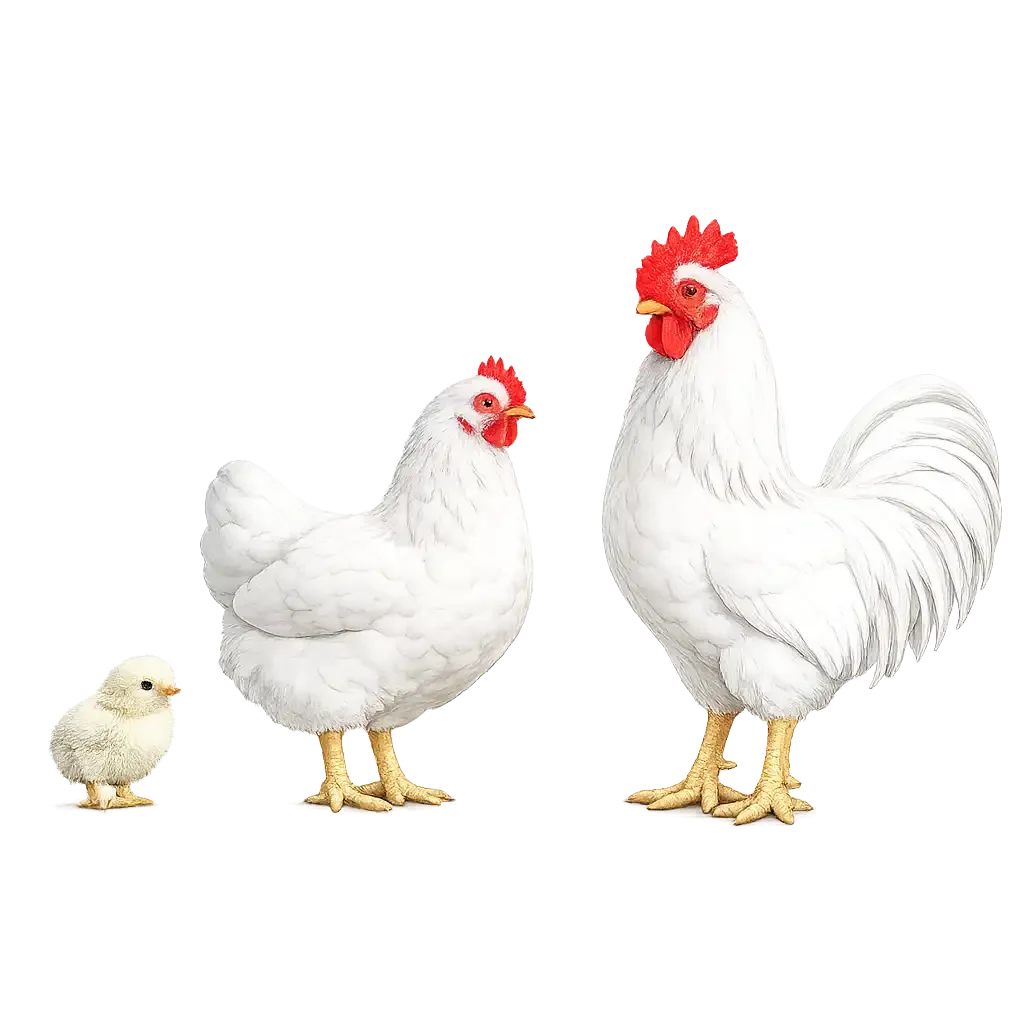
The White Leghorn lays the eggs in the grocery store. This is not hyperbole or approximation: approximately 90 percent of commercial white eggs produced in the United States come from hens that are either White Leghorns or White Leghorn-derived hybrids, making this breed the single most commercially consequential chicken in the history of American food production. The White Leghorn arrived in the United States from the Italian port city of Livorno in 1828, initially called Italian fowl or White Spanish, recognized by the APA in 1874, and refined through English Minorca crosses and American commercial selection into the most feed-efficient, most prolifically laying, most consistently producing white egg breed ever standardized. A well-managed White Leghorn hen produces 280 to 320 large white eggs per year on approximately 125 grams of feed per day, a feed-to-egg conversion ratio that no other breed approaches and that drove the Leghorn's adoption by commercial egg operations from the early 20th century onward until it became the default commercial layer worldwide.
The characteristics that make the White Leghorn the most productive heritage egg layer available are inseparable from the characteristics that make it the most challenging heritage breed for many backyard and homestead keepers. The White Leghorn is nervous, alert, vocal, and strongly inclined to avoid human contact. It flies over standard fencing readily. It is not broody, makes no effort to mother its chicks, and does not seek interaction with its keeper even with regular handling. It is in every practical sense the opposite of the Silkie, the Black Australorp, and the Plymouth Rock varieties that this directory recommends for keepers who want a calm, handleable, people-friendly flock. For keepers who understand this temperament clearly and want the best feed-to-egg ratio available from a heritage breed, the highest white egg production volume in the directory, and a truly self-sufficient forager that manages itself efficiently on range and does not require or want significant keeper interaction to perform at its best, the White Leghorn is genuinely irreplaceable. No other heritage breed comes close to what it does on the egg production side of the ledger.
Quick Facts
Class: Mediterranean (APA)
Weight: Hens approximately 4.5 to 5.5 lbs; roosters approximately 6 lbs
Egg Production: Approximately 280 to 320 large white eggs per year; 5 or more eggs per week; among the highest heritage breed production figures documented
Egg Color: White; pure white; no tinting or cream coloring
Egg Size: Large to extra-large; minimum 55 grams per APA standard
Primary Purpose: Egg production; the foundational breed of commercial white egg production worldwide
Temperament: Nervous, alert, active, and flighty; strongly independent; not people-seeking; can become more manageable with regular handling from young but does not typically become a lap bird; intelligent and resourceful
Brooding: Essentially never; selectively bred for non-broodiness over generations; considered a non-sitter breed; incubator or surrogate broody hen required for hatching
Flight Capability: Excellent; one of the strongest fliers among standard-sized heritage breeds; high fencing or covered runs required for reliable containment
APA Recognition: 1874; Mediterranean Class; among the first breeds recognized by the APA
Country of Origin: Tuscany, Italy; exported from Livorno; arrived in the United States 1828
Varieties (APA): White is the most widely kept and commercially dominant variety; the APA recognizes twelve Leghorn varieties including Single Comb White, Rose Comb White, Single Comb Brown, Rose Comb Brown, Buff, Silver, Black, Exchequer, and others
Comb Type: Single comb (standard); rose comb variety also exists; single comb presents significant frostbite risk in hard winters; rose comb variety eliminates this risk
Distinctive Trait: The highest white egg production of any heritage breed; best feed-to-egg conversion ratio of any recognized breed; pure white plumage; yellow legs and beak; large drooping single comb on hens; upright single comb on roosters; the dominant commercial egg layer worldwide
Conservation Status: Non-industrial strains on Livestock Conservancy Watch list; industrial strains are not at risk
Lifespan: 4 to 6 years for commercial strains; non-industrial heritage strains may live 5 to 8 years
Breed Overview
The White Leghorn's origin in the Tuscan region of northern Italy predates any formal breed documentation. The Livornese chickens of the Marche and Tuscany regions, small-bodied landrace birds that laid a remarkable number of eggs on minimal feed, had been kept in central Italy for centuries before attracting outside attention. Their local character reflected centuries of development under conditions that selected for exactly the traits the White Leghorn still expresses: maximum egg production on minimum feed, strong foraging ability to supplement scarce resources, alertness and flight capability for predator survival without human protection, and no wasted energy on broodiness or meat development. These were working birds in the oldest sense, shaped by necessity rather than by any breeder's deliberate plan.
The name Leghorn is an anglicization of Livorno, the port city in the Tuscany region from which these birds were first exported to America. The first documented importation to the United States occurred around 1828, with additional importations in 1830 and 1831. The white variety was originally described in American poultry literature as Italian fowl or White Spanish and noted in the Poultry Bulletin of 1881 as birds with disproportionately large combs and precocious laying ability, a description that remains accurate to this day. Brown Leghorns arrived separately, imported by N.P. Ward around 1835, though that early importation seems to have disappeared before subsequent birds arrived. The definitive importation that established the ancestors of today's non-industrial flocks came in 1852 when Captain Gates arrived in Mystic, Connecticut, with birds that formed the foundation of subsequent American Leghorn development.
The APA recognized the Leghorn in 1874, among the very first breeds to receive formal American breed recognition, and the breed's trajectory through the subsequent century and a half is one of the most consequential stories in American agricultural history. English breeders, who valued the Leghorn's laying ability but found its small body insufficiently useful for dual-purpose production, crossed the breed with Minorca chickens to increase its size and bring it closer to a genuine dual-purpose farm fowl. This English strain, Minorca-influenced and somewhat heavier than the original Italian birds, was re-exported to America beginning around 1910 and became the foundation of the commercial poultry industry's transition from farm flocks to industrial egg production.
By the mid-20th century, intensive commercial selection of the White Leghorn for maximum egg production efficiency had produced what the Livestock Conservancy describes as the industrial type: birds so specialized for cage-based commercial production that they differ meaningfully from the non-industrial heritage strains in temperament adaptability, foraging ability, and performance outside commercial housing systems. The Livestock Conservancy maintains a Watch listing specifically for non-industrial Leghorn strains, recognizing that the heritage farm bird from which the commercial strain was derived is a distinct and increasingly rare genetic resource worth preserving separately from the industrial layer that dominates commercial production.
Plumage and Appearance
The White Leghorn's appearance is among the most immediately recognizable in the poultry world: pure white feathering from head to tail, bright yellow legs and beak, a large bright red single comb, and the alert, upright, slightly forward-leaning posture of a bird that is always watching its environment with focused attention.
The single comb is the breed's most immediately distinctive physical feature. On the rooster it stands upright with five distinct points and can be substantial in size. On the hen it falls to one side in the characteristic Mediterranean breed droop, the comb too large to stand fully upright under its own weight, giving the Leghorn hen her characteristic rakish appearance. The comb's size is what makes it effective for heat dissipation in the hot Mediterranean climate of the breed's origin, and it is also what creates the frostbite vulnerability that is the breed's primary cold-climate management challenge.
The body is trim, light, and aerodynamic in the way that a bird specifically evolved for active ranging rather than for meat production looks: narrow through the chest compared to dual-purpose breeds, with a moderate-length back, a tail carried at an upward angle, and overall proportions that suggest speed and agility rather than substance. This body type is why the White Leghorn's feed efficiency is so exceptional: the bird is not maintaining a heavy frame or producing the muscle mass of a dual-purpose breed, every calorie of feed goes toward egg production with minimal diversion to body maintenance.
The plumage is pure white throughout, clean and without mottling or other color variation in a correctly marked bird. White earlobes, a characteristic of Mediterranean breeds, are present but do not predict egg color in the way the folk belief assumes: the connection between white earlobes and white eggs is correlational in Mediterranean breeds rather than causally direct.
The rose comb variety of the White Leghorn exists and is APA recognized, carrying a low, flat comb with a rearward-pointing leader rather than the large upright single comb. The rose comb eliminates the frostbite risk of the single comb variety while maintaining identical production and temperament characteristics. The rose comb White Leghorn is less commonly available than the single comb variety but is the practical choice for keepers in hard-winter regions who want Leghorn production without cold-comb management.
Egg Production
The White Leghorn's egg production figures are the defining characteristic of the breed and the reason for everything else about it, including its commercial dominance, its global distribution, its temperament selection history, and its position in this directory. A well-managed White Leghorn hen produces 280 to 320 large white eggs per year, or 5 or more per week, on approximately 125 grams of feed per day. These figures represent the best feed-to-egg conversion ratio and the highest sustained white egg production volume of any recognized heritage breed.
For direct comparison: the Black Australorp, the highest-producing heritage dual-purpose breed in this directory, produces 250 to 300 brown eggs per year. The Ancona, the Leghorn's closest Mediterranean competitor for white egg production, produces 200 to 220. The White Leghorn's production ceiling is genuinely above any comparable heritage breed and approaches the performance of some commercial hybrid layers that were specifically developed to exceed it.
The eggs are pure white, large to extra-large at a minimum of 55 grams, and produced with a consistency across the year that includes stronger winter production than many heritage breeds. Hens begin laying at approximately 17 to 20 weeks of age, somewhat earlier than most heritage dual-purpose breeds at 5 to 7 months.
Broodiness has been selectively bred out of the commercial White Leghorn over generations with such thoroughness that the breed is considered essentially non-broody. Hens virtually never commit to incubation and are not attentive mothers when they do occasionally go broody. The Livestock Conservancy notes that non-industrial heritage strains retain somewhat more variation in broodiness than commercial strains, but the breed as a whole is reliably a non-sitter. Keepers who want natural flock propagation must use an incubator or a surrogate broody hen of another breed.
The industrial versus non-industrial strain distinction matters for production longevity. Commercial White Leghorn strains, selected for peak production in commercial cage environments, may show more rapid production decline outside commercial housing conditions than non-industrial heritage strains maintained for range and small farm performance. Keepers who want the full productive lifespan of a non-industrial heritage Leghorn should source specifically from breeders maintaining non-industrial strains rather than from hatcheries supplying commercial production markets.
Temperament and Behavior
The White Leghorn's temperament is the single most important characteristic for a prospective keeper to understand before acquiring the breed, and the one most consistently underestimated by keepers who encounter the Leghorn's exceptional production figures and focus on that without adequately accounting for the management implications of the temperament that accompanies it.
The White Leghorn is nervous, alert, vocal, and flight-capable in a way that places it among the most active and least handleable standard-sized heritage breeds. This is not a defect or a sign of poor socialization. It is the direct expression of centuries of survival selection in the Italian countryside, where a chicken that was alert, quick to alarm, loud when threatened, and capable of flying to safety lived longer and produced more eggs over its life than a calm, trusting bird that stayed on the ground when a predator approached. The same character that makes the Leghorn an outstanding free-range survivor in a high-predator environment makes it an uncomfortable bird in a small backyard where close human contact is frequent and where flying over the fence is a management problem rather than a survival strategy.
Keeper accounts divide consistently between those who find the Leghorn's independence and activity genuinely enjoyable to observe and manage, and those who find the constant alertness, noise, and avoidance of human contact frustrating compared to the friendly, approachable breeds they expected. Neither group is wrong. The Leghorn is not a bad chicken. It is a specific chicken that performs exactly as its centuries of development shaped it to perform, and the keeper's experience depends almost entirely on whether their management situation and personal preferences align with what the breed actually is rather than what they hoped it might be.
Roosters are active flock guardians, alert to aerial and ground threats, and vocal in their alarm calls. They are generally not human-aggressive when raised with regular calm handling, and their protective alertness is a genuine practical asset in free-range environments where predator pressure is real.
The breed is highly intelligent and resourceful in the foraging context that it was built for. A White Leghorn flock on genuine open range manages itself with minimal keeper input, finding food efficiently, avoiding predators effectively, and ranging farther and more purposefully than heavier, less active breeds.
Climate Adaptability
The White Leghorn's Italian Mediterranean origin is its most relevant climate context. The breed was developed in a climate of warm summers, mild winters, and generally temperate conditions, and it reflects this heritage in both its heat tolerance and its cold-weather limitations.
Heat tolerance is excellent. The large single comb provides effective heat dissipation by radiating heat through its vascular surface, and the light body weight generates less metabolic heat than larger dual-purpose breeds. The White Leghorn handles hot summers comfortably with standard shade and cool water access and outperforms heavier breeds in high-heat environments.
Cold hardiness is the breed's primary climate limitation and requires honest management planning in northern regions. The single comb's size and the large wattles present significant frostbite risk during sustained hard freezes, particularly for roosters whose combs are larger than hens'. Petroleum jelly application during cold snaps, dry well-ventilated housing that prevents moisture buildup, and avoiding drafts at roost level are the standard management practices for single-combed breeds in cold winters. The rose comb variety eliminates the frostbite risk entirely and is the practical choice for hard-winter regions.
The Livestock Conservancy notes that despite the cold-climate limitations of the large single comb, the breed generally manages cold winters adequately with appropriate housing and comb protection, and continues producing eggs more consistently through winter than many breeds of comparable size.
Housing and Management
The White Leghorn's housing requirements diverge from standard backyard breed guidelines primarily in two areas: containment height and management philosophy.
Containment requires six-foot or taller fencing, or covered runs, for reliable results. The White Leghorn flies over standard four and five-foot fencing without difficulty and will roost in trees if given the opportunity. This flight capability is one of the breed's most consistently noted management challenges for keepers transitioning from heavier breeds, and planning the containment infrastructure before acquiring birds rather than after the first fence escape is strongly recommended.
Management philosophy is the more important consideration. The White Leghorn performs best in a management model that provides genuine range access, accepts the breed's independent character rather than trying to overcome it through intensive handling programs, and evaluates the flock's value through its egg production rather than through its responsiveness to human interaction. Keepers who approach the White Leghorn as a working poultry breed rather than as a pet or a companion animal, and who set up their range and housing accordingly, find the breed straightforward and remarkably productive. Keepers who expect the Leghorn to become handleable and friendly in the manner of an Australorp or Plymouth Rock will be consistently disappointed.
The breed's exceptional feed efficiency is one of its most practically valuable management characteristics. At approximately 125 grams of feed per day and with strong foraging ability on range, the White Leghorn's feed cost per egg produced is lower than any comparable heritage breed. For homestead operations where feed cost is a significant component of the economic calculation, this efficiency is a genuine and quantifiable advantage.
Confinement tolerance is moderate. White Leghorns can be managed in confined runs adequately, but they are active, busy birds that become bored and stressed in small spaces and perform better with generous run dimensions and enrichment. Full-time small-run confinement produces more stressed, noisier, and less productive birds than range access or large run management.
Sourcing Considerations
The White Leghorn is available from virtually every mainstream hatchery in North America. This wide availability makes sourcing uncomplicated for keepers who want production-oriented White Leghorn stock from established commercial lines.
The industrial versus non-industrial strain distinction is the primary sourcing consideration for homestead keepers. Commercial production strains, maintained for cage-based industrial egg production, may perform differently in backyard and small farm range environments than non-industrial heritage strains maintained for outdoor performance. The Livestock Conservancy's non-industrial Leghorn program and the breeders associated with it maintain heritage strains specifically adapted to free-range and small farm management conditions. For keepers who want the full non-industrial heritage Leghorn experience rather than a commercial production strain in a backyard setting, sourcing from the Livestock Conservancy's breeder network produces better starting stock than general hatchery birds.
The rose comb variety, recommended for cold-climate keepers, is significantly less commonly available than the single comb variety and requires specialty sourcing through breeders who specifically maintain the rose comb line.
Pros and Cons
Pros
The highest white egg production of any heritage breed; 280 to 320 large white eggs per year
The best feed-to-egg conversion ratio of any recognized breed; approximately 125 grams of feed per day
Early lay onset at approximately 17 to 20 weeks; among the earliest-maturing heritage breeds
Outstanding heat tolerance; handles hot climates better than most dual-purpose breeds
Exceptional flight capability provides genuine predator evasion without human intervention
Outstanding forager; self-sufficient on range with minimal keeper input
Widely available from mainstream hatcheries; no specialty sourcing required for production strains
Rose comb variety eliminates frostbite risk for cold-climate keepers
Genuinely self-managing in the right range environment; low daily management demand
APA recognized since 1874; one of the foundational breeds of American poultry history
Cons
Highly nervous, flighty, and alert temperament; not suitable for keepers who want calm, handleable, or people-friendly birds
Requires high fencing or covered runs; flies over standard four to five foot fencing readily
Single comb presents significant frostbite risk in hard winters; requires active cold management or selection of rose comb variety
Essentially non-broody; incubator or surrogate broody hen required for flock propagation
Very noisy; frequent alarm calling and general vocalization unsuitable for noise-sensitive settings
Limited meat utility; light body and production-focused genetics make the Leghorn a poor table bird
Industrial strains may perform differently outside commercial housing than non-industrial heritage strains
Non-industrial heritage strains require specialty sourcing through Livestock Conservancy networks
White plumage more visible to aerial predators in open free-range settings than darker varieties
Profitability
The White Leghorn's profitability is built on the most favorable feed-to-egg economics of any heritage breed in this directory. At 280 to 320 large white eggs per year on approximately 125 grams of feed daily, the White Leghorn's cost per egg produced is lower than any comparable heritage alternative. For homestead operations where feed cost is a significant input and egg volume is the primary revenue driver, this efficiency advantage translates directly into better margins than any other heritage white egg layer can provide.
White eggs from a heritage White Leghorn do not carry the same direct-sale premium as blue Ameraucana eggs, chocolate Marans eggs, or heritage brown eggs from documented heritage breeds, since white eggs are visually identical to commercial production eggs and command no immediate novelty premium in direct-sale markets. The heritage provenance and non-industrial strain story can be developed into a meaningful marketing narrative for buyers who care about where their white eggs come from, but this requires active communication rather than the passive visual differentiation that blue or chocolate eggs provide.
The breed's self-sufficient foraging character and low feed consumption make it the most economically efficient layer for range-based operations where range access substantially supplements the commercial feed ration. The combination of the breed's exceptional foraging range and its low base feed consumption produces the lowest possible feed cost per egg of any heritage breed in managed range conditions.
Comparison With Related Breeds
Black Australorp: The most productive heritage brown egg layer in this directory, laying 250 to 300 large brown eggs per year in a genuinely calm, beginner-friendly, dual-purpose bird. The Australorp produces fewer eggs than the White Leghorn but in a more manageable temperament and with genuine dual-purpose meat utility. For keepers who want the highest production from a manageable heritage breed, the Australorp is the better homestead choice; for keepers who specifically want white eggs at maximum volume and can work with the Leghorn's temperament, the Leghorn is the answer.
Ancona: The closest Mediterranean comparison for white egg production. The Ancona lays 200 to 220 white eggs per year, significantly fewer than the Leghorn's 280 to 320, but specifically surpasses the Leghorn as a winter layer in documented comparisons. The Ancona is nearly as flighty as the Leghorn, carries the same single comb cold-climate limitation, and is a Watch-listed conservation breed. For keepers who want white egg production with stronger winter consistency and conservation value, the Ancona is the alternative; for maximum annual white egg volume, the Leghorn wins decisively.
Austra White: The most practical comparison for keepers who want Leghorn-class production in a calmer bird. The Austra White, a Black Australorp and White Leghorn cross covered in a dedicated post in this directory, produces 220 to 280 cream to off-white eggs per year in a noticeably calmer, heavier, more handleable bird than the pure White Leghorn. The Austra White sacrifices a portion of the Leghorn's production ceiling for meaningful temperament improvement and slightly richer egg color. For keepers who want the Leghorn's production logic without the Leghorn's management challenges, the Austra White is the most direct alternative.
White Rock: A useful contrast that illustrates the fundamental tradeoff between production specialization and dual-purpose balance. The White Rock produces 200 to 280 large brown eggs per year in a calm, friendly, genuinely dual-purpose heritage bird that handles confinement well, produces a worthwhile table bird, and does not fly over fencing. The White Leghorn produces 280 to 320 white eggs per year in an active, flighty, essentially single-purpose layer that does not produce useful meat and cannot be contained by standard fencing. The comparison clarifies which values a keeper prioritizes: maximum egg volume and feed efficiency, or balanced dual-purpose utility in a manageable bird.
Final Verdict
The White Leghorn is the most productive white egg layer in the heritage breed world and has been for over two centuries. No other breed in this directory or any directory lays more large white eggs per year on less feed. These are the facts about what the White Leghorn does, and they are genuinely impressive facts that have driven the breed's adoption across every continent and into every commercial egg production system in the world. The equally important facts about what the White Leghorn is, nervous, flighty, vocal, flight-capable, non-broody, and strongly disinclined toward human interaction, are what determine whether this breed and a given keeper are a practical match. Both sets of facts are true simultaneously and neither cancels the other. The keeper who provides high containment, genuine range access, and a management philosophy that respects the Leghorn's independence rather than fighting it, gets the most productive white egg layer available from a heritage breed with two centuries of documented performance. The keeper who wants a calm, interactive flock companion that also lays well should look elsewhere in this directory. The dual purpose and homestead category is better for including it.
Frequently Asked Questions
Why is the White Leghorn called Leghorn if it comes from Italy? Leghorn is the anglicization of Livorno, the Italian port city in the Tuscany region from which the breed was first exported to the United States around 1828. The birds were originally called Italian fowl or White Spanish in American poultry literature before the name Leghorn became standard. The name reflects the port of export rather than the city of origin, which was the Tuscany region more broadly rather than Livorno specifically.
What is the difference between industrial and non-industrial White Leghorn strains? The industrial White Leghorn has been selected for generations specifically for maximum performance in cage-based commercial egg production environments, optimizing for peak first-year production, small body size for cage density efficiency, and feed-to-egg conversion under controlled commercial conditions. Non-industrial heritage strains maintained by breeders in the Livestock Conservancy network are selected for range and small farm performance, retaining the breed's original foraging ability, climate adaptability, and productive longevity outside commercial housing systems. The Livestock Conservancy maintains a Watch listing specifically for non-industrial strains recognizing them as a distinct genetic resource from the industrial layer.
Can I keep White Leghorns in a standard backyard run? With adequate fencing height and enough space to manage the breed's active, high-energy character. Standard four to five foot fencing will not reliably contain White Leghorns, which fly freely. Six-foot fencing or covered runs provide reliable containment. The breed also does poorly in small, cramped runs where boredom and stress reduce production and increase noise and management difficulty. Adequate run space with enrichment and range access where possible produces better results than minimum-standard confinement.
Why don't White Leghorn hens go broody? Broodiness has been selectively bred out of the commercial White Leghorn over many generations of deliberate selection against it, because a broody hen stops laying eggs, which reduces the annual production total that commercial and production-focused breeding programs optimize for. Non-industrial heritage strains retain slightly more broodiness variation than commercial strains, but the breed as a whole is reliably non-broody. Incubators or surrogate broody hens of another breed are required for flock propagation.
Is the White Leghorn good for cold climates? With management, but not without it. The large single comb presents significant frostbite risk during sustained hard freezes, which requires active preventive management including petroleum jelly application, dry housing, and draft prevention at roost level. The rose comb variety of the White Leghorn eliminates this risk entirely and is the practical choice for hard-winter regions. The breed's body handles cold adequately with good housing; the comb is the specific vulnerability requiring attention.
Where can I buy non-industrial heritage White Leghorn chicks? The Livestock Conservancy's Heritage Breed Finder and breeder directory are the primary resources for verified non-industrial heritage White Leghorn stock. Most mainstream hatcheries carry the single comb White Leghorn as a standard offering, though their strains may reflect commercial production line genetics rather than non-industrial heritage selection. The rose comb variety requires specialty sourcing through breeders who specifically maintain that line.
Related Breeds
Austra White
Ancona
Black Australorp
White Rock
Exchequer Leghorn
California White