
White Langshan
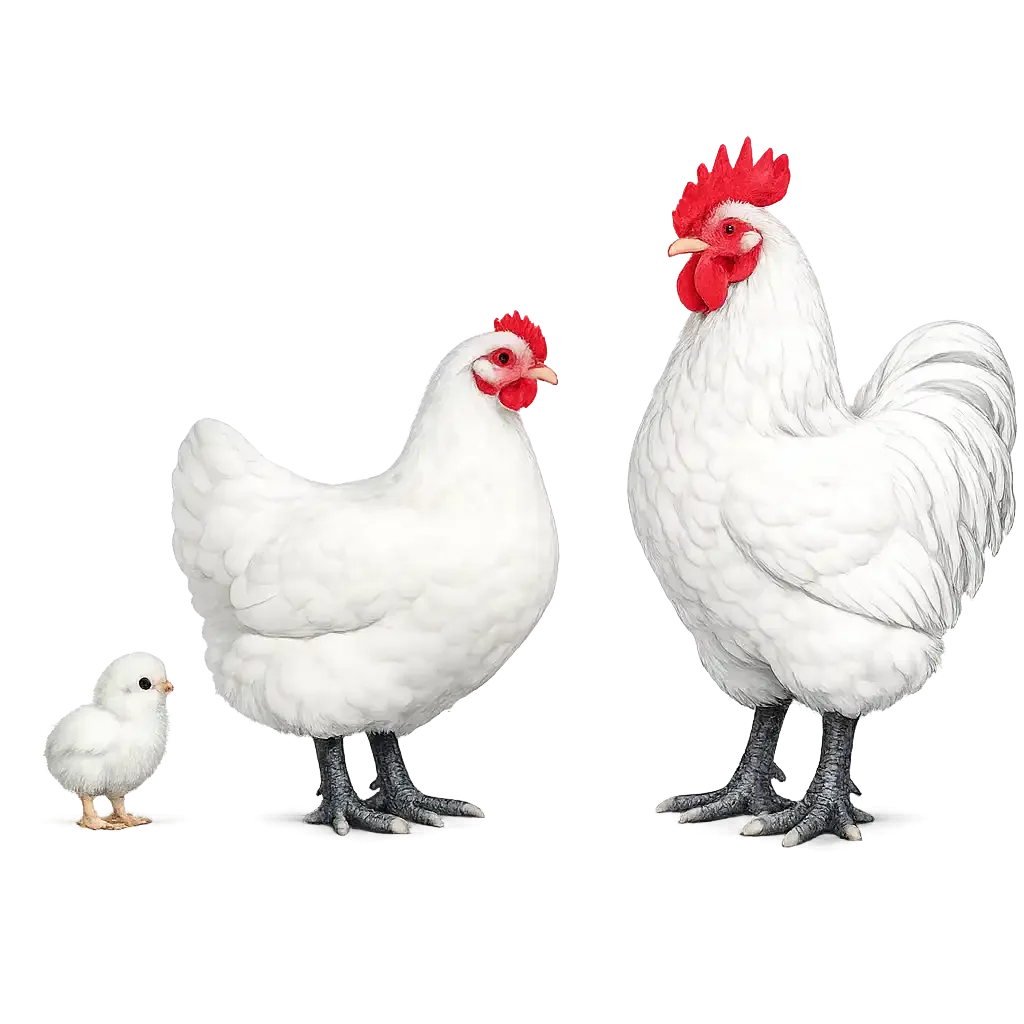
The White Langshan is one of the rarest heritage breeds available from a mainstream American hatchery, carrying a Threatened listing from the Livestock Conservancy, an APA recognition dating to 1893, and a foundational role in the creation of some of the most widely kept breeds in this directory. The breed takes its name from Wolf Hill, Langshan in Chinese, a modest prominence on the Jiangsu plain just south of Nantong on the Yangtze River in eastern China, roughly 100 miles from Shanghai, where the chickens that would become the Langshan breed had been kept for many centuries before they were first brought to the Western world. The Langshan Chicken Farm in Nantong has been actively preserving, breeding, and improving the original breed since 1959 with support from the Chinese government, making Wolf Hill one of the few places on earth where a chicken breed's geographic name and its living preservation site are still the same location.
The White Langshan is a variety of the Croad Langshan, the original type imported by Major F.T. Croad from China to England in 1872 and distinguished from the show-oriented Modern Langshan and the clean-legged German Langshan that developed from it. White sports, genetically white birds produced spontaneously from Black Langshan breeding flocks, first appeared in England in 1885 and were recognized by the APA in 1893, ten years after the original Black variety's 1883 recognition. McMurray Hatchery carries the White Langshan as one of their APA-certified breeds, with their flock regularly evaluated by an APA-certified judge to confirm breed standard compliance, making it one of the most accessible conservation-quality White Langshan sources in North America.
The White Langshan's practical profile is that of a large, tall, stately, feather-footed dual-purpose heritage breed with a distinctive U-shaped silhouette, 150 to 200 large brown eggs per year sometimes carrying a purplish bloom, exceptional white-meat carcass quality with relatively small bones, genuine cold and heat adaptability across a wider climate range than most Asiatic breeds, and the calm, curious, people-oriented temperament that makes it simultaneously a rewarding exhibition bird and a manageable homestead layer. It is not a breed for keepers who want maximum production efficiency from a common heritage breed. It is the breed for keepers who want the specific combination of rare conservation value, extraordinary breed history, distinctive U-shaped elegance, and genuine dual-purpose utility from one of the oldest and most foundationally important breeds in the heritage poultry world.
Quick Facts
Class: Asiatic (APA)
Weight: Roosters approximately 9.5 lbs; hens approximately 7.5 lbs; cockerels approximately 8.5 lbs; pullets approximately 6.5 lbs; bantam variety also recognized
Egg Production: Approximately 150 to 200 large brown eggs per year; some with a pale purplish bloom; winter-hardy layer that maintains production through cold months; laying continues past 6 years of age
Egg Color: Mid to dark brown; occasionally with pale purplish bloom that is rare among heritage breeds and specific to the Langshan
Egg Size: Large
Primary Purpose: Dual purpose; eggs and meat; exceptional white breast meat with small bones relative to body size; historically valued as roaster and capon
Temperament: Very calm; docile; friendly and easily tamed; develops relationships with individual keepers; good with children; tolerates confinement well while thriving in range conditions; one of the most even-tempered large heritage breeds
Brooding: Moderate; hens tend not to go broody until April or May and are described as not overly determined sitters but faithful and attentive mothers; broodiness moderate and seasonal rather than persistent
Flight Capability: Good; despite large body size, Langshans can fly over high fences; covered runs or high fencing required for containment
APA Recognition: 1893; Asiatic Class; White variety; recognized varieties are Black (1883), White (1893), and Blue (1987); McMurray White Langshan is an APA-certified flock evaluated to breed standard
Country of Origin: Wolf Hill (Langshan), Jiangsu province, China; imported to England 1872 by Major F.T. Croad; imported to America 1878
Comb Type: Single comb; medium-sized; standard frostbite management in hard winters
Distinctive Trait: Distinctive U-shaped silhouette from upright tail carriage and deep, full breast; lightly feathered shanks and outer toe, lighter feathering than Cochins or Brahmas; bluish-black shanks with pink between scales and white soles and toenails; white skin; small bones relative to body size; chicks hatch dark gray to smoky-white before transitioning to pure white adult plumage; the breed contributed to development of Orpington, Marans, Barnevelder, Jersey Giant, and Plymouth Rock; the only Asiatic breed suited to the Southern United States per the Livestock Conservancy
Conservation Status: Threatened (Livestock Conservancy); among the rarest heritage breeds available from any mainstream American hatchery; active preservation programs in China, Britain, and the United States
Lifespan: 8 to 10 years
Breed Overview
The Langshan's introduction to the Western world in 1872 was surrounded by immediate confusion and genuine controversy that shaped the breed's development and explains the four distinct types that exist today. When Major F.T. Croad brought the first Langshan birds to England from the port of Shanghai, British poultry enthusiasts familiar with the Black Shanghai chicken, which would later be classified as the Cochin, saw the tall black birds and assumed they were simply another variety of Shanghai. The Langshan is superficially similar to the Cochin in its dark color and feathered legs, and some breeders immediately began crossing the new imports with Cochins to supposedly improve the plumage, which actually degraded the Langshan's unique characteristics rather than improving them.
Major Croad's niece, Miss A.C. Croad, recognized the confusion and worked throughout her life to document and promote the breed's distinct identity, keeping the original import line as close as possible to the Chinese birds and resisting the various crossing attempts that other breeders pursued. The Croad Langshan Club was established in 1904 in her honor, and the name Croad Langshan was adopted to specifically distinguish the original utility type from the taller, more show-oriented Modern Langshan that English breeders developed by selecting for extreme leg length at the expense of the breed's large breast and original body type.
American Langshan history is specifically connected to the Croad line. The American birds imported in 1878 came from the Croad flock and were the utility-oriented birds that the Livestock Conservancy notes came from China with no need of improvement or alteration. The Black variety was APA-recognized in 1883, and the American Langshan Club formed in 1887 and remains active today as one of the longest-continuously-operating single-breed clubs in American poultry history. The White variety's recognition in 1893 from the spontaneous white sports that appeared in Black Langshan flocks in England completed the two-variety standard that most American keepers know, with the Blue variety's addition not coming until 1987.
The Langshan's contribution to other breeds is among the most extensive of any single heritage breed in the development of American and British poultry. The shorter-legged Cochin-influenced Langshan crosses contributed to William Cook's Black Orpington. The breed contributed to the development of the Marans, the Barnevelder, the Black Jersey Giant, and multiple Plymouth Rock varieties. The Livestock Conservancy specifically documents the Langshan's role in both the Orpington and the Jersey Giant, and The Featherbrain notes the connection to the Jersey Giant explicitly. The Langshan's white skin, full breast, small bones, and excellent white meat quality were characteristics that other breeders specifically sought when incorporating Langshan genetics into their breeding programs.
Plumage and Appearance
The White Langshan's appearance is defined first by the breed's extraordinary silhouette and second by the variety's pure white plumage that expresses it. The U-shaped body profile, created by the upright tail carriage that rises nearly as high as the head and the full, deep breast carried well forward, gives the Langshan a visual distinctiveness that no other breed in this directory replicates. Viewed from the side, the bird's long back slopes downward from the shoulders and then the tail rises sharply in a nearly straight line from the base, creating the characteristic U or V shape that is the most reliable visual identification marker of the breed from a distance.
The White Langshan's plumage is pure white throughout in mature birds, a clean and uniform white that contrasts with the breed's dark eyes and the bluish-black shanks with their characteristic pink between the scales. The white soles and white toenails are specific to the White variety and part of the breed standard, matching the Hungarian preference for white-skin breeds that William Cook also specifically incorporated into the Orpington's design.
Chick plumage is one of the White Langshan's more surprising characteristics. McMurray's product page specifically documents that White Langshan chicks hatch ranging from dark gray to smoky-white, transitioning to pure white adult plumage as juvenile feathers develop. This dark chick coloring in a breed that becomes pure white at maturity is consistent with the pattern documented for White Plymouth Rocks, White Jersey Giants, and White Orpingtons, and it is not a sign of incorrect variety identification.
The legs carry light feathering on the shanks and outer toe, distinguishing the Langshan from the clean-legged Mediterranean breeds and the smooth-legged American class breeds while also carrying significantly less feathering than the Cochins and Brahmas in the Asiatic class. The McMurray product page specifically notes this distinction: Langshans are not as heavily feathered on their legs and toes as Cochins. This lighter leg feathering reduces but does not eliminate the feathered-leg management considerations of wet conditions and mud accumulation that apply to all feather-footed breeds.
The body is large with a full, deep breast, long back, and relatively small bones that produce a high meat-to-bone ratio notable for a breed of the Langshan's standing frame. The skin is white throughout. Eyes are very dark brown, nearly black, giving the White Langshan a striking contrast between the dark eyes and the pure white plumage.
Egg Production
The White Langshan's egg production falls in the 150 to 200 large brown eggs per year range that is documented consistently across breed sources and that reflects the breed's genuine dual-purpose utility character rather than selection for maximum laying performance. This is solid heritage layer performance, comparable to Wyandottes and Brahmas, without the Australorp's peak production ceiling.
The most distinctive egg characteristic of the Langshan is the occasional purplish bloom that some hens deposit on their eggs, producing a brown egg with a faint violet tint that is rare among heritage breeds and essentially unique to the Langshan. The Backyard Poultry breed profile describes these as mid to dark brown, sometimes with pale purple bloom, and The Featherbrain notes that dark purplish eggs do occur from some strains but are rare in American hatchery birds. The purplish bloom, when present, is deposited on the egg surface during the final stages of laying and can be washed away with water, revealing the standard brown shell beneath. It is a cosmetic characteristic rather than a structural one, but it is sufficiently unusual and visually striking that it generates consistent keeper interest and is one of the more distinctive egg characteristics in any heritage breed.
Winter laying is specifically documented as a Langshan strength, with the breed maintaining production through cold months when many heritage breeds reduce output, and the Backyard Poultry breed profile notes that laying continues past 6 years of age, declining only after that point and sometimes continuing to 10 years. This long productive lifespan combined with the breed's 8 to 10 year general lifespan creates a productive egg-laying career significantly longer than most heritage breeds' commercial laying window.
Laying onset is slow. McMurray's Q&A specifically confirms that Langshans are slow to mature, with laying beginning at approximately 6 to 7 months of age compared to the 5-month onset of faster-maturing heritage breeds like Barred Rocks or Australorps. The McMurray blog note compares Langshans specifically to Whiting True Blues and Ameraucanas, which begin at or before 20 weeks, while Langshans are 22 weeks or later. This slower onset is consistent with the breed's large body size and slower growth trajectory.
Meat Quality
The White Langshan's meat quality is among the highest of any dual-purpose heritage breed in the directory in terms of white meat abundance and flavor, and the specific combination of characteristics the Livestock Conservancy documents is unusual for a Asiatic class breed: full breasts with abundant white meat that is rich in flavor, and relatively small bones for its body size that produce a favorable meat-to-bone ratio.
The white meat abundance specifically distinguishes the Langshan from most Asiatic breeds, which tend toward richer, fattier, darker-meat profiles from their Chinese and Asian heritage. The Langshan's particular breed character produces white breast meat in quantity alongside the rich flavor of a genuinely heritage-raised table bird, which is why historical keepers specifically valued Langshan cockerels as roasting birds and caponizing subjects. Hobby Farms documents that roosters make delicious roasters and are often castrated into capons to allow larger size development, which reflects the breed's historical table bird reputation.
The white plumage of the White variety provides the same clean-dressing carcass advantage documented for White Plymouth Rocks and White Orpingtons: white pin feather stubs against white skin disappear during processing rather than leaving the dark residue that black feathering would leave. The White Langshan dressed carcass is visually clean and pale-skinned, appealing to buyers familiar with commercial chicken presentation.
Growth to market weight is slow, consistent with the breed's general slow-maturation character. Keepers who want heritage table birds from Langshan genetics should plan for a 22 to 26 week grow-out timeline to reach meaningful processing weight rather than the 16 to 20 weeks sufficient for faster-maturing heritage breeds.
Temperament and Behavior
The White Langshan's temperament is consistently described across all breed sources as very calm, docile, easily tamed, and genuinely curious about and attached to individual human keepers. The Livestock Conservancy specifically rates temperament as very calm, the strongest calm rating applied to any breed in their documentation. The Featherbrain notes that Langshan chickens commonly develop relationships with their keepers and can become quite attached to you, and The Happy Chicken Coop describes them as calm and docile yet confident.
This combination of extreme docility and genuine confidence distinguishes the Langshan from breeds that are calm because they are heavy and sluggish versus calm because they are genuinely settled and secure. The Langshan is an active, alert bird that observes its environment with the characteristic dark-eyed intelligence that keeper accounts consistently note, while remaining completely unagitated by human presence and approach. The breed does not flush or scatter from keeper approach the way Mediterranean light breeds do, and it does not require the careful socialization that some assertive heritage breeds need to develop manageable adult roosters. The docility is genuine and extends to the roosters in most accounts.
Confinement tolerance is good, making the Langshan more flexible for homestead operations without extensive range access than its active foraging character would suggest. The breed forages actively and productively in range conditions, but it adapts to well-managed confined runs without the stress and feather-picking behaviors that confinement-intolerant breeds like the Blue Andalusian develop.
One significant and often underemphasized management consideration is flight capability. Multiple breed sources specifically warn that despite their large body size, Langshans can and do fly over high fences. The A-Z Animals profile notes they enjoy flying and have no problem clearing a tall fence. This flight capability is unusual in a 9.5-pound heritage breed and is the specific management adaptation required for White Langshan keeping that standard large heritage breed housing assumptions do not account for. Covered runs or fencing significantly higher than standard 4 to 5 foot backyard fencing is required for reliable containment.
Climate Adaptability
The White Langshan's climate adaptability is the most specific and most practically unusual of any Asiatic class breed in this directory. The Livestock Conservancy specifically documents the Langshan as the only Asiatic breed suited to the Southern United States, a distinction that reflects the breed's origin in the humid subtropical climate of the Yangtze River delta region with its damp, cool winters, hot humid summers, and frequent storms. Most Asiatic breeds, the Cochin and Brahma specifically, were developed in drier northern Chinese climates and perform less well in humid heat and wet conditions. The Langshan's origin specifically in the Jiangsu lowlands, one of the most humid regions of China, produced a breed hardened to humidity that no other Asiatic breed can match.
Cold hardiness is genuine but requires the standard single-comb frostbite management that applies to any single-combed breed. The tight feathering, described consistently as tighter and closer to the body than the Cochin's looser feathering, provides reasonable insulation without the extreme cold tolerance of the dense fluffy feathering of Orpingtons. The breed is described as relatively cold-hardy but preferring not to live in the coldest environments, which positions it as a good three-season breed in cold northern regions with appropriate cold management rather than a breed specifically suited to the most severe winter conditions.
Heat tolerance is specifically documented as good to excellent, particularly in humid heat where other Asiatic breeds struggle. The tight feathering rather than the full fluffy feathering of Cochins and Brahmas gives the Langshan better heat dissipation in summer than more heavily feathered Asiatic breeds, making it the Asiatic class choice for keepers in humid warm climates who want the Asiatic temperament and body type without the heat management challenges that Cochins and Brahmas present.
The breed's preference for well-drained land is specifically documented and should be taken seriously as a siting consideration. The feathered shanks and toes accumulate mud and wet matter in persistently wet or waterlogged conditions, and the breed performs less well on poorly drained land than on dry, well-draining range. Keepers on clay soils or in high-rainfall regions should assess drainage carefully and consider raised run surfaces or gravel-based outdoor areas if natural drainage is inadequate.
Housing and Management
Several management considerations specific to the White Langshan require planning before acquiring the breed that standard heritage breed assumptions do not address.
Flight capability is the most important infrastructure departure from standard heritage breed housing. Where 4 to 5 foot fencing adequately contains most large heritage breeds whose body weight prevents sustained flight, Langshans are specifically documented as able to clear high fences despite their substantial size. Covered runs with overhead netting or hardware cloth, or fencing of 6 to 7 feet or more, are required for reliable containment. This is a non-negotiable infrastructure requirement; keeper accounts of Langshans found outside their nominal enclosures are consistent and well-documented.
Roost height management is important given the breed's large body weight. Roosting from heights greater than 2 to 3 feet creates leg and foot strain and potential injury risk for birds weighing 7.5 to 9.5 pounds landing from height repeatedly. Low roost bars at 18 to 24 inches and padded landing areas below roosts reduce the cumulative joint stress that hard landings produce in large heavy birds. Backyard Poultry specifically notes that heavy birds require lower perches, six inches to 15 centimeters in the Transylvanian Naked Neck profile context, which applies equally to the Langshan.
The feathered legs and toes require the same dry litter management and regular inspection for mud accumulation and scaly leg mites that apply to all feather-footed breeds. The Langshan's lighter leg feathering relative to Cochins and Brahmas reduces but does not eliminate these considerations. Well-drained outdoor access, regular litter replacement, and periodic leg and toe inspection are appropriate routine management for the breed.
Nesting boxes sized for 7.5-pound hens, approximately 14 by 14 inches, accommodate the breed comfortably. The Langshan's moderate broodiness, specifically documented as appearing in April and May rather than distributed throughout the year, means that broodiness management is a seasonal rather than year-round consideration.
Conservation Significance
The White Langshan's Threatened status from the Livestock Conservancy is the most serious conservation designation applied to any breed in this directory beyond Endangered, and it reflects a genuinely precarious population situation for one of the most historically important breeds in the heritage poultry world. The breed that helped create the Orpington, contributed to the Jersey Giant, the Marans, and the Barnevelder, and served as one of the most widely kept dual-purpose breeds in England and America through the 19th century is now genuinely rare enough that mainstream hatchery availability is a significant factor in its conservation.
McMurray Hatchery's APA-certified White Langshan flock, evaluated by an APA-certified judge to confirm breed standard compliance, is one of the most accessible sources of conservation-quality White Langshan birds in North America. The APA certification specifically indicates that the birds conform to the breed standard rather than merely carrying the Langshan name, which is meaningful for keepers who want their acquisition to contribute to genuine breed conservation rather than simply adding a Langshan-labeled bird to their flock.
The American Langshan Club, active since 1887, is one of the longest-continuously-operating single-breed clubs in American poultry history and connects White Langshan keepers with the conservation community, exhibition opportunities, and networking for sourcing pure-breeding birds from dedicated breeders focused specifically on breed standard compliance. The Croad Langshan Club in Britain and preservation programs at the research station near Gödöllő in Hungary, combined with the Chinese government-supported breeding program in Nantong, represent an unusually coordinated international conservation effort for a breed whose population remains precariously small.
Pros and Cons
Pros
One of the most historically foundational heritage breeds in existence; contributed genetics to Orpington, Marans, Barnevelder, Jersey Giant, and Plymouth Rock development
APA recognition since 1893; McMurray APA-certified flock evaluated to breed standard; one of the most accessible conservation-quality White Langshan sources in North America
The only Asiatic class breed suited to the Southern United States per the Livestock Conservancy; uniquely adapted to humid subtropical conditions among Asiatic breeds
Exceptional white breast meat with small bones relative to body size; historically valued as roaster and capon
Distinctive U-shaped silhouette and pure white plumage create exhibition appeal and visual flock distinction
Occasional purplish egg bloom is among the rarest and most distinctive egg characteristics in any heritage breed
Long productive laying lifespan continuing past 6 years; overall lifespan of 8 to 10 years
Winter production maintained through cold months
Very calm, docile, and people-oriented temperament; one of the most even-tempered large heritage breeds
Good confinement tolerance alongside genuine foraging productivity in range conditions
Good heat and humidity tolerance, especially in humid subtropical conditions where other Asiatic breeds struggle
White plumage produces clean-dressing carcass without dark pin feather residue
Conservation contribution: keeping White Langshans supports one of the most genuinely Threatened heritage breeds in the American poultry market
Cons
Threatened conservation status reflects genuinely rare population; sourcing requires planning and possibly waiting for availability
Can fly over high fences despite large body size; covered runs or high fencing required; this is the most operationally significant management departure from standard large heritage breed housing
Slow to mature; laying onset at 6 to 7 months versus 5 months for faster heritage breeds
Egg production at 150 to 200 per year is lower than the highest-producing dual-purpose heritage breeds
Feathered legs and toes require dry litter management, mud monitoring, and scaly leg mite inspection
Prefers well-drained land; performs less well on wet or poorly draining soil
Slow growth to processing weight; 22 to 26 weeks for meaningful heritage table bird carcass
Broodiness is moderate and seasonal; not reliably broody for planned natural hatching programs throughout the year
Single comb requires standard frostbite management in hard winters
The breed prefers not to live in the coldest environments despite reasonable cold hardiness
Profitability
The White Langshan's profitability is built primarily on the intersection of conservation rarity, breed story depth, exhibition value, and the specific characteristics of its eggs and carcass rather than on production volume.
Conservation-premium egg pricing is available from the White Langshan's Threatened status and extraordinary breed history in a way that no recovered or common heritage breed can approach. Buyers who specifically seek heritage conservation breed eggs, direct-sale customers who value the narrative of 19th-century Chinese Wolf Hill genetics producing their breakfast eggs through a chain of history that includes Major Croad's 1872 import, Miss Croad's lifelong conservation work, and the American Langshan Club's 138-year continuous operation, pay meaningful premiums for that story over commodity or even standard heritage brown eggs. The occasional purplish egg bloom, when it appears, is a genuinely distinctive product characteristic that strengthens the story further.
Exhibition revenue from APA-certified breeding stock connects the White Langshan keeper to the exhibition poultry community, which pays meaningfully higher prices for breed-standard birds from certified flocks than for generic heritage breed chicks. McMurray's APA certification specifically makes their White Langshan stock appropriate foundation stock for buyers entering the exhibition community, which creates a secondary market connection that most heritage breed poultry does not provide.
Heritage table bird revenue from Langshan cockerels and capons processed at appropriate maturity reflects the breed's historically documented white meat quality and the premium that heritage poultry buyers place on breeds with documented Chinese origin, centuries of continuous breeding, and the specific table qualities that the Livestock Conservancy specifically praises.
Comparison With Related Breeds
Black Langshan: The original and most widely kept Langshan variety, sharing identical breed character across all practical dimensions. The Black variety is more commonly available from hatcheries and specialty breeders, carries the original beetle-green iridescent plumage that is among the most visually striking of any heritage breed, and produces the same egg profile and body weight as the White. The White variety's specific advantages are the clean-dressing white-feathered carcass presentation and the visual distinction of pure white plumage on the Langshan's distinctive U-shaped frame. Conservation contribution is equivalent between varieties; both are Threatened and both require dedicated keeper support to sustain the breed.
Black Australorp: The most direct comparison for a large, dark-feathered, calm Asiatic-heritage dual-purpose layer, covered in a dedicated post in this directory. The Black Australorp descended from Black Langshan crosses taken to Australia, which makes the comparison almost genealogical. The Australorp produces 250 to 300 brown eggs per year, significantly more than the Langshan's 150 to 200, in a slightly smaller, more production-oriented body without the Langshan's purplish egg bloom, distinctive silhouette, or conservation rarity. For keepers who want maximum production from calm Asiatic heritage genetics, the Australorp wins on volume; for keepers who want the originating breed's rare conservation status and extraordinary breed depth, the Langshan is the answer.
Brahma: The most familiar Asiatic class comparison breed in American heritage poultry keeping, also heavily feathered and large-bodied. The Brahma is more cold-hardy than the Langshan but less suited to humid heat, lacks the Langshan's distinctive U-shaped silhouette, and carries a pea comb that eliminates frostbite risk in the coldest winters. The Brahma is more widely available, no longer Threatened, and more broadly managed in American heritage poultry operations. The Langshan's contributions to other breeds through its foundational role, its extraordinary breed story, and its Threatened conservation status are the specific arguments for choosing it over the more accessible Brahma for keepers motivated by conservation contribution.
Black Jersey Giant: The large American class breed whose development specifically incorporated Langshan genetics, covered in a dedicated post in this directory. The Jersey Giant reaches 13 to 15 pounds at heritage standard versus the Langshan's 9.5 pounds for roosters, produces 150 to 250 large brown eggs per year, and carries the same very calm temperament. The Langshan's smaller-boned, white-meated carcass with more white meat per pound and the occasional purplish egg bloom distinguish it from its American descendant. Both are calm, large, conservation-status breeds with genuine dual-purpose utility; the Langshan is the original, the Jersey Giant is the American development from it.
Final Verdict
The White Langshan is the most historically significant rare breed in this directory and one of the most genuinely worthwhile conservation breeding opportunities available from a mainstream American hatchery. The breed that helped create the Orpington, contributed to the Jersey Giant and the Marans, gave the Barnevelder its dark egg genetics, and served American and British homesteads for half a century before industrial poultry displaced it deserves far more keeper attention than its Threatened conservation status reflects. The flight capability over high fences is the most operationally significant departure from standard heritage breed housing planning and must be addressed before birds arrive. The slow maturity, lower production ceiling, and feathered-leg mud management are genuine considerations that keepers should weigh honestly. For the keeper who brings the appropriate infrastructure planning together with genuine appreciation for the breed's extraordinary depth of history, its calm and curious temperament, its distinctive U-shaped elegance in pure white plumage, and the conservation opportunity that keeping a genuinely Threatened breed provides, the White Langshan delivers one of the most rewarding and most historically meaningful heritage breed experiences available in North American homestead poultry.
Frequently Asked Questions
Why do White Langshan chicks hatch gray or dark rather than white? White Langshan chicks hatch ranging from dark gray to smoky-white and transition to pure white adult plumage as juvenile feathers replace the natal down over the first several weeks. This is normal for the variety and is not a sign of incorrect breed identification. The same gray-to-white chick transition is documented for White Plymouth Rocks, White Jersey Giants, and White Orpingtons. The pure white adult plumage develops fully as the bird matures.
Can White Langshans really fly over fences despite their large size? Yes. Multiple breed sources specifically document that Langshans, despite weighing 7.5 to 9.5 pounds at maturity, can and do fly over high fences. This is unusual for a large heritage breed and is the most operationally significant management consideration specific to the Langshan that standard large heritage breed housing assumptions do not account for. Covered runs with overhead netting or fencing significantly higher than the standard 4 to 5 foot backyard fencing is required for reliable containment. Keeper accounts of Langshans found outside their enclosures are well-documented in the breed community.
What is the purplish bloom on Langshan eggs and how common is it? The purplish bloom is a pigment deposit applied to the outer surface of the brown eggshell during the final stages of laying, creating a faint violet tint visible on the egg surface. It can be washed away with water, revealing the standard brown shell beneath. The bloom is a genuine characteristic of some Langshan hens and strains, though The Featherbrain notes it is quite rare in American hatchery birds compared to pure-breeding conservation strains. Its occurrence varies between individual hens and strains; not all White Langshan hens produce the purplish bloom, but enough do that it is considered a breed characteristic rather than an anomaly.
Why is the Langshan the only Asiatic breed suited to the Southern United States? The Langshan originated in the Jiangsu province of eastern China along the Yangtze River delta, one of the most humid subtropical regions in China, with hot humid summers, frequent summer storms, and cool damp winters. Most other Asiatic breeds, the Cochin and Brahma specifically, were developed in drier northern Chinese climates and handle humidity less well. The Langshan's centuries of adaptation to humid subtropical conditions in its Chinese homeland produced climate tolerance that translates specifically to the American South's humid climate, which other Asiatic breeds find more challenging. The tight feathering also provides better heat dissipation in summer than the Cochin's dense fluffy feathering.
How does the Langshan connect to other breeds in the directory? The Langshan's contribution to other breeds is among the most extensive of any heritage breed. The shorter-legged Cochin-crossed Langshan birds contributed to William Cook's original Black Orpington development, which means the White Orpington post in this directory traces partial ancestry to the Langshan. The Black Jersey Giant's development specifically incorporated Langshan genetics, making the Jersey Giant a direct American descendant. The Marans and Barnevelder used Langshan blood in their foundational matings, and Plymouth Rock development also incorporated Langshan genetics according to multiple breed histories. The Black Australorp, covered in its own post, is an Australian development from Black Orpington stock that itself traces to Langshan crosses, giving the Langshan an indirect but traceable connection to the Australorp as well.
Related Breeds
Black Australorp
Black Jersey Giant
White Orpington
White Plymouth Rock
Bielefelder
Malines