
White Silkie Bantam
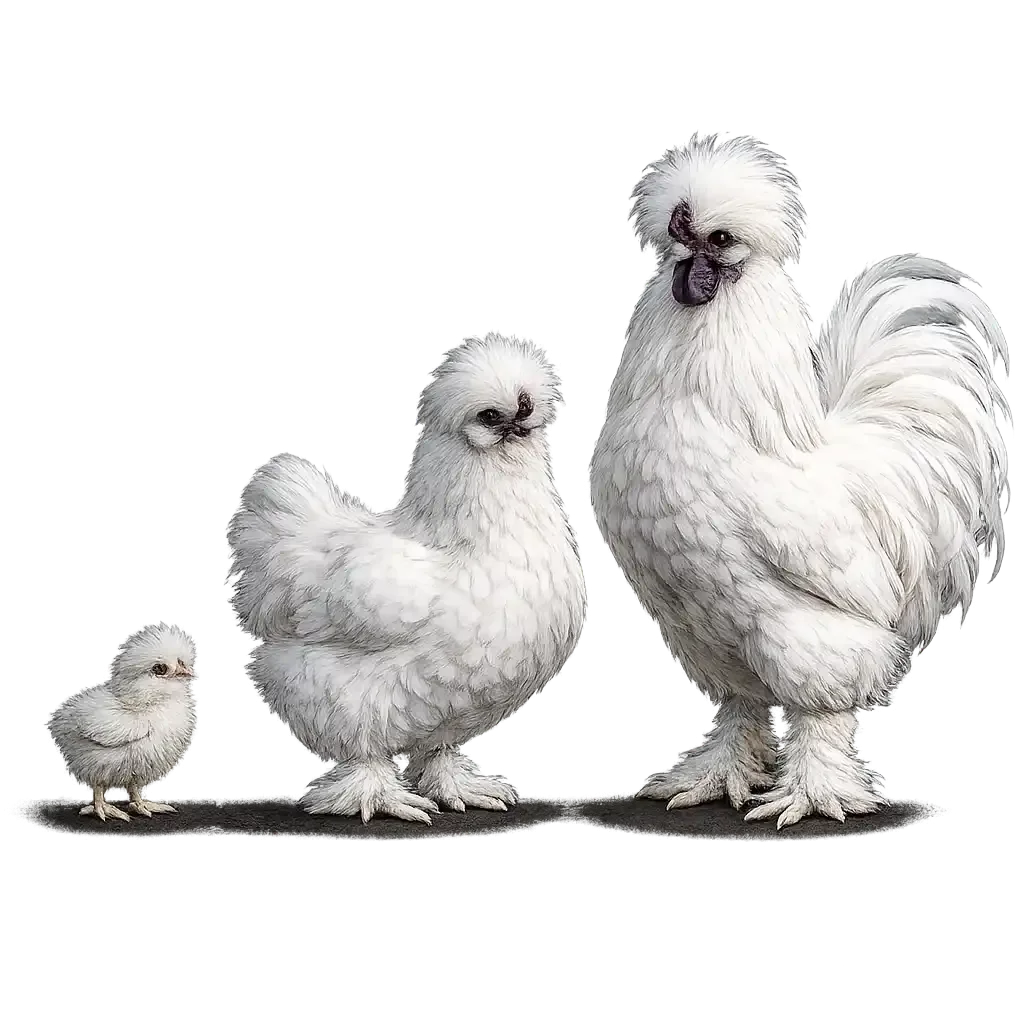
Pick up a White Silkie Bantam and you will immediately understand why early Dutch farmers, encountering the breed for the first time in the 17th century, reportedly claimed it must be a cross between a chicken and a rabbit. The feathers have no barbicels, the tiny interlocking hooks that give normal chicken feathers their smooth, flat, water-shedding structure. Without them, every feather on the bird fans out independently in a soft, loose filament, and the cumulative effect across the entire body is a cloud of white fluff that feels exactly like silk or fine fur to the touch. Add to this the black skin, bones, and dark organs visible beneath the plumage, the turquoise-blue earlobes, the five toes on each foot, the walnut comb, and the small crest of feathers on the crown, and you have a bird so far removed from the standard chicken silhouette that its poultry identity seems almost incidental to its character. The White Silkie Bantam is the most popular ornamental chicken breed in the world, the most recommended breed for families with children and first-time chicken keepers, and the most reliable natural broody hen available for hatching eggs from other breeds. Its history reaches back to ancient China, where the breed known as wu gu ji, or black-boned chicken, appears in records from the Tang dynasty and was documented by Marco Polo during his travels in the 13th century as a furry chicken unlike anything he had seen before. It arrived in the West by the mid-1800s and was admitted to the American Poultry Association Standard of Perfection in 1874. For the backyard keeper who wants a gentle, fluffy, people-oriented companion that also serves as a living incubator capable of hatching eggs from any breed in the flock, the White Silkie Bantam is the single best answer to both requirements simultaneously.
Quick Facts
Class: All Other Standard Breeds (APA); classified as bantam only in the United States and Canada
Weight: Roosters approximately 36 oz (1 kg); hens approximately 32 oz (900 g) per APA standard
Egg Production: Approximately 100 to 120 small cream to tinted eggs per year; heavily interrupted by frequent broodiness
Egg Color: White to cream to very light tinted
Egg Size: Small
Primary Purpose: Ornamental; exhibition; pet; broody hen for hatching eggs of other breeds
Temperament: Exceptionally docile, affectionate, and people-oriented; considered the lap dog of the chicken world; tolerant of children
Brooding: Extremely broody; one of the most reliably broody breeds available; excellent natural mother; will hatch eggs from virtually any poultry species
Flight Capability: Essentially none; the hookless feather structure prevents flight entirely
APA Recognition: 1874; one of the earliest recognized breeds in the North American standard
Country of Origin: Ancient China; Tang dynasty records and Marco Polo documentation place the breed in China by at least the 13th century
Varieties (APA): White, Black, Blue, Buff, Splash, Partridge, Grey; bearded and non-bearded forms exist for most colors
Comb Type: Walnut comb; minimal frostbite risk
Distinctive Trait: Hookless silk-like feathering covering the entire body; black skin, bones, and dark organs; turquoise-blue earlobes; five toes; walnut comb; crest
Conservation Status: Not at risk; widely available
Lifespan: 7 to 9 years
Breed Overview
The Silkie's documented history in China predates almost every breed in the Western poultry tradition. References to black-boned chickens with unusual feathering appear in Chinese literature and historical records from the Tang dynasty, and the breed's use in traditional Chinese medicine as a restorative food, particularly in soups prescribed for postpartum recovery and general vitality, has continued without interruption for over a thousand years. The specific Chinese name wu gu ji, meaning black-boned chicken, reflects the breed's most medically significant characteristic in Chinese medicinal tradition: the fibromelanosis-driven hyperpigmentation that extends through the skin, bones, muscles, and organs, producing the dark tissue that Chinese medicine associates with nutritional and restorative properties. Scientific analysis of Silkie meat has confirmed that it contains higher levels of carnosine and other antioxidant compounds than standard chicken meat, lending some empirical support to the long-standing medicinal claims.
Marco Polo's 13th-century account of a furry chicken in Asia is the earliest Western documentation of the Silkie, though he did not record it as an edible bird but as a curiosity. European traders and travelers continued to note the breed over subsequent centuries, and by the early 1600s Silkies had reached Europe, where they were described with some confusion by observers who struggled to categorize an animal that looked like a chicken from a distance but felt entirely different to the touch. The Dutch claims of rabbit crossbreeding, while anatomically impossible and scientifically incorrect, reflected the genuine bewilderment of people encountering the hookless feather structure for the first time.
The breed was formally recognized by the APA in 1874, the same year as the Sultan, placing both in the first cohort of officially standardized American breeds. In the United States and Canada the Silkie is classified exclusively as a bantam; the standard-sized Silkie recognized in European standards is not acknowledged by North American registries. This classification distinction is worth understanding because it means that all APA-recognized Silkie show competition in North America, including the White Silkie Bantam, takes place within the bantam class regardless of the bird's actual size.
The White variety is the most widely recognized and most commonly kept of the APA-recognized Silkie colors. Its pure white plumage, unmarked by any secondary color, shows the hookless feather texture most dramatically and creates the clearest visual impression of the breed's defining characteristic. Exhibition breeders working with the White Silkie select for the cleanest possible white throughout the plumage, including the crest, beard, and foot feathering, with any yellow tinting or off-white areas treated as faults.
Plumage and Appearance
The White Silkie Bantam's feathering is its defining characteristic and the first thing any observer notices. Normal chicken feathers have a central shaft from which barbs extend, and from those barbs, barbules extend and hook into each other through tiny barbicels, creating the flat, interlocking surface of a standard feather. The Silkie carries a recessive autosomal gene that eliminates these barbicels, leaving the barbs as individual filaments that fan out freely in all directions without connecting to neighboring barbs. The result is not a smooth feather but a soft, loose, multidirectional plume that resembles the individual hairs of a fur coat more than the structured vane of a conventional feather.
This hookless feathering covers the entire body of the White Silkie Bantam, from the crest on the crown to the feathered shanks and toes. The white color, unmarked by any other pigment, gives the plumage an almost luminous quality in good light. The absence of the interlocking feather structure means that the plumage cannot provide the water-shedding, wind-resistant protection of normal feathering, which has direct practical implications for housing and wet-weather management.
Beneath the white plumage, the Silkie's skin is blue-black, the result of fibromelanosis, the same EDN3 gene duplication on chromosome 20 that produces the black skin, organs, and bones of the Ayam Cemani. In the Silkie, fibromelanosis is expressed heterozygously rather than homozygously, producing consistent black skin and bones but less complete internal organ pigmentation than the Ayam Cemani's homozygous expression. The contrast between the pure white exterior plumage and the blue-black skin visible at the face, comb, and wattles is one of the most visually striking features of the breed at close range.
The turquoise-blue earlobes are unique among chicken breeds. Most breeds have red or white earlobes; the Silkie's distinctive turquoise-blue coloring is a breed standard requirement and one of the features exhibition judges evaluate specifically. The walnut comb is small, compact, and sits low on the skull, presenting minimal frostbite risk. The crest of feathers on the crown varies in fullness between individuals and strains, and in bearded Silkies an additional muff of feathering beneath the beak covers the earlobes, adding further to the fully-feathered face appearance.
The five toes, polydactyly produced by the same genetic trait found in the Sultan, Dorking, Houdan, and Faverolle, are a breed standard requirement. The fifth toe grows directly above and behind the fourth rear toe, pointing upward rather than downward. Six-toed individuals occur occasionally but are not accepted under breed standards.
The body is compact, short-backed, and rounded, carried upright with the wings held low and close to the body. The overall impression is of a small, perfectly round, white fluffy ball that moves with a busy, purposeful waddle quite different from the striding gait of larger breeds.
Egg Production
The White Silkie Bantam's egg production needs to be understood in the context of the breed's exceptional broodiness, because the two are inseparable in practice. An ideal year of Silkie production might reach 100 to 120 small cream to tinted eggs, but reaching that figure requires consistent egg collection to prevent hens from accumulating a clutch and committing to incubation. In practice, most Silkie hens go broody multiple times per year, each broody episode lasting three weeks of incubation plus additional weeks of chick rearing if eggs are allowed to hatch. A Silkie hen that goes broody three or four times per year, as many do during the spring and summer months, produces substantially fewer than 100 eggs annually because the broody periods interrupt laying for extended cumulative periods.
This broodiness is not a fault in the Silkie but one of its most valuable and practical characteristics. The Silkie's combination of reliable broodiness, small body weight that reduces egg-crushing risk during incubation, and patient, attentive maternal behavior makes it one of the most useful natural incubators available for any poultry keeper who wants to hatch eggs from other breeds without an artificial incubator. White Silkie Bantam hens will sit on eggs from chickens, ducks, turkeys, guinea fowl, and other poultry species with equal commitment, and they raise the chicks, ducklings, or poults that hatch with the same attentiveness they would give their own offspring. This surrogate brooding utility is genuinely valuable on a mixed homestead or small farm and compensates practically for the breed's modest direct egg production.
Hens begin laying at approximately 7 to 9 months of age, later than most production breeds, consistent with the Silkie's slower maturity timeline. Eggs are small, cream to lightly tinted, and suitable for table use, though the small size means more eggs are needed per recipe compared to the large eggs of production breeds.
Temperament and Behavior
The White Silkie Bantam's temperament is the quality most responsible for its position as the most recommended backyard chicken breed for families and beginners. The breed is not merely calm or manageable in the way that many docile heritage breeds are calm: it is actively, consistently affectionate in a way that is rare in any chicken breed. Silkies seek human contact rather than tolerating it. They approach voluntarily, accept being picked up and held without resistance, settle contentedly on laps, and interact with their keepers in ways that experienced chicken owners consistently describe as more like a pet than a typical backyard bird.
This people-orientation makes the White Silkie Bantam an exceptional breed for children, who can interact with it safely and positively from a young age without the wariness or startled responses that even docile larger breeds can show. The breed's small size adds a safety element: a White Silkie Bantam cannot injure a child the way a startled large-breed rooster can, and the bird's typical response to unexpected handling is patient acceptance rather than alarm.
The breed is also notably quiet. Roosters crow, as all roosters do, but Silkie crowing is generally described as softer and less penetrating than the crowing of larger breeds, and hens maintain a frequent, soft conversational vocalization that keepers find pleasant rather than disruptive. This quiet character makes the White Silkie Bantam well-suited to suburban and urban backyard settings where noise is a consideration.
The Silkie's vulnerability in mixed flocks mirrors the Sultan's in some respects: the crest can limit peripheral vision, and the breed's non-assertive character makes it susceptible to bullying from larger or more dominant breeds. Unlike the Sultan, the Silkie is somewhat more robust in mixed flocks when companion breeds are chosen thoughtfully, and many keepers successfully maintain Silkies alongside other docile breeds. However, keeping Silkies with assertive production breeds, game heritage birds, or any significantly larger companion creates welfare risks that careful flock planning can avoid.
Climate Adaptability
The White Silkie Bantam's climate considerations are dominated by one fundamental characteristic: the hookless feathering cannot shed water. A Silkie caught in rain or exposed to persistent wet conditions becomes thoroughly soaked far more quickly than a normal-feathered breed, and a wet Silkie is a chilled Silkie. The breed requires covered housing access at all times and cannot safely free-range in wet weather without shelter readily available.
This wet-weather vulnerability does not mean the White Silkie Bantam is generally cold-sensitive. In dry cold conditions with appropriate housing, the breed manages winter temperatures adequately, and the walnut comb presents minimal frostbite risk. The practical cold-weather requirement is simply that housing must be dry and wind-protected, which is good practice for any chicken breed and not a special burden for the Silkie specifically.
Heat tolerance is reasonable. The small body size and relatively low metabolic rate of a bantam breed mean the White Silkie Bantam does not generate as much body heat as larger breeds and handles warm conditions with standard shade and cool water access. The dense feathering can cause discomfort during extreme heat events, and shade access is important during peak summer temperatures, but the breed does not require special heat management beyond what good backyard husbandry already provides.
The crest feathering, like the Sultan's, can obstruct the bird's vision as it grows toward the eyes. Regular trimming around the eyes is the standard management practice for keepers maintaining Silkie welfare, particularly important given the breed's reduced predator awareness that results partly from impaired peripheral vision.
Housing and Management
The White Silkie Bantam's housing requirements center on two priorities: dryness and appropriate companion selection. A covered run or ready access to covered shelter is essential given the breed's inability to shed water. Deep, dry litter in a well-ventilated but draft-protected coop provides the indoor conditions the breed needs without requiring elaborate infrastructure.
The Silkie's inability to fly, a direct consequence of the hookless feather structure that prevents the aerodynamic function of normal feathers, means that roost bars should be placed at a low height accessible by the birds without requiring a jump they cannot manage. Most Silkie keepers place roost bars at approximately 12 to 18 inches from the floor, low enough that birds reach them easily but high enough to satisfy the instinct to roost above ground level.
Foot feather management follows similar principles to the Sultan: regular inspection for accumulated litter, manure, or debris matted into the toe feathering, with gentle cleaning as needed and dry litter management to prevent accumulation in the first place.
Broody hen management requires a decision from the keeper: whether to collect eggs consistently to reduce broody episodes and maintain higher production, or to allow selected hens to go broody and exploit the breed's remarkable natural incubation ability. Many keepers do both, collecting eggs from most hens while deliberately allowing one or two reliable broodies to incubate batches of eggs from other breeds in the flock. The White Silkie Bantam's broody commitment is strong enough that a hen will persist through a full 21-day incubation cycle and beyond with minimal management intervention beyond providing food, water, and nest box protection from disturbance.
Sourcing Considerations
The White Silkie Bantam is widely available from mainstream hatcheries across North America and does not require the specialty sourcing that rare conservation breeds demand. Murray McMurray, Meyer Hatchery, Cackle Hatchery, and most regional poultry hatcheries carry White Silkie Bantams as a standard offering, and farm supply stores stock Silkie chicks seasonally in most regions. This broad availability makes it one of the easiest ornamental breeds to source without specialty connections or waiting lists.
Hatchery stock and exhibition stock differ in ways that matter for show purposes. Exhibition-quality White Silkie Bantams from breeders focused on correct type show more consistent crest fullness, more thorough foot feathering, cleaner white plumage without yellow tinting, and more precise conformational type than hatchery birds selected primarily for production volume rather than exhibition standards. For backyard companions and surrogate brooding purposes, hatchery stock is entirely appropriate. For competitive showing, sourcing from breeders active in the Silkie community produces better starting birds.
Pros and Cons
Pros
The most people-oriented and affectionate chicken breed available; actively seeks human contact and tolerates handling from all ages
Best natural broody hen for hatching eggs from any poultry species; reliable, committed, attentive
Completely unable to fly; no containment challenges related to flight
Walnut comb; minimal frostbite risk in cold climates
Quiet vocalization; suitable for suburban and urban settings
Genuinely safe for children; small size and calm temperament eliminate the risks that larger breeds can present
Widely available from mainstream hatcheries; no specialty sourcing required
APA recognition since 1874; well-established exhibition breed with active support community
The most recognizable and visually distinctive backyard chicken breed in the world
Cons
Hookless feathering cannot shed water; wet conditions cause rapid chilling; covered housing essential
Egg production of 100 to 120 small eggs per year is low, and frequent broodiness reduces actual annual totals further
Vulnerable to bullying in mixed flocks with assertive or dominant breeds
Crest feathering reduces peripheral vision; regular trimming required for bird welfare
Foot feathering requires regular inspection and cleaning
Susceptible to lice and mites given the dense feathering; regular parasite checks are important
Not suitable for open free-ranging in wet weather or areas with significant predator pressure; crest limits predator awareness
Small egg size requires more eggs per recipe compared to production breed eggs
Profitability
The White Silkie Bantam's commercial value is built primarily around three distinct markets: pet and companion chicken sales, exhibition breeding, and broody hen services or chick hatching for other breeds.
Pet chicken demand for Silkies is the strongest and most consistent of these markets. The breed's reputation as the friendliest and most child-appropriate backyard chicken, supported by consistent keeper recommendations across social media and poultry communities, creates steady buyer interest from families, urban chicken keepers, and beginners who want a manageable, affectionate first bird. Silkie chicks and pullets from reputable breeders command prices above commodity hatchery stock because buyers seeking companion-quality birds are willing to pay for birds with good temperament history and correct breed type.
Exhibition breeding produces ongoing demand for verified correct-type birds among the active Silkie show community. The White variety's exhibition requirements around clean white plumage, full crest, complete foot feathering, and turquoise earlobes mean that consistently producing exhibition-quality birds requires selective breeding investment that supports premium pricing.
The broody hen market is smaller but genuine. Keepers managing other poultry species who want reliable natural incubation without artificial incubators will pay for proven broody Silkie hens, particularly from operations demonstrating a track record of successful hatching across multiple seasons.
Comparison With Related Breeds
Black Silkie Bantam: The closest comparison within the Silkie family. Shares all the defining breed characteristics of the White Silkie Bantam including temperament, broodiness, hookless feathering, fibromelanosis traits, and five toes. The difference is entirely in plumage color: the Black Silkie's black feathering contrasts sharply with its black skin and creates a dramatically different visual impression from the White's cloud-like all-white appearance. Exhibition breeders select for slightly different plumage characteristics in each color, but practical keeping requirements are identical.
White Sultan: The most similar breed in terms of management requirements and backyard character. Both the White Sultan and White Silkie Bantam are gentle, people-oriented, ornamental breeds vulnerable to wet conditions and to bullying from assertive flockmates. The Sultan has more unique decorative features but less consistent broodiness than the Silkie. The Silkie is more widely available and generally more robust than the Sultan in everyday backyard management.
Buff Silkie Bantam: Another variety sharing all Silkie characteristics with the only difference being the warm golden-buff plumage color. Equally suitable for all the same purposes; color preference is the deciding factor.
Cochin Bantam: A similarly fluffy, docile bantam breed with feathered shanks and a gentle temperament that is frequently recommended alongside the Silkie as a companion breed. The Cochin Bantam has standard feathering rather than hookless feathering, is slightly better in wet weather, lays somewhat more consistently, and has less pronounced broodiness than the Silkie. A good companion choice for a mixed Silkie flock.
Polish Chicken: Shares the crest feature and the associated vision management requirements. The Polish is a larger bird, lays more eggs than the Silkie, has standard feathering, and is somewhat more active and less deliberately people-oriented than the Silkie. Both breeds require crest trimming for welfare maintenance.
Final Verdict
The White Silkie Bantam has been the world's most popular ornamental chicken breed for good reason, and that reason has not changed since Marco Polo first recorded a furry chicken in 13th-century China: no other chicken feels the way a Silkie feels, looks the way a Silkie looks, or behaves the way a Silkie behaves toward the people who keep it. The wet-weather vulnerability is real and requires covered housing. The egg production is modest and frequently interrupted by broodiness. The mixed-flock vulnerability requires thoughtful companion selection. None of these limitations are reasons to choose a different breed for a keeper who values a gentle, beautiful, people-seeking backyard companion that also functions as the most reliable natural incubator available for any eggs they want to hatch. For families with children, for urban and suburban backyard keepers, for anyone who wants the chicken world's closest equivalent to a lap dog, the White Silkie Bantam is the answer. The backyard chickens category is better for including it.
Frequently Asked Questions
Why does the White Silkie Bantam have black skin? The black skin, bones, and darkened organs of the Silkie are caused by fibromelanosis, a genetic condition produced by a duplication near the EDN3 gene on chromosome 20 that triggers overproduction of melanin across body tissues. The same gene mutation, in more complete homozygous expression, produces the total internal blackness of the Ayam Cemani. In the Silkie, the heterozygous expression produces consistent black skin and bones with less complete internal organ pigmentation. The condition has been present in the breed for over two thousand years of Chinese selective breeding.
How many eggs does a White Silkie Bantam lay? Approximately 100 to 120 small cream to tinted eggs in an ideal year, but most hens produce substantially fewer in practice due to frequent broodiness. A Silkie hen going broody three or four times per year loses several months of potential laying to incubation and chick-rearing cycles. Keepers who collect eggs consistently to discourage brooding will see production closer to the 100 to 120 range; keepers who allow natural brooding will see significantly less direct egg production but gain the breed's valuable natural incubation function.
Are White Silkie Bantams good for children? They are consistently rated as the best chicken breed for children of any age. The combination of small size, extremely gentle temperament, people-seeking behavior, and tolerance for handling makes the White Silkie Bantam a safe and positive first chicken for children. They are patient with inexperienced handling and rarely show alarm or defensive behavior when approached calmly.
Can White Silkie Bantams get wet? Not safely without covered shelter nearby. The hookless feather structure that gives the Silkie its characteristic appearance cannot shed water, and a wet Silkie soaks through to the skin rapidly. Wet birds become chilled quickly, especially in any wind. Covered runs and ready access to dry shelter are essential management requirements, not optional considerations. White Silkie Bantams should not be left to free-range in rain without reliable dry shelter access.
Why is the Silkie such a good broody hen? The Silkie's strong brooding instinct has been reinforced through thousands of years of selective breeding in China and subsequent centuries of Western breeding, while most commercial production breeds have had broodiness actively selected against. The result is a breed in which nearly every hen will go broody regularly and commit to the full incubation cycle with patience and attentiveness. The bantam body weight reduces the risk of egg crushing during incubation. The breed will sit on and hatch eggs from virtually any poultry species presented to her, making her a universal natural incubator for mixed flocks.
What is the difference between bearded and non-bearded Silkies? Bearded Silkies carry an additional muff of feathering beneath the beak that covers the earlobes, further adding to the fully-feathered face appearance and more completely concealing the turquoise-blue earlobes. Non-bearded Silkies lack this muff, making the earlobes visible. Both bearded and non-bearded forms exist for most color varieties including White, and both are accepted under APA standards. The choice between them is primarily aesthetic; all practical characteristics are identical.
Where can I buy White Silkie Bantam chicks? From most mainstream hatcheries and many farm supply stores that stock chicks seasonally. Murray McMurray, Meyer Hatchery, and Cackle Hatchery all carry White Silkie Bantams as standard offerings. For exhibition-quality birds, contacting breeders active in the Silkie community through the American Poultry Association or regional poultry show circuits produces better starting stock than hatchery birds selected for volume rather than exhibition type.
Related Breeds
Black Silkie Bantam
Buff Silkie Bantam
Blue Silkie Bantam
White Sultan
Cochin Bantam
Polish Chicken