
White Sultan
Backyard Chickens | May 2025 | Written by Arthur Simitian
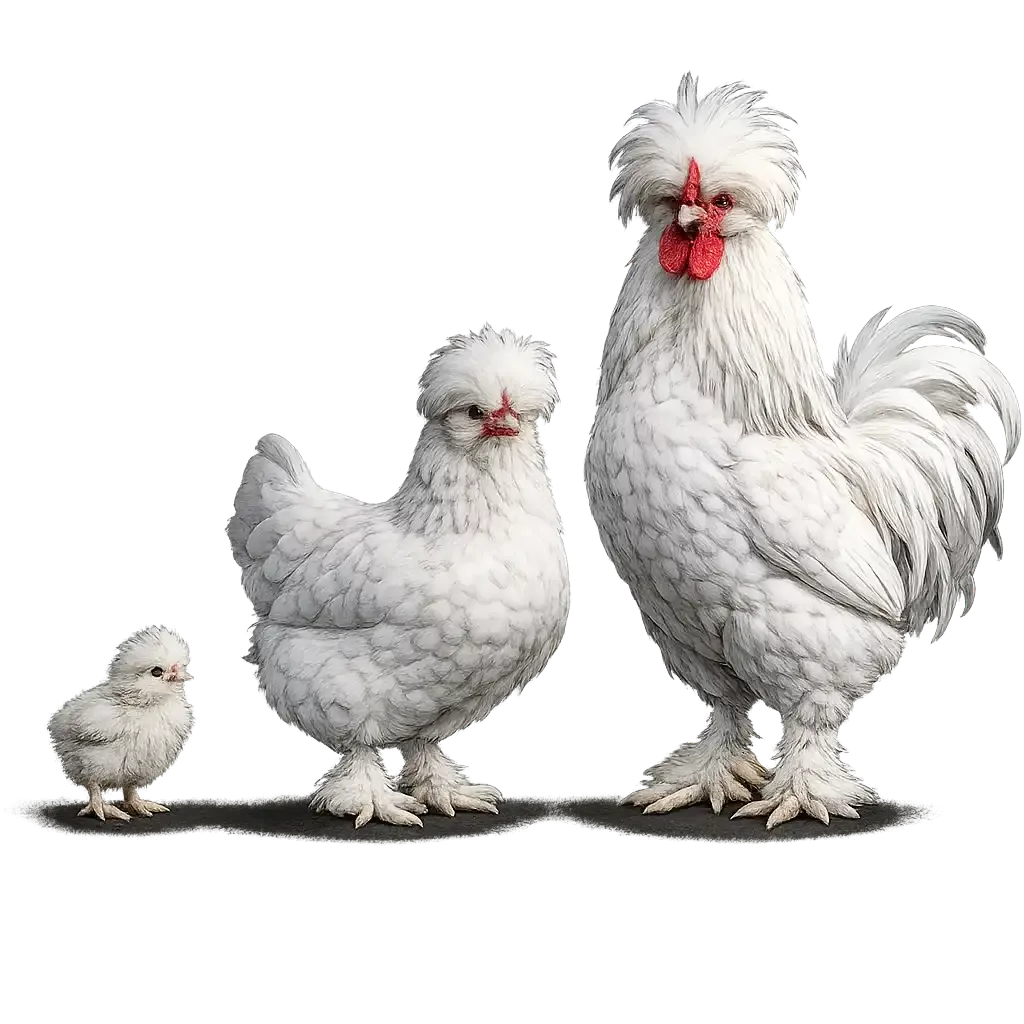
There is no chicken in the world with more decorative features packed onto a single bird than the White Sultan. Count them: a large, globe-shaped white crest that crowns the head like a powder puff, a full beard and muffs framing the face, a V-shaped comb nearly hidden beneath the feathering, long flowing tail feathers, profusely feathered shanks and toes, vulture hocks, low-carried wings that sweep close to the body, and five toes on each foot where almost every other chicken has four. No single one of these features is unique to the Sultan. No other breed combines all of them in one animal. The result is a bird that looks less like a chicken and more like an elaborate living ornament, which is precisely what it was bred to be. The Sultan originated in the Ottoman Empire, where it was known as the Serai Taook, meaning Fowls of the Palace, and was kept in the gardens of the Sultan's court in Constantinople as a living expression of royal wealth and taste. It arrived in England in 1854, reached America in 1867, and was admitted to the American Poultry Association Standard of Perfection in 1874, making it one of the oldest recognized breeds in the North American standard. It is today listed as Critical by the Livestock Conservancy, with a small but devoted community of breeders working to maintain its numbers. For the backyard keeper who wants a gentle, quiet, easily tamed ornamental bird that does minimal damage to gardens and lawns, tolerates confinement contentedly, and generates more visitor reaction per square foot than any other breed in the flock, the White Sultan is in a category entirely its own.
Quick Facts
Class: All Other Standard Breeds (APA)
Weight: Roosters approximately 6 lbs; hens approximately 4 lbs
Egg Production: Approximately 50 to 80 small white eggs per year; cyclical laying pattern
Egg Color: White; occasionally very light tinted
Egg Size: Small to medium
Primary Purpose: Ornamental; exhibition; pet; conservation
Temperament: Extremely docile, calm, and friendly; one of the most people-oriented breeds in the directory; can be bullied by assertive breeds
Brooding: Low; hens rarely go broody and are generally non-setters
Flight Capability: Low; heavy feathering and calm disposition make flight rarely attempted
APA Recognition: 1874; one of the earliest recognized breeds in the North American standard
Country of Origin: Turkey; Ottoman Empire; developed from southeastern European stock
Varieties (APA): White only; Black and Blue exist but are not APA-recognized in North America
Comb Type: V-shaped (horned) comb; nearly hidden under crest feathering; minimal frostbite risk on the comb itself
Distinctive Trait: More unique decorative features combined in one breed than any other chicken: crest, beard, muffs, feathered shanks and toes, vulture hocks, five toes, V-comb
Conservation Status: Critical (Livestock Conservancy)
Lifespan: 5 to 8 years; some individuals reaching beyond 10 years under optimal conditions
Breed Overview
The Sultan's history begins not in a breeding program with a practical goal but in the palace gardens of the Ottoman Empire, where the bird known as the Serai Taook, or Fowls of the Sultan, was maintained as an ornamental luxury by the ruling court in Constantinople. Unlike most breeds in the directory whose development can be traced to a deliberate effort to improve egg production, meat yield, or climate hardiness, the Sultan was selected entirely for visual impact: the most feathering, the most ornamentation, the most dramatic appearance possible on a living bird. The practical traits that homestead and production breeders valued were irrelevant. What mattered was the display.
The first export to the Western world came in 1854, when Elizabeth Watts of Hampstead, England, the editor of the London-based Poultry Chronicle, received a small flock from a friend living in Constantinople. The birds arrived in, as she described it, dreadful condition, dirty, mud-stained, and matted with feathers clinging together from the journey. She was unable to determine their color until months later, after the birds had molted their ruined feathers and replaced them with clean new plumage, revealing the pure white that defines the breed. The first British Sultan flock thus began from these bedraggled survivors of a long sea voyage.
The breed reached North America in 1867 when a woman in New York sent birds to poultry expert and author George O. Brown, who wrote that they were the tamest and most contented birds he had ever owned. He noted that they were fonder of grain and insects than vegetables and that they almost constantly produced the contented soft vocalization that chicken keepers recognize as a sign of a settled, happy flock. His account established the Sultan's reputation for gentle, agreeable temperament that has held consistently through every subsequent generation of keepers.
The APA admitted the Sultan to the Standard of Perfection in 1874, making it one of the first breeds formally recognized under the North American standard. Despite this early recognition, the breed has never achieved widespread popularity, partly because its ornamental focus makes it impractical for production purposes and partly because its management requirements, specifically its vulnerability to wet conditions, feather damage, and bullying by assertive breeds, demand more attentive husbandry than hardier utility breeds.
The breed nearly disappeared between the World Wars, and was revived through careful crosses with Polish chickens, Houdans, and other crested breeds to rebuild numbers and restore genetic diversity. This revival history means that careful bloodline verification remains important for breeders working to maintain correct type, as the outcrossing introduced genetic variation that can produce off-type birds in subsequent generations without careful selection.
Plumage and Appearance
The White Sultan is best understood by working through its distinctive features systematically, because no single description captures the cumulative visual effect of so many ornamental traits combined.
The crest is the most immediately striking feature: a large, rounded, globe-shaped mass of white feathers arising from a pronounced protuberance on the skull, flowing forward and outward in all directions. It is not a flat topknot but a three-dimensional sphere of feathering that frames and partially obscures the face when viewed from the front. The crest can impair the bird's forward and peripheral vision, which has practical management implications. Birds with limited vision from crest overgrowth are more easily startled, less able to spot predators, and more vulnerable to unexpected contact. Regular trimming of feathers around the eyes is a standard management practice for keepers maintaining Sultan welfare.
The beard and muffs are full, covering the lower face and chin and blending into the crest feathering above to create a nearly complete facial covering. The V-shaped comb, composed of two upright points forming a fork shape, is small and sits almost entirely hidden beneath the crest feathering. Wattles are minimal or absent in well-feathered specimens, further adding to the impression of a face composed entirely of white feathers.
The body is compact and moderately rounded, carried with the wings held low and close to the body, nearly covering the shanks when at rest. The tail is long and flowing, carried upright. Leg and foot feathering is profuse, covering the shanks and extending across the toes in dense white feathering. The five toes on each foot, a polydactyly trait shared with Dorkings and Houdans among APA-recognized breeds, are another distinguishing physical characteristic. The vulture hocks, feathering that extends backward and downward from the hock joint, complete the picture of a bird encased in white feathering from crest to toe.
The overall impression in a well-bred White Sultan is of a pure white bird of moderate size that appears far larger and more imposing than its actual weight of four to six pounds because every inch of its surface is covered in flowing white feathers. When a Sultan moves through a garden, the combination of crest, tail, and foot feathering creates an effect that experienced poultry keepers consistently describe as unlike anything else in the chicken world.
Egg Production
The White Sultan's egg production should be understood honestly and without expectation before the breed is chosen for a flock. Annual production of approximately 50 to 80 small white eggs represents the realistic range for well-managed Sultan hens, and some individuals produce less. The eggs are small, white, and of good quality for their size, but the volume is among the lowest of any APA-recognized breed.
The laying pattern is cyclical rather than consistent: Sultan hens typically lay for a period of approximately 8 to 12 days, then stop laying for a period of roughly two weeks before resuming. This on-off pattern continues through the year in non-broody hens and produces the annual total of 50 to 80 eggs through repeated short cycles rather than sustained daily production. Some hens may not begin laying until as late as 10 months of age, significantly later than production breeds that begin at 18 to 20 weeks.
Hens are generally non-setters and rarely go broody, which means natural flock propagation through Sultan hens is unreliable. Most Sultan breeders use incubators to propagate the breed. When Sultan hens do go broody, reports from keepers suggest they can be attentive mothers, but this is individual variation rather than a breed characteristic that can be counted on.
The Sultan's egg production is not the reason anyone keeps the breed and should not factor significantly into the decision to add it to a flock. Keepers who want meaningful egg supply from their birds will be better served by almost any other breed in the directory. The Sultan is kept for its beauty, its temperament, and its conservation value.
Temperament and Behavior
The White Sultan's temperament is its most practically important characteristic for backyard keeping and the quality that has defined its reputation since George O. Brown first described his birds in 1867 as the tamest and most contented he had ever owned. Sultan chickens are genuinely, deeply calm. They do not startle easily under normal conditions, they do not flee from human approach, they vocalize softly and frequently in the contented manner that keepers find pleasant rather than disruptive, and they become tame with minimal handling effort. Roosters show almost no human-directed aggression, a notable contrast to game-heritage breeds and even to some docile dual-purpose breeds whose roosters can become assertive.
The breed is described by virtually every keeper who has maintained them as genuinely enjoyable company: birds that approach voluntarily, accept being handled without resistance, and interact with their keeper in ways that feel engaged rather than merely tolerant. This people-oriented character, combined with the breed's dramatic appearance, makes the Sultan an exceptionally effective breed for introducing children and visitors to chickens, since the bird's response to human presence is calm curiosity rather than alarm.
The Sultan's vulnerability in mixed flocks is the practical counterweight to its exceptional tameness. The same calm, non-assertive character that makes the breed so pleasant to keep also means it is completely unable to defend itself against bullying from more assertive breeds. The crest limits peripheral vision, reducing the Sultan's ability to monitor flock dynamics and anticipate aggression. The profuse feathering on the head and feet creates physical targets that aggressive flockmates will peck at. Sultan chickens kept in mixed flocks with assertive or dominant breeds frequently suffer feather damage, stress, and in extreme cases fatal injury from sustained attack.
The practical management conclusion is clear and consistent across keeper experience: Sultan chickens do best when kept exclusively with other Sultan chickens or with similarly gentle, non-assertive ornamental breeds such as Polish, Silkie, or other crested varieties. Keeping them in a mixed flock with Rhode Island Reds, Wyandottes, or production layers is a management risk that frequently produces poor outcomes for the Sultan birds.
Climate Adaptability
The White Sultan's climate requirements are the most specific and demanding of any breed covered so far in this directory, and understanding them is essential before committing to the breed.
Cold hardiness is limited. The V-shaped comb itself presents minimal frostbite risk given its small size and near-complete concealment under crest feathering. The actual cold vulnerability comes from the breed's profuse feathering rather than from the comb. Wet conditions in cold weather cause the dense feathering on the shanks and toes to mat and freeze, creating a genuine welfare risk. Crest feathering that becomes wet in cold conditions takes extended time to dry and can develop into a matted, chilled mass that affects the bird's ability to see and regulate body temperature. The Sultan requires dry, well-insulated housing during cold weather and should not be exposed to wet, muddy run conditions in winter.
Heat tolerance is reasonable when the bird is kept dry and in shade. Unlike heavy-bodied breeds whose dense feathering creates a direct body heat problem in summer, the Sultan's moderate body weight means the feathering is less of a thermal burden than it might appear. Shade, cool water, and dry run conditions support the breed through summer heat without special intervention beyond standard practice.
The central climate management principle for the Sultan is dryness. Wet conditions at any temperature create problems: wet crest feathering limits vision and chills the bird, wet foot feathering mats and compacts causing discomfort and potential injury, and wet litter produces the mud that rapidly ruins the Sultan's extensive ground-contact feathering. Covered runs, dry litter, and careful drainage management are not optional considerations for Sultan keepers but essential requirements for maintaining the breed's health and appearance.
Housing and Management
The Sultan's housing requirements are more specific than most backyard breeds and center on three priorities: dryness, gentle flockmates, and vision management.
Indoor space follows standard guidelines at four square feet per bird. The outdoor run must be covered or otherwise protected from rain and mud accumulation. Wood chips or similar free-draining litter materials that do not compact into mud under foot traffic are the standard substrate recommendation. Many Sultan breeders maintain their birds in covered runs year-round and bring birds into clean indoor spaces during periods of wet weather, treating the Sultan's feathering with the same attention a show dog breeder might bring to maintaining a long-coated show dog in good condition.
Roost bar placement should account for the Sultan's relatively low flight capability and its foot feathering. Roost bars at a modest height, two feet or so, reduce the risk of foot feather damage from repeated jumping down to the floor while still providing the elevated roosting position that chickens prefer for security and comfort.
Crest management is a routine care requirement that surprises some first-time Sultan keepers. The crest feathers grow toward the eyes and can obstruct vision progressively over time. Trimming the feathers around the eyes using small scissors or tying the crest feathers back temporarily using a small band are both practiced by Sultan keepers to maintain clear sightlines without sacrificing the crest's visual impact. The frequency of trimming needed depends on the individual bird's crest growth rate and feather direction but is typically a management task that needs attention several times per year.
Foot feather management similarly requires periodic inspection. Feathers on the toes and shanks can accumulate mud, manure, or bedding material that if left unaddressed dries into hard masses that restrict the bird's movement and cause discomfort. Regular inspection and gentle cleaning of the foot feathering, combined with the dry run management that prevents accumulation in the first place, keeps this under control without becoming a burdensome routine.
Sourcing Considerations
The White Sultan's Critical conservation status means that sourcing quality birds requires deliberate research. Mainstream hatcheries occasionally carry Sultan chicks but their stock frequently lacks the correct combination of breed characteristics, particularly the full complement of five toes, proper V-comb, correct crest shape, and profuse foot feathering that define the breed. For keepers interested in maintaining correct breed type or in contributing to Sultan conservation, sourcing from breeders active in the Sultan community and familiar with the outcross history of the breed's revival produces better starting stock.
The Livestock Conservancy breeders directory and the American Poultry Association breeder referral network are the primary sourcing resources in North America. The breed's small population means that breeders with quality stock may have limited availability and waiting periods, and geographic flexibility in sourcing is often necessary.
The Sultan's outcross history with Polish, Houdan, and other crested breeds during the post-war revival means that careful evaluation of birds against the APA standard before purchasing is important. Off-type birds lacking five toes, with incorrect comb type, or with inadequate foot feathering may be descendants of crosses that have not been fully selected back to correct Sultan type across subsequent generations.
Pros and Cons
Pros
Extraordinary visual presence; more unique decorative features combined in one breed than any other chicken in the world
Exceptional temperament; among the calmest, most people-oriented, and easiest to tame breeds available
Does minimal damage to garden grass and plantings; historically noted for this quality since the breed's first importation to England
Tolerates confinement contentedly; well-suited to small covered runs and urban garden settings
Quiet vocalization; soft, frequent contented sounds rather than alarming calls; rooster crowing is generally described as quieter than most breeds
V-shaped comb presents minimal frostbite risk
APA recognition since 1874; one of the oldest recognized breeds in the North American standard
Conservation breeding: keeping White Sultans actively supports a Critical breed
Excellent breed for introducing children and visitors to chickens
Cons
Critical conservation status; quality stock is difficult to source
Egg production of 50 to 80 small white eggs per year is among the lowest of any recognized breed
Requires dry run conditions and covered housing; wet and muddy conditions rapidly damage feathering and cause health problems
Extremely vulnerable to bullying; cannot be safely kept with assertive or dominant breeds
Crest feathering reduces peripheral vision; regular trimming or tying back required for bird welfare
Foot feathering requires regular inspection and cleaning to prevent matted accumulation
Cold hardiness limited; wet cold conditions create genuine welfare risk
Poor predator evasion; vision limitation and non-reactive temperament make the breed highly vulnerable in free-range situations
Not suitable for open free-ranging; requires protected run environments
Profitability
The White Sultan's profitability is built entirely on ornamental and conservation value rather than production utility. Exhibition quality birds from verified bloodlines with correct breed type command premium prices through specialty poultry networks and show connections. Hatching eggs and chicks from verified Sultan flocks have a consistent market among conservation breeders and ornamental poultry enthusiasts, supported by the breed's Critical status and the small supply of quality birds relative to ongoing interest.
The Sultan's remarkable appearance and exceptional tameness also create a secondary market opportunity that most other breeds do not share: as a pet chicken. Urban and suburban keepers who want a chicken primarily as a companion animal rather than for production purposes find the Sultan's people-oriented temperament and garden-friendly behavior hard to match. This pet market is distinct from the exhibition market and represents a genuine revenue stream for breeders willing to market to it alongside the traditional poultry community.
The breed's conservation status means that breeders maintaining correct-type verified flocks are in a strong position within their niche. The Sultan is rare enough that supply reliably falls short of demand from serious buyers, which supports price stability for quality stock from established breeders.
Comparison With Related Breeds
Polish Chicken: The closest genetic relative in the modern Sultan breed, having been used as an outcross during the post-war revival. Polish chickens share the crest feature and similar management requirements around vision and wet-weather crest protection, but lack the Sultan's beard, muffs, feathered shanks and toes, vulture hocks, and five-toed polydactyly. The Polish is more widely available and somewhat hardier than the Sultan. Both require protected keeping away from assertive breeds.
Silkie: Another extremely docile, ornamental breed frequently recommended as a Sultan companion. The Silkie shares the Sultan's gentle temperament, suitability for protected confinement, and incompatibility with assertive flockmates. The Silkie's fur-like feathering and black skin are visually quite different from the Sultan's white plumage and conventional feather structure. Both are excellent pet chickens; the Silkie is more widely available and somewhat easier to manage.
Houdan: A French breed that was also used as an outcross in Sultan revival breeding. The Houdan has a crest and five toes, sharing those features with the Sultan, but is a larger, heavier bird with a mottled black and white pattern and a butterfly-shaped comb. The Houdan is a more productive layer and a better dual-purpose bird than the Sultan, making it a practical alternative for keepers who want ornamental character alongside more useful production.
Appenzeller Spitzhauben: A Swiss crested breed with a distinctive forward-pointing crest and a hardier, more active temperament than the Sultan. The Spitzhauben is a better layer, more cold-hardy, and more capable of foraging and free-ranging than the Sultan, but requires more space and is not suitable for tight confinement. For keepers who want an ornamental crested breed that is more practically hardy than the Sultan, the Spitzhauben is a useful comparison.
Final Verdict
The White Sultan is not a chicken for everyone, and it is honest about this from the moment you first encounter one. It does not lay well, it cannot defend itself, it cannot see clearly without regular crest management, and it requires dry housing conditions that most backyard setups need to be specifically designed to provide. All of these limitations are real and worth knowing before committing to the breed.
What the Sultan offers in return is equally real. No other chicken generates the same reaction from visitors. No other breed is as consistently gentle, as easy to handle, or as genuinely people-oriented from such an early age. No other backyard bird does less damage to a garden while still being a chicken. And no other breed carries the specific combination of palace history, Ottoman royal association, near-extinction survival, and elaborate living beauty that makes the Sultan genuinely unlike anything else in the poultry world.
For the backyard keeper who understands the management requirements, provides appropriate housing, keeps the Sultan with compatible gentle companions, and values beauty and temperament over production, the White Sultan is one of the most rewarding breeds in the directory. The backyard chickens category is better for including it.
Frequently Asked Questions
How many eggs does a White Sultan lay per year? Approximately 50 to 80 small white eggs per year under good management, produced in a cyclical pattern of roughly 8 to 12 days of laying followed by approximately two weeks off before resuming. Some hens may not begin laying until 10 months of age. The Sultan is not a laying breed and should not be chosen by keepers for whom egg supply is a priority.
Are White Sultans good with children? Yes, exceptionally so. The breed is among the calmest and most tolerant of any chicken with children, approaching voluntarily, accepting handling without alarm, and showing almost no defensive or aggressive behavior. The crest does limit the bird's peripheral vision, which means approached from a direction the bird cannot see may cause a startled response, but gentle front-approach contact is usually accepted without difficulty.
Can White Sultans be kept in a mixed flock? Only with similarly gentle, non-assertive breeds. Keeping Sultans with dominant production breeds, game-heritage birds, or any assertive flock member typically results in feather damage, stress, and potential serious injury to the Sultan birds. Suitable companion breeds include Polish, Silkie, and similarly ornamental crested or gentle varieties. The Sultan's limited vision from crest feathering makes it especially vulnerable because it cannot monitor flock dynamics effectively enough to avoid bullying situations.
Why does the White Sultan have five toes? Five toes, technically called polydactyly, is a genetic trait that the Sultan shares with a small number of other breeds including the Dorking, Houdan, and Faverolle. In the Sultan it is a breed standard requirement and a disqualifying fault in exhibition birds that present with only four toes. The fifth toe is an extra toe arising above and behind the normal rear toe, pointing upward rather than downward.
How do I manage the Sultan's crest feathering? The crest grows progressively toward the eyes and can eventually obstruct the bird's forward and peripheral vision to a degree that affects welfare and safety. Most keepers manage this by trimming the feathers around the eyes with small scissors several times per year, removing enough to restore a clear sightline without significantly reducing the visual impact of the crest. Some breeders temporarily tie back the crest feathers using a small soft band during feeding and ranging, releasing them afterward. Neither approach harms the bird and both are established practices among Sultan keepers.
How cold hardy is the White Sultan? Limited cold hardiness. The V-shaped comb presents minimal frostbite risk due to its small size and concealment under feathering. The real vulnerability is the extensive feathering on shanks, toes, and crest, which becomes dangerously matted and chilled in wet cold conditions. Dry, well-insulated housing with covered run access is required for Sultan welfare in cold climates. The breed should not be exposed to wet mud or standing water, particularly in cold weather.
Where can I find White Sultan chickens? The Livestock Conservancy breeders directory and the American Poultry Association breeder referral network are the primary North American sourcing resources. The breed's Critical conservation status means that quality stock from breeders maintaining correct breed type is limited and may involve waiting lists. Mainstream hatcheries occasionally offer Sultan chicks but their stock may not represent correct breed type for exhibition or conservation purposes. Poultry exhibitions are good venues for meeting Sultan breeders directly.
Related Breeds
Polish Chicken
Silkie Chicken
Houdan
Mottled Houdan
Appenzeller Spitzhauben
Crevecoeur