
Black Scoter
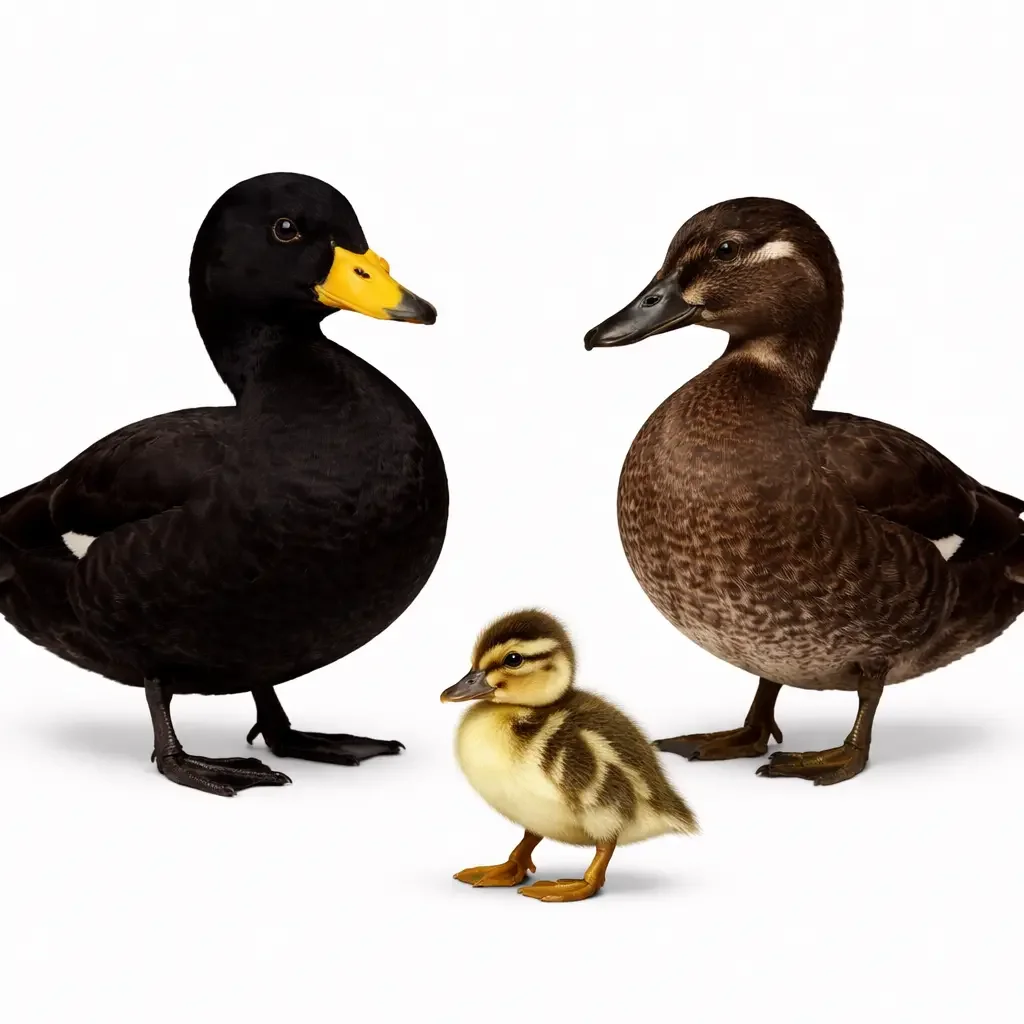
The Black Scoter is the smallest, least common, and most vocally distinctive of North America's three scoter species. A stark, all-black sea duck with a pumpkin-orange knob at the base of its bill, the drake is one of the more immediately identifiable ducks on the continent at any range. It is also one of the most vocal waterfowl in North America, and flocks of wintering birds are often heard before they are seen, the males producing a wistful, descending whistle that carries across open coastal water. Listed as Near Threatened by the IUCN, it is the only one of the three scoters carrying an elevated conservation status, and it completes the scoter trio in this wild duck series alongside the White-winged and Surf Scoters.
Quick Facts
Scientific Name: Melanitta americana
Class: Aves
Order: Anseriformes
Family: Anatidae
Average Weight: Males about 2.4 pounds; females about 2.2 pounds
Average Length: 17 to 19 inches
Wingspan: About 28 inches
Conservation Status: Near Threatened (IUCN); Yellow Alert Tipping Point species (2025 State of the Birds); global breeding population estimated at 900,000
Primary Range: Breeds in tundra and boreal zones of Alaska and eastern Canada; winters on Pacific and Atlantic coasts
Midwest Relevance: Great Lakes and inland lake migrant; less consistently present than the other two scoters
Taxonomy Note: Split from the Common Scoter of Eurasia as a full species in 2009 based on differences in courtship calls and bill morphology
Image Section
Feature image: Drake Black Scoter on open water, showing all-black plumage and bright orange-yellow bill knobSecondary image: Female Black Scoter showing dark brown cap and contrasting pale cheekThird image: Flock of Black Scoters in flight along coastline
Species Overview
The Black Scoter carries the simplest plumage of the three North American scoters and, in the drake, one of the most striking. The male is entirely velvety black with no white markings anywhere on the body, head, or wings. The sole color accent is the bill: a large, rounded orange-yellow knob at the base of an otherwise dark bill that is bright enough to identify the species at considerable distance. This bill knob is a reliable and distinctive field mark that separates the Black Scoter from all other North American ducks with no additional features needed.
Females are rich dark brown overall with a strongly contrasting face pattern: a dark blackish-brown cap extending from the forehead down through the eye, sharply separated from pale buffy-white cheeks and throat below. This high-contrast face pattern is the most reliable field mark for hens and distinguishes them from female Surf and White-winged Scoters in mixed flocks. Females carry a tiny smudge of yellow near the base of the upper bill that mirrors the more dramatic male bill pattern.
The genus name Melanitta translates from Greek as black duck, an accurate if spare description. The species was formally separated from the Common Scoter of Eurasia in 2009 based on research demonstrating consistent differences in male courtship calls and bill morphology between the two forms. The two were previously treated as a single species for most of the twentieth century.
The Black Scoter has two disjunct breeding populations in North America. The eastern population breeds across northern Quebec and Labrador west to Hudson Bay. The western population breeds on coastal tundra in western Alaska. The two populations winter separately, with eastern birds concentrated on the Atlantic Coast and western birds on the Pacific Coast.
Hunting
Season and Timing
Black Scoters are legal game birds managed under the same sea duck hunting framework as Surf and White-winged Scoters. U.S. harvest data for the three scoter species are not reported separately, but the Black Scoter is consistently the least harvested of the three, with historical estimates indicating roughly 10,000 to 11,000 birds taken annually in the U.S., compared to higher totals for the Surf and White-winged Scoters. Atlantic Flyway harvest accounts for approximately 80 percent of total U.S. take.
For Midwest hunters, the Black Scoter is the least reliably encountered of the three scoters. All three species transit the Great Lakes during fall migration, but the Black Scoter appears in smaller numbers and is less consistently present through the winter than the White-winged Scoter in particular. Inland sightings across the broader Midwest occur during migration, typically after storm events that push overland migrants off their coastal routes, and birds do not normally linger on freshwater bodies where their preferred shellfish food is unavailable.
Sea duck season dates and bag limits vary by state and are distinct from standard duck season regulations. Confirming current rules with your state wildlife agency before hunting is essential.
Where to Hunt
On the Great Lakes, Black Scoters use open water over sandy and gravelly substrate in areas with accessible invertebrate prey. They show somewhat less affinity for the zebra mussel beds that have drawn increasing White-winged Scoter numbers to the Great Lakes, and they appear in smaller concentrations than the other two scoter species across most Great Lakes settings.
On the Atlantic Coast, the primary hunting grounds are open sandy bays and nearshore ocean areas where mussels and other bivalves concentrate. Tens of thousands of Black Scoters migrate past prominent Atlantic headlands during late fall, creating concentrated hunting opportunities for dedicated sea duck hunters in New England and the Mid-Atlantic. This coastal hunting culture is not accessible to most Midwest hunters, but it represents the primary context in which Black Scoters are actively pursued as a target species.
Difficulty
Black Scoters are not particularly wary of decoys and share the general approachability of the scoter group in hunting situations. The primary challenges are locating birds in meaningful numbers on the Great Lakes and managing the open-water conditions that accompany sea duck hunting. For incidental encounters on inland lakes during storm-driven migration, the species tends to be resting and relatively easy to approach compared to pressured dabbling ducks.
Decoys and Calling
Large dark decoy spreads work for Black Scoters as they do for the other scoter species. Unlike the White-winged and Surf Scoters, the Black Scoter is a notably vocal bird, and this vocal character can be used to an advantage. Drakes produce a clear, descending whistle that is distinct from any other North American duck call. A drake Black Scoter call, combined with a dark decoy spread, provides both visual and audio attraction that is particularly effective when birds are within hearing range.
Meat Quality
Black Scoter meat shares the strong-flavored, marine character of the other two scoter species, driven by a winter diet consisting almost entirely of mussels, clams, and other bivalves. The same preparation principles apply: prompt field care, skinning, fat removal, brining, and robust cooking methods suited to strongly flavored meat.
Freshwater birds encountered on the Great Lakes or inland lakes during migration may carry a somewhat milder flavor than coastal birds feeding on salt-water shellfish, though the difference is not dramatic given the short time most birds spend in freshwater settings.
Best Preparations
Braising, stewing, and grinding for sausage are the most reliable approaches. Slow braises with wine, aromatics, and acidic components produce the best results. Black Scoter chili and heavily seasoned preparations work well. Light, quick cooking methods suited to dabbling ducks are not appropriate for this species.
Behavior and Identification
The Black Scoter is the most vocal of the three North American scoters and among the most vocal of all waterfowl. Drake courtship calls are a clear, wistful, descending whistle that carries across open water and can help locate flocks before they come into visual range. This vocal character is distinctive and useful both for identification and for hunting. The call is evocative of open coastal habitat and is frequently described as one of the more memorable sounds in North American waterfowl.
The Black Scoter performs a distinctive display behavior that separates it behaviorally from the other two scoters. When executing the wing-flap display on the water, the bird holds its body up out of the water while flapping and ends the display with a sharp downward thrust of the head, a motion that appears abrupt and mechanical compared to the smoother displays of the other scoter species.
Foraging is by deep diving, with the feet providing primary propulsion and the wings partially opened for maneuvering underwater. In summer on freshwater breeding lakes, the diet shifts to aquatic insects, caddisflies, fish eggs, and plant material. In winter on coastal waters, mussels and other bivalves dominate. Birds swallow shellfish whole and crush them in a muscular gizzard that contains accumulated sand and grit to aid in shell processing.
Overland migration occurs at high altitude and across a broad front, which is part of why storm events push Black Scoters inland to lakes and reservoirs well away from coastal routes. These inland birds are typically resting rather than feeding and depart once weather allows them to continue migration. They do not normally linger on freshwater bodies for more than a few days.
Climate and Range
The Black Scoter has two separate breeding populations in North America. The western population breeds on coastal and near-coastal tundra in western Alaska and a small portion of the Bering Sea coastal region. The eastern population breeds across the tundra and boreal-tundra transition zone of northern Quebec, Labrador, and the areas surrounding Hudson Bay. The two populations are believed to winter separately, with Pacific and Atlantic coast concentrations corresponding to western and eastern breeding birds respectively.
Fall migration is among the later movements in North American waterfowl, with significant coastal movements occurring from October through December. Tens of thousands of birds may pass prominent Atlantic headlands during peak fall migration, providing dramatic spectacle for observers along the New England and Mid-Atlantic coast.
The species is listed as Near Threatened by the IUCN, a more elevated status than either the Surf or White-winged Scoter, which are both classified as Least Concern. The 2025 State of the Birds report designates it a Yellow Alert Tipping Point species, meaning it has lost more than 50 percent of its population over the past 50 years. Recent trends are relatively stable, but the historical decline places the species in a category requiring monitoring and conservation attention. Causes of the long-term decline are not well understood. Habitat degradation on both breeding and wintering areas, environmental contaminants, oil spills, and potential impacts from oil and gas development in nesting areas are recognized concerns. Basic breeding biology remains poorly documented, which limits the ability to identify specific drivers of population change.
Homestead Suitability and Pond Management
Black Scoters cannot be legally kept without federal permits. They are protected under the Migratory Bird Treaty Act.
For Midwest homesteaders, the Black Scoter has no practical habitat management relevance. It is a coastal and open-water species that does not respond to managed pond or wetland habitat on private land. Great Lakes and large inland lake properties may observe Black Scoters during migration, and reporting sightings to eBird contributes to understanding the species' inland distribution during fall and spring passage.
Pros and Cons
Pros
The most immediately distinctive of the three scoters: all-black body with bright orange bill knob identifies the drake at any range
The most vocal North American scoter, producing a memorable and identifiable call that sets it apart from all other ducks
Near Threatened status gives conservation-minded hunters an added incentive to understand and document the species
Splits from the Common Scoter in 2009 give it an interesting recent taxonomic history
Completes the three-scoter set in the series alongside Surf and White-winged Scoters
Cons
Near Threatened conservation status; has lost more than 50 percent of population over 50 years
The least common of the three North American scoters with the lowest U.S. harvest totals
Least consistent Great Lakes presence of the three scoters
Strongly flavored meat requiring specific preparation techniques
Breeding biology remains exceptionally poorly studied despite the species' relatively widespread range
Profitability Note
Wild Black Scoters cannot be commercially harvested or sold. All value is recreational and ecological. The species has no meaningful hunting lease or harvest value for Midwest landowners. Sea duck hunting opportunities on the Great Lakes do not reliably center on Black Scoters given their lower abundance in that system compared to White-winged Scoters.
Comparison With Related Species
White-winged Scoter: The White-winged Scoter is the largest of the three North American scoters and the most commonly encountered on the Great Lakes. The drake White-winged Scoter carries a small white eye mark and a bold white wing patch absent from the Black Scoter. The Black Scoter drake is entirely featureless black except for the bill knob. On conservation status the two differ: White-winged Scoter is Least Concern while Black Scoter is Near Threatened. See the White-winged Scoter guide for a full comparison.
Surf Scoter: The Surf Scoter is intermediate in size between the Black and White-winged Scoters. The drake carries bold white patches on the forehead and nape on an otherwise black body, easily separating it from the unmarked Black Scoter. The Surf Scoter is more common than the Black Scoter across most of the continent and is the source of the skunkhead nickname, while the Black Scoter is the source of the most vocal calls in the scoter group. See the Surf Scoter guide for a full comparison.
Common Scoter: The Common Scoter of Eurasia was considered the same species as the Black Scoter until 2009. The two are externally very similar, with the most reliable separation based on bill knob shape and coloration and differences in male courtship calls. The Common Scoter is a very rare vagrant to North America and is unlikely to be encountered by Midwest hunters or observers.
Long-tailed Duck: The Long-tailed Duck shares Great Lakes and coastal wintering habitat with Black Scoters and is another sea duck managed under similar regulations. It is smaller, more buoyant, and far more seasonally variable in plumage, with three distinct plumage phases per year. See the Long-tailed Duck guide for a full comparison.
Final Verdict
The Black Scoter is the quiet member of the North American scoter trio in terms of range concentration and hunting pressure, but it is anything but quiet in the field. Its drake's whistling call is one of the most evocative sounds in coastal waterfowling, and the bird's clean, minimalist plumage makes the orange bill knob stand out with unusual clarity. Its Near Threatened status separates it from the other two scoters and gives it a conservation dimension worth understanding. For Midwest hunters, it is the rarest of the three scoters to encounter, but when it appears on a storm-tossed inland lake during October migration, it is unmistakable and memorable.
Frequently Asked Questions
How do I identify a Black Scoter? The drake is the simplest identification in North American scoters: entirely black body with no white markings and a bright pumpkin-orange knob at the base of the bill. No other common North American duck matches this combination. Hens are dark brown with a dark cap sharply contrasting against pale buffy cheeks, a pattern different from the more muted facial markings of female Surf and White-winged Scoters.
Is the Black Scoter endangered? It is listed as Near Threatened by the IUCN and is designated a Yellow Alert Tipping Point species in the 2025 State of the Birds report, indicating it has lost more than 50 percent of its population over 50 years. It is not currently listed as endangered under the U.S. Endangered Species Act, and hunting seasons remain open under managed bag limits.
Are Black Scoters common on the Great Lakes? They occur on the Great Lakes during fall migration but are the least consistently present of the three scoters in that system. White-winged Scoters are more reliably encountered on the Great Lakes in significant numbers.
What does the Black Scoter sound like? The drake produces a clear, wistful, descending whistle unlike any other North American scoter or dabbling duck. Flocks can often be located by this call before the birds come into visual range. It is among the more distinctive and memorable sounds in North American waterfowling.
When was the Black Scoter recognized as a separate species from the Common Scoter? In 2009, based on a study documenting consistent differences in male courtship calls and bill knob morphology between the North American Black Scoter and the Eurasian Common Scoter. The two had been treated as a single species through most of the twentieth century.