
Foxglove
Quick Overview
Common Name: Foxglove, Common Foxglove, Digitalis
Scientific Name: Digitalis purpurea, Digitalis x mertonensis
Plant Type: Biennial, short-lived perennial in some species
USDA Zones: 4 to 9
Sun Requirement: Full Sun to Partial Shade
Soil Type: Well-drained, moderately fertile, humus-rich
Bloom Season: Late Spring through Early Summer
Height: 36 to 72 inches depending on variety
Pollinator Friendly: Yes
Edible: No, extremely toxic if ingested
Why Grow Foxglove on a Homestead
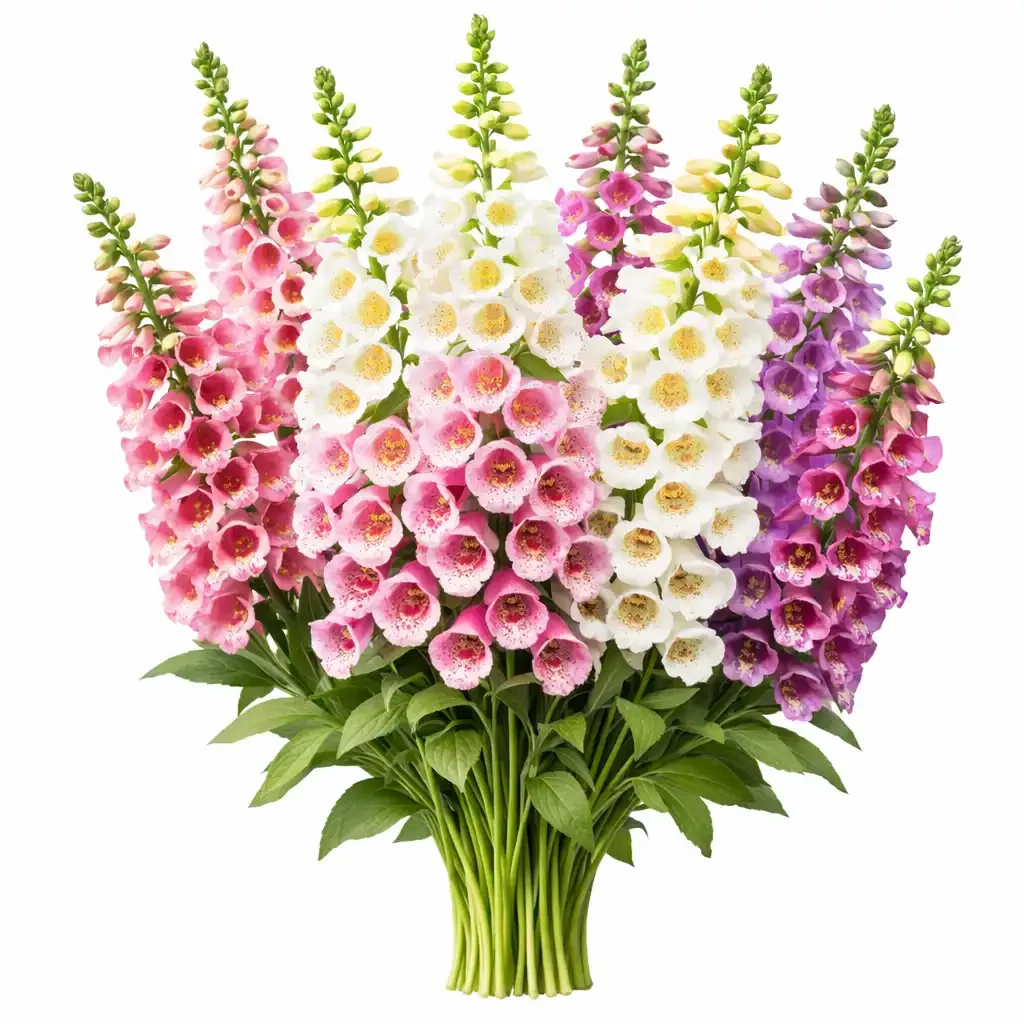
Foxglove is one of the most dramatically beautiful and commercially exciting cut flowers available to homestead growers. Its tall, majestic spikes densely packed with pendant, tubular bells in shades of purple, lavender, pink, cream, white, apricot, and soft yellow, each inner bell delicately spotted with contrasting markings, create a quality of wild, romantic beauty that is genuinely unlike any other late spring cut flower. In the professional floral industry Foxglove is considered one of the most sought-after and distinctive vertical accent flowers available for the late spring and early summer season, providing the kind of tall, dramatic, loosely natural structure that has come to define the most celebrated contemporary garden-style and romantic floral design.
For homestead growers, Foxglove represents one of the most commercially exciting biennial cut flower opportunities available. As a biennial it requires planning and a two-year commitment to establishing productive self-seeding populations, but once that population is established it effectively becomes a self-renewing permanent resource in the garden that returns each year from self-sown seed with minimal additional investment. The tall spikes it produces are genuinely irreplaceable in the cut flower market, providing a vertical drama and romantic wildness that customers and florists actively seek and that is virtually impossible to replicate with any other commonly grown spring or early summer cut flower.
Here is why Foxglove deserves a prominent spot on your homestead:
It provides tall, dramatic, genuinely irreplaceable vertical spikes in the late spring market. Foxglove spikes reaching 48 to 72 inches are the tallest and most dramatically vertical cut flower stems available in the late spring and early summer market. This extraordinary height and the loosely natural, pendant quality of the bell flowers create a visual impact that commands attention and premium pricing.
It is the defining flower of the contemporary romantic and garden-style floral aesthetic. The wild, romantic quality of Foxglove spikes has made them the signature flower of the garden-style and romantic floral design movements that have dominated the wedding and event market for the past decade. Wedding florists working in these styles consistently seek out and pay premium prices for quality Foxglove stems.
Self-seeding creates a self-renewing productive resource. Once established, a well-managed Foxglove planting self-seeds prolifically, returning year after year from self-sown seed and effectively becoming a permanent cut flower resource with minimal ongoing seed investment.
It thrives in partial shade where many other cut flower crops struggle. Foxglove tolerates and even performs well in partial shade, making it an excellent choice for the shaded areas of homesteads that are difficult to use productively for sun-demanding crops.
The rarity of locally grown Foxglove as a cut flower creates a premium market position. Despite its extraordinary commercial value, Foxglove remains significantly underutilized as a dedicated cut flower crop by most homestead operations, creating an essentially uncontested local market position for growers who develop productive plantings.
Growing Conditions
Sunlight
Foxglove performs well in full sun to partial shade. It is more shade tolerant than most cut flower crops and produces good stems with as little as three to four hours of direct sunlight per day. In full sun with adequate moisture it produces the tallest, strongest stems with the most abundant and well-developed flower spikes. In partial shade stems are somewhat taller and more elegant, which can actually be an advantage for cut flower use as longer stems command higher prices. In hot climates, afternoon shade helps prevent heat stress that causes premature bolting and reduced bloom quality. The shade tolerance of Foxglove makes it an excellent choice for growing under deciduous trees or in partially shaded areas of the homestead that are difficult to use for more sun-demanding crops.
Soil
Foxglove prefers well-drained, moderately fertile, humus-rich soil. It performs best in soil that has been amended with compost or leaf mold to create a rich, moisture-retentive but well-drained growing medium. Good drainage is important as Foxglove does not tolerate waterlogged conditions. Unlike many cut flower crops that perform better in lean conditions, Foxglove actually benefits from moderately fertile soil that supports the vigorous growth necessary to produce the tall, strong spikes most valuable for cut flower production. Soil pH between 5.5 and 7.0 is suitable.
Water
Water consistently during the establishment phase and throughout the active growing and blooming season. Foxglove needs regular moisture during its growth phase and the moisture stress that causes most damage occurs during the spike development phase when the plant is producing the tall stem and filling out the bells along the spike. Drought stress during this critical period causes shortened spikes with fewer and smaller bells that are less commercially valuable. Water deeply and consistently, particularly during dry periods in late spring, to maintain the moisture levels that produce the most impressive spikes for market.
Temperature
Foxglove is a cool season biennial that performs best in moderate temperatures. It tolerates frost and actually requires a period of winter cold to develop the flower spikes in its second year, as the cold triggers the transition from vegetative rosette to flowering plant. It blooms best in the cool conditions of late spring and early summer before summer heat arrives. In very hot summer climates the blooming period is shorter and the quality of late-season spikes can decline as heat intensifies. In mild winter climates within USDA zones 8 to 9 some varieties can be grown as winter-sown annuals that bloom in spring without a full year of establishment, but the most reliable and impressive spikes come from plants that have experienced a full winter cold period.
Planting Guide
Foxglove is a biennial that germinates and produces vegetative rosettes in its first year, overwinters as a basal rosette, and produces flowering spikes in its second year. Managing the biennial cycle correctly is the key to establishing and maintaining a continuously productive Foxglove planting.
Step 1: Sow seeds outdoors in late spring to early summer, typically May through July, for flowering spikes the following year. This gives plants a full growing season to develop strong rosettes before their flowering winter and spring.
Step 2: Choose a location with full sun to partial shade and well-drained, moderately fertile soil. Foxglove is excellent for growing under deciduous trees, in partially shaded borders, and in any location that provides good light without extreme afternoon heat.
Step 3: Prepare a fine seedbed. Foxglove seeds are very small and need good soil contact to germinate. Sow seeds on the surface or cover with only the thinnest possible dusting of fine soil or vermiculite. Press seeds gently into the soil surface.
Step 4: Water gently with a fine mist after sowing and keep the soil surface lightly moist until germination, which typically occurs within 14 to 21 days in warm soil.
Step 5: Thin seedlings to 12 to 18 inches apart once they are large enough to handle. Proper spacing is important for developing strong, well-branched plants that produce the largest, most impressive flowering spikes.
Step 6: Allow a proportion of plants each season to self-seed naturally to maintain a continuous self-renewing planting. Once a Foxglove planting is established and self-seeding reliably, only minimal additional seed investment is needed to maintain productive populations indefinitely.
Seed vs Transplant: Direct sowing is the most practical and economical approach for large plantings. Nursery transplants work well for establishing small initial plantings quickly but direct sowing is more economical at production scale.
Spacing: 12 to 18 inches apart for cut flower production.
Planting Season: Late spring through early summer for blooms the following year. Some varieties can be sown in late summer for blooming the following spring in mild climates.
Maintenance
Managing the Biennial Cycle
Maintaining a continuous productive planting requires managing both first-year and second-year plants simultaneously. In the first year of establishing a Foxglove planting all plants are in their vegetative rosette stage and no commercial harvest is possible. From the second year onward, maintaining a self-seeding population that includes both year classes ensures a continuous annual harvest from year two forward.
Allow a designated proportion of plants to set seed and self-sow each season. Foxglove self-seeds prolifically and even a small proportion of plants allowed to complete their natural life cycle will provide abundant volunteer seedlings the following season. Thin volunteer seedlings to appropriate spacing as they emerge each year.
Some annual Foxglove varieties have been developed that bloom in their first year from early indoor sowing, which eliminates the two-year establishment wait and may be worth considering for impatient growers beginning their first season.
Staking
Tall Foxglove varieties, particularly those reaching 48 to 72 inches, may need light staking in exposed locations. Install bamboo stakes or horizontal support netting early in the season before stems reach their full height. The tall, top-heavy spikes are vulnerable to wind and rain damage without support, particularly just before and during the blooming period.
Fertilizing
Apply a balanced fertilizer or compost top dressing in early spring as second-year plants begin their vigorous growth phase. This supports the strong, rapid growth needed to produce the impressive spikes most valuable for cut flower production. Avoid excessive nitrogen which can promote lush foliage at the expense of the tall, strong spike development that creates commercial value.
Safety
Foxglove contains cardiac glycosides throughout all parts of the plant that are toxic to humans and animals if ingested. Always wear gloves when handling Foxglove plants and wash hands thoroughly after working with them. Clearly communicate the toxic nature of Foxglove to customers and display appropriate information at market stands. Never sell or market Foxglove in contexts where it could be mistaken for an edible plant.
Harvesting
When to Harvest
Harvest Foxglove spikes when the lowest three to five florets on the spike are open and the remaining florets above are still in bud, with the very tip of the spike still showing tightly closed buds. At this stage the spike continues to open progressively from the bottom upward after cutting, giving the stem a long and evolving display in the vase. Spikes harvested when too few florets are open may not develop fully after cutting. Spikes harvested when most florets are already open have a shorter remaining vase life. Harvest in the early morning when stems are fully hydrated and temperatures are cool. Use gloves when harvesting as all parts of the plant are toxic.
How to Cut
Use clean, sharp scissors or pruners and wear gloves. Cut spikes as long as possible at the base of the stem. For most varieties this produces stems of 24 to 48 inches or more depending on the height of the variety. Remove any foliage that would be below the waterline. Place cut stems immediately into a bucket of cool water. Wash hands and tools thoroughly after harvesting.
Conditioning
After cutting, place stems in deep cool water in a cool, dark location for several hours or overnight before sale or arrangement. Foxglove conditions readily and the remaining buds continue to open progressively during the conditioning period, providing a continuously developing display throughout the vase life.
How Often to Harvest
During the Foxglove blooming period in late spring through early summer, harvest every two to three days as new spikes reach the correct stage. After the main central spike is harvested, many varieties produce lateral shoots that develop secondary flowering spikes of somewhat smaller size but still excellent commercial quality. These secondary spikes can extend the harvest window by two to four weeks beyond the main central spike harvest.
Vase Life
Foxglove typically lasts 7 to 10 days as a fresh cut flower with proper conditioning and care. Strip all foliage below the waterline, recut stems at an angle, and place in fresh water with a floral preservative. Change water every two to three days and recut stems to maximize longevity. Keep arrangements in the coolest available location as Foxglove performs significantly better in cool conditions.
Uses on a Homestead
Cut Flower Use
Foxglove is primarily grown as a dramatic vertical accent flower in mixed late spring and early summer bouquets and arrangements. Its tall, loosely natural spikes of pendant bells create a wild, romantic quality that is genuinely unlike any other spring cut flower. It pairs magnificently with peonies, roses, sweet peas, ranunculus, and other romantic late spring flowers in arrangements that capture the lush, wild beauty of the early summer garden at its most romantic and atmospheric. Even a single Foxglove spike transforms the character and scale of any mixed arrangement it appears in.
Wedding and Event Flowers
Foxglove is one of the most sought-after specialty flowers for garden-style and romantic wedding designs. Its tall, dramatic spikes are the signature vertical accent in the most celebrated contemporary wedding floristry, creating the wild, romantic, loosely natural quality that defines the garden-style aesthetic that has dominated the wedding market for the past decade. Wedding florists who work in garden and romantic styles consistently seek out and pay premium prices for quality Foxglove stems during their brief late spring and early summer season.
Farmers Market
Foxglove is one of the most visually extraordinary and commercially exciting specialty flowers a homestead grower can bring to a late spring or early summer farmers market. The towering spikes of pendant bells create an immediate, dramatic display presence that draws customers from across the market. Its relative rarity as a dedicated cut flower crop at most markets generates immediate customer curiosity and strong purchasing enthusiasm, and the romantic, nostalgic quality of the flowers resonates powerfully with customers who associate Foxglove with the most beautiful cottage and country gardens.
Pollinator Support
Foxglove is one of the most important pollinator plants available to homestead growers. The tubular bells are specifically adapted for bumblebees which are among the most important pollinating insects in cool climate gardens. A productive Foxglove planting provides one of the most important bumblebee resources available during the late spring and early summer period.
Can You Make Money With Foxglove
Yes, Foxglove is one of the most financially rewarding specialty biennial cut flower crops available to homestead growers. Its combination of genuine market rarity, dramatic visual impact, alignment with the peak late spring wedding season, and the self-seeding habit that dramatically reduces ongoing production costs creates a specialty cut flower with an exceptional financial profile.
Genuine market rarity creates essentially uncontested premium positioning. Despite its extraordinary commercial value, Foxglove remains significantly underutilized as a cut flower crop by most homestead operations. Being a reliable local source of quality Foxglove spikes creates a premium market position with minimal local competition that supports the highest per-stem prices available from any late spring vertical accent flower.
Wedding market demand is exceptional. Foxglove is the defining vertical accent flower of the contemporary romantic and garden-style floral aesthetic that has dominated the wedding market for the past decade. Wedding florists working in these styles actively seek out local sources and pay premium prices for quality stems during the brief late spring blooming season.
Self-seeding habit reduces ongoing production costs dramatically. Once established, a productive Foxglove planting self-seeds prolifically, returning year after year with minimal additional seed investment. The ongoing cost of production is essentially just the time required to manage and harvest the established self-seeding population.
Secondary spike production extends the harvest window. After the main central spike is harvested, lateral shoots produce secondary spikes that extend the commercially productive season by two to four weeks, increasing the total yield per established planting significantly.
Farmers Market: Fresh Foxglove spikes sell for 3 to 6 dollars per individual stem at retail given their extraordinary height and drama. Mixed bundles of three to five spikes sell for 12 to 25 dollars depending on spike size and quality.
Florists and Wedding Designers: Foxglove is among the most sought-after specialty vertical accent flowers for spring wedding work. Wholesale pricing of 2 to 4 dollars per spike reflects the premium nature of this specialty product. Establishing supply relationships with local wedding florists during the brief Foxglove season is one of the most financially rewarding sales opportunities available to homestead Foxglove producers.
CSA Flower Subscriptions: Including Foxglove spikes in a late spring flower subscription box creates an extraordinary and immediately dramatic experience for subscribers. A single spike in a subscription box dramatically elevates the visual quality and perceived value of the entire delivery.
Companion Plants
Foxglove grows beautifully alongside other late spring and early summer flowering plants with similar growing requirements and complementary bloom times.
Peonies: Both bloom in late spring and early summer and complement each other magnificently in romantic mixed arrangements where Foxglove provides tall vertical drama and peonies provide lush, opulent focal blooms.
Roses: Both bloom in late spring and early summer and the tall, loosely natural spikes of Foxglove create a beautiful contrast with the structured, refined form of rose blooms in mixed arrangements.
Sweet Peas: Both are fragrant cool season flowers that bloom at overlapping times and complement each other beautifully in romantic mixed bouquets where Foxglove provides vertical drama and sweet peas provide fragrant delicacy.
Allium: Both produce tall, vertical flowering stems in late spring and early summer and complement each other in bold mixed arrangements where the spherical form of allium contrasts with the elongated bell-packed spikes of Foxglove.
Larkspur: Both are tall, vertical cool season flowers that complement each other beautifully in romantic mixed arrangements and share similar self-seeding management approaches in the cutting garden.
Honesty (Lunaria): Both are biennials that can be managed as self-seeding populations in similar partial shade conditions, creating a complementary woodland garden cutting garden.
Common Problems
Failure to Bloom in First Year
The most common frustration with Foxglove for beginning growers. Standard biennial Foxglove varieties do not bloom in their first year from seed and produce only a vegetative rosette. This is entirely normal and expected. The first-year rosette is the plant building the strong root system and energy reserves needed for the dramatic spike production in the second year. Plan for a one-year establishment period before the first harvest. Some annual varieties have been developed that bloom in their first year from early indoor sowing and may be worth considering for growers who need first-year production.
Crown Rot
Can occur in poorly drained or waterlogged soil. Foxglove does not tolerate consistently wet conditions particularly around the crown. Ensure good drainage, avoid overwatering, and never allow water to pool around the base of plants. Remove and replace any plants showing signs of crown rot immediately.
Powdery Mildew
Can appear on foliage late in the season as temperatures rise. Good air circulation through proper plant spacing and avoiding overhead watering are the most effective preventive measures. Remove affected foliage promptly.
Aphids
Occasionally appear on stems and developing flower buds. Treat promptly with a strong spray of water or neem oil. Aphid damage to developing buds can reduce the quality of the bells that open from affected buds.
Failure to Self-Seed
Can occur when all spikes are harvested before any seed capsules mature and disperse, or when soil conditions are not suitable for self-seeding. Allow a designated proportion of plants in a specific area to complete their natural life cycle and disperse seed. Lightly disturb the soil surface in that area after seed dispersal to improve seed to soil contact for germination.
Varieties to Consider
Digitalis purpurea Excelsior Hybrids: One of the most widely grown Foxglove series for cut flower production. Tall spikes reaching 48 to 60 inches with flowers arranged horizontally around the entire spike rather than on one side only, creating a more full and dramatic appearance. Available in a range of colors including white, cream, pink, purple, and bicolors. Very popular with florists for the more symmetrical, full-spike appearance.
Digitalis purpurea Camelot Series: A series developed specifically for cut flower and landscape production with very tall, strong spikes reaching 48 to 72 inches. Very good color range including white, lavender, cream, and deep rose with distinctive inner spotting. Excellent performance and reliable productivity make this one of the most commercially important Foxglove series for homestead production.
Digitalis purpurea Alba: Pure white spikes with minimal inner spotting. One of the most commercially valuable Foxglove colors for wedding work and for mixed white arrangements. Very popular with wedding florists for its clean, elegant white form.
Digitalis purpurea Pam's Choice: A distinctive variety with white outer bells and a deep burgundy-purple inner spotting pattern creating a striking two-toned appearance. Extremely popular with florists and customers for its unusual and beautiful bicolor pattern.
Digitalis purpurea Dalmatian Series: A compact to medium-height series reaching 24 to 36 inches that was originally developed as an annual type. Somewhat earlier to bloom than standard biennial varieties and available in individual colors including white, purple, peach, and rose. Useful for growers who want first-year blooms from early indoor sowing.
Digitalis x mertonensis (Strawberry Foxglove): A perennial hybrid species with unusual warm copper-rose to strawberry red blooms in a slightly different color range from standard Digitalis purpurea. Genuinely perennial rather than biennial, returning reliably for several years. The unusual warm color tones command premium prices from florists seeking something different from standard purple and white forms.
Digitalis purpurea Sutton's Apricot: A classic variety with unusual soft apricot to peachy-pink blooms that are genuinely distinctive from the standard purple and pink forms. Very popular with florists working with warm, romantic color palettes. Commands premium prices for its unusual and sought-after color.
Final Thoughts
Foxglove is one of the most romantically beautiful, most commercially distinctive, and most genuinely exciting specialty cut flower crops available to homestead growers. Its towering spikes of pendant bells define the contemporary romantic and garden-style floral aesthetic that drives so much of the premium wedding market, and its genuine rarity as a locally produced cut flower creates a market position with essentially no local competition and strong customer and florist willingness to pay premium prices during its brief and brilliant late spring and early summer season. The biennial growing cycle requires planning and a commitment to establishing and managing self-seeding populations over time, but once that investment is made a productive Foxglove planting becomes one of the most rewarding and self-sustaining specialty cut flower resources a homestead can have. Sow seeds in early summer for flowering spikes the following year, manage the self-seeding cycle to maintain a continuously productive mixed-age population, provide adequate moisture during the critical spike development phase, wear gloves during all harvesting and handling, and Foxglove will reward your homestead with some of the most dramatically beautiful, most wedding-market-ready, and most commercially powerful tall stems available from any late spring biennial cut flower crop.
FAQ
Is Foxglove dangerous to grow and sell? Foxglove contains cardiac glycosides, principally digitoxin and digoxin, throughout all parts of the plant that are extremely toxic to humans and animals if ingested. However, Foxglove is widely and safely grown as a garden plant and cut flower throughout the world and does not pose a contact hazard in normal handling with basic precautions. Always wear gloves when harvesting and handling Foxglove and wash hands thoroughly afterward. Never handle plants near food preparation areas without thoroughly washing hands and tools. When selling at farmers markets, clearly communicate that Foxglove is toxic if ingested and keep it physically separated from edible plants or products. Foxglove should never be sold to customers with young children or pets without clear and prominent toxic plant warnings.
How do I manage the biennial cycle for continuous annual harvest? The key is maintaining a self-seeding population that always includes both first-year rosettes and second-year flowering plants simultaneously. In year one of establishing a new planting, sow seeds in late spring through early summer. These plants will be vegetative rosettes in year one with no harvest. In year two these plants flower and provide the first harvest. Simultaneously in year two, allow some of the flowering plants to set seed and self-sow, creating a new cohort of first-year rosettes that will flower the following year. From year two onward, this self-sustaining cycle of flowering plants and new seedlings provides a continuous annual harvest. The critical management task is ensuring enough plants self-seed each season to maintain the population indefinitely.
Are there annual Foxglove varieties that bloom in the first year? Yes, some Foxglove varieties have been developed that bloom in their first year from early indoor sowing, eliminating the two-year establishment period of standard biennial varieties. The Dalmatian Series is one of the most widely available first-year blooming types and produces somewhat shorter spikes than the tallest biennial varieties. Starting seeds indoors 10 to 14 weeks before the last frost date gives the earliest possible first-year blooms from these annual types. While first-year blooming varieties solve the establishment timing problem, the most impressive and commercially valuable tall spikes are generally produced by the biennial varieties that have had a full year of vegetative development before flowering.
What is the best Foxglove variety for wedding floristry? Wedding florists generally prefer the tallest, most elegant varieties with the most refined bell spacing and the most commercially sought-after colors. Digitalis purpurea Camelot Series in white and lavender is one of the most widely requested for its exceptional height and refined appearance. Digitalis purpurea Alba in pure white is essential for white and soft-toned wedding designs. Pam's Choice with its striking white and burgundy bicolor pattern is extremely popular for romantic and garden-style designs. Sutton's Apricot is highly valued for its unusual warm tone that complements the peach, apricot, and caramel color palettes that have been consistently popular in contemporary wedding design.
Can Foxglove be grown in hot climates? Foxglove is primarily suited to climates with cool springs within its natural hardiness range of USDA zones 4 to 9. In climates with early, intense spring heat the blooming period is shortened and the quality of spikes declines more rapidly as temperatures rise. In hot climates the most important strategies for maximizing Foxglove performance are providing afternoon shade to reduce heat stress, maintaining consistent moisture to prevent drought stress during spike development, and timing plantings so that spikes develop and bloom during the coolest available spring period. In climates with very hot springs or very short cool seasons, Foxglove may be a marginal crop with a very brief and somewhat unpredictable production window. In these climates the Dalmatian annual types sown very early indoors and grown under protection until the brief cool season begins may give more reliable results than standard biennial varieties.