
Leucadendron
Quick Overview
Common Name: Leucadendron, Conebush, Safari Sunset
Scientific Name: Leucadendron spp.
Plant Type: Perennial Shrub
USDA Zones: 9 to 11
Sun Requirement: Full Sun
Soil Type: Well-drained, sandy, acidic, very low fertility
Bloom Season: Fall through Spring, varies by variety
Height: 3 to 10 feet depending on species and variety
Pollinator Friendly: Yes
Edible: No
Why Grow Leucadendron on a Homestead
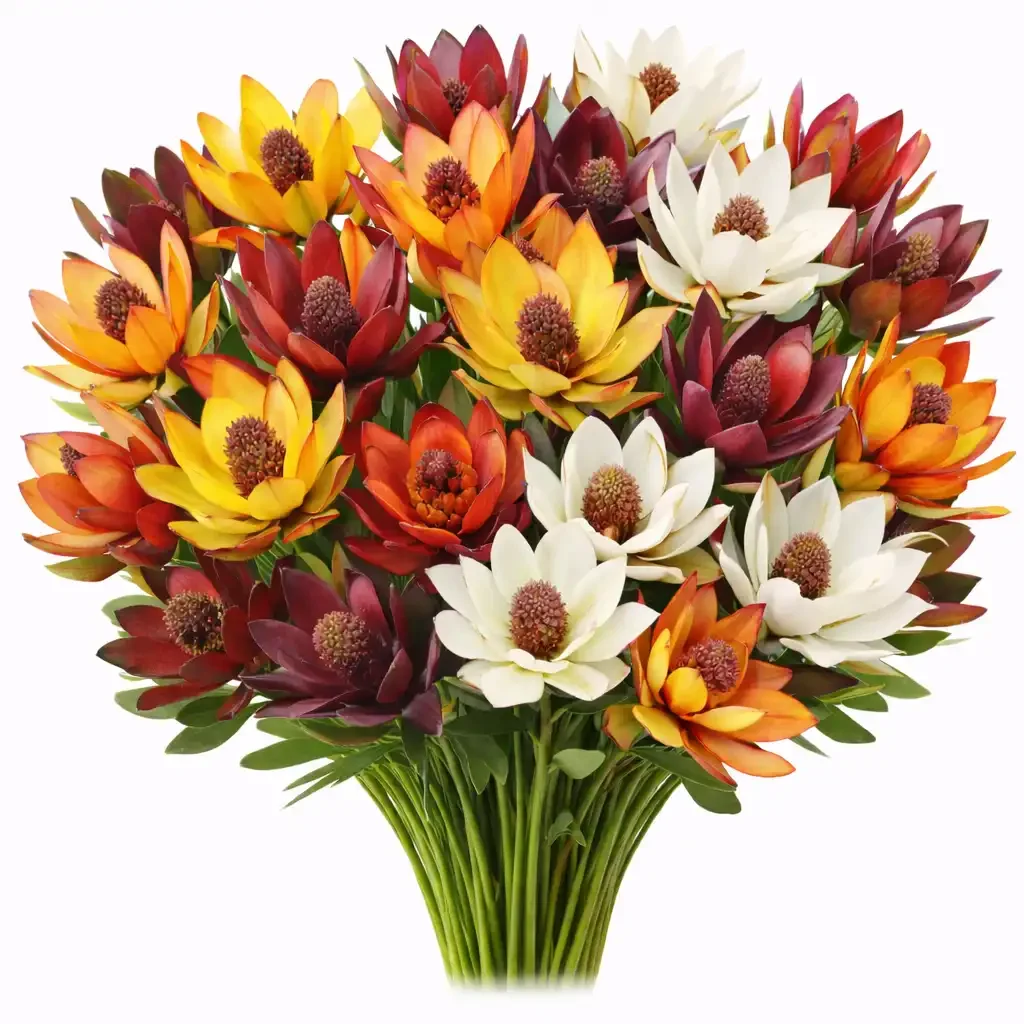
Leucadendron is one of the most commercially versatile and visually distinctive foliage and cut flower crops available to homestead growers in warm, dry climates. Unlike most members of the Proteaceae family that are grown primarily for their flowers, Leucadendron is valued primarily for its extraordinary colored bracts and foliage, which surround small central flower structures in shades of deep burgundy, rich red, warm yellow, soft cream, and vibrant lime green that intensify dramatically as the plant approaches its blooming period. These colored bracts create a bold, architectural quality in arrangements that florists describe as irreplaceable and that wedding designers seek out for the warm, rich tones that no other foliage or flower crop can quite replicate.
For homestead growers in warm, dry climates within USDA zones 9 to 11, Leucadendron represents one of the most strategically valuable long-term shrub crops available. It shares the same Mediterranean climate adaptability as its Proteaceae family relatives Protea and Pincushion Protea, thriving in the full sun, excellent drainage, low fertility soil, and mild winters that characterize the best growing regions in the continental United States for this entire plant family. It blooms and produces its most vividly colored bracts through fall and winter, precisely when the wedding and event season is at its most active and when warm-toned foliage is in the highest demand from florists working with seasonal color palettes.
What distinguishes Leucadendron from its Proteaceae relatives is its extraordinary versatility. It functions simultaneously as a focal flower, a structural foliage element, a color accent, and a dried flower product, giving homestead growers multiple ways to sell and position every stem produced. A single well-established Leucadendron shrub can produce dozens of harvestable stems per season, each usable in multiple market channels, and can remain productive for fifteen to twenty years or more with minimal ongoing input after establishment.
Here is why Leucadendron deserves a place on your homestead:
It provides irreplaceable warm-toned foliage and bracts in the fall and winter market. The deep burgundy, rich red, and warm yellow tones of Leucadendron bracts at their peak color are genuinely not replicated by any other foliage or cut flower crop. Florists and wedding designers working with warm seasonal color palettes actively seek out local Leucadendron supply and pay premium prices for reliable stems.
It functions as both a focal flower and a structural foliage element. Leucadendron is uniquely versatile in the cut flower market. It can serve as the featured element in a design or as a bold structural foliage that supports other focal flowers. This versatility makes it useful to a wider range of florists than more specialized specialty flowers.
It dries magnificently with exceptional color retention. Leucadendron dries better than almost any other cut flower or foliage crop, retaining much of its vivid bract color for months or even years when dried properly. This exceptional dried flower performance creates a year-round income stream from a seasonal harvest.
It shares growing requirements with Protea and Pincushion Protea. Homestead growers who have successfully established Protea or Pincushion Protea can add Leucadendron to the same growing area with the same cultural practices, creating a diverse and complementary Proteaceae family planting with minimal additional learning.
It is a long-lived, low-input perennial investment. Once established in appropriate conditions, Leucadendron requires very little water, no fertilizing, and minimal pest or disease management, delivering exceptional long-term return on the initial investment in plants and establishment.
Growing Conditions
Sunlight
Leucadendron requires full sun without exception. It needs at least 6 to 8 hours of direct sunlight per day and performs best with maximum sun exposure throughout the day. Insufficient sunlight results in weak, unproductive plants with poor bract coloration and dramatically reduced stem yield. Full sun is the single most non-negotiable growing requirement for productive Leucadendron.
Soil
Like all Proteaceae family members, Leucadendron has extremely specific soil requirements that are fundamentally different from most garden plants. It must have fast-draining, sandy or gravelly, acidic soil with very low fertility and critically very low phosphorus levels. Leucadendron has evolved specialized proteoid root structures in the nutrient-poor soils of the South African fynbos that allow it to extract nutrients from conditions so lean that most other plants cannot survive. In rich, fertile, or poorly drained soil, Leucadendron almost invariably fails from root rot or phosphorus toxicity.
The non-negotiable soil requirements are excellent drainage, very low phosphorus, acidic pH between 5.0 and 6.5, and low overall fertility. If your native soil does not meet these requirements, building raised beds with a custom mix of coarse sand, perlite, and a small amount of acidic organic matter such as pine bark fines is the most reliable approach. Never add compost, manure, or any phosphorus-containing fertilizer to Leucadendron planting areas.
Water
Leucadendron is highly drought tolerant once established and thrives in the dry summer conditions that characterize the best growing regions for the Proteaceae family. It requires regular watering during its first one to two years to establish a strong root system but after that needs only occasional deep watering during the driest periods. Overwatering is one of the most common and most devastating mistakes with Leucadendron. Once established, treat it as a drought-tolerant Mediterranean shrub and water very infrequently and deeply.
Temperature
Leucadendron is best suited to USDA zones 9 to 11. It tolerates light frost but is damaged by hard freezes below approximately 25 to 28 degrees Fahrenheit. Most species prefer mild temperatures, low humidity, and dry summer conditions. High humidity combined with warm temperatures creates ideal conditions for the Phytophthora root rot that is the most serious threat to all Proteaceae family members. The low humidity and dry summers found in warm Mediterranean-climate regions within USDA zones 9 to 11 are the most important climate factors that make those zones so well suited to Leucadendron production.
Planting Guide
Leucadendron is best planted from container-grown nursery plants. Growing from seed is very slow and variable, taking several years to produce plants of useful size and productive potential. Container plants from reputable specialty nurseries that focus on South African and Australian native plants give the fastest and most reliable path to productive shrubs.
Step 1: Choose a planting location with full sun, excellent drainage, and isolation from any irrigation systems serving other plants. Even occasional drift from neighboring irrigation can provide more water than established Leucadendron needs and contributes to the root rot that is its most serious threat.
Step 2: Assess your native soil carefully before planting. Ideal soil is sandy, well-drained, naturally acidic, and low in phosphorus. Have your soil tested before planting. If your soil is heavy, clay-based, alkaline, or has been heavily amended with compost or manure in the past, building raised beds is strongly recommended.
Step 3: If building raised beds, fill with a custom mix of approximately 60 percent coarse sand or decomposed granite, 30 percent native sandy soil if available, and 10 percent pine bark fines or other acidic organic matter. Never add compost, manure, or any phosphorus-containing material to Leucadendron planting beds.
Step 4: Dig a planting hole twice as wide as the root ball and the same depth as the container. Do not amend the planting hole with any fertilizer or compost. Backfill with the native or custom soil mix only.
Step 5: Plant the shrub at exactly the same depth it was growing in its container. Never plant deeper than the container depth as burying the crown increases the risk of crown rot significantly.
Step 6: Water thoroughly after planting and maintain regular watering throughout the first growing season to support root establishment. Gradually reduce watering frequency through the second season as the plant develops its characteristic drought tolerance.
Seed vs Transplant: Always use nursery-grown container plants. Growing from seed is impractical for homestead cut flower production due to the very long time to useful productive size.
Spacing: 4 to 8 feet apart depending on the species and its mature size. Leucadendron needs good air circulation and adequate room to develop its natural form.
Planting Season: Fall or early spring in USDA zones 9 to 11. Avoid planting during the hottest summer months when establishment stress is greatest.
Maintenance
Pruning
Pruning is the most important ongoing maintenance practice for productive Leucadendron. After each stem is harvested, cut back to just above a healthy lateral shoot or set of leaves lower on the stem. This encourages the development of new productive shoots from lateral branches below each cut and prevents the plant from becoming progressively more woody and less productive over time.
After the main harvest season, a more significant shaping pruning that removes approximately one quarter to one third of the overall growth helps maintain a well-branched, productive shrub shape and sets up a strong framework of new growth for the following season. Never cut back into completely bare, leafless wood as Leucadendron does not regenerate readily from stems without foliage.
Fertilizing
Fertilizing is the area where the most serious and irreversible mistakes are made with Leucadendron. Like all Proteaceae family members, Leucadendron is critically sensitive to phosphorus and can be killed by fertilizers, composts, or manures containing it. This includes virtually all standard garden fertilizers, most commercially available composts, and all animal manures. Never apply any phosphorus-containing material to Leucadendron under any circumstances.
If any fertilization is considered necessary, use only fertilizers specifically formulated and labeled as phosphorus-free for Australian and South African native plants. In most cases, established Leucadendron growing in appropriately lean soil needs absolutely no fertilization and performs best when none is applied.
Pest Control
Leucadendron is largely pest resistant in appropriate growing conditions. Scale insects can occasionally colonize stems and are best treated with horticultural oil applied in early spring before new growth begins. Root rot caused by Phytophthora is the most serious threat but is a disease management issue rather than a pest problem.
Disease Prevention
Phytophthora root rot is the primary and most serious disease threat to Leucadendron and is almost always caused by poor drainage, overwatering, or planting in inappropriate soil conditions. Prevention through excellent drainage, appropriate soil preparation, and careful infrequent watering is the only effective management strategy. Once Phytophthora infects a plant the plant cannot be saved. Remove and destroy infected plants immediately and do not replant any Proteaceae family plants in the same location.
Harvesting
When to Harvest
Harvest Leucadendron stems when the bracts have reached their most vivid color and the central flower structure is either still developing or just beginning to open. For most varieties the optimal harvest stage is when the colored bracts are fully expanded and showing their most intense color but before the central flower cone has fully opened and begun to deteriorate. This stage provides the longest vase life and the best dried flower performance. Harvest in the early morning when stems are fully hydrated.
How to Cut
Use clean, sharp pruners. Cut stems as long as possible, ideally 18 to 30 inches or more depending on the natural stem length of the variety. Cut just above a healthy set of leaves or a lateral shoot to encourage new stem production from the branch below the cut. Remove all leaves from the lower third of the stem immediately after cutting and place stems in cool water immediately.
Conditioning
Place cut stems in deep cool water for several hours or overnight before sale or arrangement. Leucadendron stems are generally good water absorbers and condition readily. Recutting stems under water before placing in fresh conditioning water helps ensure optimal water uptake.
Drying
Leucadendron dries magnificently and is one of the most commercially valuable dried foliage and flower products available. The vivid bract colors retain exceptionally well when dried, particularly the deep burgundy and red tones of varieties like Safari Sunset. To dry Leucadendron, stand stems upright in a container without water or hang upside down in a warm, dry, well-ventilated space. The bracts and foliage hold their form and color for months or even years when properly dried.
Vase Life
Leucadendron has an excellent vase life as a fresh cut stem, typically lasting two to three weeks or more with proper care. This exceptional longevity is one of its most commercially valuable qualities. Strip all foliage below the waterline, recut stems at an angle, and place in fresh water. Change water every few days to maximize longevity.
Uses on a Homestead
Cut Flower and Foliage Use
Leucadendron is grown primarily as a bold structural foliage and focal element in mixed arrangements. Its architectural form, distinctive colored bracts, and strong stems create an immediate visual impact that elevates every arrangement it appears in. It pairs magnificently with Protea, Pincushion Protea, Banksia, Waxflower, and Eucalyptus in exotic South African-inspired arrangements. It also pairs beautifully with garden roses, dahlias, and other romantic flowers where its bold structure and warm tones provide a dramatic and sophisticated counterpoint to softer blooms.
Dried Flower and Foliage Use
Dried Leucadendron is among the most commercially valuable dried foliage products available. The vivid bract colors, particularly the deep burgundy and red tones, retain exceptionally well when dried, creating premium products with extraordinary shelf life. Dried Leucadendron stems and arrangements command premium prices through craft markets, specialty gift shops, floral studios, and online platforms.
Wedding and Event Flowers
Leucadendron is enormously popular in the high-end wedding market for its bold, warm tones and structural quality. Its deep burgundy and rich red varieties are particularly sought after for fall and winter weddings where warm, jewel-toned color palettes are most popular. Wedding florists pay premium prices for quality Leucadendron stems and a reliable local source is one of the most valued specialty supplier relationships available to a homestead flower operation.
Landscape and Farm Aesthetic
Mature Leucadendron shrubs are extraordinarily beautiful in the landscape, particularly in fall and winter when the bracts reach their most vivid color. A homestead planting of mixed Leucadendron varieties in full color creates a spectacular visual display that generates powerful social media content and attracts customer interest and agritourism traffic.
Can You Make Money With Leucadendron
Yes, Leucadendron is one of the most financially rewarding long-term cut flower and foliage investments available to homestead growers in appropriate climates. Its combination of premium pricing, exceptional vase life, year-round dried flower income, and very low ongoing input costs after establishment creates one of the highest returns on investment available in specialty cut flower production.
Irreplaceable warm-toned foliage commands premium pricing. The deep burgundy, rich red, and warm yellow tones of Leucadendron bracts at peak color are genuinely not replicated by any other foliage crop. This uniqueness justifies premium pricing and creates strong florist loyalty once a supply relationship is established.
Exceptional vase life increases florist value. At two to three weeks or more in the vase, Leucadendron delivers outstanding value per dollar to florists, making them genuinely willing to pay premium prices and creating strong repeat business.
Year-round dried flower income. Leucadendron dries better than almost any other cut foliage, retaining its vivid bract color for months or years. The same seasonal harvest provides fresh cut stems for the immediate market and dried products for year-round sales through online shops, craft markets, and specialty gift stores.
Rare local supply creates premium market position. Leucadendron is not widely grown by small farms even in appropriate climates. A reliable local source creates an essentially uncontested market position that supports premium pricing indefinitely.
Farmers Market: Fresh Leucadendron stems sell for 5 to 15 dollars per stem at retail depending on variety, stem length, and bract color intensity. Mixed arrangements featuring Leucadendron command premium prices that reflect the high value of this specialty foliage.
Florists and Wedding Designers: Leucadendron is among the most sought-after specialty foliage in the wholesale cut flower market, particularly for fall and winter wedding work. Establishing supply relationships with local florists and wedding designers creates a reliable and extremely profitable ongoing sales channel.
Dried Flower Market: Dried Leucadendron stems and arrangements command premium prices through craft markets, specialty gift shops, and online stores. The combination of vivid color retention and exceptional longevity makes dried Leucadendron one of the most compelling dried foliage products available.
Online Shop: Dried Leucadendron ships well and commands premium prices online. An Etsy shop or direct online store featuring dried Leucadendron arrangements and single stems can generate meaningful revenue from customers well beyond your local market.
Companion Plants
Leucadendron grows best alongside other plants from South African and Australian native plant communities that share its specific growing requirements.
Protea: The most natural companion from the same fynbos ecosystem. Shares identical growing requirements and creates stunning complementary combinations in arrangements and in the landscape. Protea and Leucadendron together form the foundation of a South African cut flower planting.
Pincushion Protea (Leucospermum): Another South African Proteaceae family member with identical growing requirements. The bold pincushion blooms of Leucospermum provide spectacular contrast to the structural bracts of Leucadendron in arrangements.
Waxflower: Shares nearly identical growing requirements including the critical phosphorus sensitivity. Provides delicate filler material that pairs beautifully with the bold structure of Leucadendron in arrangements.
Banksia: An Australian Proteaceae family member with dramatic cone-like structures. Shares similar growing requirements and complements Leucadendron beautifully in exotic mixed arrangements.
Lavender: Thrives in similar well-drained, lean, full-sun Mediterranean conditions. A natural landscape companion that grows well alongside Leucadendron and provides complementary filler material.
Rosemary: Another Mediterranean native with similar drought tolerance and lean-soil preferences. Useful as a landscape companion and as aromatic foliage material in arrangements.
Common Problems
Root Rot (Phytophthora)
The most serious and most common problem with Leucadendron. Caused almost entirely by poor drainage, overwatering, or planting in inappropriate heavy or fertile soil. Symptoms include sudden wilting, yellowing foliage, and rapid plant death. There is no effective treatment once infection is established. Prevention through excellent drainage, appropriate soil preparation, and careful infrequent watering is the only effective management strategy. Remove and destroy infected plants immediately and do not replant any Proteaceae family plants in the same location.
Phosphorus Toxicity
The second most common cause of Leucadendron failure. Applying any fertilizer, compost, or manure containing phosphorus can cause progressive and fatal phosphorus toxicity. Symptoms develop slowly and include yellowing foliage, browning leaf tips, and eventual plant death. Never apply standard garden fertilizers, compost, or manure to Leucadendron. This rule applies without exception and is the most important ongoing management principle for this entire plant family.
Failure to Develop Vivid Bract Color
Usually caused by insufficient sun, overly fertile soil, plants that have not yet reached maturity, or incorrect pruning that removes potential coloring bracts before they develop. Ensure maximum full sun exposure, maintain lean well-drained soil conditions, allow adequate time for plants to reach maturity, and prune correctly after each harvest rather than removing all current-season growth at once.
Scale Insects
Can colonize stems and reduce plant vigor over time. Monitor plants regularly and treat with horticultural oil at the first sign of scale infestation before populations build to damaging levels. Apply in early spring before new growth begins for the most effective timing.
Wind Damage
Leucadendron shrubs, particularly young plants before they have established a strong root system, can be damaged by strong winds. Choose sheltered planting locations where possible or provide temporary wind protection for young plants in their first growing season.
Varieties to Consider
Safari Sunset: The most widely grown and commercially important Leucadendron variety in the world. Deep burgundy to wine-red bracts on strong upright stems. The vivid color intensifies dramatically in fall and winter. Exceptional stem length and outstanding dried flower performance. The standard commercial variety and the most reliable choice for homestead cut flower production. Extremely popular with florists and wedding designers for fall and winter arrangements.
Jester: A striking bicolor variety with yellow-green bracts tipped with deep red. Very popular with florists for its unusual two-toned appearance that adds visual interest to arrangements. Strong stems and good productivity.
Pisa: Soft yellow bracts with a warm golden tone that is considerably lighter than most Leucadendron varieties. Very popular with florists working with soft, warm, and vintage color palettes. Commands premium prices for its unusual soft yellow color.
Inca Gold: Bright, warm yellow bracts on strong stems. Very popular at farmers markets and with florists for its vivid yellow color that is relatively rare in the Leucadendron range. Excellent dried flower performance with good color retention when dried.
Silver Tree (Leucadendron argenteum): A dramatically different species grown primarily for its extraordinary silver-white foliage rather than colored bracts. The intensely silver leaves create a spectacular metallic foliage effect in arrangements. Very popular with high-end florists and wedding designers for its unusual and luxurious appearance. More tender than most Leucadendron varieties and best suited to the most frost-free areas of USDA zones 10 to 11.
Ebony: Deep, almost black-purple bracts at peak color. Extremely popular with florists and wedding designers working with dramatic, dark, and moody color palettes. Commands the highest prices of any Leucadendron variety for its unusual and striking deep coloration.
Cloudbank Ginny: Compact shrub habit with soft cream to pink bracts. Very popular for smaller spaces and container production. Good productivity and reliable performance.
Wilson's Wonder: A vigorous variety with deep red bracts on strong, arching stems. Very popular for large-scale event and wedding installations where bold, warm color and strong stems are needed in quantity.
Final Thoughts
Leucadendron is one of the most strategically compelling and financially rewarding long-term investments available to homestead flower growers in warm, dry climates within USDA zones 9 to 11. Its irreplaceable warm-toned bract colors, exceptional versatility as both a fresh cut stem and a dried flower product, very long vase life, and near-zero ongoing input requirements after establishment combine to create one of the most favorable long-term financial profiles of any perennial cut flower crop. In a local market where most growers offer the same seasonal annuals and common summer perennials, a reliable supply of locally grown Leucadendron in its spectacular fall and winter color places your homestead in a premium market category that is essentially uncontested. Prepare your soil correctly, never apply phosphorus in any form, plant in full sun with excellent drainage, prune after every harvest to maintain productive branching, and Leucadendron will reward your homestead with decades of spectacular color and exceptional revenue.
FAQ
What is the difference between Leucadendron and Protea? Leucadendron and Protea are different but closely related genera within the same Proteaceae family. True Protea plants produce large bowl-shaped flowers surrounded by pointed bracts and are grown primarily for their dramatic blooms. Leucadendron is grown primarily for its colored bracts and foliage that surround a much smaller central flower cone. In floral design Leucadendron functions primarily as a structural foliage and color element while Protea functions primarily as a dramatic focal flower. Both share identical growing requirements and are native to the South African fynbos.
Why does Leucadendron need phosphorus-free conditions? Leucadendron evolved over millions of years in the extraordinarily phosphorus-poor soils of the South African fynbos. In response it developed specialized proteoid root structures that are extremely efficient at extracting the tiny amounts of phosphorus present in these naturally lean soils. When plants adapted to such low-phosphorus conditions are suddenly exposed to the phosphorus levels present in standard fertilizers or composts, the specialized root structures cannot regulate absorption effectively and the plant accumulates toxic levels of phosphorus in its tissues. The resulting toxicity is progressive and almost always fatal. This sensitivity is a reflection of Leucadendron's extraordinary adaptation to conditions that would challenge almost any other plant.
How do I know when Leucadendron bracts are at peak color for harvesting? The bracts of most Leucadendron varieties color up gradually from green to their characteristic vivid tones as the plant approaches its natural bloom period. Peak color is typically reached when the bracts are fully expanded, showing their most intense and saturated color, and the central flower cone is still developing or just beginning to open. For Safari Sunset this means harvesting when the bracts are at their deepest burgundy-red. Harvesting at this peak color stage gives the best fresh vase life and the most vivid color retention when dried.
Can Leucadendron be grown in containers? Yes, Leucadendron can be grown in large containers with a well-draining, phosphorus-free growing mix. Container growing gives you precise control over soil composition and drainage and allows plants to be moved to sheltered locations during unusually cold weather. Use containers with excellent drainage holes and a custom mix of coarse sand, perlite, and a small amount of acidic organic matter. Never use standard potting mixes containing compost or fertilizer. Container plants typically produce somewhat fewer and shorter stems than ground-planted shrubs but can be productive and commercially viable for growers with limited suitable ground space.
How long does Leucadendron take to reach full productive maturity? Most Leucadendron varieties begin producing harvestable stems within one to two years of planting from nursery container plants. Full productive maturity where plants are generating maximum stem yield typically takes two to four years. This is considerably faster than Protea and Pincushion Protea, making Leucadendron one of the fastest-establishing members of the Proteaceae family for commercial cut flower production. Purchasing the largest available container size from the nursery and planting in appropriate conditions gives the fastest path to productive plants.