
Arnica
Written By Arthur Simitian
QUICK FACTS
Common Name
Arnica, Mountain Arnica, Leopard's Bane, Wolf's Bane, Mountain Tobacco; the name Wolf's Bane is shared with aconite (Aconitum species) and creates occasional confusion; arnica and aconite are entirely different plants from different families; arnica is a Compositae daisy-family member while aconite is a Ranunculaceae buttercup family member of genuine toxicity; both names warn of the plants' unsuitability for internal use, but through different mechanisms and at entirely different severity levels
Scientific Name
Arnica montana; Asteraceae family (daisy or composite family); native to the subalpine and alpine meadows, acid heathlands, and mountain grasslands of central and northern Europe, from the Pyrenees and Alps east through the Carpathians and into Siberia; protected by law in many European countries due to overharvesting from wild populations; the species is listed on Appendix I of the Convention on the Conservation of European Wildlife and Natural Habitats; this protected status makes cultivated production important and gives homestead cultivation particular conservation value
Plant Type
Hardy perennial; forms a basal rosette of paired leaves from which erect flowering stems rise in summer; spreads slowly by shallow rhizome to form small colonies over time; dies back to the ground in winter and re-emerges reliably in spring; long-lived in suitable conditions; the above-ground plant is modest in stature but the golden-orange flower heads are among the most visually striking of any perennial herb in summer bloom
Hardiness Zones
Zones 4 to 8; the alpine and subalpine native habitat predicts both the cold hardiness and the summer heat sensitivity accurately; arnica thrives in cool to moderate summer temperatures and declines in prolonged summer heat above about 80 to 85 degrees Fahrenheit; it is better suited to the Pacific Northwest, New England, the upper Midwest, and high-elevation gardens in the mountain states than to hot humid summers in the southeastern United States or the low-desert Southwest
Height
Six to twenty-four inches; the basal rosette of leaves stays low; the flowering stems rise erect to variable heights depending on growing conditions; plants in poor, lean, well-drained alpine soil are shorter and more compact; plants in richer garden soil grow taller with more foliage
Flower Description
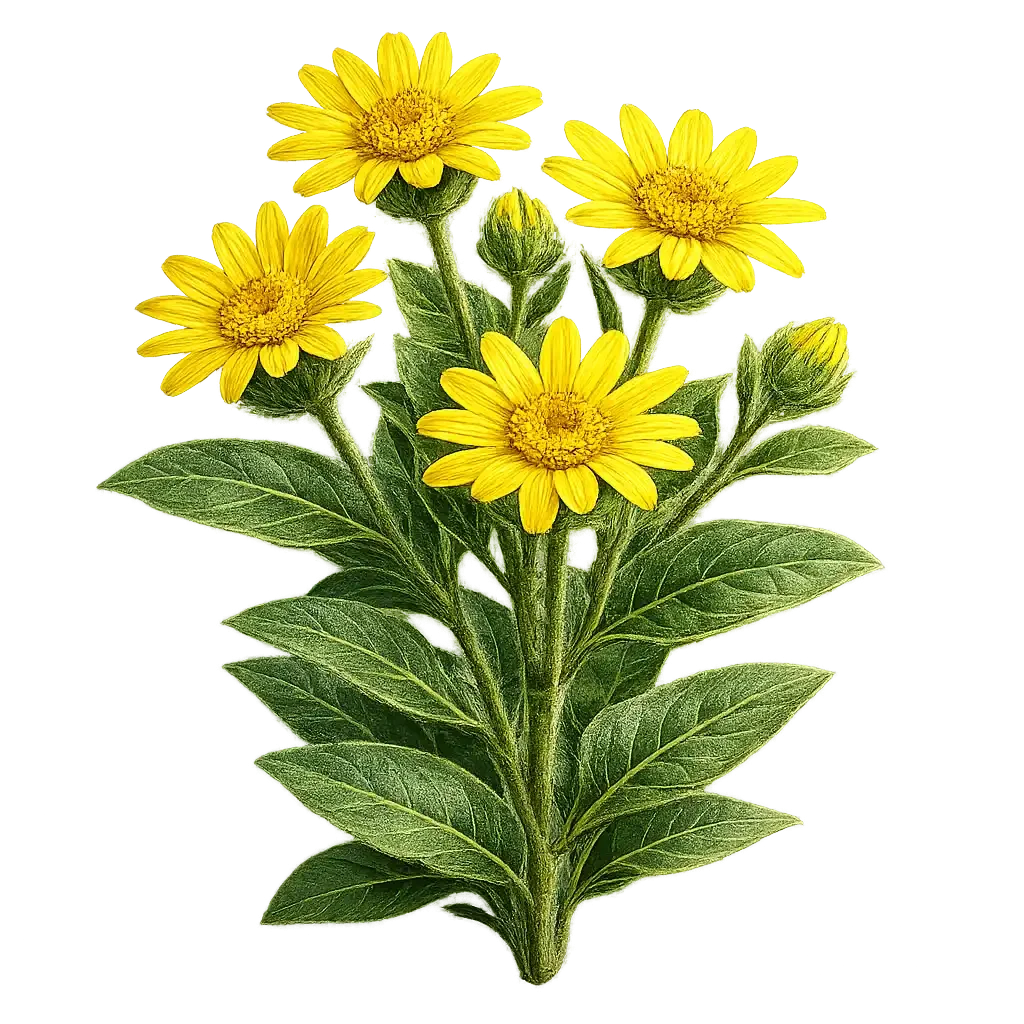
Large daisy-like composite flower heads two to three inches across; vivid golden-orange to yellow-orange ray florets, typically twelve to fifteen per head, each strap-shaped with a slightly notched or three-toothed tip; dense rounded orange-yellow disc of tubular florets at the center; involucre of glandular-hairy bracts beneath the head; the flower heads are the primary medicinal harvest and are among the most aromatic of any Compositae, with a resinous, faintly spicy scent from the sesquiterpene lactone fraction; flowering period is June through August
Primary Active Compounds
Sesquiterpene lactones, primarily helenalin and dihydrohelenalin and their ester derivatives (the primary anti-inflammatory and cytotoxic compounds; helenalin inhibits the NF-kB transcription factor, a central regulator of the inflammatory cascade, at concentrations achievable in topical preparations; also responsible for contact dermatitis in sensitive individuals and for the systemic toxicity at internal doses); flavonoids including isoquercitrin, astragalin, and luteolin (anti-inflammatory, antioxidant); thymol and other essential oil constituents in the flowers (antimicrobial, contribute to fragrance); caffeic acid derivatives including chlorogenic acid (anti-inflammatory); polysaccharides; carotenoids (contribute to the vivid orange-yellow color)
Topical Use Summary
Applied externally as oil, salve, cream, or diluted tincture for bruises, blunt trauma, muscle soreness, sprains, joint pain, post-surgical swelling, and superficial phlebitis; well-supported by multiple clinical trials demonstrating reduced bruising, swelling, and pain following surgical procedures and sports injuries; Commission E approved for topical use for bruises, contusions, muscle pain, joint pain, and superficial phlebitis; one of the most clinically validated topical anti-inflammatory herbs in Western herbal medicine
Internal Use Status
Not safe for internal use; helenalin and dihydrohelenalin cause severe gastroenteritis, hemorrhagic gastritis, cardiac arrhythmia, and in documented cases death when taken internally at medicinal doses; the same compounds responsible for the potent anti-inflammatory topical activity are responsible for the systemic toxicity when absorbed through the gastrointestinal tract at concentrations higher than those achievable through intact-skin topical application; homeopathic arnica preparations at extreme dilution are a separate category governed by entirely different considerations than herbal preparations and are outside the scope of this entry
Arnica is the topical anti-inflammatory herb with the strongest clinical evidence in Western herbal medicine, a plant whose helenalin sesquiterpene lactone chemistry inhibits the NF-kB inflammatory pathway with a mechanism now well-characterized at the molecular level, and whose effects on post-surgical bruising, sports injury swelling, and muscle soreness have been confirmed in multiple randomized controlled trials. It is also the herb in this series with the most categorical internal use prohibition: the same helenalin chemistry that makes arnica a highly effective topical anti-inflammatory makes it a gastric and cardiac toxin when taken internally at medicinal concentrations. This is not a nuanced dose-dependent consideration in the way that many herb cautions are; it is a hard limit with documented fatalities in the historical literature. The two facts, extraordinary topical efficacy and genuine internal toxicity, are inseparable properties of the same chemical and define the complete practical guide to using arnica correctly: on the skin, never in the mouth.
Introduction
Arnica montana has been used in European folk medicine for at least five hundred years, with the earliest documented references appearing in German-language herbals from the sixteenth century. It was primarily a plant of alpine farming communities and mountain shepherds in central Europe, who had ready access to the wild-growing flowers and who applied the bruise-healing properties empirically long before anyone understood the mechanism. The folk names mountain tobacco, from the historical practice of smoking dried arnica flowers as an emergency tobacco substitute in tobacco-scarce alpine communities, and Wolf's Bane and Leopard's Bane, from the observation that the plant repelled or harmed certain animals when consumed, document both the widespread traditional use and the early recognition of its toxicity when ingested.
The plant's protected legal status across much of Europe today reflects the direct consequence of that historical popularity: centuries of wild harvesting for folk medicine, combined with habitat loss as alpine meadows were converted or abandoned and the successional vegetation changed their character, reduced wild arnica populations to levels that prompted legal protection in Germany, the Netherlands, Switzerland, and other European countries. This conservation context is worth holding in mind for homestead growers: cultivating arnica reduces pressure on wild populations and contributes to the availability of a plant that cannot be legally harvested from the wild in much of its native range.
The Asteraceae family membership connects arnica to echinacea, calendula, chamomile, and feverfew, all of which appear in this series and share the composite flower head structure of ray and disc florets. The family also includes ragweed, feverfew, and chrysanthemum, which are relevant to the contact allergy discussion below.
How to Grow
Growing Requirements
Arnica montana is one of the more demanding herbs in this series in terms of matching its specific native habitat conditions. The alpine and subalpine meadows where it grows naturally are characterized by acid soil of low pH, typically between four point five and six, that is poor in nutrients particularly nitrogen, well-drained, and often sandy or gravelly; cool summer temperatures; high light; and moderate to low moisture. Attempting to grow arnica in rich, well-amended garden soil with high nitrogen content produces lush, disease-prone growth that performs poorly and is short-lived. The lean, acid conditions of the native habitat are not a compromise to work around; they are the conditions under which arnica's chemistry develops correctly and the plant thrives.
Soil acidity is the most common obstacle for gardeners outside naturally acid regions. A soil pH of five to six is ideal; anything above six point five produces yellowing, poor growth, and decline. Test the soil pH before planting and amend with elemental sulfur, pine needle mulch, or acidic compost if the native soil is neutral to alkaline. A dedicated raised bed with a mix of acid potting soil, coarse sand or perlite, and pine bark or aged pine needle compost creates an appropriate growing medium where the native garden soil is unsuitable.
Full sun to light shade; the high-altitude native habitat means arnica is adapted to intense but cool sunlight; in warm climates it benefits from afternoon shade during the hottest part of summer. Keep soil consistently but moderately moist; arnica does not tolerate drought during the growing season but is equally intolerant of waterlogged soil. Avoid fertilizing with nitrogen, which promotes lush vegetative growth at the expense of flower head production and sesquiterpene lactone concentration.
Starting from Seed and Division
Arnica grows from seed but with some patience required: the seeds are slow to germinate and the seedlings grow slowly in the first season, producing primarily a basal rosette in year one and beginning to flower in year two or three. Cold stratification improves germination rates; refrigerate moist seeds for four to six weeks before sowing, or winter-sow in outdoor containers and allow natural cold stratification through winter for spring emergence. Sow at the soil surface or barely covered, as the seeds require light for germination.
Division of established clumps in early spring is the fastest way to expand an existing planting; arnica's rhizomatous habit produces offshoots that can be separated carefully and replanted. Divisions establish more quickly than seedlings and may flower in the same season as division.
Harvesting the Flowers
Harvest the flower heads when they are fully open, in the morning after dew has dried, cutting the stem just below the head. The sesquiterpene lactone content is highest in freshly opened flowers before the disc florets have fully matured; harvest at peak opening rather than waiting for the ray florets to reflex backward, which signals the flowers are past their prime medicinal potency. Handle harvested flowers carefully and wash hands after handling, as the helenalin can cause contact dermatitis in sensitive individuals even through handling the fresh flowers.
Dry flower heads on screens in a single layer in a warm, shaded, well-ventilated space for five to seven days; the flowers are more delicate than most root or leaf harvests and overdrying at high temperatures degrades the sesquiterpene lactone fraction. Dried flowers should retain their color and fragrance; yellowed, odorless dried flowers have lost significant potency. Store in sealed glass jars away from light and heat and use within one year for best quality.
Topical Preparations
Arnica-Infused Oil
The arnica-infused oil is the foundational preparation for homestead use and the base for the salve described below. Pack a clean, dry glass jar loosely with dried arnica flower heads; fresh flowers contain too much moisture and will cause the oil to become rancid or moldy. Cover completely with a carrier oil; olive oil is traditional and has a long shelf life; sunflower or jojoba oil are lighter alternatives for people who prefer a less viscous topical. The oil should cover the flowers by at least one inch.
For a cold infusion, seal the jar and place in a sunny window for four to six weeks, shaking daily; the heat from sunlight extracts the oil-soluble sesquiterpene lactones and flavonoids slowly into the carrier. For a faster warm infusion, place the jar in a water bath or dehydrator at 100 to 110 degrees Fahrenheit for forty-eight to seventy-two hours. Strain through cheesecloth, pressing firmly to recover all the oil from the flowers. The finished oil should be a warm golden-orange color with the characteristic resinous arnica fragrance. Store in a sealed dark glass bottle away from light; use within one year.
Arnica Salve
The salve extends the arnica oil into a solid preparation that is easier to apply to bruises and sore muscles than liquid oil. Gently melt one ounce of pure beeswax in a double boiler or heatproof measuring cup set in simmering water. Once melted, add eight ounces of arnica-infused oil and stir to combine. Remove from heat; optionally add ten to fifteen drops of lavender essential oil or a small amount of calendula-infused oil for additional skin-soothing properties. Pour immediately into small tins or glass jars before the mixture begins to set. The finished salve should be firm but spreadable at room temperature. Label clearly for topical use only. Store in a cool, dark location; use within one year.
Arnica salve: application guide and appropriate uses
The arnica salve prepared above is appropriate for the following applications when used correctly. Apply a small amount to the affected area and massage gently in a circular motion two to three times daily. Do not apply more salve than is needed to lightly cover the area; more is not more effective and increases the risk of skin reaction in sensitive individuals.
Bruises and contusions from blunt trauma: apply as soon as possible after injury, before significant swelling has developed, and continue for three to five days; multiple clinical trials support significant reduction in bruise size and color intensity compared to placebo when arnica preparations are applied promptly after injury. Post-surgical bruising and swelling: arnica preparations have been studied in the context of rhinoplasty, facelift surgery, and orthopedic procedures, where reduction in post-operative bruising and swelling is a consistent finding; confirm with the surgical team that topical application is appropriate before and after a specific procedure. Muscle soreness from exertion: apply to sore muscles after intense physical work or exercise; the NF-kB inhibition reduces the inflammatory component of delayed-onset muscle soreness, with the effect most pronounced when application begins within a few hours of the exertion. Joint pain from sprains, strains, and osteoarthritis: Commission E approval specifically includes these applications; apply directly to the affected joint two to three times daily.
Do not apply to broken skin, open wounds, or areas with active infection. Do not apply near mucous membranes including lips, eyes, or nostrils. Do not apply to areas of skin that will be covered by tight bandaging for extended periods, as occlusion increases absorption and helenalin skin reactions. Do not use on children under the age of two. Do not apply more frequently than the label instructs; the contact dermatitis risk increases with frequency and quantity of application.
Watch for signs of helenalin contact sensitization, which can develop after several applications even in people who tolerated the first applications well: redness, itching, small blisters, or a spreading rash beyond the application area indicates sensitization has occurred and the preparation should be discontinued permanently; once sensitized to helenalin, reactions will recur and worsen with any future arnica application.
Cautions: The primary cautions for arnica are categorically different from most herbs in this series and must be understood clearly before cultivation or use. Internal use toxicity: arnica preparations should never be taken internally; whole plant preparations, tinctures, teas, and any preparation intended for ingestion are not safe; the helenalin sesquiterpene lactones cause severe hemorrhagic gastroenteritis, cardiac arrhythmia, and in documented historical cases death at medicinal internal doses; the Commission E lists arnica as unsafe for internal use; no traditional or anecdotal evidence of safe internal use changes this risk profile; the one apparent exception is ultra-dilute homeopathic arnica preparations, which are governed by different principles and contain no measurable amount of the active compounds. Contact sensitization: helenalin is a common contact allergen; between one and three percent of the general population will develop contact dermatitis from topical arnica application; the risk is higher in people with known Asteraceae or Compositae family allergy, which includes allergy to ragweed, chrysanthemum, chamomile, calendula, or echinacea; any itching, redness, or vesicle formation on the skin after application indicates sensitization; discontinue use immediately and permanently if sensitization occurs. Broken skin: do not apply any arnica preparation to open wounds, broken skin, or skin with compromised barrier function; absorption through broken skin increases helenalin systemic exposure substantially above what occurs through intact skin application. Pregnancy and nursing: topical arnica use on limited skin areas at recommended frequency is cautiously used during pregnancy in some clinical contexts, but is generally avoided during pregnancy and nursing as a precaution given the systemic toxicity profile of the active compounds; discuss with a healthcare provider before use. Children: avoid application on young children; the higher surface-area-to-body-weight ratio of children increases systemic absorption risk from topical preparations. Allergy testing: consider applying a small amount of diluted arnica preparation to the inner forearm for twenty-four hours before first full use, to screen for contact sensitivity before applying to a larger skin area. Protected species: in Europe, Arnica montana is legally protected and cannot be harvested from the wild in many jurisdictions; always grow your own or source from cultivated supply.
The NF-kB Mechanism and Why It Matters
The molecular mechanism of arnica's anti-inflammatory activity is worth understanding because it explains both the efficacy and the toxicity in the same framework. NF-kB (nuclear factor kappa-light-chain-enhancer of activated B cells) is a transcription factor that acts as a master switch for the inflammatory response: when activated, it turns on the production of pro-inflammatory cytokines, prostaglandins, and other mediators that drive acute and chronic inflammation. Helenalin inhibits NF-kB activity by alkylating its subunits, preventing transcription of the downstream inflammatory mediators.
This is a powerful and non-selective mechanism. At the concentrations achievable through topical application to intact skin, helenalin penetrates the dermis and subcutaneous tissue at concentrations sufficient to reduce local NF-kB-driven inflammation without reaching systemic circulation at significant levels. At the concentrations achievable through gastrointestinal absorption of an ingested preparation, the same NF-kB inhibition occurs throughout the gastrointestinal epithelium and systemically, causing the mucosal and cardiac damage documented in toxicity cases. The preparation method and the route of exposure are what determine whether the effect is therapeutic or harmful; the compound itself does not change.
This mechanism profile also explains why arnica preparations work best when applied promptly after injury, before the NF-kB-driven inflammatory cascade has fully developed, rather than after significant swelling and bruising have already formed. The acute inflammatory response following blunt trauma is largely NF-kB-dependent in its early phases; intervening in that phase with a topical helenalin preparation reduces the cascade at its source rather than treating the downstream consequences.
Arnica in the Garden and Broader Landscape
Arnica montana is a genuine ornamental asset in the acid meadow or mountain garden style planting. The vivid golden-orange flower heads rising above the compact basal rosette in June through August provide the warm color that acid-soil and woodland garden plantings often lack; the companions in its native habitat include heather, bilberry, Nardus stricta grass, gentians, and mountain pansies, all of which suggest an alpine or acid meadow garden style that has its own coherent aesthetic.
For homesteaders with naturally acid soils in cool summer climates, particularly in the Pacific Northwest, New England, the upper Midwest, or mountain west at elevation, arnica can be grown in a dedicated bed or at the edge of an existing acid garden planting with modest soil preparation. For homesteaders in warmer, more alkaline regions, the dedicated raised bed approach with acidified growing medium is necessary but entirely workable for a small medicinal planting. The harvested flower heads produce enough arnica-infused oil from even a modest planting of five to ten plants to supply a household's topical anti-inflammatory needs for a full year.
Pros and Cons
Advantages
The topical anti-inflammatory clinical evidence base for arnica is among the strongest in Western herbal medicine; multiple randomized controlled trials have confirmed significant reduction in post-surgical bruising and swelling, sports injury recovery time, and osteoarthritis pain and stiffness compared to placebo; Commission E approval specifically for bruises, contusions, muscle pain, joint pain, and superficial phlebitis reflects this evidence base; this is a herb whose topical efficacy has been validated at the level of evidence required for pharmaceutical approval in Germany
The NF-kB inhibition mechanism is now well-characterized at the molecular level, providing a clear pharmacological explanation for the observed clinical effects; this mechanistic clarity distinguishes arnica from many traditional topical herbs where the mechanism is poorly understood; knowing why it works informs when and how to apply it most effectively
Growing arnica contributes to the conservation of a legally protected species whose wild populations have been significantly reduced by centuries of harvesting; the homestead grower producing their own arnica from cultivated plants reduces pressure on wild populations and participates in the preservation of a plant with deep cultural and ecological significance in its native alpine habitat
A modest planting of five to ten plants provides enough flower head harvest to produce a year's supply of arnica oil and salve for household topical use; the per-unit cost of homegrown arnica preparations is substantially lower than commercial arnica products, and the quality of preparations made from freshly harvested, carefully dried flowers from verified Arnica montana is at least equal to commercial products
The vivid golden-orange flowers in midsummer are genuinely beautiful and earn their garden position on ornamental grounds independently of medicinal value; in an acid garden or alpine meadow-style planting they contribute a warm color note that is difficult to achieve with other plants adapted to those conditions
Limitations
The strict acid soil and cool summer temperature requirements exclude arnica from successful cultivation in a significant portion of North American gardens; hot, humid summers and neutral to alkaline soils, which characterize most of the eastern and southern United States and much of the interior West at low elevation, are genuinely unsuitable conditions that require either a dedicated raised bed with artificially acidified medium or acceptance that arnica will not thrive; this is not a herb that can be adapted to challenging conditions through management alone
The internal use toxicity is an absolute limitation that defines the entire use profile of the plant; arnica is the only herb in this series with documented human fatalities from internal use at medicinal doses; the clear and consistent prohibition against internal use narrows the application to topical use only, which limits its value compared to most other herbs in this series that can be used both internally and externally
Helenalin contact sensitization affects a meaningful minority of users and develops unpredictably; a person who has used arnica preparations without reaction for months may develop sensitization that then makes all future arnica use impossible; once sensitized, the reaction recurs with any exposure and worsens; the sensitization rate in people with known Asteraceae allergy is substantially higher than in the general population, limiting arnica's use for anyone with a chamomile, ragweed, or chrysanthemum allergy history
Slow establishment from seed with first-season flowering rare means the medicinal harvest is delayed one to two years after planting; combined with the modest above-ground plant size and the need for careful acid soil management, arnica requires more patient and attentive cultivation than most herbs in this series, particularly in the establishment phase
The commercially available arnica products, both the standardized topical gels and creams from European pharmaceutical manufacturers and the more variable homeopathic preparations, are widely accessible and relatively inexpensive; the practical case for growing arnica yourself is strongest for homesteaders who value self-sufficiency, want verified species-identity and cultivation practices, or live in naturally acid cool-summer climates where arnica grows without special accommodation
Final Thoughts
Arnica asks for acid soil, cool summers, patience through the first seedling year, and the consistent understanding that it belongs on the skin and nowhere else. In return it gives one of the most clinically validated topical preparations in the European herbal tradition, a flower whose golden-orange sunburst in midsummer is worth growing for its own sake, and the satisfaction of producing a household medicine from a legally protected mountain plant whose wild populations depend partly on the willingness of gardeners to cultivate it.
Harvest at full open. Dry carefully at low heat. Infuse in olive oil for six weeks. Make the salve. Apply it the next time someone in the household takes a knock, a fall, or returns home aching from a hard day's physical work. The five-hundred-year European folk medicine tradition and the randomized controlled trials are pointing at the same jar on the shelf.