
Basil
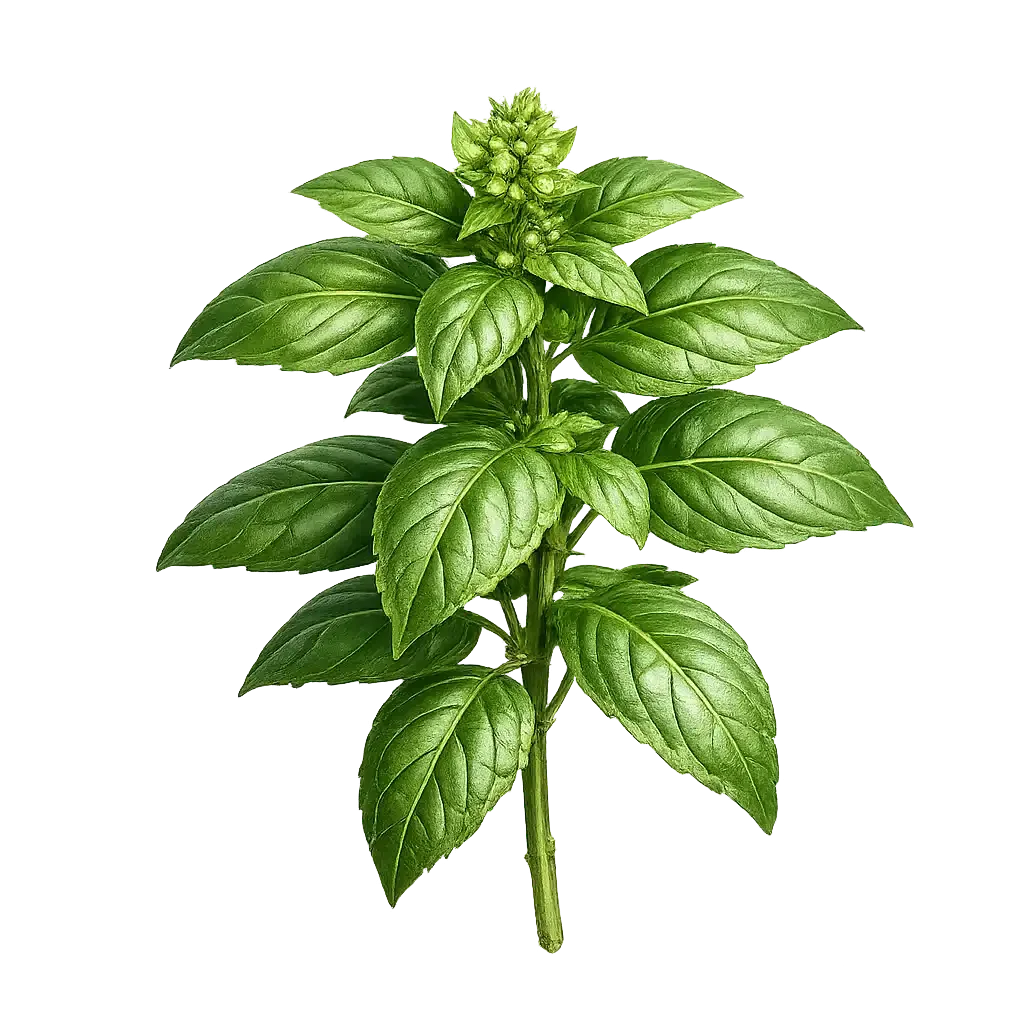
Written By Arthur Simitian
QUICK FACTS
Common Name
Basil, Sweet Basil, Genovese Basil, Italian Basil; the genus Ocimum contains over sixty species, of which Ocimum basilicum is the primary culinary species in Western cooking; closely related culinary species include Thai Basil (Ocimum basilicum var. thyrsiflora), Holy Basil or Tulsi (Ocimum tenuiflorum, covered separately in this series), and Lemon Basil (Ocimum citriodorum); the name basil derives from the Greek basilikon, meaning royal or kingly
Scientific Name
Ocimum basilicum; Lamiaceae family; native to tropical regions of central Africa and Southeast Asia; introduced to the Mediterranean through ancient trade routes and cultivated continuously in European and Asian kitchen gardens for over three thousand years; one of the most widely grown culinary herbs in the world across every major food culture
Plant Type
Tender annual; killed by frost and damaged by temperatures below 50 degrees Fahrenheit even without frost; requires warm soil and warm air temperatures to thrive; native to tropical conditions and retains those temperature requirements in cultivation regardless of how many generations it has been grown in temperate climates
Hardiness
Not frost-tolerant under any circumstances; cold sensitivity below 50 degrees Fahrenheit causes chilling injury visible as blackening of leaves and growing tips even without frost; the minimum soil temperature for direct sowing is 60 degrees Fahrenheit, with 65 to 70 degrees producing the fastest germination; transplants should not go outdoors until nighttime temperatures are reliably above 50 degrees
Height
Twelve to twenty-four inches for most Genovese-type varieties when regularly pinched; unpinched plants bolt more quickly and produce a taller, less bushy, less productive form; compact varieties such as Spicy Globe and Dwarf Italian remain at six to eight inches; Thai basil tends to twelve to eighteen inches with a more upright habit
Flavor Profile by Type
Genovese (sweet basil): the flavor standard for Italian cooking; intensely sweet, slightly clove-like, with anise-floral warmth; the highest linalool and eugenol content of the major culinary types. Thai basil: anise-forward, slightly spicy, with a licorice intensity that holds up to heat better than Genovese; contains higher methyl chavicol (estragole) content. Lemon basil: bright citrus-lemon note from citral; mild sweetness. Purple/Dark Opal basil: milder, slightly less sweet than Genovese, primarily ornamental. Spicy Globe: compact, fine-leaved, slightly spicy; good container variety
Primary Active Compounds
Linalool (monoterpene alcohol; primary aromatic compound in Genovese basil; anti-inflammatory, anti-anxiety, antimicrobial; the compound most responsible for the sweet floral dimension of the flavor); eugenol (phenylpropanoid; clove-like aromatic; antimicrobial; anti-inflammatory; the compound shared with cloves, cinnamon, and bay that gives basil its warm spice note); methyl chavicol or estragole (phenylpropanoid; dominant in Thai basil and tarragon; anise-licorice character; see cautions); rosmarinic acid (anti-inflammatory polyphenol; high concentration, consistent across Lamiaceae family); beta-caryophyllene; camphor (higher in some varieties)
Cold Sensitivity Mechanism
The blackening of basil leaves in cold temperatures is not frost damage but chilling injury: the lipid membranes of basil cells are disrupted at temperatures below approximately 50 degrees Fahrenheit, causing cellular leakage and the characteristic black discoloration; this is why basil should never be refrigerated (cold storage causes the same cellular damage), why it should not be placed in cold water, and why freshly cut basil keeps best in a glass of room-temperature water on the counter rather than in the refrigerator
Succession Sowing
Essential for a continuous supply through the season; a single sowing produces a glut in midsummer followed by a declining harvest as plants bolt; sowing every three to four weeks from the last frost through midsummer ensures a continuous supply of young, productive plants at peak leaf quality through the entire warm season; at least three successions are recommended for households that use basil heavily
Basil is the herb that more than any other defines the flavor of a season: the first bruised leaf of summer, the scent rising from a bunch carried home from the farmers market, the moment a handful hits olive oil and transforms a bowl of sliced tomatoes from a salad into something that tastes like the particular light of a July afternoon. No other herb in this series is more directly linked to a single temperature regime, a single cuisine's identity, or a single harvest window. It is also the herb where the gap between grower and buyer is widest: the basil available in supermarkets, harvested before peak oil development, stored cold, shipped in modified atmosphere packaging, and placed in refrigerated cases that guarantee chilling injury, is a fundamentally different product from basil harvested two minutes before it reaches the plate. The chemical argument is concrete: linalool and eugenol, the compounds that produce basil's characteristic warm sweetness, are most concentrated in young leaves at peak summer growth before the plant has bolted, and they begin to degrade as soon as the leaf is cut or chilled. The management system that delivers that quality to the kitchen, regular pinching, succession sowing, harvest in the morning, never refrigerate, use immediately, is not complicated. It simply requires understanding what basil is and what it needs.
Introduction
Basil's cultivation history extends to at least 3000 BCE in India, where it appears in Ayurvedic texts as a sacred and medicinal plant; in ancient Egypt, where dried basil was found in tombs as part of embalming preparations; and in ancient Greece and Rome, where it was simultaneously a culinary herb, a medicinal plant, and a symbol with varying cultural associations ranging from royalty to antipathy, depending on the regional tradition. The contradictory cultural record of basil, simultaneously sacred in Hindu practice as Holy Basil and associated with evil and scorpions in some classical European traditions, reflects the breadth of its geographic distribution and the diversity of human cultures that encountered and interpreted the same plant.
The plant's association with Italian cooking specifically is medieval in origin, developing through the cooking traditions of Liguria and the broader Mediterranean as basil cultivation moved from the Arab-influenced Mediterranean trade routes into European kitchen gardens from around the twelfth century. The Genovese pesto preparation, which today represents basil's most iconic culinary application globally, appears in recorded form in Ligurian cookbooks from the mid-nineteenth century, though its origins in Ligurian home cooking are likely considerably older.
The Lamiaceae family membership connects basil to most of the other aromatic culinary herbs in this series: mint, oregano, thyme, rosemary, sage, lavender, and the Monarda species all share the square stem, opposite leaves, and two-lipped flowers of the mint family, and all share rosmarinic acid as a common anti-inflammatory polyphenol alongside their distinctive volatile oil profiles.
The Pinching System
Understanding the pinching system is the single most productive piece of management knowledge for basil cultivation. A basil plant's lifecycle is to grow vegetative leaves, then produce a flower spike, set seed, and die. Every management decision in basil cultivation is either aligned with this lifecycle, in the case of growing basil for seed production, or working against it, in the case of growing basil for maximum leaf harvest over the longest possible season. The pinching system works against the lifecycle by continuously removing the terminal growing point before it develops into a flower spike, forcing the plant to redirect its energy into lateral branch production at every pinching point.
The technique: when a basil stem has developed three to four pairs of leaves, pinch or cut the stem just above the second pair of leaves. Two new lateral shoots will develop from the leaf axils at that node. When those two shoots have each developed three to four pairs of leaves, pinch each of them just above the second pair of leaves. Four shoots develop. Continue this process throughout the growing season. A plant that would have produced one central stem with limited leaf surface if unpinched becomes a densely branching bush that produces several times more leaf surface area and continues producing for months rather than weeks.
Pinch any flower buds as soon as they appear, before the white flowers open. Once a stem has flowered and the plant has begun setting seed, the leaf quality and essential oil content of that stem declines rapidly. Consistent flower bud removal extends the productive harvest season substantially.
How to Grow
Starting from Seed
Start basil indoors four to six weeks before the last frost date, or direct sow outdoors after the last frost when soil temperatures reach at least 60 degrees Fahrenheit. Basil seed germinates in three to five days at 70 degrees soil temperature and in one to two days at 75 to 80 degrees; the warm soil requirement is non-negotiable. Sown in cold soil, basil germinates slowly and unevenly or fails entirely.
Sow seeds shallowly, no more than one quarter inch deep, in warm seed-starting mix under supplemental lighting indoors or in a south-facing window. Thin to one seedling per cell when the first true leaves appear; basil seedlings compete poorly when overcrowded. Harden off transplants over one week by gradually increasing outdoor exposure, keeping them protected from temperatures below 50 degrees throughout the hardening-off period.
For succession sowing, start a new flat every three to four weeks from four weeks before the last frost through midsummer. The final succession, sown in midsummer, extends the fresh basil harvest into autumn in most climates.
Transplanting and Spacing
Transplant basil into warm, well-drained, moderately fertile soil in full sun only after nighttime temperatures are reliably above 50 degrees. Basil planted into cold soil in a cold night climate will sit without growing, often for weeks, while plants held back until conditions are genuinely warm will catch up and surpass the earlier plantings within two to three weeks. Patience with temperature is the most common adjustment new basil growers need to make.
Space Genovese-type plants twelve to fifteen inches apart to allow for the bushy spread that regular pinching produces. In containers, one Genovese plant per twelve-inch pot is the minimum for good productivity; two plants per fourteen-inch pot produces a fuller-looking container and allows alternating harvest from each plant.
Watering and Soil
Basil prefers consistently moist but not waterlogged soil; the large soft leaves transpire significant moisture in summer heat and drought stress causes rapid bolting and reduced leaf quality. Water at the base of the plant rather than overhead; wet leaves in humid conditions increase the risk of Botrytis and downy mildew, both of which are significant fungal problems in basil. A layer of mulch at the base conserves soil moisture and reduces the watering frequency.
Moderately fertile soil produces the best balance of leaf size and essential oil concentration. Rich soil with high nitrogen produces lush soft leaves with diluted essential oil; lean soil produces smaller leaves with concentrated oil. The practical optimum is moderate fertility: a well-amended kitchen garden bed or a container mix with slow-release balanced fertilizer supplemented every four to six weeks with a dilute liquid feed.
Harvesting
Harvest basil in the morning after the dew has dried, when the essential oil content is highest. For the best culinary quality, harvest young leaves from the upper growing tips rather than stripping large older leaves from the lower stem; the youngest leaves at the growing tips have the highest linalool and eugenol concentration. Regular harvesting by the pinching method described above is simultaneously the harvest technique and the growth management technique; every harvest improves the next harvest by inducing more branching.
Never refrigerate cut basil. The cold causes the cellular chilling injury described in the Quick Facts: the leaves blacken within hours of cold storage, the essential oil degrades, and the texture collapses. Cut basil keeps best in a glass of room-temperature water on the kitchen counter, like cut flowers, out of direct sun. It will keep this way for five to seven days; change the water every two days. Cover loosely with a plastic bag to reduce moisture loss from the leaves.
For drying, basil retains some but not all of its essential oil character through the drying process; dried basil has a different, less fresh flavor than fresh but is still useful in cooked applications. Dry in small bundles away from light and heat at the lowest feasible temperature; oven drying at the lowest setting, or air drying in a shaded, ventilated space, both produce acceptable dried basil. Store in sealed glass jars away from light and use within six months.
Culinary Uses
Fresh Applications: The Priority
Fresh basil is categorically superior to dried in every application where the heat-sensitive linalool and eugenol are the flavor goal. This includes all the primary Italian applications: insalata Caprese, bruschetta, pizza Margherita, pasta al pomodoro, and any preparation where basil is added after cooking rather than cooked. The leaves should be torn rather than cut with a metal knife where possible; metal oxidizes the cut surface and accelerates flavor degradation; torn leaves retain their essential oil at the cut edge longer than sliced ones.
Fresh basil added at the very end of cooking, or after the heat is off, preserves the most aromatic quality. The linalool that gives Genovese basil its characteristic sweetness begins to volatilize at cooking temperatures; a preparation where basil is added raw to a warm dish at serving retains far more of this character than one where basil is cooked into the sauce from the beginning. The classic tomato sauce technique of adding a handful of torn basil off the heat, then placing the lid on the pan for two minutes before serving, is not mere convention; it captures the steam-carried aromatic at the table.
Pesto
Genovese pesto is the most globally recognized basil preparation and one of the most effective vehicles for concentrating and preserving fresh basil's essential oil character. The traditional method, grinding the basil in a marble mortar with coarse salt to rupture the oil glands rather than slicing them as a blade does, extracts more aromatic oil than blender processing and produces a slightly different emulsification of the oil with the other components. For homestead-scale production where a mortar and pestle is practical, the traditional method produces superior results; for batch production where large quantities of pesto are made for freezing, a food processor is entirely workable.
The key variables in pesto quality are the basil itself, the olive oil, and the Parmigiano Reggiano. Pesto made from basil harvested at peak essential oil content before the plant has bolted, combined with a fruity, well-made extra virgin olive oil and genuine Parmigiano Reggiano rather than pre-grated generic Parmesan, is a different preparation from pesto made with supermarket basil, generic olive oil, and pre-grated mixed hard cheese. The homestead grower controls the most important variable, which is the basil.
Pesto freezes extremely well: pack into ice cube trays, freeze solid, and transfer to sealed bags for storage of up to one year. Freeze without the cheese if freezing large batches; add freshly grated cheese when thawing for the best flavor. The frozen pesto cube is one of the most efficient ways to preserve a summer basil harvest for year-round use.
Thai Basil in Asian Cooking
Thai basil (Ocimum basilicum var. thyrsiflora) occupies a different culinary register from Genovese basil and is not interchangeable in Southeast Asian cooking even though the plants are taxonomically close. The higher methyl chavicol content produces the characteristic anise-forward, slightly spicy flavor that defines Thai basil stir-fries, green curries, Vietnamese pho, and Taiwanese three-cup chicken. Critically, Thai basil holds its flavor under heat significantly better than Genovese; its higher methyl chavicol and lower linalool profile means the dominant flavor compounds survive cooking temperatures that would vaporize the more delicate Genovese aromatics. This is why Thai basil is added during the last few minutes of stir-frying rather than raw at serving, and why it works in a coconut curry sauce in a way that Genovese basil does not.
Pesto Genovese: method and variations
The base preparation below makes enough pesto for approximately four servings of pasta. Double or triple for batch freezing. The quantities are for the mortar method; for processor method, pulse rather than blend continuously to avoid overheating the oil.
Begin with two packed cups of fresh Genovese basil leaves, rinsed and fully dried; any water on the leaves makes the pesto watery and dulls the flavor. In a large marble mortar, combine the basil leaves with a generous pinch of coarse sea salt. Grind with a circular pestle motion, pressing the leaves against the mortar wall rather than pounding them, until a rough paste forms. The salt acts as an abrasive to break open the oil glands. Add one clove of garlic, peeled, and continue grinding until the garlic is fully incorporated. Add two tablespoons of lightly toasted pine nuts and grind to a coarse paste. Add three tablespoons of freshly grated Parmigiano Reggiano and one tablespoon of Pecorino Romano, stirring to combine. Slowly drizzle in five to six tablespoons of good-quality extra virgin olive oil, stirring continuously to emulsify. Taste and adjust salt. The finished pesto should be thick, vivid green, and intensely fragrant.
For freezing: omit the cheese, pack into ice cube trays, top each well with a thin film of olive oil to prevent oxidation, freeze solid, and transfer to zip-lock bags. Label with the date. Use within twelve months. Thaw at room temperature for thirty minutes, stir in freshly grated cheese, and toss with hot pasta water-loosened pasta immediately.
Variations worth knowing: walnut pesto replaces pine nuts with walnuts for a deeper, earthier character appropriate to pasta with roasted vegetables or white bean dishes. Arugula-basil pesto adds equal parts arugula to basil for a peppery dimension. Sun-dried tomato pesto incorporates six to eight oil-packed sun-dried tomatoes with the basil and replaces some of the olive oil with the tomato oil; the result is a deep red, intensely savory spread better suited to bruschetta and crostini than to delicate fresh pasta.
Medicinal Uses
The traditional Ayurvedic and folk medicinal use of basil centers on its antimicrobial, anti-inflammatory, and digestive properties, all of which are consistent with the linalool, eugenol, and rosmarinic acid content. Basil leaf tea, prepared from one tablespoon of fresh leaves per cup of hot water steeped covered for five minutes, provides a gentle carminative and digestive preparation for gas, bloating, and post-meal discomfort. The anti-inflammatory rosmarinic acid content is consistent across the Lamiaceae family and places basil alongside the other mint-family herbs as a mild systemic anti-inflammatory when consumed regularly as a food.
The antimicrobial properties of basil essential oil have been well-documented in laboratory studies, with eugenol and linalool active against a broad spectrum of bacteria and fungi including food spoilage organisms. This antimicrobial activity is one possible explanation for the traditional pairing of fresh basil with tomatoes and olive oil in Mediterranean cooking: in conditions where food safety depended on natural antimicrobials, combining aromatic herbs with foods may have provided a practical preservation benefit alongside the flavor contribution.
The anti-anxiety effects of linalool in animal models are well-established and constitute one of the more interesting pharmacological properties of Genovese basil's primary aromatic compound. The same compound is found at higher concentrations in lavender, where its anxiolytic activity is better clinically studied, but the basil context is worth noting for growers interested in the mood and stress applications of culinary herbs.
Cautions: Basil at normal culinary quantities has an excellent safety record spanning thousands of years of continuous food use with no significant documented toxicity from culinary use. The following specific points apply. Estragole (methyl chavicol): Thai basil, lemon basil, and several other Ocimum varieties contain significant concentrations of estragole, a phenylpropanoid that is hepatotoxic and potentially carcinogenic in rodent studies at very high doses; the European Food Safety Authority assessed estragole in 2001 and concluded that the exposure from normal culinary use of basil is not a meaningful health concern, but regular consumption of very large quantities of high-estragole varieties in concentrated form is not recommended; Genovese basil has lower estragole content than Thai basil; normal cooking use of any variety is within the range considered safe by European regulatory assessment. Pregnancy: basil at culinary food quantities consumed normally is safe during pregnancy; concentrated basil extracts, essential oil preparations, and therapeutic doses of basil preparations are not recommended during pregnancy due to potential uterine-stimulating activity at high doses. Lamiaceae family allergy: possible cross-reactivity with other mint-family herbs; uncommon but documented. Basil essential oil should never be taken internally at undiluted or therapeutic doses; as with all concentrated essential oils, the concentrations present in the oil far exceed those achievable through normal food consumption and the toxicity profile at those concentrations is entirely different from culinary use. Blood thinning: eugenol at high concentrations has antiplatelet activity; people taking anticoagulant medications who wish to consume very large quantities of basil in concentrated forms should discuss this with their prescriber, though normal culinary quantities are not a clinical concern.
Variety Guide for the Homestead Kitchen
Genovese (Sweet Basil)
The standard for Italian cooking and pesto; large cupped leaves with intense linalool-eugenol aroma; bolts more slowly than many varieties; best for fresh use, pesto production, and drying. Key varieties include Genovese DOP (the authentic Ligurian variety with protected designation of origin status), Dolce Fresca (improved mildew resistance, slow to bolt, excellent flavor), and Eleonora (very large leaves, vigorous).
Thai Basil
Purple stems and flower spikes, narrower darker leaves than Genovese, strong anise-licorice flavor from methyl chavicol; holds up to heat better than sweet basil; essential for Southeast Asian stir-fries, curries, and Vietnamese applications; grows more upright than Genovese; also more tolerant of heat and slight drought.
Lemon Basil
Bright citrus-lemon character from citral; smaller leaves than Genovese; particularly well-suited to fish, seafood, and light summer preparations where a lemon-herb note is wanted without actual citrus; excellent in vinaigrettes and fresh salads; combines well with mint in herb-infused water and summer drinks.
Spicy Globe
Compact dome-forming habit to eight inches; tiny fine-textured leaves; slightly spicy, intensely aromatic; the best container variety for a windowsill or small patio; ornamentally attractive as a low edging plant; harvest whole sprigs rather than individual leaves.
Purple Basil (Dark Opal, Red Rubin)
Vivid purple-black foliage; primarily ornamental but fully edible; milder, slightly less sweet flavor than Genovese; makes a striking purple basil vinegar when packed into white wine vinegar for two weeks; the purple color is from anthocyanins with documented antioxidant activity; an attractive element in a mixed herb planting where visual variety matters.
Companion Planting
The traditional companion planting association between basil and tomatoes is one of the most widely repeated in kitchen garden literature and has been examined with enough scientific attention to warrant a nuanced assessment. The claim that basil improves tomato flavor when grown nearby has not been confirmed by replicated controlled trials; the anecdotal basis for the flavor improvement is likely rooted in the fact that growers who tend basil carefully also tend tomatoes carefully, and that the two plants simply grow in the same conditions rather than influencing each other chemically through the soil or air.
The claim that basil repels aphids and whitefly from tomatoes has some laboratory-level support in volatile compound studies showing that basil essential oil compounds repel thrips, aphids, and some flies in direct exposure assays, though the field translation of this effect under normal garden conditions is less well-documented. Practically, growing basil between tomato plants is a productive use of space, keeps the basil in a warm, sheltered microclimate that suits it, and places two plants that are harvested and used together in close proximity for harvest convenience. These are sufficient justifications regardless of the companion planting chemistry debate.
Pros and Cons
Advantages
Fresh garden basil at peak essential oil concentration before bolting is categorically different from any commercially available product; the linalool and eugenol content of a leaf harvested two minutes before it reaches the plate is the standard against which all other basil forms are measured and the primary argument for growing your own; this quality advantage is not replicated by any supply chain alternative
The pinching system, once understood and practiced consistently, produces a dramatic multiplier on leaf yield from a single plant; a well-managed pinched plant produces several times more leaf area across the season than an unpinched plant and extends the productive season from weeks to months; the management technique is simple and the reward is immediate and visible
Succession sowing creates a continuous supply of young, peak-quality plants throughout the warm season without requiring any single planting to carry the entire harvest burden; the three-to-four-week succession interval is manageable and the total seed and space investment is modest relative to the harvest it produces
Pesto made from homegrown basil and frozen in cubes provides a year-round supply of one of the most versatile culinary preparations in Italian cooking at a cost per serving that is dramatically lower than commercial pesto and at a quality level that commercial pesto cannot match; the homestead pesto freezer stock is one of the highest-value outputs of the kitchen herb garden
The variety range within the Ocimum genus provides distinct flavor profiles for distinct culinary applications: Genovese for Italian, Thai for Southeast Asian, Lemon for fish and light summer preparations, Spicy Globe for containers; growing two or three varieties simultaneously covers the full range of basil applications without significant additional space or management burden
Limitations
Cold sensitivity is the defining limitation of basil cultivation and admits no workaround; below 50 degrees Fahrenheit, basil is damaged; below 32 degrees it dies; in cold-summer climates or in seasons with late cold snaps, basil production is unreliable and the growing window is genuinely short; this is a plant with a hard climatic constraint that no management technique fully overcomes
Downy mildew (Peronospora belbahrii), a water mold pathogen specific to basil, has become increasingly prevalent across North America and Europe since its global spread beginning around 2007; it causes rapid yellowing and browning of leaves with a gray-purple fuzzy underside sporulation, and can devastate an entire planting within days in warm humid conditions; selecting resistant varieties such as Eleonora, Dolce Fresca, or the specifically mildew-resistant Genovese varieties is the primary management strategy; no chemical treatment is effective once infection is established
The requirement for succession sowing to maintain a continuous harvest means basil demands more ongoing garden attention than most perennial herbs; the grower who sows once in spring and expects a continuous supply through autumn will be disappointed by midsummer; the succession sowing discipline requires planning and calendar awareness that perennial herb management does not
Drying significantly diminishes basil quality relative to fresh; unlike thyme, rosemary, and bay, which retain substantial aromatic character through drying, Genovese basil's heat-sensitive linalool-dominant essential oil profile is substantially degraded by the drying process; the dried product is a different and lesser ingredient for applications where fresh basil's character is the point; freezing in pesto or as blanched leaves preserves quality far better than drying
The estragole content of Thai basil and some other varieties, while not a safety concern at normal culinary quantities, means that very large habitual consumption of high-estragole varieties in concentrated forms is not recommended; this is a minor limitation for normal household cooking but relevant for growers who process large quantities of Thai basil into concentrated sauces, pastes, or infused oils for regular daily consumption
Final Thoughts
Basil is the herb whose quality ceiling is set almost entirely by freshness, and freshness is the one variable that the homestead grower controls completely and the supply chain controls not at all. The management system, pinch consistently, sow in succession, never refrigerate, harvest in the morning, is not a set of arbitrary rules but a direct response to what the plant's chemistry requires and what its lifecycle tendencies are.
Grow Genovese for pesto and Italian cooking. Grow Thai basil if Southeast Asian cooking is a regular part of the kitchen. Sow every three weeks through summer so there is always a young, productive plant coming in behind the one that is peaking. Pack a year's worth of pesto into the freezer in August. These are the instructions that make basil a kitchen resource rather than a seasonal novelty, and they have been essentially the same in every kitchen garden where basil has been grown well for three thousand years.