
Bee Balm (Monarda)
Written By Arthur Simitian
QUICK FACTS
Common Name
Bee Balm, Oswego Tea, Scarlet Bee Balm, Crimson Bee Balm; the name Oswego Tea comes from the Oswego people of present-day western New York, where colonial botanist John Bartram encountered the plant and documented its use as a beverage herb in 1743; the name bee balm refers to its traditional use as a component of soothing preparations for bee stings and to its exceptional attraction of bumblebees, though hummingbirds are arguably its most characteristic visitors
Scientific Name
Monarda didyma; Lamiaceae family; the species name didyma refers to the paired anthers; native to moist, rich forests and stream edges of the eastern United States and adjacent Canada, from southern Quebec south to northern Georgia; the natural habitat of moist woodland edges distinguishes it from the prairie-adapted wild bergamot (Monarda fistulosa) and explains its greater tolerance for partial shade and moisture compared to its relative
Plant Type
Herbaceous perennial; clump-forming and rhizomatous; spreads steadily by shallow rhizomes to form increasingly wide colonies; fully deciduous, dying back to the ground in winter and re-emerging in spring; long-lived with proper management
Hardiness Zones
Zones 3 to 9; cold-hardy across essentially all of North America and most of temperate Europe; the woodland edge native habitat provides slightly more cold and heat tolerance than species from open prairie habitats; no winter protection required
Height
Two to four feet, occasionally to five feet in rich, moist soil; the flower stems are erect and rarely need staking; the clump spreads to two to three feet wide over two to three seasons and continues expanding annually without division
Flower Color
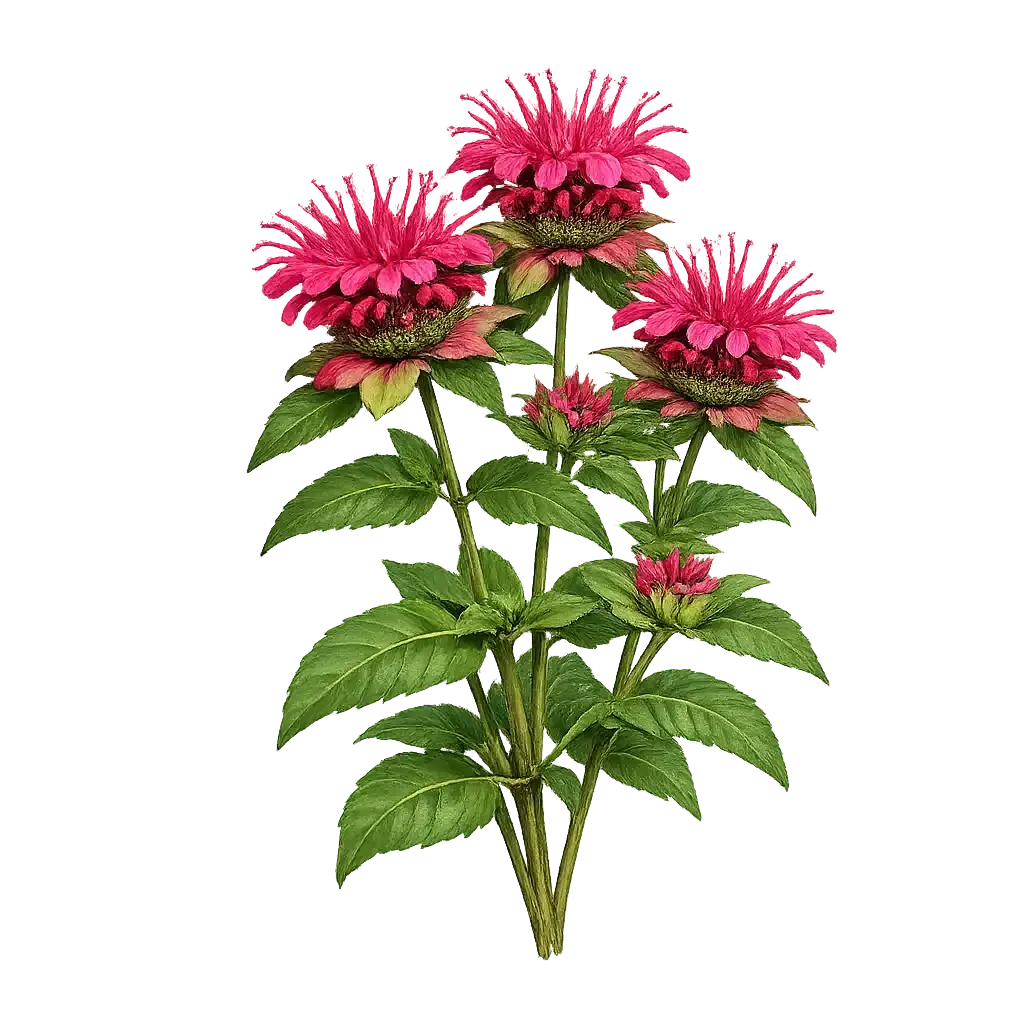
Vivid scarlet red in the species; the single most visually striking flower color in the summer herb garden; cultivated varieties extend the color range into pink, lavender, purple, and white, though the species scarlet is the form most attractive to hummingbirds and most historically and medicinally documented; named cultivars include Cambridge Scarlet (reliable scarlet), Gardenview Scarlet (mildew-resistant scarlet), Raspberry Wine (deep wine-red), and Marshall's Delight (clear pink with good mildew resistance)
Flavor and Fragrance
More citrus-bergamot and less oregano-thyme than wild bergamot; the essential oil chemistry of Monarda didyma has a higher proportion of citral, geraniol, and linalool relative to thymol and carvacrol compared to Monarda fistulosa; this produces a flavor that sits between Earl Grey tea and spiced citrus rather than the oregano-lavender of wild bergamot; the two species are complementary rather than interchangeable in flavor applications
Primary Active Compounds
Thymol and carvacrol (antimicrobial phenols; present at lower relative concentrations than in wild bergamot but still pharmacologically significant); linalool and geraniol (monoterpene alcohols; anti-anxiety, anti-inflammatory, antimicrobial); citral (aldehyde; contributes citrus note; antimicrobial); rosmarinic acid (anti-inflammatory polyphenol; consistent across Lamiaceae family); luteolin; tannins; mucilaginous polysaccharides
Hummingbird Value
Exceptional; the scarlet color and long tube length of Monarda didyma flowers are a precise morphological match for ruby-throated hummingbird foraging: red is the color hummingbirds preferentially seek, and the tube length matches the hummingbird bill length in a way that excludes many competing insects and ensures that the hummingbird, while feeding, contacts the anthers and stigmas and provides effective pollination; bee balm is consistently listed as among the top five plants for attracting ruby-throated hummingbirds across its native range
Indigenous Use
The Oswego, Haudenosaunee (Iroquois), and other eastern woodland nations used Monarda didyma as a beverage herb, a cold and fever remedy, and a treatment for digestive complaints; the essential oil was applied topically for skin conditions and as an insect repellent; the beverage use was adopted by American colonists after the Boston Tea Party as a substitute for British black tea and became known as Oswego tea in reference to the Indigenous source
Bee balm is the herb that stops visitors in the midsummer garden. The vivid scarlet flower heads, each a dense crown of long curved tubular flowers that radiate outward in every direction like a botanical firework, draw the eye from across the garden; the ruby-throated hummingbirds they attract bring movement and flash to the border from July through August; and the citrus-spice fragrance of the bruised leaves links the plant to its history as Oswego tea, the colonial-era beverage that American families brewed when British tea imports were politically unacceptable and the native plants of their continent proved themselves entirely equal to the task. The medicinal chemistry is real and complementary to wild bergamot: a higher proportion of citral and linalool alongside the thymol and carvacrol produces a flavor and therapeutic profile that is more citrus-forward and gentler in character than its prairie relative, better suited to the soothing, diaphoretic, and carminative applications where warmth and comfort rather than pungency are the qualities wanted. The two Monarda species together cover the full range of the genus's practical applications, and a garden that grows both has one of the most complete native medicinal plantings in the temperate herb world.
Introduction
The historical moment that fixed bee balm in the American culinary and cultural record is the Boston Tea Party of December 1773, when colonists protesting British taxation dumped an entire shipment of East India Company tea into Boston Harbor. The political decision to boycott British tea that followed required American households to find substitute beverages, and among the plants they turned to was Monarda didyma, whose use as a pleasant aromatic beverage herb had been documented from the Oswego people by botanical explorer John Bartram thirty years earlier. Oswego tea entered American domestic practice as a patriotic as well as a practical choice, and the plant's association with that moment of colonial identity has given it a cultural resonance in American garden history that few other herbs share.
Bee balm was introduced to European gardens in the mid-seventeenth century through the active plant exchange between the colonies and English botanical gardens of the period, and it became a cultivated ornamental across Europe almost immediately, valued for the vivid scarlet flower color that was unusual in the European garden palette of the time. Philip Miller's Gardener's Dictionary of 1731 describes it as a showy border plant of the first order, a judgment that three centuries of ornamental horticulture has continued to endorse.
The Monarda genus as a whole, encompassing approximately twenty species native to North America, occupies a coherent medicinal position: all species share the Lamiaceae essential oil chemistry with thymol, carvacrol, and their aromatic relatives, all have documented Indigenous medicinal use for respiratory, digestive, and antimicrobial applications, and all produce showy globular flower heads that are among the most productive pollinator plants in the summer garden. The distinction between species is primarily one of flavor emphasis and habitat preference rather than fundamental difference in chemistry or application.
Bee Balm vs. Wild Bergamot: Knowing Both
Because this series covers both Monarda didyma (bee balm) and Monarda fistulosa (wild bergamot) as separate entries, it is worth being direct about the relationship between the two and the practical reasons to grow both rather than choosing one.
The differences are real and meaningful. Wild bergamot is the prairie species: drought-tolerant, adapted to lean dry soils, lavender-flowered, with a stronger thymol-carvacrol profile and the more pungent oregano-lavender flavor. It has the broader native range, extending across most of North America, and the more extensive Indigenous medicinal use record. Bee balm is the woodland-edge species: more tolerant of moisture and partial shade, scarlet-flowered, with a higher proportion of citral and linalool producing a more citrus-forward flavor, and the more spectacular ornamental presence in the garden. The hummingbird attraction of bee balm is specific and reliable in a way that wild bergamot does not replicate; the drought tolerance and prairie-garden suitability of wild bergamot is a practical advantage that bee balm does not offer.
In practice, the two plants together cover different positions in the garden, different flavor applications in the kitchen, and different ecological functions in the pollinator community. A dry sunny border favors wild bergamot; a moist partly shaded bed near a woodland edge favors bee balm. An oregano-forward culinary application favors wild bergamot; a citrus-spice tea or dessert application favors bee balm. The bumblebees prefer wild bergamot's accessible open flowers while the hummingbirds work the long red tubes of bee balm almost exclusively. There is no reason to choose between them.
How to Grow
Site and Soil
Bee balm's native habitat of moist, rich woodland edges and stream banks defines its optimal garden conditions more precisely than most herbs in this series. It prefers moderately fertile, consistently moist but well-drained soil in full sun to partial shade. Unlike wild bergamot, which performs better under mild stress on lean dry soils, bee balm genuinely benefits from soil fertility and consistent moisture and produces its best growth and flowering on rich amended beds that approximate its woodland edge origins.
Full sun produces the most flowers and the best mildew resistance; partial shade is tolerated and sometimes preferred in hot southern climates where afternoon shade reduces heat stress and prolongs the flowering season. The critical failure mode for bee balm is drought in combination with heat: plants under serious moisture stress in summer perform poorly, produce fewer flowers, and are most susceptible to powdery mildew. Consistent soil moisture through the summer, either from rainfall or irrigation, is the primary cultural requirement that distinguishes bee balm's needs from wild bergamot's.
Establishment and Spread
Bee balm grows readily from seed, division, or stem cuttings. Named cultivars do not come true from seed and must be propagated by division or cuttings to maintain their specific characteristics; the species form is variable from seed but uniformly vigorous. Start seeds indoors eight to ten weeks before the last frost or direct sow outdoors in autumn; cold stratification improves germination rates for spring sowing. Transplants establish readily.
Division is the most reliable propagation method and should be practiced every two to three years in any case to maintain the vigor of the planting. Bee balm's rhizomes spread outward from the original planting center annually; the center of an old clump often becomes hollow and dies out while the productive growth is at the outer edges. Digging and replanting the outer sections every two to three years renews the planting completely and provides new plants for additional areas.
Space plants eighteen to twenty-four inches apart; the spreading habit fills the intervening space within two seasons in good growing conditions.
Powdery Mildew Management
Powdery mildew is the defining management challenge for bee balm and Monarda species in cultivation, and it requires direct address rather than dismissal. The white powdery coating on the upper leaf surface appears in late summer in virtually every planting in humid climates, regardless of care taken; it is most severe in crowded plantings with poor air circulation, in shade, and during dry spells following wet periods.
The most effective management combination: select a mildew-resistant cultivar for ornamental plantings where late-season appearance matters (Gardenview Scarlet and Marshall's Delight are the most recommended for mildew resistance while maintaining good flower quality); space plants generously; grow in full sun with good air circulation; avoid overhead watering; and cut the entire clump to the ground in late summer after flowering, which removes the mildewed foliage and stimulates clean new growth through autumn. The mildew does not kill the plant and does not affect the quality of flowers or leaves harvested before it appears; it is an aesthetic problem of the post-flowering season rather than a health threat to the planting.
Harvesting
Harvest flower heads when fully open and the majority of tubular flowers in each head are extended, cutting stems with several leaf pairs below the head. Morning harvest after the dew has dried captures the highest essential oil content. Fresh flowers are used immediately for culinary applications; flowers for drying are hung in small bundles or spread on screens in a warm, shaded, ventilated space and dried for seven to ten days.
The scarlet flower petals, separated from the calyx, retain their vivid color through drying better than most red herb flowers, making bee balm one of the more rewarding herbs for dried flower preparation. The dried whole heads are used in potpourri, herbal wreaths, and decorative arrangements where the globe shape and the deep red retain visual impact for months in dry indoor conditions.
Harvest leaves for tea and culinary use from spring through early summer, before flowering, when the citrus-aromatic oil content is highest and the leaves are most tender. Dry in small bundles away from light and heat; properly dried bee balm leaf retains its characteristic citrus-spice fragrance for twelve months in sealed glass storage.
Culinary Uses
Oswego Tea
The traditional Oswego tea preparation is one to two teaspoons of dried leaf and flower per cup of just-off-boil water, steeped covered for ten minutes. The result is a warm amber tea with a distinctive citrus-spice character: bergamot citrus in the top note, warm spice in the body, and a gentle floral quality from the linalool and geraniol. It is one of the more immediately pleasant tasting herb teas in the series, with a flavor that requires no acquired taste or tolerance for medicinal bitterness.
The flavor profile is close enough to Earl Grey that bee balm tea is sometimes described as a homegrown alternative to the bergamot-orange-flavored black tea, though the comparison only holds loosely: Earl Grey has the tannin body of black tea that bee balm lacks, and the citrus character is from a different botanical source. What bee balm tea has that Earl Grey does not is a genuine antimicrobial and antispasmodic activity, making it simultaneously a pleasant everyday beverage and a medicinal preparation.
Culinary Flowers and Leaves
The vivid scarlet petals of bee balm, separated from the calyx and used fresh, are among the most visually dramatic edible flower garnishes in the herb garden. The flavor is mild, mildly spicy, and slightly citrus; the color is a vivid red that holds in cold preparations and fades in heat. Fresh petals scattered over fruit salads, green salads, and cold desserts, or floated on summer drinks, provide a color impact that no other common garden herb flower matches.
Dried bee balm petals are used as a spice and garnish in the same way dried rose petals are used in Middle Eastern and North African cooking: ground into spice blends, stirred into rice dishes, incorporated into herb butters, or sprinkled over finished savory dishes where the color and mild floral-spice character add complexity. The combination of bee balm petals with dried rose petals, lavender, and thyme produces a spice blend with a floral depth appropriate to lamb, roasted vegetables, and grain salads.
The fresh leaves, finely chopped, are used as an oregano-bergamot seasoning in cooking, particularly with poultry, pork, and bean dishes where the citrus-spice quality of bee balm complements the richness of the protein. The flavor is more delicate than wild bergamot in cooked applications and does not hold as well in extended heat; bee balm leaf is best added in the final minutes of cooking or used raw as a finishing herb.
Oswego tea and its variations
The base Oswego tea is straightforward: one to two teaspoons of dried bee balm leaf and flower per cup of water just off the boil, steeped covered for ten minutes, strained and served. The covered steep is essential; the citral, linalool, and thymol that make the tea both pleasant and medicinal are volatile and evaporate with uncovered steeping, producing a weaker and less aromatic cup.
From that base, the variations are worth knowing. Bee balm and rose hip tea combines equal parts dried bee balm and dried rose hip pieces, producing a bright, vitamin C-rich blend with a fruity-citrus character that is particularly good cold-steeped overnight in the refrigerator. Bee balm and chamomile tea, equal parts of both, pairs the citrus-spice warmth of bee balm with the apple-floral sedative quality of chamomile for an evening relaxation blend whose combined flavor is more nuanced than either herb alone. Bee balm and elderflower tea, two parts bee balm to one part dried elderflower, creates a diaphoretic blend appropriate at the onset of a cold or fever, combining the warming aromatic action of bee balm with the gentle diaphoretic of elderflower for a more comprehensive fever-support preparation than either provides individually.
Bee balm lemonade, made by preparing a strong bee balm tea, cooling it, and combining it with freshly squeezed lemon juice and honey to taste, is a summer drink that benefits from both the flavor and the fresh red color of the flowers, which tints the lemonade a faint pink before the lemon acid shifts it. Pour over ice and garnish with fresh bee balm flower heads and lemon slices. The drink captures both the traditional Oswego tea heritage and the summer garden context of the plant in a single preparation that is appropriate for guests who have not encountered the herb before.
Medicinal Uses
Respiratory and Fever Support
The thymol and carvacrol content of bee balm, though proportionally lower than in wild bergamot, remains pharmacologically significant for antimicrobial and antispasmodic applications. Hot bee balm tea taken at the onset of a cold or respiratory infection provides the same warming, diaphoretic, and antispasmodic support as wild bergamot tea, with a more citrus-forward flavor that many people find more immediately appealing when ill. The diaphoretic action, promoting perspiration during the rising phase of a fever, is supported by the hot liquid itself as well as by the specific pharmacological action of the essential oil components.
The linalool and geraniol content that distinguishes bee balm from wild bergamot adds an anti-anxiety and mild sedative dimension to the respiratory application: a cup of bee balm tea during a cold or flu provides warmth, antimicrobial volatile compounds, bronchial antispasmodic activity, and mild anxiolytic action simultaneously. This multi-mechanism profile is the pharmacological argument for why hot aromatic herbal teas have supported respiratory illness management across essentially every traditional culture that had access to aromatic Lamiaceae plants.
Digestive and Carminative
The same essential oil chemistry that makes bee balm a respiratory herb makes it an effective carminative and digestive antispasmodic. A cup of bee balm tea after a heavy or gas-producing meal relieves bloating and digestive discomfort through the same smooth muscle relaxation mechanism as mint, thyme, and oregano tea. The flavor is more pleasant to most palates than mint for people who find mint too cool or too sharp in the digestive tea context; bee balm provides a warmer, gentler carminative action with a flavor that many people prefer.
Topical Applications
Fresh bruised bee balm leaves applied topically deliver thymol, carvacrol, and geraniol to the skin surface, providing antimicrobial activity against minor wound infections and anti-inflammatory relief from insect bites, stings, and minor skin irritations. The traditional use of bee balm preparations for bee stings, which gave the plant one interpretation of its common name, reflects both the anti-inflammatory action of the essential oil components and the soothing effect of the mucilaginous polysaccharides in the leaf tissue applied as a poultice.
A strong decoction of bee balm leaf used as a topical wash for fungal skin infections, particularly athlete's foot, is consistent with the documented antifungal activity of thymol and linalool against Candida and dermatophyte species in laboratory assays. This application parallels the topical use of thyme decoction for the same purpose and is appropriate as a complementary homestead first-response treatment.
Cautions: Bee balm at normal culinary tea and topical use quantities has a long, safe traditional use record with no significant documented toxicity. The following points apply. The essential oil at concentrated extract levels is an irritant; undiluted Monarda essential oil should not be applied directly to skin without a carrier oil; this caution applies to concentrated extracts and not to the herb tea or fresh leaf preparations. Pregnancy: the thymol and carvacrol content places bee balm in the traditional emmenagogue category at high medicinal doses; one to two cups of tea daily is within the range of safe culinary and supportive use, but large habitual doses during pregnancy are not recommended. The thymol content creates the same thyroid medication interaction consideration as wild bergamot and other thymol-containing Lamiaceae: people taking thyroid medications who wish to consume bee balm regularly should discuss this with their prescriber. Lamiaceae family allergy: people with known allergy to other mint-family plants should approach bee balm with appropriate caution. The spreading rhizomatous habit is vigorous in moist, rich soil; in formal beds bee balm may require annual containment to prevent it from overtaking neighboring plants; a physical barrier or regular division maintains the colony within its intended area. Named cultivars selected for mildew resistance, disease, or double flowers may have different essential oil profiles than the species form; for medicinal use, the species Monarda didyma or a cultivar with confirmed high essential oil content is preferred over ornamental cultivars selected primarily for visual characteristics.
The Hummingbird Connection
The relationship between Monarda didyma and the ruby-throated hummingbird is one of the cleaner examples of coevolved plant-pollinator morphology in the temperate garden. The flower tube length of bee balm corresponds closely to the bill length of the ruby-throated hummingbird; the vivid scarlet color falls precisely in the wavelength range that hummingbirds preferentially seek; and the flowers produce nectar continuously through the peak of the hummingbird's summer range in the eastern United States. The result is a plant that is, in practical terms, a hummingbird magnet from July through August, drawing individual birds into repeated visits that can be observed closely and that provide the kind of garden experience that no purchased ornamental fully replicates.
For the homestead garden with a broad ecological function, the hummingbird attraction of bee balm is not merely aesthetic. Ruby-throated hummingbirds are significant pollinators of tubular-flowered plants in the eastern North American garden, and their regular presence increases the pollination rate of compatible flowering crops nearby. The combination of bee balm for hummingbird attraction, wild bergamot for bumblebee attraction, and echinacea for both bees and butterflies produces a native plant community that actively supports the full pollinator guild across the summer season.
Pros and Cons
Advantages
The most visually spectacular flowering herb in this series for midsummer garden impact; the vivid scarlet globular flower heads on tall upright stems create a border presence that earns its space many times over purely on ornamental grounds, independent of any culinary or medicinal contribution
Reliable ruby-throated hummingbird attraction from July through August in eastern North America; for homesteaders who value the presence of hummingbirds in the garden, bee balm is the single most effective planting for the purpose, with a coevolutionary relationship that makes the attraction close to guaranteed in the bird's range
The citrus-bergamot flavor profile of bee balm tea is among the most immediately pleasant in this series; the Oswego tea tradition provides a well-tested beverage application that requires no acquired taste; it is an herb that the whole household drinks rather than one that the medicinal herb grower uses alone
Greater moisture and partial shade tolerance than wild bergamot makes it appropriate for garden positions that are unsuitable for most other culinary and medicinal herbs: the partly shaded moist bed near a building foundation or under a high tree canopy that would fail most Mediterranean herbs suits bee balm entirely
The dried scarlet flowers retain their vivid color through drying and storage better than most red herb flowers, making bee balm one of the most rewarding herbs for dried floral preparations including wreaths, potpourri, and decorative arrangements where the visual impact of the dried flower continues to contribute for months
Limitations
Powdery mildew on the foliage in late summer is essentially universal in humid climates and represents the most significant ongoing management challenge; while mildew-resistant cultivars mitigate the problem, no cultivar completely eliminates it in conditions where high humidity, heat, and variable moisture coincide; the planting will require the post-flowering cutback as a routine management measure in most gardens
Moisture requirement distinguishes bee balm from most other perennial herbs in this series, which are predominantly drought-tolerant Mediterranean or prairie species; gardens without consistent summer rainfall or irrigation may find bee balm unreliable, and drought-stressed plants are the most susceptible to both poor flower production and powdery mildew
The spreading rhizomatous habit requires management in formal beds; without containment or regular division, bee balm will overtake neighboring plants over three to four seasons; the spreading is an asset in a naturalistic or wild garden setting but a genuine management demand in a structured border
Named cultivars for ornamental characteristics may have reduced essential oil content compared to the species form; growers who purchase bee balm from ornamental nurseries without specifying essential oil content for medicinal use may find that highly bred cultivars deliver less aromatic and pharmacological potency per unit of harvest than the unimproved species
Hummingbird attraction is specific to the range of the ruby-throated hummingbird in eastern North America; in western North America, where the dominant hummingbird species differ, bee balm is less specifically matched to local pollinators, and wild bergamot's broader pollinator appeal across bee species may be a more productive choice in western gardens
Final Thoughts
Bee balm earns its position in the herb garden on three independent grounds and does not need all three to justify its presence. The ornamental case alone is sufficient: the scarlet flower heads in July and August are among the most vivid things the temperate garden produces, and a planting of bee balm in full flower stops people in their tracks in a way that few other herbs do. The hummingbird case adds a dimension of living garden experience that no ornamental can substitute. The medicinal and culinary case provides a harvest with genuine value and a historical depth that connects the modern homestead to both the Indigenous knowledge and the colonial American domestic tradition that shaped the use of this plant.
Grow it in moist, fertile soil in a sunny position. Divide it every two to three years. Cut it to the ground after flowering when the mildew appears. Brew the Oswego tea on the first day of a cold. Watch the hummingbirds in July. These are instructions that every generation of gardeners who grew bee balm would recognize as unchanged across three centuries of the plant's cultivation history.