
Borage
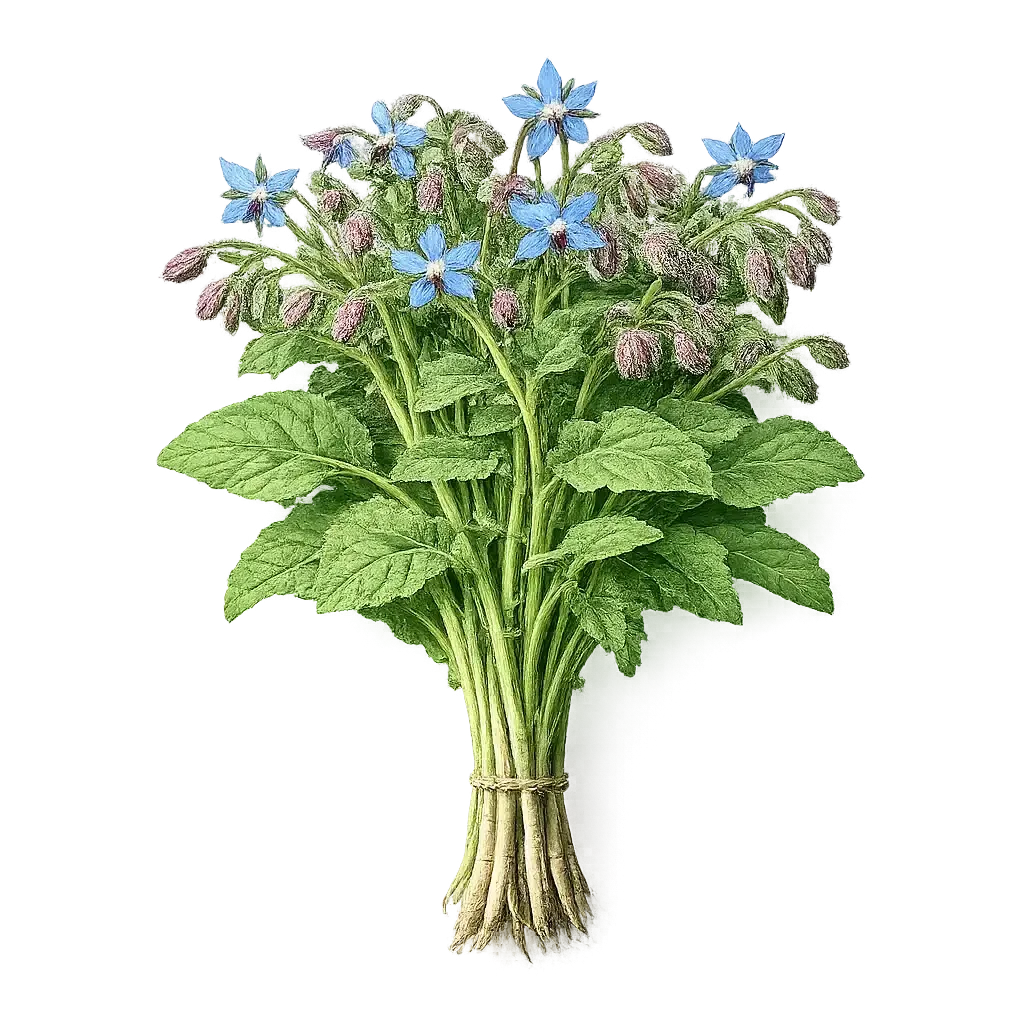
Written By Arthur Simitian
QUICK FACTS
Common Name
Borage, Starflower; the name borage is generally considered to derive from the Latin borrago or the Arabic abu rach (father of sweat), a reference to its traditional use as a diaphoretic herb; the name Starflower refers to the perfectly five-pointed star shape of the flowers
Scientific Name
Borago officinalis; Boraginaceae family; the species name officinalis indicates historical official medicinal use; native to the Mediterranean region; cultivated in European gardens since at least the medieval period and naturalized extensively across Europe, North America, and other temperate regions as a garden escape
Plant Type
Hardy annual; self-seeds so prolifically and reliably in hospitable conditions that it effectively behaves as a permanent garden resident from the second season forward without deliberate replanting; the seeds germinate readily in autumn or spring and seedlings are frost-tolerant, meaning autumn-sown volunteers often overwinter and flower earlier than spring-sown plants
Hardiness
Annual; seedlings tolerate light frost; the plant is killed by hard freezing but re-establishes readily from self-sown seed; in mild-winter climates autumn volunteers flower through the cool season; in cold-winter climates it operates as a spring-through-autumn annual
Height
Eighteen to thirty-six inches, depending on soil fertility and moisture; on rich, well-watered soil a single plant can become a substantial branching shrub; on leaner dry soil it stays more compact and produces the same flower density at smaller scale
Flower Color
Vivid true blue; one of the relatively few genuinely blue flowers in the herb and vegetable garden; aging flowers fade from blue through pale blue to pink or lilac, creating color variation within the same flower head that is visually attractive; white-flowered cultivars exist but the blue-flowered species is the standard medicinal and culinary form
Harvest Parts
Flowers: the primary harvest for culinary use, harvested when fully open; the entire star including the dark anther cone is used, or the petals alone after removing the green calyx; Leaves: young leaves before bristles harden, used raw in small quantities or cooked; Seeds: cold-pressed for the seed oil
Primary Active Compounds
Seed oil: gamma-linolenic acid (GLA; an omega-6 essential fatty acid; borage seed oil at 17 to 25 percent GLA content is the richest botanical source of GLA, surpassing evening primrose oil; GLA is the precursor to anti-inflammatory prostaglandins of the PGE1 series and is the primary reason borage seed oil is commercially produced); pyrrolizidine alkaloids (PAs; present in the leaves and flowers at low levels; hepatotoxic at high doses; the key safety consideration for internal leaf and flower use; see cautions); potassium, calcium, and vitamin C in fresh leaves; mucilaginous polysaccharides; tannins
Traditional Uses
European herbal tradition from Dioscorides onward: mood elevation and courage; the Latin and English herbals consistently describe borage as a plant that cheers the heart and drives away sadness; adrenal support and recovery from illness; diaphoretic tea for fevers; topical application for dry and inflamed skin; the seed oil was not part of the traditional preparation record but has become a significant modern commercial product for skin care and inflammatory conditions
Pollinator Value
Exceptionally high; borage flowers produce nectar continuously through the day, accessible in the open star flowers to bumblebees, honeybees, hoverflies, and small butterflies; the plant is one of the most reliably attractive bee herbs in the temperate garden and is traditionally interplanted with strawberries and cucumbers to improve pollination rates and fruit set; beekeepers have traditionally valued borage as a continuous summer nectar source
Borage is the herb that earns its place in the garden three times over: once for the vivid true-blue star flowers that are among the most visually arresting of any herb in flower, once for the exceptional pollinator value that makes it a genuine functional companion plant for fruit and vegetable crops, and once for the GLA-rich seed oil that represents the richest botanical source of gamma-linolenic acid available from any cultivated plant. The flowers are edible, beautiful, and sufficiently striking to elevate any preparation they garnish from the ordinary to the visually memorable; the plant itself is so vigorous and such a reliable self-seeder that a single first-year planting requires no further deliberate cultivation; and the combination of constant blue flowers from midsummer through autumn with the large silver-bristled architectural leaves gives the plant a garden presence that most ornamentals cannot match. The one meaningful caution, the pyrrolizidine alkaloid content of the leaves and flowers at concentrated doses, is a genuine consideration for the internal leaf use that European herbals prescribed liberally but that modern phytotoxicology has placed under appropriate restriction. Understood correctly, this does not diminish borage's value as a garden plant, a flower garnish, or a seed oil source; it simply clarifies that the leaf and flower are used in culinary applications as occasional garnishes and flavorings rather than as the daily tonic herb the older herbals described.
Introduction
Borago officinalis has appeared in European gardens and herbals since antiquity; the plant was known to Dioscorides and Pliny, was cultivated in medieval monastery gardens as a medicinal and culinary plant, and appears in virtually every major European herbal from the fifteenth century onward with consistent descriptions of its mood-elevating and heart-cheering properties. The repeated traditional claim that borage drives away sadness and instills courage led to its use in the cups of wine given to soldiers before battle in Roman and medieval tradition, a use that persisted into the seventeenth century when borage flowers were floated on the claret cups and wine punches of English summer entertaining.
The plant naturalized across Europe and spread to North America, Australia, and New Zealand, where it is now common on disturbed ground and roadsides in temperate regions. Its capacity for self-seeding means that a single plant introduced to a garden in one year produces an established population within two or three seasons that requires no management to persist.
The modern commercial significance of borage is primarily the seed oil, which is produced at industrial scale in Canada and Europe as the leading source of GLA for the dietary supplement and cosmetic industries. The cultivated varieties selected for seed oil production have been bred for high GLA content and uniform seed-setting characteristics, though the standard garden variety also produces seed oil at levels that make hand-processing feasible at homestead scale.
How to Grow
Starting and Establishment
Direct sow borage seeds in their final position in spring after the last frost, or in autumn in mild climates where the seedlings will overwinter. The large seeds germinate readily in two to five days at moderate soil temperatures and the seedlings establish quickly. Borage develops a long taproot that makes transplanting disruptive; direct sowing in the final position is always preferable, though young seedlings at the cotyledon stage can be moved carefully if needed.
Sow one half inch deep in a sunny, well-drained position. Borage is not demanding about soil fertility; it performs adequately on lean, poor soils and produces its best seed oil on moderately fertile, well-drained ground rather than on heavily amended, rich beds. Thin seedlings to twelve to eighteen inches apart as they develop; crowded plants produce fewer flowers and more aphid pressure.
The first flowers appear approximately eight weeks after germination and continue until the first hard frost. Once established in the garden, borage self-seeds so reliably that the primary management question becomes where the volunteers appear and which ones to allow rather than how to maintain the population. A single plant can produce hundreds of seeds; the self-seeding population builds quickly.
Companion Planting Role
The traditional companion planting recommendation to interplant borage with strawberries and cucumbers has a rational basis: the continuous nectar production of borage flowers attracts bumblebees and honeybees in high density through the summer, and the presence of these pollinators improves the fruit set of nearby cucurbits and strawberries significantly. The effect is most pronounced in gardens where wild pollinator populations are limited and where cucumber, squash, and melon crops would otherwise suffer from poor pollination in mid-summer.
The claim that borage repels tomato hornworm is a traditional companion planting assertion without strong scientific support; the pollinator attraction benefit is the credible and well-documented functional contribution. Planting borage near the edges of the vegetable garden where its large size does not shade crops, but where its flowers are accessible to foraging bees working the nearby vegetable flowers, is the most productive spatial arrangement.
Culinary Uses
Edible Flowers
The borage flower is one of the most visually striking edible garnishes available from the herb garden, and its use as such has been a standard feature of English summer cooking from the Tudor period onward. The vivid blue five-pointed stars, removed from the green calyx for plating, are scattered over salads, cold soups, summer desserts, cheese boards, and drinks where the blue-violet color provides a visual contrast that no other common herb flower replicates. The flavor is mild, slightly cucumber-like, with a faint honey quality from the nectar; the texture is tender and the flowers hold their color reasonably well for several hours after plating.
Borage flowers frozen in ice cubes are a preparation with a long English summer drinks tradition: a single flower centered in each cube of a standard ice tray, topped up with water and frozen, produces ice cubes that display the perfect blue star through the clear ice. These flower cubes are used in summer punches, lemonade, gin and tonic, and water carafes where the visual effect is both striking and immediately communicative of the garden provenance of the preparation.
Candied borage flowers, made by painting each flower with beaten egg white, dusting with fine sugar, and drying in a low oven, produce a confection used to decorate cakes and desserts. The technique preserves the star shape and the blue color, though the blue fades slightly in storage; candied flowers keep for two to three weeks in a cool, dry, dark container.
Leaves
Young borage leaves before the bristles have fully hardened have a mild cucumber flavor similar to salad burnet but more assertive. They are used in small quantities in salads, finely chopped in cream cheese, or added to soups and cooked dishes where their flavor contribution is more cucumber than herb. The bristly texture of older leaves makes them unpleasant raw; cooking softens the bristles and the cooked leaf is used like spinach in soups and braised dishes in some Italian and Spanish regional traditions, where borage appears in pasta fillings and rice dishes.
The pyrrolizidine alkaloid content of the leaves is the constraint on regular substantial leaf consumption; see the cautions section for the specific guidance. At the culinary use level of young leaves as an occasional fresh garnish or as a cooked green in modest portions, the PA exposure is within the range considered acceptable by European food safety authorities, which have set guidance values rather than prohibitions for borage leaf in food use.
Borage flower ice and summer drinks
The flower-in-ice preparation is among the simplest and most visually effective things the herb garden produces, requiring nothing more than flowers, an ice tray, and time. The result is a garnish that communicates both garden provenance and visual care in a way that no commercial product replicates.
Harvest fully open borage flowers in the morning, pinching them cleanly from their calyxes at the base of the petals. The dark anther cone at the center is part of the visual appeal and should remain. Float one flower face-down in each well of a standard ice cube tray. Add just enough water to barely cover the flower and freeze until set; this locks the flower in position. Then fill each well completely with water and freeze again until solid. The two-stage process prevents the flower from floating to the surface of the cube.
The finished cubes display the perfect blue star centered within clear ice, which is most visible against light-colored drinks. Use in a jug of water with sliced cucumber and mint for a summer table drink; in lemonade; in gin and tonic; or in any cold punch where the visual element of the drinks service matters. The flowers retain their vivid blue color in the ice for several days in the freezer.
A companion preparation: a handful of fresh borage flowers and a few sprigs of fresh mint pressed between the pages of a heavy book and dried for ten days produce pressed botanical decorations for paper and stationery. The blue color dries to a softer periwinkle. This is outside the edible application but worth noting for growers with excess flowers and an interest in botanical craft.
Borage Seed Oil
Borage seed oil at seventeen to twenty-five percent gamma-linolenic acid content is the richest botanical source of GLA commercially available, surpassing evening primrose oil at eight to ten percent and black currant seed oil at fifteen to nineteen percent. GLA is an omega-6 polyunsaturated fatty acid that the body uses to produce prostaglandins of the PGE1 series, which are anti-inflammatory in their primary action and play a role in immune modulation, skin barrier function, and hormonal regulation.
The commercial application of borage seed oil is primarily in skin care, where GLA is used in formulations for dry skin, eczema, and psoriasis, and as a dietary supplement for inflammatory conditions including rheumatoid arthritis, atopic dermatitis, and premenstrual syndrome. The clinical trial evidence for borage seed oil in rheumatoid arthritis is among the more robust in the botanical supplement literature; a systematic review published in 2000 identified borage oil as one of the better-supported botanical supplements for rheumatoid joint inflammation, though the evidence base remains smaller than for pharmaceutical interventions.
At homestead scale, cold-pressing borage seed oil requires more seed than most garden plantings produce; a single plant yields perhaps five to ten grams of seed, and oil pressing requires meaningful seed quantities. The practical homestead applications are the culinary and ornamental flower uses, the companion planting role, and the ornamental value, with the seed oil remaining primarily a commercial product. A homestead grower can collect borage seed from a productive planting for saving and replanting, ensuring the self-seeding population is supplemented deliberately in areas where it is wanted.
Cautions: The primary safety consideration for borage is the pyrrolizidine alkaloid content of the leaves and flowers. PAs are hepatotoxic compounds that cause cumulative liver damage with chronic high-dose consumption; they are well-documented in Boraginaceae family plants including comfrey, which contains PAs at much higher concentrations than borage. Borage leaf and flower PA levels are significantly lower than comfrey and are generally considered within safe limits for occasional culinary use as a garnish or food ingredient; the European Food Safety Authority and German federal health authorities have both assessed borage leaf for food use and set guidance for acceptable daily intake rather than prohibition. The specific guidance is to avoid consuming large quantities of borage leaf or flower daily over extended periods; using borage flowers as an occasional garnish or the young leaves as an occasional cooked green is within the range considered acceptable by European food regulators. Concentrated preparations of borage leaf for internal medicinal use at high doses are not recommended. Pregnancy: PA-containing plants are contraindicated during pregnancy at any dose level; borage flowers and leaves should be avoided internally during pregnancy. Borage seed oil does not contain measurable PAs, as the alkaloids are not extracted into the seed oil; borage seed oil supplements are considered PA-free and are not subject to the same caution as the leaf and flower. Borage is among the most aphid-attractive plants in the herb garden; established infestations can be managed with a strong water spray or by removing heavily infested growing tips; the aphids rarely cause permanent plant damage and are controlled by the ladybirds and hoverfly larvae that borage's flowers attract, often without intervention. Boraginaceae family allergy is uncommon but documented; people with known comfrey or other Boraginaceae sensitivity should approach borage with appropriate caution.
Borage in the Garden
The visual presence of borage in flower through the summer months is among the most valuable ornamental contributions any herb makes to the kitchen garden. The combination of the large silver-bristled gray-green leaves, the nodding then reflexing vivid blue star flowers, and the continuous flowering over three to four months from midsummer through autumn produces a plant that works simultaneously as an ornamental, a pollinator attractor, and a culinary source. Few annual herbs achieve this breadth of garden value from a single planting.
The self-seeding character, once understood and accommodated rather than fought against, transforms borage from an annual that needs to be replanted into a permanent garden resident that simply distributes itself across available ground each year. Managing the self-seeding population involves pulling unwanted volunteers when small and easy to remove, and allowing the desired plants to flower and set seed in the positions where they are most useful: near the vegetable beds for pollinator service, at the edges of paths where the flowers are accessible for harvesting, and in gaps in the kitchen garden border where the scale and the blue of the flowers contribute most to the visual composition.
Pros and Cons
Advantages
The vivid true-blue star flowers are among the most visually distinctive of any herb in flower; no other common culinary herb produces the same clear blue, making borage flowers uniquely valuable as an edible garnish where visual impact and color contrast are the primary consideration
Exceptional pollinator value throughout the summer; the continuous nectar production of the open star flowers attracts bumblebees, honeybees, and hoverflies in density that measurably improves pollination rates of nearby cucurbits, strawberries, and other open-flowered crops; this functional companion planting benefit is real and documented rather than merely traditional
Self-seeds so reliably and prolifically that a single first-year planting requires no further deliberate cultivation; from the second season the population self-manages, with volunteer seedlings appearing in the areas where seed fell from the previous year's plants; the maintenance requirement after establishment approaches zero
Borage seed oil is the richest botanical source of GLA available, surpassing evening primrose oil and black currant seed oil; for homestead growers interested in the medicinal seed oil, the cultivated plant is the highest-yielding source
Fast from sowing to flower; approximately eight weeks from direct sowing to first open flowers, making borage one of the quickest-flowering herbs in the series and appropriate for filling gaps in the summer garden with color and pollinator value on a short timeline
Limitations
The pyrrolizidine alkaloid content of the leaves and flowers places a meaningful restriction on the internal leaf use that the older herbal tradition describes; borage is appropriate as a flower garnish and occasional cooked green at culinary quantities, not as a daily tonic herb or large-dose preparation; growers who expect to use it as the older herbals describe will need to adjust their approach to the modern phytotoxicological assessment
The self-seeding that makes borage low-maintenance also makes it potentially invasive in the garden context; volunteers appear in paths, between paving stones, in vegetable rows, and in neighboring beds; managing the population requires pulling volunteers when small, which becomes a regular task in a garden where borage has been established for several seasons
Scale: a well-grown borage plant at eighteen to thirty-six inches tall with large spreading branches occupies substantial ground; it is not a compact herb for small intensive kitchen gardens and competes with neighboring plants for light and moisture if not given adequate space from the outset
Aphid attraction; borage is among the most reliably aphid-hosting plants in the summer garden, and established colonies can disfigure the growing tips and reduce flowering; while these aphids are usually managed by the predator insects the borage flowers attract, the infestation period is visually unpleasant and can affect young plants before the predator population builds
The bristly texture of the leaves makes them less pleasant to handle than most herbs; harvesting and handling borage requires comfortable contact with the stiff white hairs, which cause a mild skin irritation similar to fine fiberglass in sensitive individuals; gloves are appropriate for handling large quantities
Final Thoughts
Borage asks very little: a sunny spot, direct sowing once, and the patience to let it find its own level in the garden across successive self-seeding seasons. What it gives in return is continuous vivid blue flowers through the summer months, a steady stream of bees working those flowers toward the vegetable beds, an edible garnish that is visually irreplaceable, and an architectural plant presence that earns its space many times over.
The PA caution is real and should be understood clearly. It does not change the value of borage as a garden plant, as a pollinator attractor, or as a flower garnish used in the way English cooking has used it for five centuries. It simply means the large borage leaf salad that Culpeper recommended is not the appropriate application. The flowers in the ice cube, the flowers on the salad, the bees working the vegetable beds, the seed oil on the shelf: these are the applications, and they are each excellent ones.