
Burdock
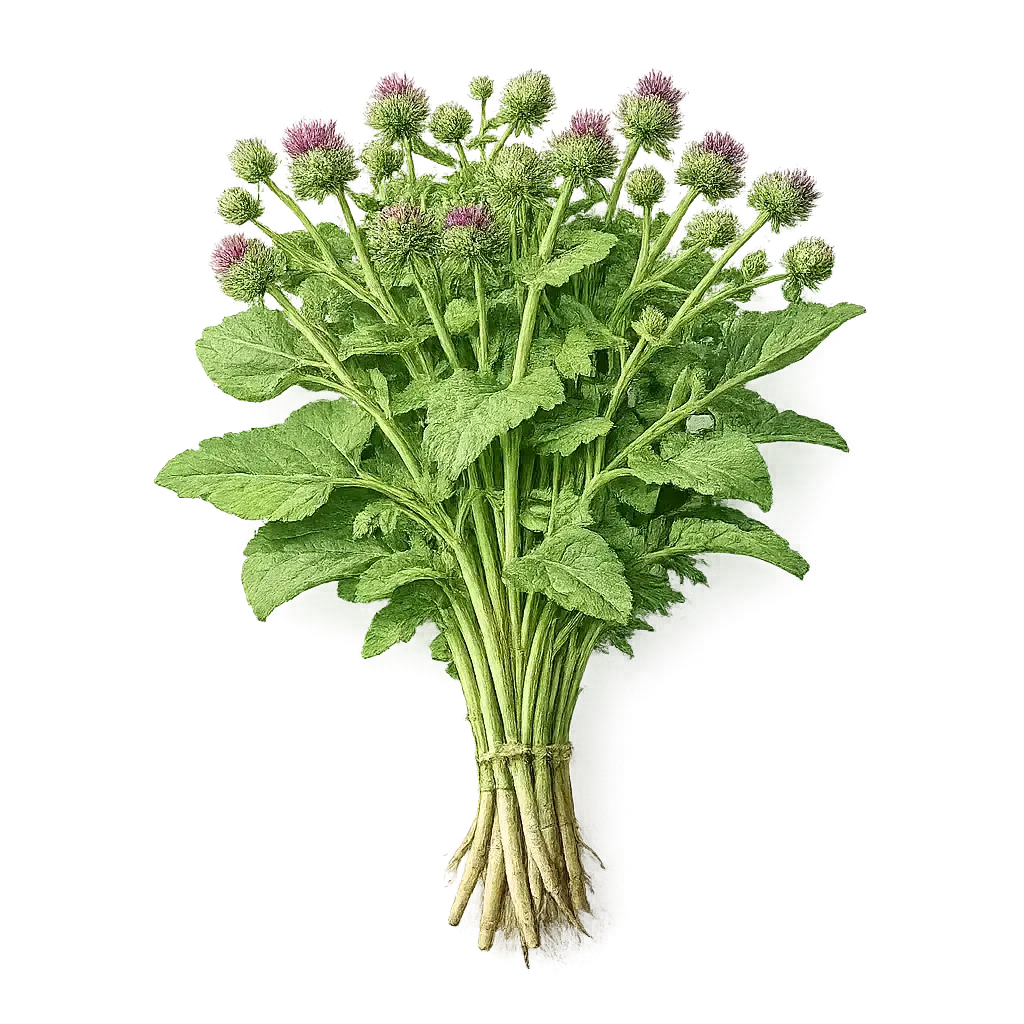
Written By Arthur Simitian
QUICK FACTS
Common Name
Burdock, Greater Burdock, Gobo (Japanese culinary name; the name most commonly used in the context of the root as a vegetable), Beggar's Buttons (referring to the burr seed heads), Cocklebur (sometimes; though this more correctly refers to Xanthium species); Arctium lappa is the primary culinary species; Arctium minus (Lesser Burdock) is smaller and more common as a weed but used similarly
Scientific Name
Arctium lappa (Greater Burdock; the preferred culinary species for gobo root); Asteraceae family; native to Europe and northern Asia; naturalized extensively across North America, South America, and Australia as a common roadside and disturbed-ground weed
Plant Type
Biennial; first year produces only the enormous basal leaf rosette and the deep taproot; second year sends up the large branching flower and burr stem to four to six feet, sets seed, and dies; the tap root is harvested at the end of the first year for maximum food quality
Hardiness Zones
Zones 3 to 9; cold-hardy throughout most of North America and Europe; the first-year taproot overwinters in the ground without protection in all but the coldest climates; self-seeds aggressively and effectively maintains a population without replanting
Height
First year: basal rosette two to three feet across, leaves sometimes reaching two feet wide individually. Second year: branching stem four to six feet tall; one of the most dramatically scaled plants in the herb garden
Harvest Parts
Root (gobo): primary culinary harvest from first-year plants, two to three feet long, one to two inches diameter, pale beige-tan exterior, white interior; Leaf stalks (petioles): young hollow petioles of first-year leaves, eaten like celery after peeling; Young leaves: large young first-year leaves eaten blanched or boiled; Young second-year flower stems: peeled and eaten like artichoke heart or asparagus before flowers open
Primary Active Compounds
Inulin (prebiotic fructooligosaccharide; up to 45 percent of root dry weight at autumn harvest; feeds Bifidobacterium and Lactobacillus species in the colon; primary reason for the root's reputation as a digestive tonic); arctigenin and arctiin (lignans; anti-inflammatory; studied for anti-tumor activity in laboratory models); chlorogenic acid; caffeic acid; tannins; polyacetylenes; sesquiterpene lactones; triterpenoids
Traditional Medicinal Uses
European and North American folk medicine: liver and gallbladder herb; lymphatic system tonic; blood purifier (in the traditional sense); topical application for eczema and psoriasis; diuretic. Japanese traditional medicine (Kampo): similar applications with additional use as an anti-inflammatory for sore throat and respiratory congestion. The root is classified as a food first and a medicine second in Japanese tradition, which reflects the practical reality that the primary value of burdock is nutritional and prebiotic
Soil Requirement
Deep, loose, stone-free soil to a depth of at least two feet; the taproot grows straight down and branches when it meets resistance, producing forked roots that are difficult to harvest cleanly; raised beds with deeply worked sandy loam produce the straightest, longest, easiest-to-harvest roots
Burdock is the herb whose most important culinary application, the gobo root of Japanese cooking, is almost entirely unknown to Western growers despite being one of the most nutritionally dense root vegetables in the traditional Japanese diet and one that grows without difficulty across most of North America and Europe. The root is sweet, earthy, and slightly nutty in flavor with a firm, crisp texture that holds up to long braising, stir-frying, and pickling; the inulin content that makes up nearly half its dry weight at autumn harvest feeds the specific beneficial gut bacteria most associated with digestive and immune health; and the plant that produces it is so vigorous that it naturalizes as a roadside weed on every inhabited continent. The challenge is not growing it but knowing what to do with it, and not being deterred by a root that requires deep loose soil and a long narrow harvest. Everything else about burdock is straightforward: sow in spring, harvest in autumn of the first year, prepare as you would a parsnip or carrot with a mild earthy sweetness rather than aggressive bitterness, and discover that the plant European children and dogs have been arriving home decorated in for centuries has been a serious kitchen vegetable in Japan for a thousand years for entirely good reasons.
Introduction
Arctium lappa is native to Europe and northern Asia and has been used as both food and medicine since antiquity. In medieval Europe the root was eaten during famines and the leaves used as large improvised wraps for carrying food and binding wounds; the plant appears in European herbals with consistent descriptions of its blood-purifying and liver-supporting properties but without the systematic culinary cultivation that developed in Asia. In Japan, gobo root became a staple vegetable through at least the tenth century and is now central to several canonical Japanese dishes including kinpira gobo, the braised and sauteed root with carrot and sesame that appears on virtually every traditional Japanese table, and gobo as a component of miso soup, rice dishes, and tempura.
The burr seed dispersal mechanism of burdock is one of the more directly consequential pieces of natural history in everyday human experience: the hooked bracts of the mature seed head, which evolved to catch in animal fur and distribute seeds across the landscape, were the direct inspiration for Velcro, invented by Swiss engineer George de Mestral in 1941 after noticing the burrs clinging to his dog's coat during a hunting trip. The mechanical principle of multiple flexible hooks engaging with a looped fabric surface was translated directly from the burdock burr's hook geometry into the now-universal fastening system.
The Asteraceae family membership connects burdock to echinacea, calendula, chamomile, and yarrow in this series. The sesquiterpene lactone content shared across the Asteraceae family creates the same cross-reactivity consideration as for the other family members: people with Asteraceae allergy should approach burdock with the same caution as chamomile or echinacea.
Growing Burdock for Gobo Root
Soil Preparation Is the Primary Investment
The quality and ease of harvest of the gobo root is determined almost entirely by the soil condition at the time of sowing. The taproot grows straight down and reaches two to three feet in length in good conditions; it branches and forks wherever it meets a stone, compaction layer, or hard pan, producing a root that is difficult to extract cleanly and has less commercial-quality straight sections. Investing in thorough soil preparation before sowing is the single most productive management action for burdock.
The preferred approach is a raised bed or deep-dug trench with loose, stone-free, well-draining soil to a minimum depth of two feet. Sandy loam amended with compost provides the ideal combination of drainage, loose structure, and modest fertility. Some Japanese gobo growers use vertical plastic pipes or cylinders filled with a sandy growing mix buried in the ground to provide an ideal column of loose media for each root; this technique produces uniformly straight roots and dramatically simplifies harvest but requires more infrastructure than open bed growing.
Avoid heavy clay, compacted soil, or soil with abundant stones. If the garden soil is heavy clay, growing burdock in a dedicated raised bed with imported sandy loam is more productive than attempting to amend the native soil. The preparation investment for burdock root is higher than for most herbs in this series, but it is a one-time investment in a bed that will continue producing roots through self-seeding for years.
Sowing and Growing
Direct sow burdock seed in spring after the last frost; the large seeds germinate readily at cool to moderate soil temperatures. Sow one inch deep and twelve to eighteen inches apart; the first-year rosette grows large and needs space to develop the leaf canopy that fuels taproot growth. Burdock can also be autumn-sown for a spring establishment, which gives the plants a head start and often produces larger roots by the following autumn.
The first-year growth is impressive: the basal leaves reach rhubarb or elephant-ear scale by midsummer, sometimes two feet across, with a leaf canopy that suppresses weeds effectively beneath it. This large leaf area drives rapid photosynthesis and carbohydrate accumulation in the taproot through the growing season, which is why the autumn-harvested root has the highest inulin content and the best flavor: the leaves have been photosynthesizing and translocating sugars downward all summer.
Water consistently through the first growing season; the large leaf area transpires significant moisture and drought stress in summer reduces root development. A layer of mulch around the base conserves moisture and keeps the soil loose around the upper root section.
Harvesting the Root
Harvest first-year roots in late autumn after the first frosts, when inulin concentration is at its peak and the flavor is sweetest. The harvest requires care: use a long narrow spade or a digging fork to loosen the soil around and below the root to its full depth before attempting to pull. Insert the tool as deep as possible alongside the root, work it back and forth to break the soil compaction, and then pull the root from above while simultaneously loosening with the tool below. Pulling without loosening the surrounding soil first snaps the root at a shallow depth and wastes the lower two-thirds of the harvest.
Alternatively, dig a trench alongside the row to the full root depth and harvest by pushing the roots sideways out of the soil wall rather than pulling vertically; this technique produces the highest rate of intact whole-root recovery, particularly in heavier soils.
Harvested roots store well in a cool humid environment, either buried in barely moist sand in a cool cellar or refrigerated wrapped in damp cloth or paper. Roots keep for two to three months in good storage conditions. For longer storage, slice into rounds, blanch briefly, and freeze.
Culinary Uses
Kinpira Gobo
Kinpira gobo is the canonical Japanese burdock preparation and the most efficient way to understand what burdock root tastes like cooked correctly. The dish is a braised and sauteed combination of julienned gobo root and carrot seasoned with soy sauce, mirin, sake, and sesame oil, finished with toasted sesame seeds. The gobo root's mild earthy sweetness, firm crisp texture even after cooking, and absorption of the umami-sweet braising liquid produce a side dish of deceptive depth of flavor from simple ingredients.
The critical technique is soaking the julienned or thinly sliced root in cold water with a small amount of rice vinegar or plain water for fifteen to thirty minutes after cutting; this removes excess tannins that cause bitterness and prevents the cut surface from oxidizing to an unpleasant brown color. Drain well before cooking. The soaked root is then stir-fried in sesame oil over medium-high heat until partially tender, the carrot added, and the seasoning liquid introduced and cooked down until absorbed. The whole preparation takes about twenty minutes from cut root to table and the result is versatile as a side dish, rice topping, bento component, or soba noodle accompaniment.
The Full Edible Plant
The root is the primary harvest but not the only edible part. The large hollow leaf petioles of first-year plants, harvested young when still tender, can be peeled to remove the bitter outer skin and eaten raw in salads or cooked as a celery substitute with a mildly earthy flavor. They are particularly good lightly braised or added to soups in the same way celery stalks are used, providing body and a subtle earthiness without bitterness when properly peeled.
The young leaves of first-year plants, harvested before they reach full size, are edible blanched or boiled and used like any large leafy green; the bitterness reduces significantly with cooking and they have a substantial, almost meaty texture appropriate for slow-cooked preparations. In some European foraging traditions the young leaves are parboiled twice, with the water changed between boilings, to reduce bitterness to an acceptable level.
The young second-year flower stems, cut before the flowers open when the stem is still soft and the pith has not yet become fibrous, can be peeled and eaten raw or lightly cooked. The flavor is mild and slightly artichoke-like; the texture is reminiscent of cardoon or tender celery. This harvest is time-limited to a brief window in spring of the second year before the stem becomes too fibrous to be palatable.
Kinpira gobo: braised burdock and carrot
This preparation is the fastest route to understanding why burdock has been a kitchen staple in Japan for a thousand years. The quantities below serve four as a side dish and keep refrigerated for three days, improving slightly as the flavors develop.
Scrub one medium gobo root (approximately twelve inches, two hundred grams) under cold water using a stiff brush; do not peel, as many of the aromatic compounds are in and just under the skin. Cut into matchsticks three to four inches long and one-eighth inch thick. Immediately submerge in a bowl of cold water with one teaspoon of rice vinegar; leave for fifteen minutes, then drain and pat dry. Peel and cut one medium carrot into the same matchstick dimensions.
Heat one tablespoon of sesame oil in a heavy pan over medium-high heat. Add the drained burdock and stir-fry for three minutes. Add the carrot and stir-fry for two more minutes. Add two tablespoons soy sauce, one tablespoon mirin, and one tablespoon sake or dry sherry. Toss to coat and cook over medium heat, stirring frequently, until the liquid is almost fully absorbed and the root is tender but still with some bite, approximately five more minutes. Taste and adjust seasoning. Remove from heat and stir in a few drops more sesame oil and one teaspoon of toasted sesame seeds. Serve warm or at room temperature.
The finished dish should have a glossy, lightly caramelized coating on each piece with a warm earthy-sweet flavor that is distinctly burdock but never bitter or medicinal tasting. If bitterness is present, the soaking step was insufficient or the roots were harvested too late in the second year rather than from first-year plants.
Medicinal Uses
The primary medicinal value of burdock at the homestead level is the inulin content of the root, which acts as a prebiotic fiber feeding Bifidobacterium and Lactobacillus species in the colon. At the inulin concentrations present in autumn-harvested burdock root, approximately thirty to forty-five percent of dry weight, regular consumption genuinely and measurably improves the populations of beneficial gut bacteria, with downstream effects on digestive regularity, immune signaling, and the production of short-chain fatty acids that support colon health. This is not traditional folk medicine at the mechanistic plausibility stage; it is the well-established science of prebiotic fiber function applied to a specific food with a documented inulin profile.
The European and North American herbal tradition describes burdock as a liver herb and a lymphatic tonic, with the root tea or tincture used for chronic skin conditions including eczema and psoriasis on the theory that improving liver and lymphatic clearance reduces the inflammatory load that manifests at the skin surface. The lignans arctigenin and arctiin have documented anti-inflammatory activity in laboratory studies, and chlorogenic acid is a well-characterized antioxidant. The clinical trial evidence for burdock-specific preparations for these traditional indications is limited, placing the evidence at the traditional use and mechanistic plausibility level rather than at the Commission E-approval standard. For the homestead grower, the prebiotic inulin story is the most evidence-based angle on burdock's health contribution and the one most directly supported by eating the root as food rather than taking an extract.
The traditional topical application of burdock leaf decoction to eczema and psoriasis reflects the tannin and arctigenin content at the leaf level and is consistent with the anti-inflammatory chemistry, though clinical evidence for this specific application is sparse.
Cautions: Burdock root at normal food quantities has a clean culinary use record extending over a thousand years in Japanese cuisine with no significant documented toxicity. The following points apply. The high inulin content causes significant gas and bloating in people whose gut microbiome is not accustomed to high-fructooligosaccharide intake; introducing burdock gradually rather than in large quantities is the appropriate approach, especially for people who do not regularly eat other high-inulin foods such as Jerusalem artichoke, chicory root, or garlic. The gas-producing effect diminishes with regular consumption as the gut microbiome adapts; it is a sign of successful prebiotic fermentation rather than intolerance in most cases. Asteraceae family cross-reactivity: people with documented ragweed, chrysanthemum, or other Asteraceae allergy should be aware of potential cross-reactivity, though burdock root allergy is uncommon in the literature compared to pollen-bearing Asteraceae relatives. Burdock has been reported to potentiate the effect of antidiabetic medications through its effect on blood glucose; people taking medications for blood sugar management should monitor their response to regular burdock consumption. Wild identification caution: burdock's first-year rosette resembles that of rhubarb (edible leaves but poisonous if the oxalic acid content is high) and more dangerously of foxglove (Digitalis species; toxic), particularly before the distinctive burr-bearing second-year stem appears; always confirm identification before harvest, using the characteristic enormous heart-shaped leaves with white-felted woolly undersides and the hollow petioles as the key distinguishing characters. Pregnancy: burdock root at large medicinal doses has traditionally been classified as an emmenagogue; culinary food use at normal quantities is not a concern, but concentrated preparations during pregnancy are not recommended.
Burdock as a Soil Tool
The two-to-three-foot taproot that makes burdock difficult to harvest also makes it one of the most effective deep soil-breaking plants available for homestead use. Planted in a compacted or clay-heavy area and allowed to complete its two-year cycle, the taproot penetrates and fractures compaction layers that shallow-rooted plants cannot reach, drawing up subsoil minerals and creating deep channels that improve drainage and aeration. When the dead second-year stem is cut at the soil surface and the root is left in place to decompose, the decaying root channel becomes a conduit for water infiltration and earthworm activity deep into the soil profile.
This is the dynamic accumulator role: burdock mines deep soil for minerals including potassium, calcium, and iron, concentrates them in its large leaf mass, and returns them to the soil surface when the leaves decay. A planting of burdock on a compacted, mineral-poor area managed through two or three biennial cycles noticeably improves the soil structure and mineral availability for subsequent plantings. For the homestead food forest or new garden bed on difficult ground, burdock is one of the more powerful biological soil improvement tools available, combining deep tillage, mineral cycling, and organic matter contribution in a single low-input plant.
Pros and Cons
Advantages
The inulin content of the autumn-harvested first-year root is among the highest of any food plant at thirty to forty-five percent of dry weight, providing a genuinely significant prebiotic fiber dose from a garden-grown food source; this is not a marginal nutritional contribution but a meaningful one with well-documented effects on beneficial gut bacteria populations
The culinary tradition of gobo in Japanese cooking provides a well-tested, delicious repertoire of preparations including kinpira gobo, miso soup, tempura, and braised dishes that make the harvest immediately useful without recipe development; this is a vegetable with a thousand-year kitchen tradition and the recipes are excellent
Produces a whole edible plant across the full biennial lifecycle: first-year root, leaf petioles, and young leaves; second-year flower stems; a single planting provides multiple harvests at different times from different parts of the same plants
Functions as a deep soil-breaking and mineral-cycling plant in compacted or poor soils; the practical soil-improvement value of a two-to-three-foot taproot decomposing in place is significant and makes burdock a dual-purpose food and soil-improvement tool in the same planting
Self-seeds aggressively once established, effectively maintaining a population indefinitely with no replanting effort; the seed bank builds quickly and volunteer seedlings appear reliably near the parent plants each spring
Limitations
The soil preparation requirement is the highest of any herb in this series; loose, stone-free, deeply worked soil to two feet minimum is not optional for a good root harvest; growers with heavy clay or stony soil face a genuine infrastructure investment before the first productive harvest
The harvest itself is physically demanding; extracting a two-to-three-foot taproot from the ground without breaking it requires a long narrow tool, patience, and technique; the first harvest is always harder than subsequent ones as the grower develops the feel for the process
The self-seeding aggressiveness that makes burdock low-maintenance in terms of replanting also makes it potentially invasive in the garden context; the burrs cling to clothing, animal fur, and garden tools, dispersing seeds beyond the intended planting area; managed burdock requires removing second-year plants before the burrs ripen or accepting that the plant will spread
The high inulin content causes significant gas and bloating until the gut microbiome adapts; this is not a lasting problem but it is a notable first-encounter experience that discourages some people from continuing before the adaptation occurs
The first-year rosette is large, shade-casting, and space-occupying; at two to three feet across, each plant claims substantial garden real estate through the growing season; burdock is not an appropriate herb for small intensive kitchen gardens but requires a dedicated area where its scale is an asset rather than a constraint
Final Thoughts
Burdock is the plant that has been available as a food source on roadsides and waste ground across the temperate world for centuries, delivering one of the highest prebiotic fiber contents of any root vegetable to anyone willing to dig it, and has been systematically overlooked in Western kitchens while Japanese cooks built a sophisticated culinary tradition around it that extends from home cooking to restaurant menus to traditional festival foods. The gap between burdock's culinary status in Japan and its weed status in most of the world it has colonized is one of the more striking examples of cultural variation in food plant recognition.
Prepare the soil well, sow in spring, harvest in the first autumn before the plants bolt, soak the cut root in cold water before cooking, make kinpira gobo. The investment in soil preparation is real. Everything after that is a reward.