
Caraway
Written By Arthur Simitian
QUICK FACTS
Common Name
Caraway, Meridian Fennel, Persian Cumin; not to be confused with cumin (Cuminum cyminum), which is a different plant with somewhat similar seeds and flavor; the confusion between caraway and cumin is persistent and reflected in some of the historical common names
Scientific Name
Carum carvi; Apiaceae family; native to western Asia, Europe, and North Africa; one of the oldest cultivated spice plants in the world, with seed remains found at Mesolithic archaeological sites in Europe dating to approximately 5000 BC
Plant Type
Biennial; produces only a leafy rosette and a storage taproot in the first year; sends up a flowering and seeding stem in the second year, then dies after setting seed; the entire seed harvest comes from the second-year plants
Hardiness
Fully cold-hardy annual to zones 3 to 9; the first-year rosette overwinters without protection in most temperate climates; the biennial cycle requires a period of cold (vernalization) to trigger the second-year flowering bolt; without sufficient winter cold the plant may remain vegetative
Height
First year: low rosette, six to twelve inches. Second year: erect branching bolt stem two to three feet tall; the dramatic size difference between years one and two is one of the more striking plant transformations in the herb garden
Edible Parts
Seeds (technically mericarps; the split halves of the paired cremocarp fruit): the primary culinary and medicinal product; Leaves: used fresh as a feathery herb in salads and soups, milder and more delicate than the seed flavor; Root: edible cooked, similar to parsnip in texture with a mild caraway flavor, harvested at the end of the first year before the plant bolts
Primary Active Compounds
Carvone (the primary flavor and pharmacological compound; a chiral monoterpenoid ketone; R-carvone gives caraway its characteristic flavor; S-carvone gives spearmint its flavor; the same molecule in different mirror-image forms produces two completely different flavor perceptions); limonene (monoterpene; citrus notes; antimicrobial); anethole (minor; anise notes); fixed oils including petroselinic acid; flavonoids
Commission E Approval
Approved for dyspeptic complaints including mild gastrointestinal spasms, feelings of fullness, and flatulence; one of the best-evidenced carminative herbs in the Commission E monographs
Primary Culinary Traditions
Central and Eastern European rye bread (caraway is the defining flavor of many traditional rye breads including German Roggenbrot, Austrian rye, and Scandinavian crispbread); sauerkraut and fermented vegetables; German and Austrian pork and sausage dishes; Aquavit (Scandinavian caraway spirit); Kummel (caraway liqueur); Harissa (some North African versions); Gouda and other aged cheeses
Caraway is the herb that asks the grower to wait a full year before the first seed harvest, and which rewards that patience with one of the most versatile and historically significant spice seeds in the European culinary tradition. The biennial growth cycle is the central fact of growing caraway and the main reason it is uncommon in home gardens despite being among the easiest plants to grow once the two-year timeline is understood and accepted. The first year produces nothing but a leafy rosette and a useful edible taproot; the second year produces the seeds, the leaves on the bolt stem, and the eventual seed harvest. This is not a difficult plant; it is simply a patient one. Understanding that the wait is finite and that succession planting in two consecutive years produces seeds every year thereafter resolves the practical management question. The chemistry of carvone, the primary flavor compound, is also worth understanding: R-carvone and S-carvone are mirror-image forms of the same molecule that activate different olfactory receptors and produce completely different flavor perceptions, which is why caraway and spearmint, both carvone-dominant, taste nothing alike. This is one of the more accessible demonstrations of chirality in everyday experience and it makes caraway a genuinely interesting herb from the chemistry direction as well as the culinary one.
Introduction
Carum carvi is one of the oldest cultivated plants in human history, with carbonized seeds recovered from Neolithic and Mesolithic sites across Europe that predate organized agriculture. The plant is native to a broad range across Eurasia and naturalized in North America, where it has escaped cultivation and grows as a roadside weed in northern states and Canada. The name caraway derives from the Arabic al-karawya, and the plant appears in Egyptian medical papyri, Roman agricultural texts, and medieval European herbals with consistent descriptions of its digestive and carminative uses.
The association between caraway and Central European cuisine is so strong that in Germany and Austria the seed is sometimes simply called Kümmel, the German word for caraway, and its presence in rye bread, sauerkraut, and pork dishes is so deeply traditional that these foods are often described as tasting wrong without it by people raised in those traditions. The Scandinavian aquavit tradition, in which caraway is the defining botanical of the spirit, extends this cultural significance northward into a distilled product that has been produced continuously since the fifteenth century.
Medicinally, caraway's carminative reputation is among the best-documented in the Apiaceae family. The Commission E approval for dyspeptic complaints including flatulence, bloating, and gastrointestinal spasm reflects a body of evidence consistent enough to meet the German regulatory standard for traditional herbal medicines, and the carvone content provides a mechanistic basis for the antispasmodic activity.
The Biennial Cycle: What to Expect Each Year
Year One: The Rosette and the Root
Sow caraway seed in spring or early summer. Direct sow is strongly preferred, as caraway has a taproot that resists transplanting once established beyond the seedling stage; sow where the plants will remain. Germination takes ten to twenty days. The first year produces a low-growing feathery rosette of finely divided leaves that resembles a miniature carrot top, with a substantial taproot developing below ground through the growing season.
The first-year rosette is entirely vegetative; no flowering stem appears. This is the year to harvest the taproot if that use interests you: lift first-year plants in autumn before the ground freezes, wash the pale carrot-shaped roots, and use them as a cooked vegetable with a mild caraway flavor and a firm texture similar to parsnip or parsley root. Roasted, boiled, or added to soups and stews, the roots are a pleasant and genuinely underused vegetable that makes the first year productive rather than a waiting period.
The first-year leaves can also be harvested lightly and used fresh as a mild feathery herb. The flavor is green and caraway-adjacent but considerably milder than the seed; use as a garnish on soups, salads, and potato dishes where a light herbal note is wanted without the assertiveness of the dried seed.
Year Two: The Bolt and the Seed Harvest
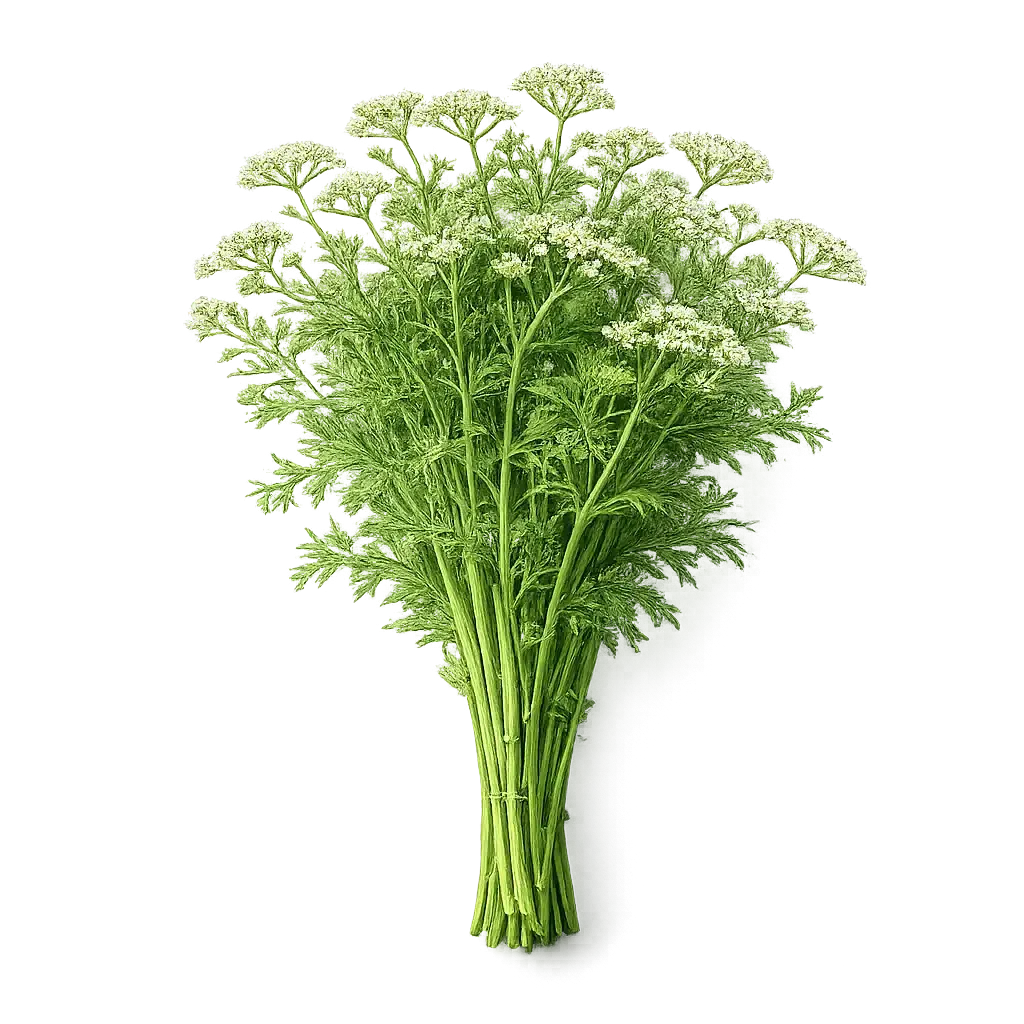
Following winter vernalization, the overwintered rosette sends up an erect, hollow, branching flowering stem in late spring or early summer. This bolt stem reaches two to three feet in height and bears the characteristic flat compound umbels of tiny white flowers. Flowering begins at the stem tips and progresses downward through the plant over several weeks, with the seeds ripening in the same succession.
The seed harvest timing is the critical management decision of the caraway year and the main source of harvest loss for first-time growers. The seeds ripen unevenly across the plant: the topmost umbels ripen first and shed their seeds while the lower umbels are still flowering or in early seed development. A grower who waits for all seeds to ripen before harvesting will lose the first-ripened seeds to shattering. The correct approach is to cut the entire stem when the first umbels have turned brown and the seeds are firm but before they begin to shed, then hang or lay the cut stems over a cloth or sheet to catch the seeds as they continue to ripen and fall over the following week to ten days.
After harvesting, thresh the dried seed heads gently by rubbing the umbels between the palms or by crushing lightly in a bag. Winnow to remove the chaff by pouring the seeds in a gentle breeze or in front of a fan. Store the cleaned, fully dried seeds in sealed glass jars away from light and heat; properly stored caraway seeds retain their volatile oil content for two to three years.
Succession Planting for Annual Harvests
A single planting of caraway produces seeds only in the second year, then dies. To establish an ongoing annual seed harvest without a gap year, sow in two consecutive years: in year one, sow a first planting; in year two, sow a second planting alongside the first-year rosettes that are about to bolt. The second-year plants produce the seed harvest in year two; the first-year plants from the second sowing produce the year-three harvest. From year two forward, the garden has plants in both growth stages simultaneously and provides a seed harvest every year.
Many growers find that allowing some plants to self-seed resolves the succession planning problem automatically: second-year plants that are not harvested completely shed seeds around their base in late summer, and these seeds germinate to produce first-year rosettes that will bolt the following year. A well-established caraway patch managed partly by deliberate harvest and partly by controlled self-seeding maintains itself and produces annual harvests with minimal replanting effort.
Culinary Uses
Rye Bread
The combination of caraway seed with rye flour is one of the most durable and cross-cultural flavor pairings in European baking, appearing in German Roggenbrot, Scandinavian rugbrod, Austrian seeded rye, and Eastern European dark breads across dozens of regional variations. The chemical affinity between caraway's carvone and the specific flavor compounds of rye flour, particularly the earthy, slightly bitter character of the rye, is such that each enhances the other in a way that the seeds do not produce in wheat bread to the same degree. Caraway also serves a practical function in dense rye breads: the volatile oils help prevent the rapid mold growth that is a challenge with rye's higher moisture content, a functional property that the traditional use predated by centuries without the chemistry to explain it.
For homestead bakers, the simplest application is one to two tablespoons of whole caraway seeds added to a standard rye bread dough and incorporated before baking. Lightly toasting the seeds in a dry pan before adding them to the dough deepens and opens the carvone flavor slightly, producing a more aromatic result than raw seeds. The seeds can also be lightly crushed to increase surface area and flavor release without fully grinding them.
Sauerkraut and Fermented Vegetables
Caraway seed is added to sauerkraut in the traditional German and Eastern European method, typically at one to two teaspoons per quart of packed cabbage. The function is both flavoring and preservation: the carvone and limonene in the seeds have documented antimicrobial activity against several spoilage bacteria and mold species, supporting the fermentation environment by inhibiting unwanted microorganisms while not significantly affecting the Lactobacillus species responsible for the lactic acid fermentation. This is a traditional application with a mechanistic basis that the traditional makers understood empirically without the microbiology to explain it.
Pork, Sausage, and Roasted Vegetables
Caraway is a defining flavor in German and Austrian pork cookery, appearing in roast pork marinades, sausage spice blends, and caraway-braised cabbage dishes that combine both of the seed's traditional culinary contexts in a single preparation. The seed's affinity with fat is high; carvone is lipophilic and its flavor is released most effectively into fatty cooking media, which makes pork roasting with caraway one of the most naturally well-matched applications in the entire herb series.
For roasted root vegetables, particularly carrots, parsnips, and potatoes, caraway provides an earthy, warm complexity that elevates the natural sweetness of the vegetables without introducing the heat of pepper or the assertiveness of rosemary. Toss root vegetables in olive oil with a teaspoon of whole or lightly crushed caraway seeds before roasting; the seeds toast gently against the vegetable surfaces during roasting and release their carvone into the oil that coats the vegetable.
Caraway-sauerkraut from homestead cabbage
This is the simplest and most traditional caraway preparation, requiring nothing but cabbage, salt, caraway seeds, time, and a crock or large jar.
Remove the outer leaves from a medium head of cabbage and set aside. Quarter and core the cabbage, then shred finely, either by knife or mandoline, to approximately one-eighth inch thickness. Weigh the shredded cabbage: the salt quantity is two percent of the cabbage weight, which for a typical two-pound head produces roughly fourteen to sixteen grams of salt. Use non-iodized salt; iodine inhibits Lactobacillus fermentation.
Toss the shredded cabbage with the salt and two teaspoons of whole caraway seeds. Massage and squeeze the cabbage vigorously for five to ten minutes until it has released enough liquid to be thoroughly wet and limp. Pack tightly into a clean one-quart mason jar, pressing the cabbage down firmly so that the released liquid rises above the cabbage surface. The cabbage must remain submerged beneath its own brine throughout fermentation; use a small zip-lock bag filled with brine as a weight if needed, or place one of the reserved outer leaves over the surface and tuck the edges down inside the jar to keep the shredded cabbage below the liquid line.
Cover loosely with a cloth or leave the lid very slightly loose to allow CO2 to escape. Ferment at cool room temperature, 65 to 72 degrees Fahrenheit, for one to four weeks depending on desired sourness. Taste after five days and every few days thereafter. When the sour flavor is to your preference, seal and refrigerate; fermentation slows dramatically but continues slowly in the cold. The caraway-fermented sauerkraut keeps refrigerated for several months.
Medicinal Uses
Caraway's Commission E-approved use for dyspeptic complaints, flatulence, and gastrointestinal spasm is supported by carvone's antispasmodic activity on smooth muscle, the same mechanism operating in peppermint's menthol and fennel's anethole. The carminative effect, the reduction of intestinal gas production and facilitation of its passage, is a practical and well-founded application of caraway seed in cooking: adding caraway to gas-producing foods including cabbage, beans, and rye bread is not merely a traditional combination but a functional one, with the seed actively reducing the flatulence-producing fermentation of the indigestible carbohydrates in those foods.
The traditional preparation of caraway tea, one teaspoon of lightly crushed seeds steeped covered for ten minutes in a cup of just-boiled water, provides a useful preparation for acute digestive discomfort. Crushing the seeds slightly before steeping increases the surface area available for volatile oil extraction and produces a stronger preparation than whole seeds. Strain and drink warm. The flavor is warming, slightly sweet, and unmistakably caraway; it is pleasant to most palates familiar with the seed in its culinary context.
Caraway oil, available as an essential oil or as a component of various European digestive preparations, is used in higher-concentration topical preparations for muscle pain and in inhalation preparations for respiratory congestion, though these uses are less central to the homestead medicinal application than the simple digestive tea.
Cautions: Caraway seed and caraway tea at normal culinary and herbal preparation quantities have a long and clean use record with no meaningful toxicity documented at reasonable consumption levels. The following points apply. As a member of the Apiaceae family, caraway shares the cross-reactivity considerations of the family: people with known allergy to other Apiaceae herbs including carrot, celery, fennel, anise, and coriander should approach caraway with appropriate caution given the potential for cross-reactive allergic response. Wild caraway encountered outside the cultivated garden should never be consumed without absolutely confident identification; the Apiaceae family lookalike hazard including poison hemlock applies to any white-umbel-flowered plant encountered in the wild. Caraway essential oil at high concentrated doses can cause skin irritation; the dilute amounts released from culinary seed use do not present this risk. The limonene content produces the same low-level photosensitization potential as other limonene-containing Apiaceae plants; people with photosensitivity should be aware of this theoretical risk from very large quantities of caraway essential oil on the skin, though culinary and tea use does not produce skin contact at relevant concentrations. Pregnancy: caraway seed at culinary quantities has an essentially clean traditional use record in pregnancy; very high medicinal doses as a uterine stimulant were used historically and should be avoided during pregnancy at large concentrated quantities, though this applies to concentrated preparations rather than to cooking with the seed.
Carvone and Chirality: The Same Molecule, Two Flavors
The most interesting chemical fact about caraway is that its primary flavor compound, carvone, exists in two mirror-image forms that activate different olfactory receptors and produce completely different flavor perceptions. R-carvone, the form found in caraway seeds, produces the characteristic warm, slightly sweet, anise-adjacent caraway flavor. S-carvone, the mirror-image molecule with identical chemical composition and molecular weight, is the primary flavor compound of spearmint and produces a completely different fresh, cool, mint perception.
This is chirality: the phenomenon in which a molecule and its mirror image are non-superimposable, like a left and right hand, and interact differently with chiral biological receptors. The olfactory receptors in the nose are themselves chiral proteins, meaning they can physically distinguish between the two mirror-image forms of carvone and send different signals to the brain. The result is that caraway and spearmint, despite both being carvone-dominated flavor plants, taste nothing alike because one contains R-carvone and the other S-carvone.
This example requires no chemistry background to appreciate: if you have caraway seeds and spearmint available in the garden or kitchen, bruising a small amount of each and smelling them back-to-back demonstrates the principle more directly than any description. The two smells are entirely distinct; the chemistry that explains why is the same chemistry that underlies much of pharmaceutical drug design, where chirality determines whether a molecule is therapeutic or inert or even harmful. Caraway is the most kitchen-accessible demonstration of this principle.
Pros and Cons
Advantages
Produces a genuinely whole edible plant across both years: first-year leaves as a mild feathery herb, first-year root as an edible vegetable comparable to parsnip, second-year leaves on the bolt stem, and the seeds that are the primary product; few herb garden plants offer this range of edible outputs across their full lifecycle
Commission E approval for digestive and carminative use reflects a genuine evidence base; the carvone antispasmodic mechanism is well-characterized and the traditional use in flatulence and bloating management is among the better-supported carminative applications in the series
The culinary tradition anchoring caraway, particularly in rye bread and sauerkraut, is deep and cross-cultural in a way that gives the homestead grower clear, tested, and delicious applications for every harvest without needing to develop new recipes; these are preparations that have been made for centuries and that produce excellent results
Once the succession planting is established, caraway requires minimal ongoing management; the self-seeding tendency in established patches reduces the replanting burden, and the plant is cold-hardy, drought-tolerant in establishment, and undemanding about soil fertility
The carvone chirality story is the most teachable piece of practical chemistry in this herb series; growing caraway alongside spearmint and demonstrating the same-molecule-two-flavors principle to children and interested adults is a genuinely educational use of the garden that extends beyond the culinary and medicinal applications
Limitations
The two-year wait for the first seed harvest is the primary barrier to adoption; growers who do not plan for the biennial cycle and do not begin succession planting until after they want seeds will experience exactly the frustration the timing structure promises
Seed harvest timing requires attention and some tolerance for imprecision; the shattering risk from waiting for uniform ripeness across the whole plant means accepting some loss or cutting early and completing the ripening off the plant, neither of which is as simple as the bulk harvest that most other herb seed crops permit
Caraway's flavor is assertive and culturally specific; it is deeply embedded in Central European culinary traditions and strongly associated with rye bread, sauerkraut, and pork, meaning growers who do not cook from that tradition may find fewer immediate applications for the harvest and may find the flavor polarizing in preparations that are unfamiliar with it
Direct sow requirement limits the flexibility of the establishment; unlike many herbs that can be started indoors and transplanted, caraway's taproot sensitivity means the growing location must be determined at sowing time and the plants cannot be moved once the taproot has developed
Apiaceae family identification caution applies to any wild-harvested caraway; the resemblance to other white-umbel Apiaceae plants including potentially toxic species means cultivated garden plantings of known-identity stock are the safe source, and any wild harvest requires absolute identification confidence
Final Thoughts
Caraway is the herb that rewards a grower willing to think in two-year cycles rather than one-season yields. The biennial structure is not an inconvenience so much as a rhythm: sow in spring, tend through summer, harvest the roots and enjoy the young leaves in autumn, watch the rosette overwinter, see the bolt in late spring, cut the seed heads as the first umbels ripen, hang to dry and thresh a week later. Done once, the succession planting structure makes it self-sustaining.
For the homesteader who bakes rye bread, makes sauerkraut, or cooks in any Central or Eastern European tradition, having fresh caraway from the garden at the point of harvest is the kind of upgrade in quality and aroma that makes the two-year investment genuinely worthwhile. The seeds harvested from your own plant and used within the year are noticeably more volatile and aromatic than anything in a commercial spice jar. That difference, compounded by the whole-plant harvest across both years, is the complete case for caraway on the homestead.