
Cilantro / Coriander
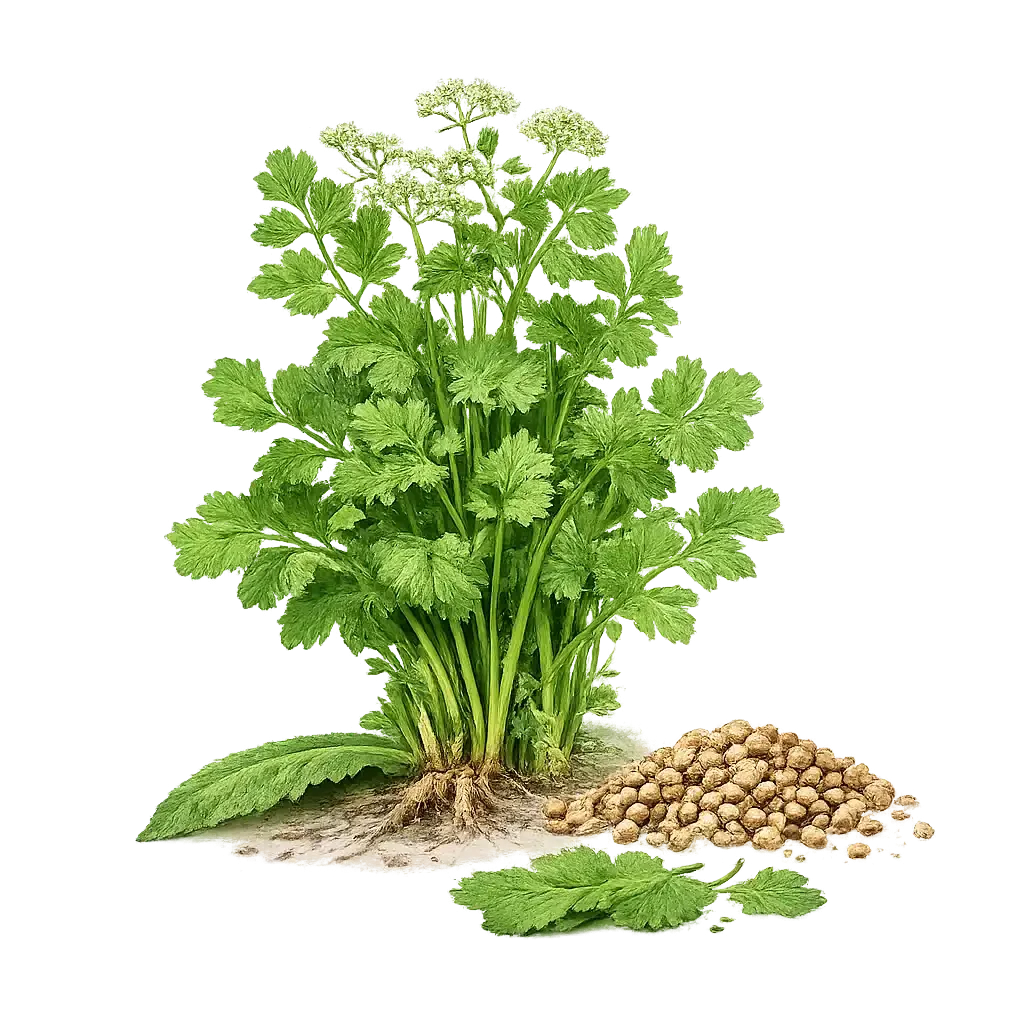
One plant, two names, two harvests: Cilantro and coriander are the same plant at different stages. In North American usage, cilantro refers to the fresh leaf and coriander to the dried seed; in British and South Asian usage, coriander is used for both. This post covers the complete lifecycle from fresh leaf to ripe seed, treating both harvests as distinct products requiring different growing strategies. If you are specifically looking for culantro (Eryngium foetidum), the heat-tolerant tropical herb with a similar flavor, that is covered in a separate post in this series.
QUICK FACTS
Common Name
Cilantro (fresh leaf; North American usage), Coriander (seed; also British English for the whole plant), Chinese Parsley, Dhania (South Asian)
Scientific Name
Coriandrum sativum; sole species in the genus; in the Apiaceae family alongside dill, fennel, parsley, and carrot
Plant Type
Cool-season annual; completes its lifecycle from germination to seed maturity in 90 to 120 days; bolts rapidly in heat and long days; can be grown as a winter annual in mild climates
Hardiness Zones
Annual grown in zones 3 to 11; spring and autumn sowings for leaf in most climates; winter annual in zones 9 to 11; does not tolerate hard frost but survives light frost
Sun Requirements
Full sun in cool seasons; partial shade in hot climates delays bolting but reduces aroma intensity
Soil Type
Well-drained, moderately fertile; pH 6.0 to 7.0; dislikes waterlogging; direct sow only, taproot does not tolerate transplanting
Days to Leaf Harvest
25 to 45 days from germination depending on variety and temperature
Days to Seed Harvest
90 to 120 days from germination
Key Growing Challenge
Rapid bolting in heat and long days; the fresh leaf harvest window is brief in summer without succession sowing or deliberate variety selection for slow-bolting
Primary Active Compounds (leaf)
Dodecanal, decanal, and (E)-2-dodecenal (aldehydes responsible for the characteristic fresh flavor and the soap perception in genetic non-tasters); linalool; camphor; geraniol; flavonoids; vitamin C, K, and A; potassium
Primary Active Compounds (seed)
Linalool (60 to 70% of seed essential oil; warm, floral, spicy; the dominant seed aroma); alpha-pinene; camphor; geraniol; flavonoids including quercetin and kaempferol; fixed oils; coumarins
Uses
One of the most widely used culinary herbs globally, fundamental to Mexican, Indian, Southeast Asian, Middle Eastern, and Central Asian cuisines; seed a primary spice in curry blends and pickling spice; carminative digestive; antimicrobial; blood sugar modulation (seed); heavy metal chelation research interest
Cilantro is the most polarizing herb in common use, dividing the population into people for whom it is an essential, irreplaceable fresh flavor and people for whom it tastes indistinguishably of soap. This division is not a matter of preference or sophistication; it has a specific genetic basis involving olfactory receptor variants that determine whether the aldehyde compounds responsible for cilantro's characteristic flavor register as fresh and bright or as a close chemical match to the compounds in bar soap. Understanding this means the homestead grower who loves cilantro is not dealing with a personal eccentricity, and the grower who cannot stand it is not missing something obvious. What both growers share is a plant with among the most extensive global culinary use of any herb in this series, a seed spice profile that is entirely distinct from the leaf and universally well-regarded even by people who dislike the fresh leaf, and a growing pattern that punishes inattention to succession timing in ways that the dill post covered but that apply with equal force here.
Introduction
Coriandrum sativum is one of the oldest documented cultivated herbs in the world; coriander seeds have been found in Neolithic archaeological sites in Europe and in Egyptian tombs dating to approximately 1000 BCE, and the plant is mentioned in Sanskrit texts, the Old Testament, and the writings of Hippocrates. It spread from its probable origin in the eastern Mediterranean and southwest Asia along every major trade route of the ancient world, arriving in India before recorded history, in China before the Han dynasty, and in the Americas with Spanish colonists in the sixteenth century. The result is a herb now fundamental to the cuisines of Mexico, India, China, Thailand, Vietnam, the Middle East, and Central Asia simultaneously, which gives it a range of culinary application across more distinct culinary traditions than any other single herb in this series.
The leaf flavor and the seed spice are different enough in character that people who use both extensively sometimes forget they come from the same plant. The leaf aldehydes produce the fresh, citrus-adjacent, slightly pungent flavor of cilantro that dissipates rapidly with heat. The seed, dominated by linalool, produces a warm, floral, slightly citrus-spice character that deepens with toasting and is stable through cooking at high temperatures. The transition between these two flavor profiles happens as the plant bolts and sets seed, with the leaves becoming progressively more sparse and the volatiles changing profile as the plant redirects energy to reproduction.
The Soap Perception: Genetics and Reality
Approximately 4 to 14 percent of people of European descent, and lower but still meaningful proportions of people with other genetic backgrounds, perceive cilantro leaf as tasting strongly of soap. A 2012 genome-wide association study identified a cluster of olfactory receptor genes on chromosome 11, particularly OR6A2, whose variants correlate with cilantro aversion. The receptor encoded by the sensitive variant of OR6A2 binds preferentially to aldehyde compounds, specifically the C10 and C12 aldehydes that give cilantro its characteristic flavor, and appears to route the signal toward the brain's representation of soapy rather than herbal. People carrying the common variant of OR6A2 perceive these aldehydes as fresh and pleasant; people carrying the sensitive variant perceive the same compounds as soapy.
The practical implication is that genuine cilantro aversion has a physiological basis and is not modifiable through repeated exposure in most people, though some people with mild aversion report partial adaptation over time. Homestead growers cooking for households with a mix of cilantro tolerators and non-tolerators sometimes manage this by offering fresh cilantro as a garnish on the side rather than incorporating it into dishes, allowing each person to determine their own exposure. The seed, whose dominant volatile is linalool rather than the offending aldehydes, is generally accepted by cilantro-averse individuals and is worth offering as a flavor contribution even in households that cannot use the leaf.
How to Grow
Direct Sow Only
Coriandrum sativum has a taproot that does not tolerate transplanting; root disturbance causes immediate bolting in the same way as dill. Direct sow seed into the final position after the last frost date in spring, or in late summer for an autumn harvest, or in autumn in mild-winter climates for a winter and early spring harvest. What is sold as coriander seed in the kitchen is actually a fruit containing two seeds; crack the fruit gently between fingers or against a hard surface before sowing to improve germination speed, or sow uncrushed and accept slightly slower, more staggered emergence.
Germination takes seven to fourteen days in warm soil between 65 and 75 degrees Fahrenheit. Soil above 80 degrees Fahrenheit at germination initiates the bolting response before usable leaf has developed; in hot climates, watering the seed bed to cool it, sowing in partial shade, or waiting for the autumn temperature drop before sowing gives better results than spring sowing into already-warm soil.
Succession Sowing
The same succession sowing discipline required for dill applies to cilantro with similar logic and similar timing. A single sowing produces plants that all bolt within a few weeks of each other when day length or temperature triggers the response, ending the fresh leaf harvest from that cohort simultaneously. Sowing a new short row every two to three weeks from the last frost date through early summer, then resuming in late summer for an autumn crop, maintains a rotating fresh supply rather than a single feast and famine cycle.
The autumn sowing approach is particularly productive in most temperate climates because the cooling temperatures and shortening days work with the plant's cool-season preference rather than against it. An August or September sowing in zones 5 through 8 often produces the best leaf quality and longest leaf harvest window of the year, with plants continuing to produce fresh leaf well into November before cold terminates the planting.
Varieties for Leaf versus Seed
Varieties selected for slow bolting and maximum leaf production include Leisure, Santos, and Calypso, bred specifically to delay the bolt response in warm conditions and produce larger leaf mass before flowering. These varieties extend the summer leaf harvest by two to four weeks compared to standard varieties and are worth seeking out for fresh leaf production in climates where midsummer heat is the primary management challenge.
For seed production, standard or heritage varieties that bolt readily are actually preferable; slow-bolting leaf varieties produce fewer seeds per plant and take longer to reach maturity, while quick-bolting varieties produce the full seed set faster. Dedicate a portion of the planting specifically to seed production by selecting a block of plants to allow bolt without harvesting the leaf, and let these run through to full seed maturity.
Harvesting
Fresh Leaf
Begin harvesting outer stems once the plant has five or six stems at three to four inches tall. Take no more than a third of the plant at each harvest, cutting stems at the base rather than stripping individual leaves. The flavor is most intense in the morning before heat drives off the volatile aldehydes; harvest and use immediately for the most aromatic result.
Cilantro does not store well in any form. Refrigerated in a glass of water with the stems submerged like cut flowers, with a loose bag over the leaves, it holds for five to seven days before wilting. Freezing whole leaves or stems in a single layer preserves flavor significantly better than drying; dried cilantro loses most of the characteristic aldehyde profile and is a poor substitute. Cilantro butter, made by blending softened butter with finely chopped fresh cilantro, salt, and lime juice, freezes well and delivers fresh flavor for months.
Coriander Seed
Allow selected plants to bolt and set seed fully; the seeds are ready when the whole plant has turned tan-brown and the seed heads are fully dry. Cut the seed heads into a paper bag and allow to dry further indoors for ten to fourteen days before threshing by rubbing the heads between the palms. The round fruits contain two seeds each; they can be used whole or lightly cracked to accelerate flavor release in cooking.
Toasting coriander seed briefly in a dry pan before grinding deepens the warm spice character significantly by driving off the remaining moisture and partially caramelizing the surface compounds. Toast only what will be used in the next few days; ground toasted coriander loses its peak flavor within a week at room temperature. Untoasted whole seed in a sealed jar keeps its flavor for two to three years.
Coriander seed in the spice pantry
Home-grown coriander seed is worth the effort even for growers who primarily want the fresh leaf, because the quality difference between freshly harvested, properly dried seed and the pre-ground commercial product is substantial. Homegrown seed retained as whole fruit and ground or cracked immediately before use delivers a linalool-forward warmth and floral complexity that pre-ground commercial coriander, which loses its primary volatiles rapidly after grinding, cannot match.
Coriander seed is fundamental to Indian curry powder and garam masala, to Moroccan ras el hanout, to Central Asian spice blends, to Ethiopian berbere, and to the pickling spice used for corned beef, dill pickles, and sauerkraut. It pairs particularly well with cumin, turmeric, and black pepper in cooked applications, and with citrus and fennel seed in fresh applications. A small dedicated block of three to five plants allowed to bolt and set seed provides a year's supply of whole seed from a single autumn harvest for a household that cooks regularly with it.
Medicinal Uses
Carminative and Digestive
Coriander seed is one of the classic carminative spices of the Ayurvedic, Chinese, and European herbal traditions, used to relieve intestinal gas, bloating, and digestive cramping through the antispasmodic activity of the seed volatile oil on gastrointestinal smooth muscle. The linalool dominant oil relaxes smooth muscle in the gut wall in the same general mechanism as the carvone in dill and the anethole in fennel, with in vitro and animal studies supporting the antispasmodic activity. Commission E in Germany has approved coriander seed for dyspeptic complaints.
Blood Sugar and Antimicrobial
Several animal model studies have demonstrated blood glucose lowering effects from coriander seed extract, attributed to the stimulation of insulin secretion and enhancement of glucose uptake. The clinical evidence in humans is preliminary; the animal data is consistent and suggests the effect is real but the dose required and the magnitude of effect in humans with normal or impaired glucose metabolism remain poorly characterized. Coriander seed consumed as a regular dietary spice is unlikely to produce measurable blood sugar effects at culinary quantities, but the pharmacological activity is genuine at higher doses.
The aldehyde compounds of the fresh leaf, particularly dodecanal, have demonstrated broad-spectrum antimicrobial activity in laboratory studies including against Salmonella and other foodborne pathogens, at concentrations consistent with its use as a fresh garnish and ingredient. This finding provides a mechanistic basis for the traditional use of fresh cilantro in food preservation contexts across hot climates, where its antimicrobial properties may have contributed meaningfully to food safety before refrigeration.
Heavy Metal Chelation
A line of research beginning in the 1990s investigated cilantro leaf's potential to chelate and mobilize heavy metals including lead, mercury, and aluminum from body tissue, with some animal model studies showing increased urinary excretion of heavy metals following cilantro consumption. This research has attracted significant popular attention, and the "heavy metal detox" use of cilantro has become a widespread alternative health claim. The human clinical evidence is very limited; the animal studies are intriguing but do not establish the dose, safety, or efficacy in humans adequately for clinical recommendation. Presenting this as an established medical use would overstate the current evidence; presenting it as biologically implausible would understate it.
Cautions: Cilantro and coriander at normal culinary doses are among the safest herbs in this series, with a several-thousand-year record of dietary use across large populations. The following specific cautions apply. Apiaceae family allergy affects a small proportion of people and can produce cross-reactivity with coriander, particularly in people with established carrot or celery allergy; the Apiaceae cross-reactivity syndrome involves oral allergy symptoms including tingling and mild swelling of the mouth and throat triggered by raw Apiaceae family plants. Anaphylaxis to coriander seed, though rare, is documented in the allergy literature and is more common than anaphylaxis to the fresh leaf; people with known spice allergy should consider coriander seed sensitization as a possibility. Phototoxic furanocoumarins are present in the leaf and seed; skin contact with the plant juices followed by sun exposure can cause phytophotodermatitis in sensitive individuals, though this is less commonly reported for coriander than for other Apiaceae members including hogweed and giant hogweed. Coriander seed at high medicinal doses has a mild hypoglycemic effect that may be additive with diabetes medications; monitoring blood glucose when adding significant supplemental doses alongside medication is appropriate. Normal culinary use as a spice does not produce a clinically meaningful effect at the quantities consumed in cooking.
Companion Planting
Cilantro in the bolting stage, when its umbel flowers are open, is an exceptionally attractive plant for beneficial insects including parasitic wasps, hoverflies, and minute pirate bugs that prey on aphids, caterpillar eggs, and whitefly. Allowing some plants to bolt and flower in and around vegetable beds rather than removing all bolting plants is the most practical beneficial insect habitat management action available in the kitchen garden, and it applies to cilantro with the same force as to dill.
Cilantro is sometimes reported in companion planting literature to repel aphids, spider mites, and potato beetles through volatile emission from the leaf. The evidence for these specific claims is limited; the beneficial insect attraction from the flowers is considerably better supported. Growing cilantro near tomatoes, peppers, and brassicas for the parasitoid wasp attraction from the flower is well-justified; growing it specifically to repel aphids through leaf volatiles is less clearly supported.
Pros and Cons
Advantages
Among the most globally versatile culinary herbs in this series; fundamental to Mexican, Indian, Southeast Asian, Middle Eastern, and Central Asian cuisines simultaneously; a single plant provides both a fresh herb and a distinct dried spice from the same growing effort
The leaf and seed have entirely different flavor profiles and culinary applications; the grower who dislikes the fresh leaf may find the seed valuable, and the grower who wants both gets two genuinely distinct kitchen ingredients from one planting
Fast to first harvest; fresh leaf available twenty-five to forty-five days from germination; one of the quickest returns from seed of any culinary herb in this series
Autumn sowings in most temperate climates produce the longest, most productive leaf harvest of the year; the cool-season preference can be used strategically to fill the herb garden gap between summer and spring
Bolting plants with open flowers are among the best beneficial insect attractors in the kitchen garden; allowing a proportion to flower rather than removing all bolting plants converts what would be a management failure into a positive service to the surrounding vegetable garden
Home-grown dried coriander seed is meaningfully superior to commercial pre-ground product; freshly harvested whole seed retains the linalool volatile profile that pre-ground loses within weeks of processing
Limitations
Bolts rapidly in heat and long days; without succession sowing on a two-to-three-week schedule through the warm season, fresh leaf production collapses quickly; the succession discipline is non-negotiable for continuous supply
The soap perception in a meaningful proportion of the population is genetically determined and not reliably modifiable; planning for this in households with mixed cilantro reception requires separate garnish provision rather than incorporation into dishes
Does not transplant; the taproot is fatally disturbed by transplanting, causing immediate bolt; direct sow only, which prevents using nursery transplants to fill garden gaps on demand
Fresh leaf does not store well and does not dry usefully; the same-day or short-term refrigerator constraint that applies to dill applies here with equal force; the herb is best grown close to the kitchen for quick harvest before use
Cool-season preference means the summer growing window in hot climates is genuinely limited; growers in USDA zones 9 and above with hot summers may find autumn through spring the only practical growing season for leaf production
Common Problems
Powdery mildew affects cilantro in humid, overcrowded conditions and is largely preventable through adequate spacing and avoiding overhead irrigation. Bacterial leaf spot causes dark water-soaked lesions on the leaves and is promoted by wet conditions combined with warm temperatures; good air circulation and avoiding splashing water on the foliage reduces incidence.
The parsley worm, the larva of the black swallowtail butterfly, feeds on cilantro and other Apiaceae family plants with the same selective attention described in the dill post. The management approach is identical: relocate rather than kill if butterfly populations are valued, or tolerate the leaf damage in a large planting where the larval population does not constitute a production threat.
The most common non-pest problem is premature bolting from transplant shock, heat, or drought. All three triggers are avoided by direct sowing, maintaining consistent soil moisture, and timing sowings for cool-season conditions. A plant that has bolted has not failed; it is producing seed and supporting beneficial insects in the process of doing what its biology requires it to do.
Final Thoughts
Cilantro and coriander reward the grower who treats them as two distinct seasonal harvests rather than a single herb that gets away from them. The fresh leaf in spring and autumn, succession-sown and harvested close to use, is among the most aromatics-rich fresh herbs available from a temperate kitchen garden. The dried seed from plants allowed to bolt and mature through summer is a spice that outperforms its commercial equivalent from the moment it comes off the plant.
Sow early, sow often for leaf. Let some bolt for the beneficial insects and the seed harvest. Grow it near the kitchen door so the harvest is a thirty-second errand rather than a trip to the back of the garden. That is the complete practical instruction set for a herb that has been feeding and healing people on every inhabited continent for five thousand years.