
Comfrey
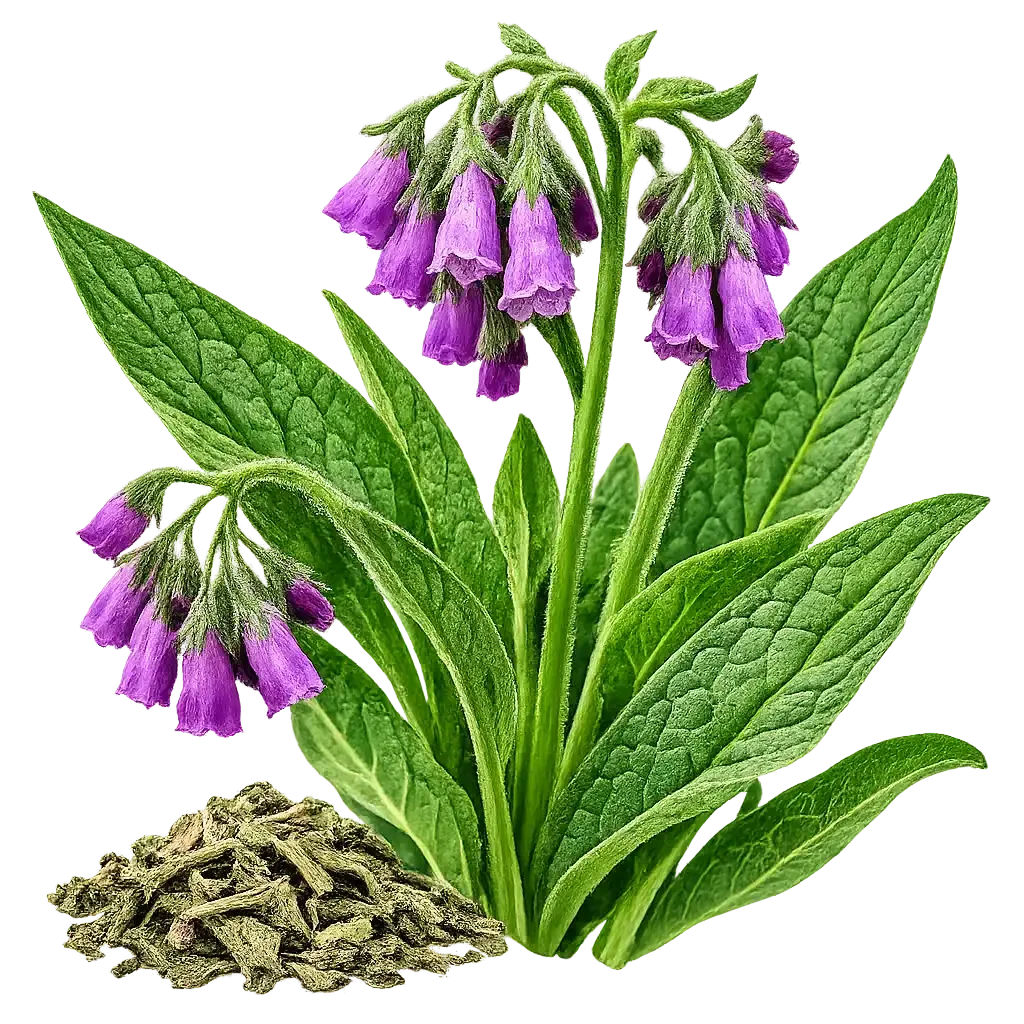
Written By Arthur Simitian
QUICK FACTS
Common Name
Comfrey, Common Comfrey, Knitbone, Boneset, Bruisewort, Blackwort; Bocking 14 and Russian Comfrey (Symphytum x uplandicum) are the sterile hybrid varieties most commonly grown on homesteads
Scientific Name
Symphytum officinale (common comfrey; sets seed; spreads); Symphytum x uplandicum (Russian comfrey; sterile hybrid; does not set seed; spreads only by root division or root fragments)
Plant Type
Hardy herbaceous perennial; dies back to the ground in winter; returns vigorously from the deep root system each spring; effectively permanent once established
Hardiness Zones
4 to 9 for common comfrey; 4 to 8 for Russian comfrey hybrids; extraordinarily cold-hardy given adequate root establishment
Sun Requirements
Full sun to partial shade; tolerates considerable shade without significant loss of biomass production; very adaptable to difficult garden positions
Soil Type
Deeply tolerant of varied soils; performs in heavy clay, poor subsoil, and disturbed ground where little else grows; prefers moist, fertile conditions for maximum biomass but establishes in most soils; pH 5.5 to 7.0
Plant Height
3 to 5 feet in flower; the large basal leaf mass alone spreads 3 to 4 feet across; Bocking 14 is the most commonly recommended homestead variety for its vigour and sterility
Harvest Parts
Leaves (topical only; multiple cuts per season from established plants; primary homestead use is as garden material); root (topical preparations; highest allantoin content)
Primary Active Compounds
Allantoin (primary wound-healing compound; stimulates cell proliferation; accelerates tissue repair; present in leaf and root; highest concentration in root); rosmarinic acid (anti-inflammatory); mucilage; tannins; pyrrolizidine alkaloids including symphytine, echimidine, and lycopsamine (hepatotoxic; present throughout the plant; concentrated in root; the central safety concern for internal use)
Garden Uses
Dynamic accumulator (deep taproot mines minerals from subsoil layers unavailable to shallow-rooted plants; leaf has high potassium, calcium, and phosphorus); liquid fertilizer tea; mulch; compost activator; chop-and-drop fertility system in food forest design
Medicinal Uses
Topical only: wound healing, bruise resolution, sprain and strain pain relief, osteoarthritis symptom relief; internal use not recommended due to pyrrolizidine alkaloid hepatotoxicity
Comfrey is the plant that homestead and permaculture literature discusses with a particular enthusiasm that is entirely justified for its garden applications and somewhat complicated by the medicinal safety picture. The two things are worth holding separately: comfrey as a garden plant is among the most productive and useful non-food perennials in the temperate homestead, providing a large biomass of nutrient-dense leaves that feeds the compost heap, activates decomposition, mulches the orchard, and, when steeped in water, produces a liquid fertilizer with a nutrient profile approximating a dilute soluble potassium feed. Comfrey as a topical medicinal plant has a genuine and well-documented evidence base for wound healing, bruise resolution, and musculoskeletal pain relief from allantoin. Comfrey as an internal medicine is a different matter entirely: the pyrrolizidine alkaloids in all parts of the plant are hepatotoxic, capable of causing veno-occlusive liver disease with repeated ingestion, and the internal use that was standard in traditional herbal medicine through the nineteenth and early twentieth centuries is now contraindicated by the regulatory authorities of every country that has reviewed the evidence. The post that follows covers all three dimensions honestly.
Introduction
Symphytum officinale is native to Europe and western Asia and belongs to the Boraginaceae family alongside borage, lungwort, and forget-me-not, sharing the family's characteristic scorpioid cyme flower clusters, bristly hairy leaves, and the presence of pyrrolizidine alkaloids in the plant chemistry. The genus name derives from the Greek symphyo, meaning to cause to grow together, a direct reference to the traditional use of the root and leaf poultice for wound healing, fracture support, and the repair of torn tendons and ligaments that gave rise to the common names knitbone and boneset.
The species has been in continuous cultivation and use in European herbal medicine for at least two thousand years, with the root particularly valued for its mucilaginous, wound-healing properties. The isolation of allantoin in the early twentieth century provided the biochemical basis for the traditional knitbone use: allantoin promotes cell proliferation and accelerates the formation of new connective tissue, granulation tissue, and epithelial cells at wound sites. This finding legitimized the topical use that traditional herbalism had relied on for centuries while the subsequent research into pyrrolizidine alkaloids complicated the internal use that had been equally traditional.
The variety most commonly recommended for homestead planting is Bocking 14, a named sterile hybrid selection of Russian comfrey (Symphytum x uplandicum) that does not set seed and spreads only by root fragments. This sterility is significant: common comfrey (S. officinale) spreads by seed and by root fragments, creating a planting that expands steadily and is extremely difficult to eradicate once established. Bocking 14 in a fixed bed expands slowly by crown growth but does not colonize adjacent areas through seed, giving the grower considerably more control over where the plant occurs. If establishing comfrey deliberately on a homestead, source Bocking 14 or another named sterile hybrid rather than common comfrey from a seed packet.
How to Grow
Establishment
Bocking 14 and other sterile hybrids do not set seed; they are established from root cuttings or crown divisions purchased from specialist herb nurseries. Plant root pieces two to four inches long horizontally in the soil at four to six inches depth in early spring or autumn, spacing plants three to four feet apart. Roots establish readily and produce the first leaf growth within two to three weeks. First-year plants produce modest leaf mass; by the second and third years, established plants produce three to five heavy cuts of leaf per season from each plant.
Common comfrey can be established from seed sown in spring, though germination is variable. Given the management advantages of sterile hybrids, starting from seed is worth it only if a specific seed source of a hybrid variety is available; otherwise purchasing root cuttings of Bocking 14 is the more practical approach.
Site Selection: Choose Carefully
The permanence of comfrey is the most important site consideration. Once established, the plant is extremely difficult to remove; the deep, fleshy taproot regenerates the entire plant from any fragment left in the soil, and repeated digging, cutting, and herbicide application over several seasons is required to eliminate an unwanted planting. Position comfrey in locations where it can remain indefinitely: the base of a fruit tree, the edge of a food forest, a dedicated fertility bed, or the back of a permanent herb garden where its large size is appropriate and where it will not need to be moved.
Avoid planting comfrey in vegetable beds that are dug and replanted seasonally; root fragments left during bed preparation produce new plants, and the resulting comfrey volunteers compete aggressively with vegetable crops. The correct model is comfrey as a permanent installation in the landscape, not as a rotated annual or biennial.
Cutting and Productivity
Established comfrey plants can be cut to near ground level three to five times per growing season from the second year onward, with each cut producing a fresh flush of large leaves within four to six weeks. Cut with shears or a sickle when the plants have reached full leaf before or just at flowering; cutting at flowering directs energy back into leaf production rather than seed set. Leave at least four to six inches of stem stubble to allow rapid regrowth. The combined leaf yield from a three-plant planting cut four times per season represents a substantial volume of nutrient-dense organic material for the garden.
Comfrey as a Garden Plant
Dynamic Accumulator
The dynamic accumulator concept proposes that comfrey's deep taproot, reaching two to six feet into the subsoil in established plants, mines minerals from depths unavailable to the shallow-fibrous root systems of most garden plants and concentrates those minerals in the large leaf biomass harvested from the surface. The leaf analysis of comfrey shows notably high levels of potassium, calcium, phosphorus, nitrogen, and trace minerals compared to most plant leaves, and the potassium content is specifically high enough to make comfrey leaves a useful potassium source in organic growing systems where synthetic potassium fertilizers are not used.
The dynamic accumulator concept has been criticized in recent years for overstating the mineral mining mechanism relative to simply concentrating what is present in the soil. The criticism has some validity: comfrey grown in mineral-poor soils produces leaves with lower mineral content than comfrey grown in fertile soils, which would not be the case if deep root mining were the primary mechanism. The practical takeaway is that comfrey leaves are a genuinely good source of potassium and other nutrients for compost and liquid fertilizer applications, but the claim that comfrey extracts minerals from otherwise inaccessible soil layers is probably overstated.
Liquid Fertilizer
Comfrey liquid fertilizer, made by wilting and submerging fresh cut leaves in water and allowing them to decompose over four to six weeks, produces a concentrated brown liquid with a strong odor and a nutrient profile that provides a useful potassium-rich feed particularly suited to fruiting plants through the growing season. Dilute ten to twenty parts water to one part concentrate before applying to prevent burning and to make the volume practical.
Making comfrey liquid fertilizer
Cut a large harvest of comfrey leaves and allow them to wilt for twenty-four to forty-eight hours to reduce volume. Pack the wilted leaves tightly into a large container with a lid, such as a thirty-gallon trash can with a lid that can be secured against the smell. Some growers use a brick or heavy weight to compress the leaves below the water line. Cover with water, seal, and leave for four to six weeks. The resulting liquid will be dark brown and strongly odorous from the decomposition process; this is normal.
Strain out the leaf material, which can go directly into the compost heap. Store the concentrate in sealed containers. Use diluted ten to twenty parts water to one part concentrate as a general potassium-rich liquid feed applied to the base of fruiting plants, tomatoes, squash, beans, and fruit trees through the growing season. Apply every two to three weeks from first fruit set through harvest.
An alternative no-liquid method: use cut comfrey leaves directly as mulch around fruit trees and berry bushes, laying a thick layer around the drip line and allowing the leaves to decompose in place. This chop-and-drop approach releases the same nutrients directly into the soil without the smell or fermentation management of the liquid preparation, and is particularly well-suited to an orchard setting where the comfrey plants can be established as a permanent ground layer beneath the trees.
Compost Activator and Mulch
Comfrey leaves added to the compost heap in alternating layers with carbon-rich material accelerate decomposition through their nitrogen and moisture contribution and through the mucilaginous compounds that promote microbial activity. A layer of comfrey leaves every six to eight inches through a compost heap significantly speeds the composting process compared to an equivalent heap without the green activator layer. The leaves decompose rapidly, within two to three weeks in warm conditions, and do not require any additional processing before addition to the heap.
Topical Medicinal Uses
Wound Healing and Allantoin
Allantoin, the primary wound-healing compound in comfrey, is one of the better-characterized plant-derived wound-healing agents in the European phytomedicine literature. It promotes cell division and tissue granulation at wound sites, stimulating the fibroblast and epithelial cell proliferation that builds new connective tissue over damaged areas. Commission E in Germany has approved topical comfrey root preparations for blunt injuries including bruises, sprains, and strains, representing a regulatory acknowledgment of the clinical evidence base that goes beyond traditional use.
Randomized controlled trials of comfrey root cream for ankle sprains, for example a 2004 trial published in Phytomedicine, found significant superiority over placebo for pain reduction and ankle mobility improvement, with the effect comparable to diclofenac gel in some measures. Similar trials for knee osteoarthritis and muscle pain have produced positive results. This is a genuine clinical evidence base rather than simply traditional use, and it supports the topical application of properly prepared comfrey root cream as a first-line approach to soft tissue injuries and joint pain.
Practical Topical Preparations
The simplest homestead topical preparation is a fresh leaf poultice: take several large comfrey leaves, bruise or pound them briefly to break the cell walls and release the mucilaginous sap, and apply directly to a bruise, sprain, or wound with a cloth wrap to hold in place. Leave for one to two hours, then remove. The allantoin and mucilage make direct contact with the skin and underlying tissue through this method.
For a more stable preparation, comfrey-infused oil made by cold or warm infusion of dried root in a carrier oil such as olive oil or coconut oil, then blended with beeswax to a salve consistency, provides a shelf-stable topical with concentrated allantoin that can be applied to bruises, sprains, and arthritic joints. Dried root is available from reputable herb suppliers; the root has significantly higher allantoin content than the leaf and produces a more potent topical preparation than leaf-only infusions.
The pyrrolizidine alkaloid safety picture: internal use is not recommended
Pyrrolizidine alkaloids (PAs) present throughout the comfrey plant, with the highest concentrations in the root, cause hepatic veno-occlusive disease through progressive obstruction of the hepatic venules. This is a cumulative dose-dependent effect; short-term occasional exposure at low levels causes different risk than prolonged repeated ingestion, but the liver damage from PAs is irreversible, progressive, and potentially fatal at sufficient cumulative exposure. The critical cases in the literature involve people who consumed comfrey tea, comfrey tincture, or comfrey-containing supplements daily for months or years; several deaths from veno-occlusive disease have been documented and attributed to comfrey PA ingestion.
The regulatory response has been comprehensive: Germany banned the internal use of PA-containing comfrey preparations in 1992; the UK's Medicines and Healthcare products Regulatory Agency advises against internal use; the US FDA has warned against comfrey dietary supplements; Australia's Therapeutic Goods Administration classifies comfrey PA content as a significant risk for internal use. Multiple countries require topical comfrey preparations to be formulated from PA-reduced extracts or to carry specific warnings against internal use and application to broken skin over large areas.
PA-reduced comfrey preparations for topical use are available commercially, processed to remove most but not all PA content. The topical absorption of PAs through intact skin is low, and short-duration topical application to small areas of intact skin is considered acceptable risk by the regulatory framework that permits commercial topical comfrey products. The cautions for topical use are: do not apply to broken skin or open wounds where systemic absorption would be significantly higher; do not use over large body surface areas for extended periods; do not use during pregnancy or breastfeeding; do not use on children under twelve. These are not hypothetical cautions; they reflect the reality of transdermal PA absorption at scale.
The homestead fresh leaf poultice applied briefly to an intact-skin bruise or sprain represents a very different exposure profile than prolonged application of concentrated root preparations to large broken-skin areas, and the risk of the former is appropriately low. The distinction between these use scenarios, and between topical and internal use, is the practical safety framework for comfrey on the homestead.
Pros and Cons
Advantages
Among the most productive fertility plants in the temperate homestead; three to five leaf cuts per season from established plants provide substantial compost activator, mulch, and liquid fertilizer material with a notably high potassium content
Topical allantoin evidence base is genuinely strong; Commission E approved for blunt injuries; randomized controlled trial evidence for ankle sprain and knee osteoarthritis comparable to pharmaceutical topical anti-inflammatories in some measures
Extremely adaptable to difficult garden positions including heavy clay, poor subsoil, partial shade, and the neglected margins where most plants fail; establishes reliably where other perennials struggle
Long-lived and self-maintaining; Bocking 14 in a fixed position requires no annual replanting, minimal management beyond periodic cutting, and no significant fertility inputs once established
Ideal food forest ground layer plant; the canopy-tolerant habit, rapid leaf production, and nutrient release from decomposing leaves make it the classic companion planting for fruit trees in permaculture design
Flowers are a significant early-season nectar source for bumblebees specifically, which have a tongue length suited to the tubular comfrey flower that most short-tongued bee species cannot access; comfrey flowers support bumblebee populations meaningfully through the late spring period
Limitations
Effectively permanent once established; the deep taproot regenerates from fragments and makes removal difficult to the point of requiring multi-season effort; site selection must be treated as final
Internal use is genuinely contraindicated by the pyrrolizidine alkaloid hepatotoxicity evidence; the traditional internal uses including comfrey tea and tincture should not be practiced; this is a harder limitation than most herbs in this series where internal use cautions are theoretical or dose-dependent
Large and assertive in the garden; at three to five feet with a similar spread, the plant is too large for small or tightly managed beds and dominates positions where smaller herbs are intended to grow
Common comfrey spreads by seed and becomes invasive in some garden contexts; Bocking 14 must be sourced specifically and confirmed sterile; seed-grown comfrey plants carry both the spreading risk and higher PA content variability
The topical safety framework for broken skin and children requires awareness; casual application without understanding the PA absorption concern leads to use outside the evidence-supported safe parameters
The liquid fertilizer preparation has a significant and persistent odor during the four-to-six-week fermentation period; positioning the fermentation container away from living areas and sealing it adequately is not optional
Common Problems
Comfrey rust, caused by the fungal pathogen Melampsorella symphyti, produces orange pustules on the leaf undersides and causes premature leaf death in affected plants. It is more of a cosmetic problem than a productivity threat in most years; affected plants continue to produce new leaves through the season. Removing and composting affected leaves rather than leaving them to drop in place reduces the spore load for the following season.
The most common management problem is not a disease but the plant's own vigor: comfrey growing in a favorable position can produce so much biomass that the surrounding garden plants are shaded and outcompeted. Regular cutting and positioning the plant appropriately from the start prevents the most significant neighbor competition issues. The cut leaves, wilted briefly, can be laid around the base of neighboring plants as a mulch, turning the comfrey's vigor into a direct benefit for the surrounding planting rather than a competitive problem.
Final Thoughts
Comfrey is the homestead plant that rewards the grower who understands what it is and what it is not. It is not the universal internal medicine of the old herbal tradition; that use carries a documented liver toxicity risk that the traditional practitioners did not have the biochemical tools to recognize. It is not a weed problem requiring eradication; that framing belongs to the lawn monoculture context where comfrey's permanent assertive growth is unwelcome. What it is, on a homestead with appropriate space, is one of the most productive single plants for soil fertility, soft-tissue injury first aid, and food forest establishment that the temperate garden contains.
Plant Bocking 14 at the base of the fruit trees. Cut it regularly. Put the leaves in the compost, or steep them for liquid feed, or lay them as mulch. Keep a small jar of comfrey salve in the first aid kit for bruises and sprains. That is the full and appropriate scope of comfrey on the modern homestead, and it is more than enough to justify its permanent presence.