
Dandelion
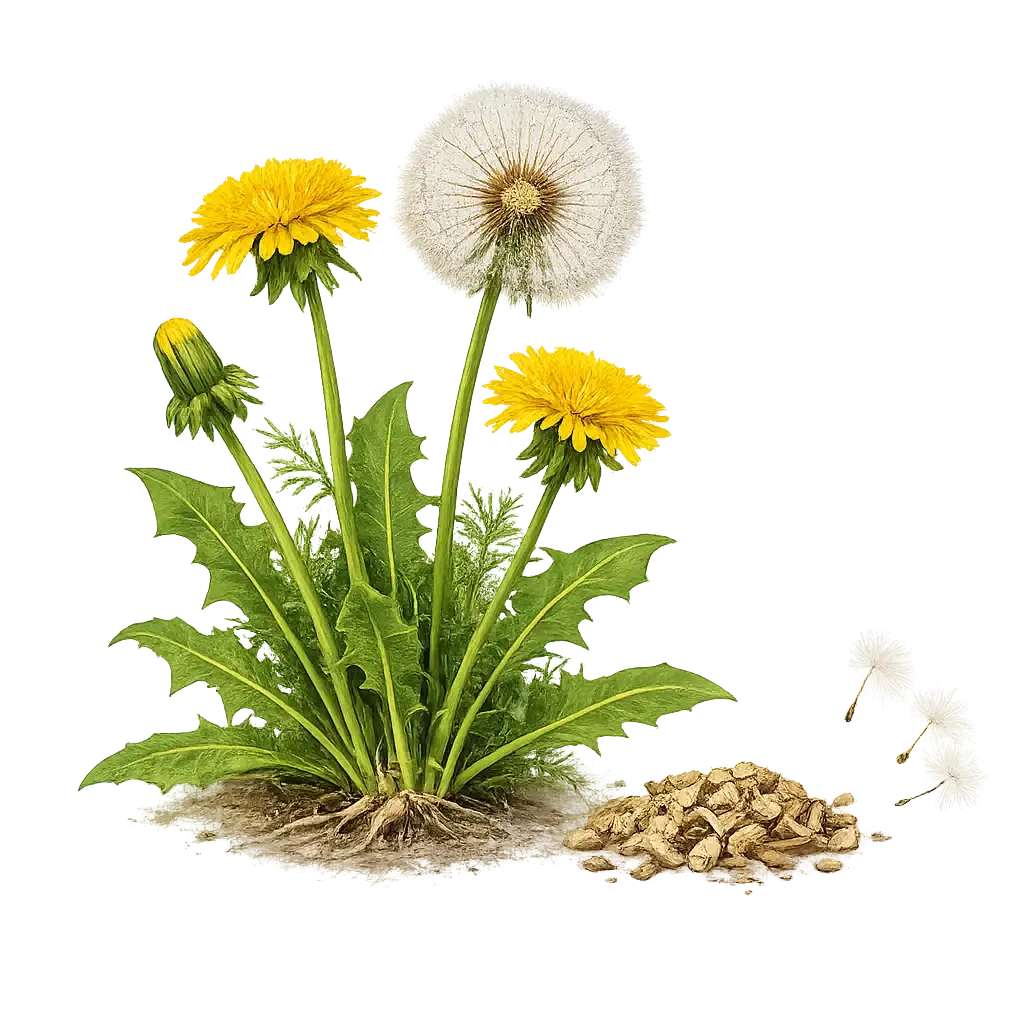
Written By Arthur Simitian
QUICK FACTS
Common Name
Dandelion, Common Dandelion, Lion's Tooth, Blowball, Pee-in-a-Bed (pissenlit in French, referring to the diuretic activity)
Scientific Name
Taraxacum officinale (aggregate species complex; apomictic; hundreds of microspecies exist but are treated as T. officinale for medicinal and culinary purposes)
Plant Type
Hardy herbaceous perennial; produces new growth from the crown and taproot each spring after winter dormancy; naturalized globally as a common weed of lawns, disturbed ground, and cultivated areas
Hardiness Zones
3 to 10; among the most cold-hardy and adaptable plants in this series; survives temperatures well below zero Fahrenheit when the root is established
Harvest Parts
Root (autumn and early spring; highest inulin content in autumn; medicinal and culinary); leaf (spring before flowering; most tender and least bitter; also harvestable through summer with some management); flower (spring; culinary; wine, fritters, infused honey)
Primary Active Compounds
Inulin (root; 12 to 15% in spring, up to 40% in autumn; prebiotic polysaccharide); taraxacin and taraxacerin (sesquiterpene lactones; bitter; liver-stimulating); taraxasterol and beta-sitosterol (triterpene sterols; anti-inflammatory); caffeic acid derivatives; flavonoids including luteolin and apigenin; potassium (leaf; notably high; relevant to the diuretic mechanism); chlorogenic acid; coumarins
Uses
Digestive bitter and liver tonic; diuretic (with potassium replacement; the leaf replaces the potassium it causes to be excreted); prebiotic root; culinary greens; root coffee substitute; flower wine and cordial; topical anti-inflammatory (latex from stem)
The Weed Question
Dandelion requires no cultivation effort once established; the homestead question is whether to harvest deliberately from existing naturalized plants, to encourage a managed patch, or to cultivate improved varieties for superior leaf production
Dandelion occupies a unique position in the homestead herb series: it is the only plant covered here that requires no deliberate growing, no seed purchase, no bed preparation, and no planting effort in any garden located outside a climate where it has not already naturalized. It is already there. The homestead question is not whether to grow it but whether to harvest it, which parts to harvest in which season, and whether to manage a deliberate patch of improved varieties or simply work with the naturalized population that the lawn suppression effort has been failing to eliminate for years. The case for taking it seriously as a food and medicine plant is stronger than its weed status suggests. The root is among the richest plant sources of inulin prebiotic fiber in the temperate garden. The spring leaf is nutritionally comparable to spinach with a notably high potassium content that is mechanistically relevant to its well-documented diuretic activity. The flower is an early spring nectar source that deserves protection rather than removal for that reason alone. The bitterness that makes raw dandelion greens initially challenging is the same sesquiterpene lactone bitterness that drives digestive secretion and liver bile production, which is where the medicinal claim has its most direct basis.
Introduction
Taraxacum officinale is native to Eurasia and was deliberately introduced to North America by European settlers who valued it as a spring vegetable and medicinal plant before the lawn culture of the twentieth century reframed it as a primary target of herbicide. The plant's Latin species name, officinale, the same suffix carried by dozens of herbs in this series, designates a plant that was officially recognized as having medicinal use in the apothecary tradition, confirming that its presence in European pharmacopoeias and kitchens was a deliberate cultural choice rather than an accidental contamination of otherwise useful ground.
The common name lion's tooth is a direct translation of the French dent-de-lion, referring to the deeply toothed leaf margins that resemble the serrated edge of a lion's jaw in profile. The French pissenlit, piss-in-bed, is a folk name that refers specifically and accurately to the diuretic activity of the leaf and has been in use long enough to appear in sixteenth-century French botanical texts, confirming that the plant's effect on urine production was recognized and named centuries before the pharmacological mechanism was understood.
The plant reproduces primarily through apomixis, producing seed without fertilization, which means individual plants are effectively clonal and the genetic variation across a lawn or field of dandelions is low. This reproductive strategy, combined with the deep taproot that regenerates the plant from a root fragment if the top is removed, explains both the plant's persistence under management pressure and its consistent medicinal and culinary quality across wild populations.
The Three Harvests by Season
Spring Leaf Harvest
The most valuable culinary and nutritional harvest comes from the young leaves in early spring, before the first flower scape emerges. At this stage the leaves are their most tender, their bitterness is at its annual minimum, and their nutritional density is at its peak. A analysis of fresh dandelion leaf shows levels of vitamins A, C, and K, iron, calcium, and potassium that compare favorably with cultivated spinach, making spring dandelion greens one of the most nutritionally complete early-season foraged vegetables available in the temperate garden.
Harvest by cutting the entire rosette at soil level or by selecting individual outer leaves from the center of the rosette, leaving the growing point intact for continued production. Young leaves from the center of an established rosette are the least bitter; outer leaves that have been exposed to full sun for several weeks are more bitter and more suitable for cooking than for raw use. Blanching the plants by covering them with an inverted pot or a thick layer of straw for seven to ten days before harvest reduces bitterness significantly and is the traditional French approach to producing dandelion greens mild enough for salad use from established lawn plants.
Once flowering begins, the leaves become progressively more bitter through summer as the sesquiterpene lactone content rises with the plant's reproductive phase. Summer and autumn leaves are still usable but require cooking to moderate the bitterness; braised, sauteed in olive oil with garlic, or added to soups and stews, older leaves perform better than as raw salad greens.
Flower Harvest
Dandelion flowers open in the first warm days of spring and represent the earliest significant nectar source of the season for bees and other pollinators emerging from winter. This ecological value deserves acknowledgment before harvest: leaving a meaningful proportion of flowers unharvested through the early spring pollinator season is the right balance, particularly on any homestead that keeps bees or depends on early pollinator activity for fruit and vegetable crops. Dandelion in flower is a managed resource, not an unlimited one to be stripped without consideration.
For culinary use, harvest flowers in the morning when they are fully open and at their most fragrant, before they begin closing in the afternoon. The golden petals alone, separated from the bitter green involucre, are the culinary part; eating the entire flower head including the involucre adds significant bitterness. The petals can be added to salads, used to make dandelion wine, infused into honey or vinegar, or made into fritters using the same battered-and-fried approach as elderflower fritters.
Dandelion flower honey infusion
Fresh dandelion petals infused into raw honey produce one of the most distinctively flavored infused honeys in the spring herb calendar, with a floral, slightly earthy sweetness that carries the character of the flower in a form that keeps indefinitely.
Separate the yellow petals from the green involucre by pulling the petals free or snipping the flower head just behind the point where the petals meet the green base. Use only the petals; the green parts are bitter and will dominate the honey if included. Allow the petals to wilt on a clean cloth for two to three hours to release surface moisture, which would otherwise dilute and potentially ferment the honey. Pack the wilted petals loosely into a clean jar, approximately one part petals to two parts honey by volume. Stir to combine, seal, and leave at room temperature for two to three weeks. The honey will turn golden-yellow as the pigments and volatile compounds infuse. Use as-is with the petals present, or strain for a cleaner product. Use on yogurt, cheese boards, and toast, or dissolved in warm water as a soothing drink.
Root Harvest
The dandelion root is the primary medicinal part and the one whose harvest timing most significantly affects its active compound profile. Autumn-harvested roots, dug after the first frost has killed back the top growth, contain inulin at concentrations of thirty to forty percent of dried root weight, making autumn the correct time for a root harvest intended for prebiotic or digestive bitter use. Spring-harvested roots, before the new leaf growth draws down the root's stored reserves, are somewhat lower in inulin but higher in taraxacin and taraxacerin, the sesquiterpene lactones responsible for the bitter taste and the liver-stimulating activity. Both harvest windows are productive; autumn for maximum prebiotic inulin, early spring for maximum bitter digestive compounds.
Dig roots using a long-bladed garden fork or a purpose-made dandelion digger that can follow the taproot to its full depth, often six to twelve inches in established plants in deep soil. Wash thoroughly, split lengthwise, and dry on racks at low heat or in a warm ventilated space until fully hard and dry. Dried root retains activity for two to three years stored in sealed glass away from light.
The fresh root exudes a white milky latex when cut, which is characteristic of the plant and harmless; allow the cut surface to air briefly before processing if the latex is excessive, as it can cause mild skin irritation in sensitive individuals from prolonged contact during root preparation.
Culinary Uses
Dandelion Greens in the Kitchen
Young spring dandelion leaves are used raw in salads across French, Italian, and German culinary traditions, dressed with warm bacon fat and vinegar in the classic French salade de pissenlit, or with olive oil, lemon, and garlic in the southern European tradition. The warm dressing approach slightly wilts the leaves and moderates their bitterness in the way that dressed arugula and radicchio are treated, making the bitterness a flavor asset rather than a challenge.
Older leaves braised in olive oil with garlic until tender, then finished with lemon juice, follow the same preparation approach used for other bitter greens including mustard, turnip tops, and mature kale. The bitterness softens significantly with cooking and the resulting dish has a pleasantly complex bitter-savory quality. Adding a pinch of sugar or a splash of balsamic vinegar to the cooking oil before adding the leaves balances the bitterness further.
Roasted Root Coffee
Roasted dandelion root is among the oldest and most practically useful coffee substitutes in the European kitchen tradition, used during periods when coffee was unavailable or unaffordable and valued in its own right for its deep, slightly bitter, roasted flavor and its complete freedom from caffeine. The preparation is straightforward: wash and dice cleaned roots into small cubes, spread on a baking sheet, and roast at 350 degrees Fahrenheit for forty-five to sixty minutes, stirring occasionally, until the pieces are dark brown throughout and fragrant. Grind the roasted root in a coffee grinder and brew by the cup or in a French press using the same ratios as ground coffee. The flavor is earthy, slightly sweet from the caramelized inulin, and genuinely comparable to weak coffee in character if not in stimulant effect.
Medicinal Uses
Digestive Bitter and Liver Tonic
The sesquiterpene lactones taraxacin and taraxacerin are the compounds responsible for dandelion's characteristic bitterness and for its primary medicinal mechanism in digestive use. Bitterness receptors on the tongue trigger a reflex stimulation of digestive secretion that increases gastric acid output, bile production and flow from the gallbladder, and pancreatic enzyme secretion. This mechanism, shared with other digestive bitters including gentian, burdock, and elecampane, supports digestion broadly by ensuring adequate secretory activity for efficient breakdown of food.
The liver-specific effect from increased bile production and flow is the basis for the traditional use of dandelion root as a liver tonic and cholagogue. Commission E in Germany has approved dandelion root and leaf for disturbances of bile flow and for dyspeptic complaints, representing a regulatory acknowledgment of the evidence base. The clinical trial evidence for dandelion specifically as a liver tonic is limited in scale but consistent in direction; the mechanistic basis through cholagogue activity is well-established.
Diuretic Activity and the Potassium Replacement Mechanism
The diuretic activity of dandelion leaf is among the best-documented clinical effects in the plant's pharmacology. A 2011 pilot study published in the Journal of Alternative and Complementary Medicine measured urine frequency and volume in human subjects following two doses of concentrated dandelion leaf extract and found statistically significant increases in both measures, providing the first controlled human data supporting the traditional diuretic use.
The mechanism is attributed to the combination of caffeic acid derivatives that reduce tubular reabsorption of water and the very high potassium content of the leaf itself. Most pharmaceutical diuretics cause potassium loss through the kidney, requiring potassium supplementation to prevent hypokalemia. Dandelion leaf's diuretic activity appears to come paired with its own potassium replacement, since the potassium excreted through increased urine output is roughly offset by the potassium content of the leaf preparation producing the diuresis. This self-compensating electrolyte balance is cited as a specific advantage of dandelion leaf over pharmaceutical diuretics for mild fluid retention in the herbal medicine literature.
Prebiotic and Nutritive
The inulin content of dandelion root, particularly in autumn-harvested roots, places it among the top plant sources of prebiotic fructooligosaccharides alongside chicory root, elecampane, and Jerusalem artichoke. The prebiotic mechanism and microbiome support function are the same as described for elecampane and fenugreek in earlier posts in this series: inulin passes undigested to the colon where it selectively feeds Bifidobacterium and Lactobacillus species. The roasted root coffee preparation retains a proportion of the inulin as well as providing the digestive bitter effect, making it a functionally active preparation rather than merely a flavor substitute.
Cautions: Dandelion at normal food and medicinal tea quantities is among the safest plants in this series, with a several-century record of regular consumption as a food vegetable across Europe and North America. The specific cautions are as follows. People with gallstones or bile duct obstruction should not use dandelion root preparations as a cholagogue; increased bile flow in the presence of gallstones or obstruction can cause biliary colic or worsen obstruction. The diuretic activity of the leaf is real and is additive with pharmaceutical diuretics and other diuretic herbs; people taking pharmaceutical diuretics should not add therapeutic doses of dandelion leaf without awareness of the combined effect and monitoring for electrolyte changes. Asteraceae family allergy cross-reactivity applies to dandelion, though dandelion allergy is considerably less common than ragweed or chrysanthemum allergy in the clinical literature. The latex from the fresh cut stem causes contact dermatitis in a small proportion of people with latex sensitization; this is relevant for people with known latex allergy who handle large quantities of fresh root. Dandelion grown on roadsides, treated lawns, or contaminated ground should not be harvested for food or medicine; the plant accumulates heavy metals and absorbs pesticide residues readily. Harvest only from unsprayed, uncontaminated ground that you have personal knowledge of. Ragwort (Senecio jacobaea) and some other toxic yellow-flowered plants are occasionally confused with dandelion by inexperienced foragers; dandelion is distinguished by its hollow, leafless, unbranched flower scape, its basal-only leaves (no stem leaves), and its milky latex, none of which are present in ragwort.
Cultivated Varieties vs. Wild Plants
Improved dandelion varieties selected for leaf production, reduced bitterness, and larger root size are available from specialty seed suppliers and are worth considering for growers who want to incorporate dandelion seriously into the kitchen garden rather than simply harvesting from lawn volunteers. Varieties including Ameliore, a French selection, and Thick-Leaved Improved produce substantially larger leaves than naturalized plants, bolt significantly later, and have been selected for reduced bitterness while retaining the nutritional and medicinal compound profile of the wild species.
A deliberate cultivated patch in a prepared bed with good deep soil also produces the large, straight taproots that are easiest to harvest cleanly for root preparations; wild plants in compacted lawn soil produce smaller, branched, difficult-to-extract roots that yield much less per digging effort. If root medicine is a primary goal, a purpose-grown bed of cultivated dandelion in deeply dug, loose soil provides far better return on harvest effort than digging lawn plants.
Pros and Cons
Advantages
Requires no cultivation effort from existing naturalized populations; the most zero-input medicinal and culinary herb in this entire series, already present and already productive on virtually every homestead in the temperate zone
Three distinct harvests across the season from a single plant, each with different peak timing and distinct culinary and medicinal applications: spring leaf for greens and nutrition, spring flower for culinary and pollinator support, autumn root for prebiotic medicine and roasted coffee
The diuretic mechanism with built-in potassium compensation is among the most pharmacologically elegant self-regulating mechanisms in this series; Commission E approved for bile flow disturbances and dyspeptic complaints
Nutritional profile of the spring leaf is exceptional among temperate foraged vegetables; vitamin A, C, and K levels, iron, calcium, and potassium content compare favorably with cultivated spinach
Autumn root inulin content of thirty to forty percent of dry weight places it among the top temperate prebiotic plants; the roasted root coffee is a genuinely functional preparation that delivers prebiotic fiber alongside the digestive bitter effect
Critical early spring nectar source for emerging pollinators; protection of a dandelion-bearing area on the homestead has direct benefit to fruit and vegetable pollination across the same season
Limitations
Harvest-site safety is the central constraint: lawn dandelions in treated gardens are contaminated with herbicide and pesticide residue and are unsafe to eat; roadside plants accumulate heavy metals; harvest is only appropriate from ground with confirmed freedom from chemical treatment and contamination
Contraindicated in gallstones and bile duct obstruction; the cholagogue activity that makes it medicinally useful for bile flow and digestion is directly problematic in gallstone disease, which affects a meaningful proportion of the adult population
Bitterness of summer and autumn leaves limits culinary versatility; the spring window for genuinely palatable raw salad greens is short, and the rest of the season requires cooking to make the leaves acceptable to most palates
Wild-harvested roots from compacted or rocky soil are difficult to extract whole and may be small, branched, and disappointing as a medicinal harvest; serious root production requires a deliberately cultivated bed with loose, deep soil
The identification caution is real for inexperienced foragers; while dandelion is visually distinctive to anyone who has spent time with it, the hollow leafless scape, basal leaf arrangement, and milky latex are the confirmation markers that should be checked before consuming any unfamiliar yellow-flowered composite plant
Final Thoughts
Dandelion is the herb that repays a change in framing more than any other in this series. The plant that the lawn care industry has spent decades and considerable marketing effort persuading homeowners to eradicate is, from a food and medicine perspective, one of the most productive and nutritionally valuable plants on the property. It grows without assistance, survives without attention, provides three distinct harvests across the season, supports early pollinators, and contains active compounds with established mechanisms for digestive, liver, diuretic, and prebiotic applications.
The homesteader who stops fighting the dandelion and starts harvesting it has not surrendered to the weed. They have recognized a managed resource that was already there, requiring only a change in perspective and a willingness to get down close to the ground with a long fork in early spring and again in autumn.