
Echinacea
Written By Arthur Simitian
QUICK FACTS
Common Name
Echinacea, Purple Coneflower, Coneflower
Scientific Name
Echinacea purpurea (most widely grown and best evidenced); Echinacea angustifolia (traditional root medicine of the Great Plains; strongest alkamide content); Echinacea pallida (pale purple coneflower; root use similar to E. angustifolia)
Plant Type
Hardy herbaceous perennial; long-lived; returns reliably from the crown each spring
Hardiness Zones
E. purpurea zones 3 to 9; E. angustifolia zones 3 to 8; E. pallida zones 3 to 8
Sun Requirements
Full sun; tolerates partial shade with reduced flowering and somewhat reduced root development; lean dry conditions preferred
Soil Type
Well-drained, lean to moderately fertile; tolerates poor, dry, sandy or gravelly soils; pH 6.0 to 7.0; rich, moist soils produce lush, less medicinally potent plants and increase disease susceptibility
Plant Height
E. purpurea 2 to 4 feet; E. angustifolia 1 to 2 feet; E. pallida 2 to 3 feet
Harvest Parts
Aerial parts including flowers and leaves (E. purpurea; harvested in flower); root (all three species; harvested autumn of year 3 or 4); both parts are used depending on preparation and application
Primary Active Compounds
Alkamides (lipophilic; direct cannabinoid CB2 receptor agonists and immune modulators; highest in E. angustifolia root and E. purpurea aerial parts); polysaccharides including arabinogalactans and heteroxylan (water-soluble; macrophage activation; highest in E. purpurea); caffeic acid derivatives including echinacoside (E. angustifolia and pallida root), cichoric acid (E. purpurea aerial parts), and chlorogenic acid; alkylamides; glycoproteins
Uses
Upper respiratory infection prevention and duration reduction; immune modulation; anti-inflammatory; wound healing topical; antiviral activity in laboratory studies; historically used by numerous Native American nations for snakebite, pain, infection, and wound treatment
Echinacea is the best-selling herbal supplement in the United States and one of the most studied medicinal plants in the world, which means the volume of research attached to it is large, the quality of that research is variable, and the public narrative around it has drifted considerably from what the evidence actually supports. The herb works, with qualifications on what working means, for whom, at what dose, and from which part of which species. The qualifications matter. Echinacea taken correctly at the onset of a cold in an otherwise healthy adult has good evidence for modest reduction in duration and severity. Echinacea taken daily for months as a preventive supplement has less clear evidence and a plausible biological reason to be skeptical. Echinacea from a preparation that has degraded through poor storage, incorrect part used, or wrong species may do nothing at all. The gap between the confident marketing claims attached to this herb and what the clinical evidence actually shows is worth closing before the grower decides how and whether to incorporate it into the homestead medicine cabinet.
Introduction
The genus Echinacea is native to eastern and central North America, with the nine recognized species distributed across the prairies, open woodlands, and rocky outcrops of the Great Plains and eastern United States. The genus name derives from the Greek echinos, meaning hedgehog or sea urchin, referring to the spiny chaff scales of the prominent central disc that distinguishes coneflower from other daisy-family plants. Before European contact, multiple Native American nations including the Lakota, Cheyenne, Comanche, and Kiowa used echinacea species as among their most important medicinal plants, applying it externally to wounds, burns, and insect bites and internally for colds, sore throats, toothache, and snakebite. The breadth of traditional application reflects a plant whose immune-activating and antimicrobial properties were recognized across independent cultural traditions over centuries of practical use.
Echinacea entered the Euro-American herbal and medical tradition in the late nineteenth century and was among the most widely used medicines in eclectic and mainstream American medicine by the early twentieth century before being displaced by the development of antibiotics and sulfa drugs. Its revival as a commercial supplement from the 1970s onward, particularly in Germany where the regulatory framework for phytomedicines required a serious evidence base, produced the research literature that forms the current evidence base for its use.
Three Species: Which One and Why
The choice of species is among the most practically important decisions in echinacea cultivation and preparation because the three main medicinal species differ meaningfully in their active compound profiles, in which plant parts carry the most activity, and in what the evidence shows for each.
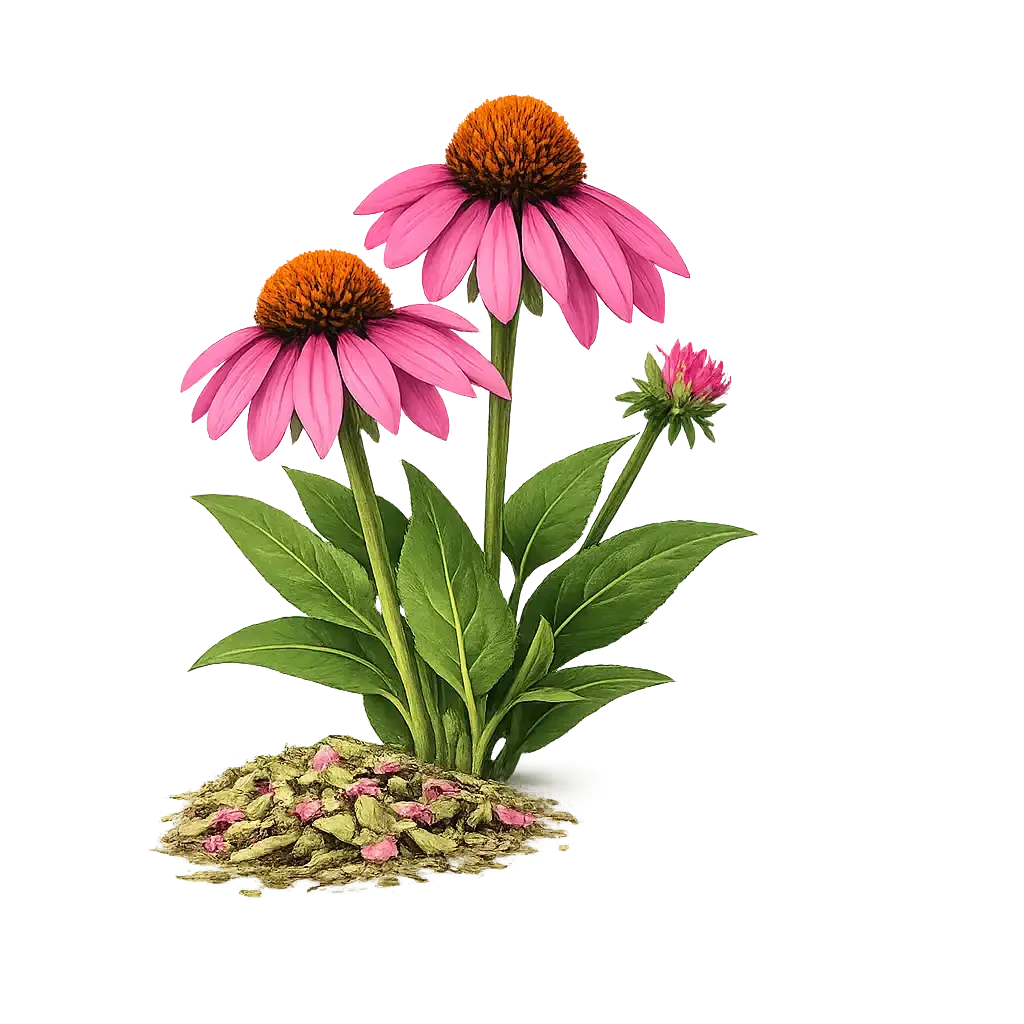
Echinacea purpurea is the easiest to grow, the most widely available, the most productive in terms of both aerial and root biomass, and the species with the largest clinical evidence base. Its primary active compounds in the aerial parts are cichoric acid and polysaccharides alongside alkamides; the aerial parts harvested in flower are the standard preparation for the evidence base around cold and flu duration reduction. E. purpurea is the correct choice for most homestead growers who want a practical, productive, well-evidenced medicinal perennial.
Echinacea angustifolia is the species most valued in the traditional eclectic medical practice of nineteenth-century American herbalism and the species with the highest alkamide content, particularly in the root. The characteristic tingling, numbing sensation on the tongue from fresh root or tincture comes from these alkamides and was historically used as a quality marker: a preparation that does not produce this sensation was considered inert. E. angustifolia is slower growing, harder to establish, and produces significantly less biomass than E. purpurea, making it more demanding for a homestead root harvest. Growers specifically interested in the traditional root medicine should grow this species, ideally alongside E. purpurea for the aerial preparation.
Echinacea pallida has a root chemistry more similar to E. angustifolia than to E. purpurea, with echinacoside and ketone alkylamides as primary compounds, and is used primarily as a root medicine. It is sometimes sold mislabeled as E. angustifolia in the commercial herb market, which has complicated the research literature. Growers working with E. pallida should be confident in their species identification before making root preparations.
How to Grow
Establishment
Echinacea purpurea establishes readily from seed sown in spring after a four-to-six-week cold stratification, or by direct autumn sowing that provides natural stratification. First-year plants produce primarily a leaf rosette; flowering typically begins in the second year. Division of established crowns in early spring or autumn is a faster establishment method and is the standard approach for propagating a known medicinal accession rather than starting from potentially variable seed.
Echinacea angustifolia and E. pallida require stratification and are slower to establish, often taking two to three years before producing significant root mass. Starting these species under controlled conditions, ensuring proper stratification, and planting out into the permanent position without further disturbance gives the best results.
Soil and Siting
The lean-soil principle applies strongly to echinacea. Plants grown in poor, dry, well-drained soil produce smaller but more medicinally concentrated root and aerial material; plants grown in rich, moist, heavily amended soil grow larger but with diluted active compound concentrations and significantly greater susceptibility to crown rot and Aster yellows disease. The prairie origin of all three species reflects their adaptation to well-drained, often rocky or sandy soils with low organic matter input and hot, dry summers.
Full sun is strongly preferred. Partial shade produces acceptable plants but noticeably reduces flowering, reduces the density of alkamides in the aerial parts, and increases disease pressure. A south-facing or west-facing position in well-drained, lean soil captures the growing conditions closest to the native prairie habitat.
Root Harvest Timing
For growers harvesting the root of E. purpurea, E. angustifolia, or E. pallida, the third or fourth autumn is the correct timing. The root reaches its peak active compound concentration only after the plant has gone through several full growing seasons; harvesting in the first or second year produces a small root with relatively low alkamide and echinacoside content. Harvest after the first hard frost has killed back the above-ground growth, when the plant has translocated its resources into the root. Save root crowns with growing points and replant to continue the stand.
Medicinal Evidence: What the Research Shows
Cold and Flu Duration and Severity
The clinical evidence base for echinacea in reducing the duration and severity of upper respiratory infections is genuine but requires careful interpretation. The most rigorous assessment is the 2015 Cochrane review of twenty-four randomized controlled trials covering more than four thousand participants, which concluded that some echinacea preparations reduced the incidence of colds and shortened their duration, but that the evidence was highly variable across preparations and the effect size was modest. The heterogeneity of results across trials reflects the genuine problem that different trials used different species, different plant parts, different extraction methods, and different doses, making cross-trial comparison inherently difficult.
The trials with the most consistent positive results used E. purpurea aerial part preparations, particularly fresh-plant pressed juice preparations or alcohol tinctures standardized to cichoric acid or alkamide content, taken at the first sign of symptoms and continued for seven to ten days. The effect in positive trials is a reduction in duration of approximately one to one and a half days and a reduction in symptom severity scores. This is a real effect, not dramatic, but clinically meaningful relative to no treatment.
The Continuous-Use Controversy
The most widely repeated caution about echinacea is that it should not be used continuously for more than eight weeks because the immune stimulation will produce tolerance or overstimulation. This claim is pervasive in herbal literature but its evidence base is weak. It derives primarily from the German Commission E monograph's recommendation for intermittent use, which was based on theoretical concern about prolonged immune stimulation rather than clinical evidence of harm from continuous use.
What the evidence actually shows is that the clinical trials demonstrating efficacy used acute, episodic dosing, typically seven to fourteen days at the onset of an infection. The evidence for continuous preventive use is weaker and less consistent than the evidence for acute use. The practical recommendation that follows from the evidence is therefore to use echinacea acutely at symptom onset rather than continuously, not because continuous use is proven harmful but because acute use is what the best evidence supports. The distinction is between a claim without evidence, continuous use causes immune exhaustion, and an accurate evidence-based recommendation, the evidence for acute use is stronger than the evidence for continuous prophylactic use.
Alkamide Mechanism
The most mechanistically interesting finding in echinacea research is that the alkamides, particularly those from E. angustifolia root and E. purpurea aerial parts, act as partial agonists at cannabinoid CB2 receptors. CB2 receptors are expressed primarily on immune cells and play a central role in modulating inflammatory responses, macrophage activation, and natural killer cell activity. This finding provides a specific receptor-level mechanism for immune modulation that goes beyond earlier models of non-specific macrophage activation and explains both the anti-inflammatory and immune-activating properties of the herb depending on context and dose.
This mechanism also explains why alkamide content is the most meaningful quality marker for echinacea preparations: a preparation with negligible alkamide content, either from wrong species, wrong plant part, or degradation through heat or age, lacks the primary mechanism of the most biologically active constituents. The tongue-tingle test for E. angustifolia root tincture has genuine scientific backing: the sensation is caused by alkamides specifically and is a reliable field quality indicator.
Making a homestead echinacea tincture: fresh aerial parts of E. purpurea
The fresh-plant pressed juice preparation used in several of the most positive clinical trials is not easily reproduced at home without a press, but a fresh-plant alcohol tincture closely approximates its active compound profile and is straightforward to make at harvest time.
Harvest E. purpurea stems, leaves, and flowers when the plant is in peak bloom, on a dry morning. Chop the aerial material finely and pack into a clean jar as tightly as possible, leaving no significant air space. Cover immediately with 60 percent alcohol, either 120-proof grain alcohol diluted to 60 percent with water, or a 75/25 blend of 100-proof vodka and 190-proof grain alcohol. The 60 percent alcohol concentration extracts both the water-soluble polysaccharides and the lipophilic alkamides that a lower-proof vodka alone would leave behind. Seal, label with date and contents, and leave in a cool dark place for four to six weeks, shaking daily. Strain through muslin, pressing the marc firmly. Bottle in dark glass. Stored properly, the tincture retains activity for two to three years.
For E. angustifolia root tincture, use dried root chopped finely in the same 60 percent alcohol menstruum. The tingle test applies: a few drops of finished tincture placed on the tongue should produce the characteristic numbing, tingling sensation within thirty seconds. Absence of the sensation indicates either wrong species, aged root with degraded alkamides, or insufficient alcohol strength in the menstruum.
Acute dose: one teaspoon of tincture in water, taken every two to three hours at the very onset of cold symptoms for the first twenty-four hours, reducing to three times daily for the following five to seven days. This acute high-frequency dosing protocol aligns with the dosing used in the positive clinical trials and differs from the once-daily capsule approach common in commercial products.
Cautions and contraindications: Echinacea is generally very well-tolerated in healthy adults at standard doses with a long history of safe use. The most clinically significant caution is the contraindication for people with autoimmune conditions including lupus, rheumatoid arthritis, multiple sclerosis, and similar conditions where additional immune stimulation could worsen disease activity; this contraindication is based on the mechanism of immune modulation and is considered real by mainstream clinical herbalists regardless of the absence of large-scale clinical evidence of harm. People taking immunosuppressant medications should not use echinacea without medical supervision. Echinacea belongs to the Asteraceae family; people with established Asteraceae allergy, particularly to ragweed or chrysanthemums, have increased risk of allergic reaction including urticaria, asthma exacerbation, and in rare cases anaphylaxis; allergy testing or cautious trial dosing is advisable in this population. Rare anaphylaxis in people without known Asteraceae allergy has been reported in the post-marketing literature, most commonly from injectable preparations but occasionally from oral use; having antihistamines available when trying echinacea for the first time is a reasonable precaution. The evidence for safety in pregnancy is insufficient; conservative practice recommends avoiding echinacea in the first trimester. HIV-positive individuals and people with active tuberculosis are sometimes advised to avoid echinacea based on theoretical concerns about immune stimulation in already-dysregulated immune states; clinical judgment from a provider familiar with the individual's immune status is appropriate in these cases.
Pros and Cons
Advantages
Among the best-evidenced medicinal plants for acute cold and flu management; the Cochrane review finding of modest but real reduction in duration and severity from E. purpurea aerial preparations taken at symptom onset represents a higher standard of evidence than most herbs in this series can claim
CB2 receptor alkamide mechanism provides a specific, receptor-level explanation for immune modulation that distinguishes echinacea from herbs with only general or poorly understood mechanisms
E. purpurea is an exceptionally easy, vigorous, long-lived perennial that provides both medicinal aerial harvests every summer and a root harvest from established plants; the garden value as an ornamental is high independent of medicinal use
All three species are native North American prairie plants with genuine importance in Indigenous medicinal traditions across multiple nations; growing them supports familiarity with plants that belong in the North American homestead garden
The tincture preparation is straightforward and the quality marker, the tongue tingle from alkamides, is one of the few herbal quality tests a home practitioner can perform reliably without laboratory equipment
Extremely cold-hardy to zone 3; suitable for homestead herb gardens across nearly all of North America and most of temperate Europe
Limitations
The most popular commercial form, once-daily standardized capsules for continuous preventive use, is the form with the weakest evidence; the research that supports echinacea supports acute, high-frequency dosing at symptom onset, not chronic daily supplementation
Species, plant part, preparation method, and alcohol concentration all meaningfully affect efficacy; a poorly made preparation from the wrong part of the wrong species is likely inert regardless of dose
Contraindicated in autoimmune conditions, a meaningful exclusion given the prevalence of autoimmune disease in the population; the immune-stimulating mechanism that makes it useful in healthy adults is the same mechanism that makes it potentially problematic in autoimmune contexts
Asteraceae family allergy cross-reactivity produces a genuine anaphylaxis risk in sensitized individuals; this is a harder caution than the theoretical concerns attached to many herbs in this series
E. angustifolia, the species with the most historically valued root and the highest alkamide content, is slow-growing and relatively low-yielding; growers who want serious E. angustifolia root harvests need to commit to a four-plus-year timeline from planting
The research literature is complicated by the species and preparation heterogeneity problem; confident claims in either direction, that echinacea definitely works or definitely does not work, both misread what the variable trial results actually show
Common Problems
Aster yellows, caused by a phytoplasma pathogen transmitted by leafhoppers, is the most serious disease affecting echinacea in garden cultivation. Infected plants develop distorted, yellowed foliage, abnormal flower development including green ray florets and cone proliferation, and eventually decline and die. There is no treatment; infected plants should be removed promptly and not composted. Controlling leafhopper populations and removing weeds that serve as alternative hosts reduces transmission pressure. Maintaining good air circulation and avoiding the rich moist soils that stress echinacea's prairie-adapted constitution reduces susceptibility.
Crown rot from waterlogging in heavy soils or excessively wet winters affects all three species, particularly in zones at the edge of their hardiness range where freeze-thaw cycling is severe. Well-drained soil and modest organic mulch around the crown, not over it, reduces winter crown rot losses. Powdery mildew affects the foliage in humid conditions late in the season and is primarily cosmetic; adequate spacing for air circulation is the preventive measure.
Final Thoughts
Echinacea earns its place on the homestead on two grounds that are separable and independently valid. As a garden plant, E. purpurea is beautiful, long-lived, native, pollinator-supporting, and grows easily in the lean dry conditions that are often the least productive positions in a herb garden. As a medicine, it has a genuine evidence base for one specific application, acute immune support at the onset of a cold, that is modest in effect size but real and clinically meaningful compared to no treatment.
The grower who grows E. purpurea in a sunny lean bed, makes a fresh-plant tincture each summer when the flowers are open, and reaches for it at the first sign of a cold taking one teaspoon in water every two to three hours for the first day is using echinacea in the form and at the timing that the best evidence supports. That is a reasonable, evidence-aligned use of a plant with a two-thousand-year tradition of practical application behind it.