
Garlic (Hardneck)
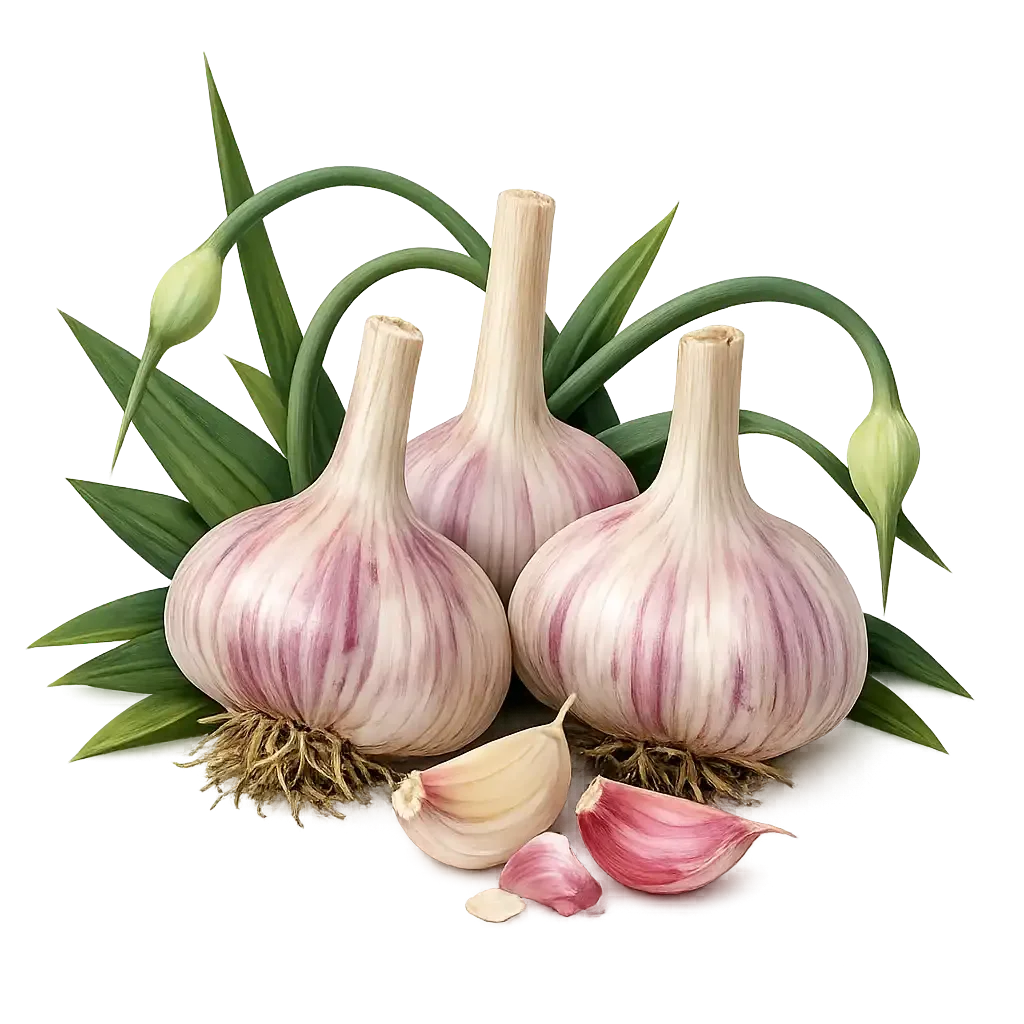
Written By Arthur Simitian
QUICK FACTS
Common Name
Hardneck Garlic
Scientific Name
Allium sativum subsp. ophioscorodon
Plant Type
Hardy bulbous perennial grown as an annual; overwintered in the ground
Hardiness Zones
3 to 9; hardneck types generally prefer cold winters for optimal bulb development; most varieties require vernalization (cold period) to form proper bulbs
Sun Requirements
Full sun; minimum 6 hours, more improves bulb size
Soil Type
Rich, loose, well-drained; pH 6.0 to 7.0; does not tolerate waterlogging or heavy clay
Planting Time
Autumn, 4 to 6 weeks before the ground freezes; late September through November depending on climate
Harvest Time
Mid-summer, when lower leaves have browned but 5 to 6 green leaves remain; timing varies by variety and latitude
Hardneck Groups
Eight groups: Rocambole, Porcelain, Purple Stripe, Marbled Purple Stripe, Glazed Purple Stripe, Asiatic, Turban, Creole
Defining Feature
Rigid central flowering stalk (scape) that must be removed to redirect energy to the bulb; fewer, larger cloves than softneck; superior flavor complexity; shorter storage life than softneck
Primary Active Compounds
Allicin (formed enzymatically from alliin when tissue is damaged; responsible for most medicinal activity); diallyl disulfide; S-allylcysteine; quercetin; fructooligosaccharides (prebiotic)
Two garlic posts: Garlic on this site is covered in two separate guides. This post covers all eight hardneck groups. The companion post covers softneck garlic, specifically the Artichoke and Silverskin groups. If you are deciding which type to grow, reading both is worthwhile: hardneck and softneck are genuinely different in flavor, storage life, growing requirements, and best uses, and the choice depends on your climate, your kitchen priorities, and how long you need your harvest to last.
Hardneck garlic is the garlic that people who care about garlic grow. This is not a slight against softneck types, which have their own considerable strengths, but a simple acknowledgment that the flavor complexity, the clove size and ease of peeling, the terroir expressiveness, and the sheer variety of character available across the eight hardneck groups represent something that the commercially dominant softneck cannot match. The rigid central scape that defines hardneck garlic as a type, the flowering stalk that spirals upward from the center of the plant each summer, requires attention and removal at the right moment, and the trade-off is a bulb that stores for only three to six months rather than the eight to twelve months softneck achieves. For any homestead with sufficient cold winters to support vernalization, that trade-off is worth making for at least a portion of the garlic planting.
Introduction
All cultivated garlic belongs to Allium sativum, but the species divides into two principal subspecies with fundamentally different characteristics. Allium sativum subsp. ophioscorodon, the hardneck group, is considered more primitive and closer to the wild ancestor Allium longicuspis native to Central Asia. It retains the genetic diversity of its origins in a way that is visible in the extraordinary range of flavor, appearance, and adaptation across the eight recognized horticultural groups. Softneck garlic, subsp. sativum, represents a later selection by human cultivators for the storage characteristics and productivity that define the commercial garlic market but at the cost of the flavor depth that hardneck types preserve.
The scape, the coiling green stalk that emerges from the center of a hardneck plant in early summer, is simultaneously the most practically important management task in hardneck garlic cultivation and, once cut, one of the most delicious early-summer vegetables available from the kitchen garden. Scapes are removed when they have completed one full coiling loop, before they straighten out and redirect energy away from the bulb into seed production. Cut scapes are tender, mildly flavored, versatile in cooking, and available for a window of two to three weeks before the main bulb harvest arrives; they are one of the pleasures of growing hardneck garlic that no commercial supply chain provides.
The allicin that gives garlic most of its medicinal character is not present in intact garlic tissue. Alliin, a sulfur-containing amino acid stored in the cell vacuoles, meets the enzyme alliinase, stored separately in the cell cytoplasm, only when tissue is damaged. Cutting, crushing, or chewing garlic brings them together, triggering the enzymatic reaction that produces allicin within seconds of the damage. This is why crushing garlic and allowing it to rest for ten to fifteen minutes before cooking, a technique sometimes called the garlic rule, produces a more medicinally active preparation than adding garlic directly to heat, which denatures the alliinase enzyme before allicin can form. The cook who lets crushed garlic rest briefly before it hits the pan has already done the most important thing for preserving its medicinal character.
How to Grow
Planting Time and Vernalization
Hardneck garlic is planted in autumn and overwinters in the ground, requiring the cold period to vernalize properly and form bulbs with distinct clove separation the following summer. Planting four to six weeks before the ground freezes solid allows roots to establish before winter dormancy but does not allow so much above-ground growth that the tender green shoots become vulnerable to frost damage. In most of the northern United States and Canada, this means planting in October; in milder climates of zones 7 through 9, planting as late as November or even December is appropriate.
Vernalization, the cold-temperature trigger for bulbing, requires a cumulative exposure of roughly forty days below 40 degrees Fahrenheit. In climates that do not reliably provide this cold period, particularly in zones 9 and 10 where winters are mild, hardneck types may produce rounds, undivided single-clove bulbs, rather than properly segmented heads. For growers in marginal climates, pre-chilling seed cloves in the refrigerator for four to six weeks before planting can substitute for insufficient field vernalization, though results are less reliable than natural cold exposure.
Soil Preparation and Planting
Garlic rewards deep soil preparation more than almost any other bulb crop. Breaking up the soil to twelve inches, incorporating generous compost throughout, and ensuring drainage is adequate before planting sets the foundation for bulb development the following summer. Garlic does not tolerate waterlogged soil at any growth stage; raised beds are worth building specifically for garlic in gardens with clay-heavy or poorly draining soil.
Plant individual cloves from the best heads of the previous year's harvest, selecting the largest cloves from the largest, most well-formed heads to maintain and improve the quality of the planting stock over successive seasons. Push each clove into the prepared soil with the pointed tip upward and the basal plate facing down, at a depth of two to three inches and a spacing of six inches between cloves and twelve inches between rows. Cover with two to four inches of straw mulch immediately after planting to insulate the soil through winter temperature fluctuations and suppress the spring weed germination that competes with the emerging garlic.
Spring and Summer Management
In spring, garlic emerges from the mulch with flat strap-like leaves that grow steadily through the cool spring weeks. Top-dress with a light application of compost or balanced fertilizer as growth resumes to support the rapid leaf development that precedes bulbing. Water consistently through spring and into early summer; reducing watering in the final two to three weeks before harvest as the outer wrapper leaves dry down helps the bulb cure in the ground before lifting.
Scape removal is the critical management task of early summer. When the scape has completed one full coil and the seed head at its tip is still pointed upward rather than drooping, cut it cleanly at its base or at the point where it emerges from the top leaf sheath. This timing, before the scape straightens and the plant invests energy in seed production, redirects the plant's resources fully into bulb development and is worth ten to fifteen percent of final bulb weight. Scapes kept in a glass of water on the kitchen counter remain usable for a week to ten days after cutting.
Harvesting and Curing
Harvest timing is critical and not forgiving in either direction. Harvest too early and the cloves have not filled out the wrappers fully; harvest too late and the outer wrapper has deteriorated, exposing the cloves, reducing storage life, and making the heads prone to falling apart. The correct harvest moment is when the lower three or four leaves have browned completely while five or six green leaves remain above. Each leaf corresponds to one wrapper layer on the bulb; five to six remaining green leaves mean five to six intact wrapper layers, which is the protective structure the cured bulb needs for storage.
Dig rather than pull, working a fork into the soil six inches away from the plant and levering upward to lift the whole bulb cleanly without breaking the stem. Brush off loose soil gently and move the harvested heads immediately to a shaded, well-ventilated curing location. Curing requires two to four weeks of warm, dry, moving air circulation: hanging bundles of ten to fifteen heads stem-to-stem in a shaded barn, garage, or covered outdoor structure with good airflow is the traditional and most effective method. After curing, trim the stems to one to two inches and the roots to a quarter inch. Cured hardneck garlic stores for three to six months depending on variety; Porcelain and Marbled Purple Stripe types store longest within the hardneck groups.
Saving planting stock: The most important habit in hardneck garlic growing is setting aside the best heads from each harvest as planting stock for the following autumn rather than using them in the kitchen. Select ten to fifteen percent of the harvest, choosing the largest, best-formed, most perfectly wrapped heads from the most vigorous-looking plants in the bed. These become the seed cloves for next year's planting. Doing this consistently over several seasons gradually adapts the variety to the specific soil and climate of the planting site, producing heads that perform better year over year than any commercially sourced planting stock. It also eliminates the annual cost of buying new seed garlic, which is among the most expensive planting material in the kitchen garden.
The Eight Hardneck Groups
Hardneck garlic taxonomy organizes hundreds of named varieties into eight groups based on shared characteristics of morphology, genetics, flavor profile, and growing behavior. Understanding the groups allows the grower to select varieties intelligently for their climate, culinary priorities, and storage needs rather than choosing blindly from a catalogue list of cultivar names.
Rocambole
CLOVES: 8 TO 13STORAGE: 4 TO 6 MONTHSZONES: 3 TO 7 (COLD WINTERS PREFERRED)
Rocambole is the variety that serious garlic cooks mean when they say garlic has flavor. Rich, complex, and deeply savory with a rounded heat that does not linger too long, Rocambole garlic is the benchmark against which every other group is measured for culinary quality. The outer wrappers are a tan to brownish-tan color with little to no purple striping, often loosely fitted around the cloves in a way that makes Rocambole the easiest hardneck type to peel. The scape makes a complete 360-degree coil, the most pronounced curl of any hardneck group.
Rocambole is the most cold-dependent of the eight groups, performing best in zones 3 through 7 where winters are reliably cold. In mild-winter climates, Rocambole frequently underperforms and is better replaced with a different group. It has the shortest storage life of the hardnecks, typically four to six months, and should be used or given away before the new year in most cases. Well-known varieties include Spanish Roja, the classic Pacific Northwest market variety, and German Red, a robust, intensely flavored Rocambole from Northern European tradition. If the goal is maximum culinary flavor and cold winters are available, Rocambole is the first choice.
Porcelain
CLOVES: 4 TO 6STORAGE: 6 TO 8 MONTHSZONES: 3 TO 8
Porcelain garlic produces the largest individual cloves of any hardneck group, wrapped in brilliant, smooth, pure-white outer skins that give the group its name. A single Porcelain head yields only four to six cloves, but each one is large enough to feel substantial in the hand, making the peeling-to-weight ratio the best of any garlic type. The flavor is hot, rich, and full when raw, moderating to a sweet, nutty depth when cooked; it is not as complex as Rocambole at its best but is more consistent across growing conditions.
Porcelain garlic is the most widely adapted hardneck group, performing reliably across zones 3 through 8 and tolerating somewhat less cold than Rocambole while still requiring sufficient vernalization. It stores longer than most other hardnecks, typically six to eight months, making it the most practical hardneck choice for growers who want the flavor advantages of hardneck types with something approaching softneck storage life. Music, from Ontario, and Georgian Crystal are among the most widely available and dependably productive Porcelain varieties. Porcelain is the recommended starting point for new hardneck growers because it is forgiving, consistent, and yields heads that are impressive enough to confirm that the growing effort was worthwhile.
Purple Stripe
CLOVES: 8 TO 12STORAGE: 4 TO 6 MONTHSZONES: 3 TO 9
The Purple Stripe group is considered the most genetically primitive of the hardneck types and is the variety closest to the ancestral Central Asian garlic from which all cultivated garlic descended. The outer wrappers display the most vivid, saturated purple striping of any group, making Purple Stripe heads among the most visually striking of all garlics. Flavor is rich, full, and classic, with a heat that develops slowly and lingers pleasantly; it is well-suited to roasting, where the sugars caramelize beautifully.
Purple Stripe is notably the best garlic group for making baked or roasted whole heads; the tightly wrapped cloves hold their structure through extended oven time while the sugars in the flesh caramelize to a sweetness that other types do not match. It adapts to a wider temperature range than Rocambole and will perform in zones up to 9 with adequate vernalization. Persian Star, from Uzbekistan, and Chesnok Red, a Ukrainian variety widely grown in the Pacific Northwest, are two of the most readily available Purple Stripe varieties. Growing Purple Stripe alongside Rocambole allows a direct comparison of the two dominant flavor styles in the hardneck category.
Marbled Purple Stripe
CLOVES: 4 TO 8STORAGE: 6 TO 8 MONTHSZONES: 3 TO 8
Marbled Purple Stripe garlic sits between the vivid striping of Purple Stripe and the clean white of Porcelain, with a distinctive marbled or blotched purple-on-white pattern on the outer wrappers that is unlike any other group. The cloves are large, often comparable to Porcelain in individual size, with a rich, sweet, complex flavor that many tasters consider among the most nuanced in the hardneck category. Importantly, Marbled Purple Stripe stores longer than most other hardneck groups, typically six to eight months, making it one of the most practical hardneck choices where extended storage matters.
The group tolerates a slightly wider range of growing conditions than the cold-sensitive Rocambole and adapts to zones 3 through 8 with reliable results. Brown Tempest and Metechi are two of the best-known Marbled Purple Stripe varieties; Metechi in particular, originating from the Republic of Georgia, is prized for its combination of exceptional flavor, large cloves, and relatively long storage life. For the grower who wants the full flavor complexity of premium hardneck types combined with storage life that competes with Porcelain, Marbled Purple Stripe is the group to explore.
Glazed Purple Stripe
CLOVES: 8 TO 12STORAGE: 4 TO 6 MONTHSZONES: 3 TO 8
Glazed Purple Stripe is the most visually distinctive group in the hardneck category and among all cultivated garlics. The outer wrappers have a metallic, almost iridescent sheen, silver to gold with overlaid purple streaking, that catches light in a way no other garlic does. This visual quality makes Glazed Purple Stripe the most striking garlic for a farmers market table or for giving as part of a curated food gift. The cloves are large and tightly wrapped; the flavor is rich and complex with a sweetness and mild earthiness that distinguishes it from both Rocambole and Purple Stripe types.
The group is the least commonly grown of the eight hardneck types, partly due to limited variety availability in North American seed garlic catalogues, which tend to favor the more commercially established Rocambole and Porcelain types. Siberian, one of the better-known Glazed Purple Stripe varieties despite the name implying a Rocambole, is available from specialist garlic growers and performs reliably in zones 4 through 7. Growing even a small quantity of Glazed Purple Stripe alongside other groups adds visual variety to the harvest that is genuinely impressive in a way that purely flavor-focused variety selection cannot match.
Asiatic
CLOVES: 6 TO 10STORAGE: 3 TO 5 MONTHSZONES: 4 TO 9
Asiatic garlic is the earliest-harvesting group in the hardneck category, typically ready two to four weeks before Rocambole or Porcelain types in the same garden, which makes it valuable for extending the fresh-garlic season at the early end. The plants bolt and form their scapes earlier than other hardneck groups, and the bulbs develop quickly once scapes have been removed. The outer wrappers range from white to tan with some purple coloring, and the cloves are medium-sized. Flavor is bold and pungent when raw, moderating more quickly on cooking than Rocambole types.
The group is specifically adapted to the continental climates of Central and East Asia and performs particularly well in climates with cold winters and hot, dry summers that favor rapid curing. It is among the best hardneck types for zones 7 through 9 where the growing season ends abruptly in summer heat, because it matures before the heat stress that reduces quality in longer-season types. Vietnamese Red and Asian Tempest are two of the more available Asiatic varieties. The short storage life of three to five months means Asiatic garlic is best positioned as fresh-use garlic consumed promptly after harvest, or as the earliest harvest in a succession planting that also includes longer-storing types.
Turban
CLOVES: 6 TO 10STORAGE: 4 TO 6 MONTHSZONES: 5 TO 9
Turban garlic is the second-earliest-harvesting group after Asiatic and shares its adaptation to warmer, drier climates with less cold vernalization requirement than other hardneck types. The name comes from the characteristic turban-like shape of the dried scape tip that wraps around the seed head before the spathe opens, a distinctive visual that distinguishes Turban from other groups in the field. The outer wrappers are white to tan with minimal purple striping; the cloves are variable in size but typically medium to large, with a mild to moderate pungency and a clean flavor that is less complex than Rocambole but pleasant and easy to use.
Turban is one of the better hardneck choices for growers in zones 7 through 9 where Rocambole often struggles, requiring less cold vernalization and completing its growth cycle before the intense summer heat that causes stress in later-maturing types. Tzan and Red Rezan are two Turban varieties with established reputations in the home growing community. For the grower in a mild-winter climate who wants hardneck character without the cold-dependence of Rocambole, Turban and Asiatic are the two groups most worth exploring first.
Creole
CLOVES: 8 TO 12STORAGE: 6 TO 12 MONTHSZONES: 7 TO 10
Creole garlic is the outlier of the hardneck category in the best possible way. Developed from garlics brought to the Americas by Spanish colonists in the sixteenth century and adapted over generations to the mild winters and hot, humid summers of the Gulf Coast and Southern states, Creole is the only hardneck group that thrives in the climates where all other hardneck types underperform. It requires minimal cold vernalization and produces properly segmented bulbs in zones 7 through 10 where every other hardneck struggles to bulb properly.
The outer wrappers of Creole garlic are often richly colored in shades of pink, rose, red, and purple, making Creole heads visually among the most beautiful in the entire garlic family. Cloves are numerous, smaller than Porcelain or Marbled Purple Stripe, with a distinctive, complex flavor that has both heat and sweetness and a mild herbal quality not found in other groups. Storage life is exceptional for a hardneck type, routinely reaching six to twelve months, which challenges the softneck storage advantage in its adapted climate. Creole Red, a Louisiana heritage variety, and Morado de Pedronera, a Spanish heritage type now grown widely in the American South, are among the best-known varieties. For any grower in zones 7 through 10 who has been disappointed by hardneck garlic attempts in mild winters, trying a Creole variety is the appropriate next step.
Medicinal Character
Garlic's medicinal record is among the most extensively documented of any food plant. The clinical evidence supports meaningful cardiovascular benefits from regular consumption: a 2012 Cochrane review found modest but statistically significant reductions in total cholesterol and LDL in people consuming garlic preparations regularly, and multiple meta-analyses have found small but consistent reductions in systolic and diastolic blood pressure. The allicin formed when garlic is crushed or cut is the primary bioactive compound, along with S-allylcysteine and diallyl disulfide that form as allicin degrades.
Garlic's antimicrobial activity is well documented in laboratory research, with allicin demonstrating inhibitory activity against a range of bacterial and fungal pathogens including Staphylococcus aureus, Helicobacter pylori, and Candida species. The traditional use of garlic as a food preservative and wound treatment across many cultures reflects this antimicrobial activity. The immune-supporting activity of garlic's fructooligosaccharide content, which acts as a prebiotic supporting beneficial gut bacteria, adds a complementary mechanism to the direct antimicrobial effect.
The practical point for kitchen use: crush or mince garlic and allow it to rest for ten to fifteen minutes before adding it to a hot pan. This gives the alliinase enzyme time to complete the conversion of alliin to allicin before heat destroys the enzyme. Adding crushed garlic directly to a hot pan denatures the alliinase before the conversion can occur and reduces allicin formation by up to seventy percent compared to pre-rested garlic.
Cautions and interactions: Garlic at culinary doses is exceptionally safe with a very long history of consumption globally. Medicinal-dose garlic supplements have documented anticoagulant activity and can potentiate the effects of warfarin and other anticoagulant medications; people on blood thinners should discuss high-dose garlic supplementation with a prescriber before adding it. Discontinuation of high-dose garlic supplementation is recommended two weeks before elective surgery for the same reason. Garlic can cause or worsen acid reflux and heartburn in susceptible individuals; reducing the dose or cooking garlic before consumption rather than using it raw reduces this effect. Contact dermatitis from prolonged handling of raw garlic is common; wearing gloves when processing large quantities prevents the skin burns and blisters that can result from extended contact. Do not store garlic in oil at room temperature: this creates anaerobic conditions that support Clostridium botulinum growth; garlic-in-oil preparations must be refrigerated and used within one week.
Pros and Cons
Advantages
Superior flavor complexity compared to commercial softneck garlic; Rocambole and Purple Stripe types in particular offer a depth of culinary character unavailable in any grocery store product
Scapes provide a bonus early-summer harvest of tender, mild, versatile vegetable material two to three weeks before the main bulb harvest
Large individual cloves, particularly in Porcelain and Marbled Purple Stripe types, make preparation faster and more efficient than commercial garlic with its numerous small cloves
Eight distinct groups offer genuine variety selection for different climates, storage needs, and culinary purposes
Planting stock saved from the best heads each year gradually adapts to the specific site and eliminates ongoing seed cost
Creole types extend hardneck growing to mild-winter climates where other hardneck groups cannot perform
Among the best-documented medicinal food plants with robust clinical evidence for cardiovascular and antimicrobial benefits
Limitations
Shorter storage life than softneck; three to eight months depending on group vs. eight to twelve months for softneck; requires planning and prioritized use before quality declines
Most groups require reliable cold winters for proper vernalization and bulb formation; unsuitable as hardneck types in zones 9 and 10 except for Creole and partially Turban and Asiatic
Scape removal must be timed correctly; missing the window costs meaningful bulb weight and is one of the more timing-sensitive tasks in the kitchen garden
Higher seed cost than softneck at initial purchase; partially offset by saving planting stock year to year
High-dose medicinal garlic supplements interact with anticoagulant medications; requires monitoring
Garlic-in-oil at room temperature is a botulism risk and cannot be stored safely without refrigeration
Common Problems
White rot (Sclerotium cepivorum) is the most serious soil-borne disease threat to garlic and all alliums, producing a white cottony fungal growth at the base of the plant and black sclerotia in the soil that persist for twenty or more years. There is no effective chemical treatment once established; infected beds should not grow any allium for the foreseeable future. Prevention through careful inspection of planting stock and avoiding introduction of infected soil on tools or boots is the only reliable strategy.
Botrytis neck rot follows from harvesting and curing in wet conditions, allowing the fungus to enter through the neck of the bulb and rot the cloves during storage. Proper curing with excellent air circulation for the full two to four weeks before storage, and harvesting only when the weather allows at least several dry days before and after, prevents the vast majority of storage rot.
Bloat nematode (Ditylenchus dipsaci) causes distorted, soft, discolored growth and is spread through infected planting stock. Starting with certified clean seed garlic from reputable sources and inspecting planting stock carefully before use are the primary prevention measures.
Leek moth and allium leaf miner are increasingly common in North American growing regions and damage leaves and occasionally bulbs. Row cover through the vulnerable spring growth period provides effective exclusion where these pests have become established.
Final Thoughts
Hardneck garlic is planted in autumn and harvested in summer, spanning nine months of quiet growth in the soil during which the garden's attention is on everything else. That long unattended period, interrupted only by scape removal in early summer, produces a harvest whose quality is determined almost entirely by three decisions: the quality of the planting stock chosen, the preparation of the soil before planting, and the timing of the harvest. Getting those three things right produces garlic that tastes like garlic should taste, in a range of varieties that the grocery store will never carry, from a plant that has been feeding and healing people for five thousand years.
Choose a group suited to your climate. Plant the largest cloves from the best heads. Remove the scape at one full coil. Harvest when five or six green leaves remain. Cure for three weeks in moving air. Everything else takes care of itself.