
Hops
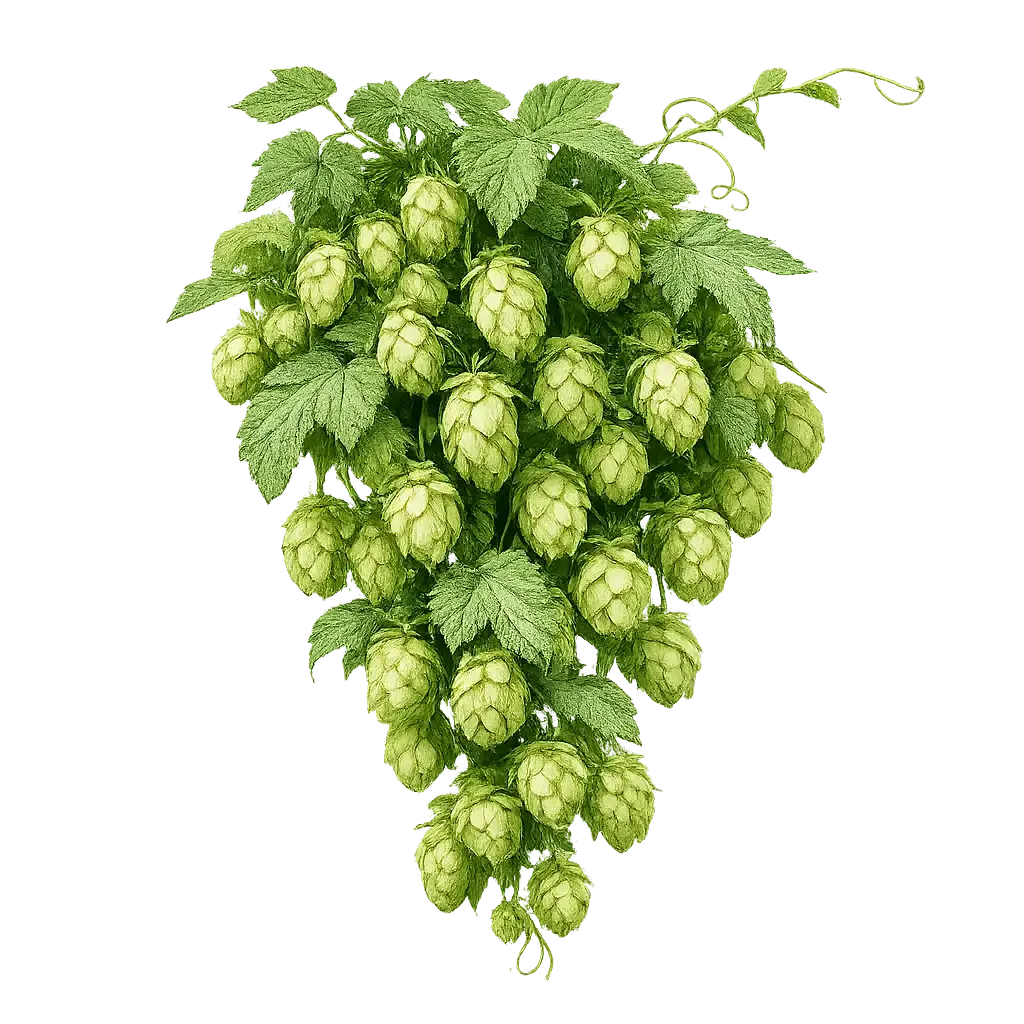
QUICK FACTS
Common Name
Hops, Common Hops
Scientific Name
Humulus lupulus
Plant Type
Hardy herbaceous perennial bine
Hardiness Zones
3 to 8; best cone production in zones 5 to 8
Sun Requirements
Full sun; minimum 6 hours, 8 or more preferred for productive cone harvest
Soil Type
Deep, fertile, well-drained, moisture-retentive; pH 6.0 to 8.0; rewards deep preparation and consistent moisture
Vertical Space Required
15 to 25 feet of vertical growing space; bines must be trained upward and managed annually
Harvest Part
Female cones (strobiles), harvested when papery, aromatic, and spring back after gentle compression; young spring shoots (edible secondary use)
Primary Active Compounds
Alpha acids (humulone, cohumulone, adhumulone); beta acids (lupulone); essential oil including myrcene, humulene, caryophyllene, farnesene; 2-methyl-3-buten-2-ol (sedative, formed from humulene degradation); xanthohumol (prenylated chalcone)
Uses
Brewing: bittering, flavor, and preservative in beer; sedative and nervine for insomnia and anxiety; digestive bitter; antimicrobial; young shoots as a spring vegetable; hop pillow for sleep
Hops is the most physically ambitious plant in this series. A bine, not a vine, climbing by wrapping its stiff, trichome-covered stems clockwise around any available support, Humulus lupulus can put on twenty feet of new growth in a single season from a root system that overwinters completely below ground and re-emerges each spring with the vigor of a plant that has spent four months doing nothing but storing energy. The cones it produces, those papery, resinous, pendulous structures that have defined the flavor and preservation of beer for a thousand years in northern Europe, are also a genuinely effective sedative and nervine whose active compound 2-methyl-3-buten-2-ol is produced from the alpha-acid humulene as the dried cone ages. The hop pillow is not folk superstition: studies confirm it improves sleep quality, and hop workers in Victorian bines were noted for an unusual sleepiness attributed to handling the fresh cones, an observation that turned out to reflect genuine sedative compound absorption through the skin. Hops is among the most rewarding plants in the homestead herb garden for anyone willing to install the infrastructure it requires and manage the extraordinary seasonal growth it produces in return.
Introduction
Humulus lupulus is native to Europe, western Asia, and North America, a member of the Cannabaceae family and the only close relative of Cannabis in common cultivation. The plant is dioecious, with male and female flowers on separate plants; only female plants produce the cones used in brewing and medicine. The bine habit, distinguished from a true vine by the fact that hops climbs by the stem itself rather than by tendrils or aerial roots, combined with the characteristic rough hooked trichomes covering every surface of the plant, allows hops to ascend a support of almost any surface texture with remarkable speed.
The use of hops in brewing dates to approximately the ninth century in what is now Germany, where it gradually displaced the herb mixtures called gruit that earlier brewers used to bitter and preserve ale. By the thirteenth century, hops had become the dominant bittering agent in northern European brewing, valued not only for flavor but for the antimicrobial activity of the alpha acids that extended the shelf life of beer considerably beyond what gruit-seasoned ale achieved. The German Reinheitsgebot of 1516, one of the oldest food purity regulations in history, named hops as one of four permitted brewing ingredients alongside water, malt, and yeast, cementing its centrality to the European brewing tradition that defines beer globally today.
The medicinal reputation of hops as a sedative has roots in the observation of hop yard workers across several centuries who fell unusually sleepy during harvest. This practical observation predated the identification of 2-methyl-3-buten-2-ol by a considerable margin. The compound is produced as humulene in the alpha acids oxidizes during the drying and storage of harvested cones, and it is present in meaningfully higher concentrations in cones that have been dried and stored for several weeks than in freshly harvested cones. This chemistry explains why hop workers harvesting fresh cones experienced a sedative effect from absorbed compounds even before the cones were fully dried, and why dried cones in a pillow continue to release sedative vapors over weeks of use.
How to Grow
Infrastructure First
The single most important preparation for growing hops is installing the vertical support structure before planting, not after the bine has already begun growing. Hops requires fifteen to twenty-five feet of vertical growing space to reach its productive potential, and the support must be in place from the day the bines emerge in spring. The traditional commercial approach uses tall poles with wire strung horizontally at height and coir or sisal twine running from ground level to the top wire, providing the rough-textured surface the bines grip with their hooked trichomes. For the homestead grower, the most practical structures are a tall sturdy trellis against a south-facing wall or fence, a pergola or arbor designed to accommodate the full height of growth, or a strong post-and-wire system with twine trained from the ground.
At the end of the growing season, the bines die back to the ground completely and the above-ground structure is removed: the whole season's growth of twenty feet or more is cut to the crown and composted, and new twine is installed fresh each spring. Planning for this complete annual clearance, and for a structure robust enough to support the considerable weight of mature bines with full cone clusters in late summer, is part of the infrastructure planning that precedes planting.
Sun Requirements
Hops is a full-sun crop with a specific day-length sensitivity that makes the latitude of the planting more important than for most plants in this series. Cone production is triggered by shortening days in late summer, and varieties are broadly classified as early, mid, or late season based on the day length that triggers their cone development. In zones 5 through 8, most widely available hop varieties flower and produce cones reliably. At lower latitudes, below approximately 35 degrees north, the day-length signal arrives too late in the season for cone development to complete before the first frost, and commercially important varieties from the Pacific Northwest or Bavaria may produce little or no harvest. Selecting varieties known to perform in the specific latitude of the planting is more important for productive cone harvest than any other single decision.
Soil Requirements
Unlike the Mediterranean drought herbs that dominate this series, hops is a crop plant that rewards deep, fertile, moisture-retentive soil with the same enthusiasm as a vigorous vegetable. Deep soil preparation to eighteen to twenty-four inches, incorporating generous compost throughout, supports the extensive root system that fuels the plant's extraordinary seasonal growth. The soil should drain well enough that roots are never waterlogged but retain enough moisture to support consistent growth through the summer without drought stress. Annual top-dressing with compost in spring, applied around the crown as the bines begin to emerge, supports the continuous high-vigor growth that peak cone production requires.
Water Needs
Consistent moisture through the growing season, particularly during the rapid growth phase from spring emergence through midsummer, supports both the bine development and the cone set that follows. Hops is far less drought-tolerant than most of the other perennials in this series and will show stress through yellowing lower leaves and reduced cone size during dry periods. Deep, infrequent watering that wets the soil to the full root depth is more effective than frequent shallow watering; mulching the root area heavily helps maintain the even soil moisture the plant requires through summer heat.
Planting
Hops is propagated from rhizome divisions, short sections of the underground rhizome with at least one bud, planted in early spring as the soil warms. Rhizomes are typically available from homebrew supply shops and specialist nurseries in late winter and early spring. Plant rhizomes horizontally at two to four inches depth, two to three feet apart, in deeply prepared soil beneath the installed support structure. Each rhizome produces bines within two to four weeks of planting as soil temperature rises.
In the first season, the plant establishes its root system rather than producing a full bine and cone harvest; first-year cone production is light or absent depending on the variety and growing conditions. The second season typically produces a substantial bine with a meaningful cone harvest, and from the third season onward a well-established plant in good conditions produces its full potential annual harvest.
Train only two to four bines per plant up the support string at the beginning of the season, removing additional emerging shoots at ground level. Concentrating the plant's energy into a small number of main bines rather than allowing every shoot to grow produces larger, better-developed cones than letting the plant spread its resources across dozens of thin bines.
Harvesting
Timing the Harvest
Hop cone harvest timing is one of the most important practical skills in growing hops, whether the purpose is brewing or medicine. The correct harvest moment is identified through a combination of visual, tactile, and aromatic cues rather than calendar date, because the timing varies by variety, latitude, and season. Ripe cones are papery and dry to the touch, spring back fully after gentle compression, feel light relative to their size, and release a pronounced resinous, floral, bitter aroma when gently squeezed. The bracts of the cone should be fully closed and dry; cones that still feel wet, heavy, or spongy are not ready.
The lupulin glands visible at the base of each bract, the powdery yellow material that is the concentrated source of alpha acids and essential oils, should be a bright, deep yellow at peak ripeness. Pale yellow or greenish lupulin indicates under-ripe cones; dark orange-brown lupulin indicates over-ripe cones where the alpha acids have begun to oxidize and the brewing and medicinal quality has declined. The harvest window for most varieties is one to two weeks from when the first cones reach the ripe stage; checking every two or three days through this period and harvesting cone clusters as they ripen is more productive than a single whole-plant harvest.
Drying and Storage
Fresh hops cones must be dried promptly after harvest to prevent mold and to convert the humulene in the alpha acids into the 2-methyl-3-buten-2-ol that is the primary sedative compound and that continues to develop during storage. Spread cones in a single layer on mesh drying racks in a warm, well-ventilated space at no more than 140 degrees Fahrenheit if using any heat; air drying in a dry summer climate takes two to four days. Correctly dried cones feel papery and very light, with no soft spots or moisture in the center bracts.
Store dried cones immediately in airtight bags with as much air removed as possible, or in vacuum-sealed bags, in the freezer for brewing use where alpha acid preservation is the priority. For medicinal use as a sleep herb, sealed glass containers at room temperature or refrigerator storage is adequate; the sedative 2-methyl-3-buten-2-ol continues to develop from humulene degradation for several weeks after harvest, meaning that cones stored for four to six weeks have higher sedative compound content than freshly dried cones.
Hops in homestead brewing: The decision of which hops to grow for brewing involves understanding the two functional roles that hops performs in a beer recipe: bittering and aroma. Bittering hops contribute alpha acid isomerization during the boil, providing the characteristic bitterness that balances malt sweetness; they are added early in the boil and their volatile aromatic compounds largely boil off. Aroma hops are added late in the boil, or after the boil in the technique called dry-hopping, where the temperature is too low to isomerize alpha acids but the essential oils are extracted intact, contributing the floral, resinous, citrus, or earthy aromatics that define a beer's nose and late flavor. Most varieties can serve both roles in a small batch, but knowing whether a variety leans toward high-alpha bittering use or low-alpha aromatic use guides the recipe. For the homestead brewer growing one variety, dual-purpose varieties with moderate alpha content and expressive aroma are the most versatile starting point; Cascade, developed in the United States with its characteristic floral-citrus character, is the most widely grown homestead variety for this reason and is reliably productive in zones 5 through 8. For purely medicinal use, the specific variety matters less than fresh harvest at peak lupulin content, prompt drying, and four to six weeks of storage before use.
How to Use
Sedative and Sleep Uses
Hops is among the better-evidenced sedative herbs in this series, with a specific identified active compound and a body of clinical research supporting its use for insomnia and anxiety, particularly in combination with valerian. The compound 2-methyl-3-buten-2-ol, produced from humulene degradation in dried cones, has demonstrated CNS depressant activity in rodent models and is the mechanistic explanation for the observed sedation in hop workers and in clinical preparations.
Multiple clinical trials have evaluated hops in combination with valerian for insomnia, consistently finding that the combination improves sleep latency, sleep duration, and sleep quality compared to placebo, with an effect size comparable to low-dose benzodiazepines in some studies but without the dependency concerns of that drug class. The combination of valerian's GABAergic activity with the 2-methyl-3-buten-2-ol mechanism in hops produces a more consistent result than either herb used alone, and the combination is specifically named in the German Commission E monographs for sleep disturbance and nervous tension.
The traditional hop pillow, a small fabric pouch filled with dried hops cones placed near the head during sleep, works through inhalation of the volatile sedative compounds released from the cones as body heat warms them. A 2012 study published in Acta Horticulturae confirmed significantly improved sleep quality in nurses on irregular shift schedules using hop pillows compared to controls, the most methodologically relevant clinical population for testing a sleep aid. Refreshing the pillow contents every two to three weeks maintains effective volatile compound release as the stored cones gradually lose potency. This is one of the most effortless medicinal applications in this series: the only preparation required is filling a small fabric sachet with dried cones from the home harvest.
Hop tea from dried cones, one to two teaspoons per cup steeped covered for ten minutes, produces a bitter, earthy preparation that delivers the sedative compounds orally. The bitterness is considerable and most people find the taste challenging without honey. A tincture in high-proof alcohol is a more practical oral preparation that concentrates the bitter acids and essential oils; one to two milliliters in warm water before sleep is the typical dose.
Digestive Uses
The bitter alpha acids in hops cones provide the same bitter receptor stimulation as other digestive bitters in this series, increasing digestive secretion and bile flow, reducing intestinal gas, and supporting efficient digestion of rich meals. The bitter quality of hops is among the most intense in this series, reflecting the same alpha acid concentration that makes it effective as a brewing bittering agent. Small amounts of hops in a bitters preparation or as a hop tea before a heavy meal serve the digestive function that the entire European bitters tradition is built around.
Young Shoots as Vegetable
In the first two to four weeks of spring emergence, when the new bine shoots have reached four to six inches above the soil, these young tips can be cut and cooked as a vegetable with a flavor combining asparagus, artichoke, and a mild herbal bitterness. This use is traditional in Belgium and the hop-growing regions of Kent, England, where young hop shoots have historically appeared as a springtime delicacy in the same seasonal niche as asparagus. They can be blanched briefly in salted water and dressed simply with butter and lemon, used in risotto or pasta in the manner of asparagus, or added to omelettes where the mild bitterness works well with egg. Harvesting a small number of shoots for eating does not significantly affect cone production later in the season when the plant has more than enough vigour to replace what is removed.
End-of-Season Management
After harvest in late summer or early autumn, the bines continue to photosynthesize and transfer energy back to the root system through the first frost, which is why cutting the bines immediately after cone harvest is counterproductive. Allow the bines to stand until the first hard frost kills the above-ground growth, then cut them to the ground and compost the whole season's growth. The crown and rhizomes overwinter dormant in the soil with no protection required in zones 5 through 8; in zones 3 and 4, a light mulch over the crown through the coldest months provides additional insurance.
Each spring, remove excess rhizome growth from around the planting if the plant has spread beyond its intended position. Hops spreads through underground rhizomes and can colonize a considerable area of the garden over several years if not managed; the same physical barrier approach used for mint and horseradish applies here, though hops is generally managed by annual rhizome trimming around the crown rather than by permanent containment structures.
Lifespan of the Plant
An established hop plant in good growing conditions is effectively permanent. Commercial hop yards in Bavaria and Kent contain plants of twenty years or more in continuous production, and the root system of a well-established garden hop becomes progressively more extensive and productive through the first five to eight years before reaching its mature productive equilibrium. Productivity does not naturally decline with age in hops as it does in some other perennials; the main management task is controlling the spread of rhizomes rather than managing age-related decline.
Handling, cautions, and dog toxicity: Fresh hops cones and spent hops from brewing are severely toxic to dogs, causing a syndrome called malignant hyperthermia that can be fatal even in small amounts. This is one of the most serious pet safety concerns in this series: keep fresh cones, drying cones, spent brewing hops, and all hops processing waste completely inaccessible to dogs. The compound responsible has not been definitively identified, and the toxicity is not reduced by cooking or drying. Cats are not known to be affected at the same level of risk, but keeping hops products away from all pets is prudent. For human use, hops is contraindicated in depression, as the sedative and CNS depressant activity can worsen depressive symptoms. It is contraindicated in pregnancy due to the estrogen-like activity of the hop cone compounds, which can interfere with hormonal balance at medicinal doses; culinary use in beer at normal quantities does not present this concern. The estrogenic activity of 8-prenylnaringenin in the cones, which is among the most potent phytoestrogens identified in any plant, is relevant for women with hormone-sensitive conditions including estrogen-receptor-positive breast cancer, endometriosis, and uterine fibroids, for whom medicinal hop preparations are not appropriate. Hops should not be combined with pharmaceutical sedatives, anxiolytics, or sleep medications without medical guidance due to additive CNS depression. The rough stem trichomes cause skin irritation in sensitive individuals; wearing long sleeves and gloves when training and harvesting bines prevents the contact dermatitis that some people develop from prolonged exposure.
Pros and Cons
Advantages
Provides both a primary brewing ingredient for homestead beer making and a well-evidenced sedative herb from the same harvest, with no other plant in this series offering comparable dual utility
2-methyl-3-buten-2-ol is a specifically identified sedative compound with clinical trial support; the hop pillow application is one of the most effortless medicinal preparations in the series requiring no processing beyond drying
Young spring shoots provide one of the most prized seasonal vegetables in European traditional cooking, available weeks before most of the garden is producing
Among the most productive plants per crown in this series; an established plant in good conditions yields pounds of dried cones per season
Highly ornamental through the growing season; the large palmate leaves and pendulous green cone clusters on vigorous bines are visually distinctive and provide valuable summer shade on a pergola or trellis
Exceptionally long-lived and self-perpetuating perennial; an established plant effectively never needs replacement
Limitations
Requires fifteen to twenty-five feet of vertical growing space and a robust support structure installed before planting; the infrastructure investment is the highest of any plant in this series
Severely toxic to dogs; a serious safety concern for dog-owning homesteads requiring complete isolation of all cones and processing waste from canine access
Contraindicated in depression, in hormone-sensitive conditions due to strong phytoestrogenic activity, and in pregnancy at medicinal doses
Spreads by underground rhizome and requires annual management to prevent unwanted colonization of adjacent areas
Cone harvest timing is skill-dependent and the window is narrow; missing peak ripeness produces inferior brewing and medicinal quality
Latitude-sensitive cone production; varieties must be matched to the specific latitude of the planting for reliable annual yield
First-year plants rarely produce a meaningful cone harvest; the plant requires two to three seasons to reach full productive capacity
Common Problems
Downy mildew (Pseudoperonospora humuli) is the most serious disease threat to hops in temperate climates with wet spring weather. Infected shoots appear stunted, pale, and brittle in early spring; infected leaves develop the characteristic yellow angular lesions on the upper surface with grey-purple sporulation on the lower surface. Managing the disease requires removing infected shoots and leaves promptly, improving air circulation through the bine canopy, and avoiding overhead irrigation that keeps foliage wet. Copper-based fungicides provide some control in severe cases; resistant varieties are the most practical long-term solution for growers in consistently wet spring climates.
Powdery mildew (Podosphaera macularis) appears in late summer as the white powdery coating familiar from other susceptible plants. It is more cosmetic than yield-limiting in most home garden situations but can affect cone quality in a severe infection. Good spacing and air circulation prevent most powdery mildew development; removing the most heavily affected leaves if infection develops limits spread.
Spider mites thrive in hot, dry conditions and can cause significant defoliation of hop bines in summer drought, producing the fine webbing and stippled yellowing leaves that are their signature. Maintaining adequate soil moisture through summer reduces plant stress that makes spider mite populations explode; introducing predatory mites or applying insecticidal soap at the first signs of infestation prevents escalation to damaging levels.
Hop aphids colonize new growth in spring and can significantly affect bine vigor if populations build unchecked. They are controlled by the ladybird, lacewing, and parasitic wasp populations that develop naturally in a diverse garden environment; chemical intervention is rarely necessary in a planting with good biodiversity around it.
Final Thoughts
Hops demands more from the homestead than any other herb in this series: more vertical space, more structural investment, more annual management, more attention to harvest timing. What it gives back is equally outsized: a brewing ingredient of the highest freshness and quality, a genuinely effective sedative whose hop pillow application requires nothing more than stuffing dried cones into a fabric pouch, a spectacular ornamental for the summer garden, and a spring vegetable that most gardeners with hops growing have never thought to harvest.
Install the structure before the rhizome goes in the ground. Train two to four bines only. Watch the lupulin carefully as harvest approaches. Keep every scrap of it away from dogs. The plant will do the rest with a vigor that has to be seen to be believed.