
Horseradish
QUICK FACTS
Common Name
Horseradish
Scientific Name
Armoracia rusticana
Plant Type
Hardy herbaceous perennial
Hardiness Zones
3 to 9
Sun Requirements
Full sun to partial shade; full sun preferred for maximum root development
Soil Type
Deep, fertile, moist, well-drained; pH 6.0 to 7.5; tolerates a wide range but rewards deep preparation
Plant Height
18 to 36 inches in leaf; to 5 feet in flower
Spacing
18 to 24 inches; spreads vigorously and must be managed
Harvest Part
Roots (primary), harvested in autumn after the first frost or in early spring; young leaves (secondary culinary use)
Primary Active Compound
Allyl isothiocyanate, produced enzymatically when sinigrin (a glucosinolate) contacts myrosinase upon cell damage; responsible for the intense pungency and all principal medicinal actions
Uses
Culinary condiment across Central and Eastern European cooking; sinus-clearing decongestant; antimicrobial for respiratory and urinary infections; digestive stimulant; topical counterirritant
Horseradish is the most pungent plant in this series and one of the most straightforward to grow, process, and use. The active compound allyl isothiocyanate that produces the searing, sinus-clearing heat when a fresh root is grated does not exist in the undamaged root at all: it forms instantly through an enzymatic reaction the moment cell walls are broken, combining the glucosinolate sinigrin with the enzyme myrosinase that were stored in separate cellular compartments. This chemistry explains why fresh-grated horseradish is dramatically more powerful than commercial prepared horseradish that has been sitting in a jar, why adding vinegar immediately after grating locks in a milder heat while waiting before adding vinegar produces the most intense result, and why cooking destroys the pungency entirely. The allyl isothiocyanate that makes horseradish fierce at the table is also bacteriostatic against a range of pathogens, genuinely decongestant for blocked sinuses, and the compound behind a traditional respiratory and urinary antimicrobial use that modern in vitro research supports. The plant itself is vigorous to the point of becoming a garden management challenge, hardy through severe cold, and capable of providing a harvest from a small planting that far exceeds most households' needs. It asks only for deep soil, adequate moisture, and an honest plan for containing its spread.
Introduction
Armoracia rusticana is native to southeastern Europe and western Asia, a member of the Brassicaceae crucifer family alongside mustard, wasabi, and the brassica vegetables with which it shares the glucosinolate chemistry that produces pungent isothiocyanate compounds. The plant has been cultivated in central and eastern Europe since at least the medieval period and was documented as both a food and a medicine in German, Polish, and Scandinavian traditions from the fifteenth century onward. It spread through European colonization to the Americas, where it naturalized in many temperate regions and became sufficiently established in some areas to behave as a persistent near-native plant.
The name derives from the Old English horser, meaning coarse or strong, combined with radish, a description of the root's character relative to the common radish rather than any equine association. The plant's relationship with Ashkenazi Jewish cooking is among its most culturally significant: chrain, the grated horseradish condiment prepared with or without beets, is the traditional accompaniment to gefilte fish and the bitter herb of the Passover seder, a religious and culinary tradition that has made horseradish one of the most widely recognized condiment ingredients in the world.
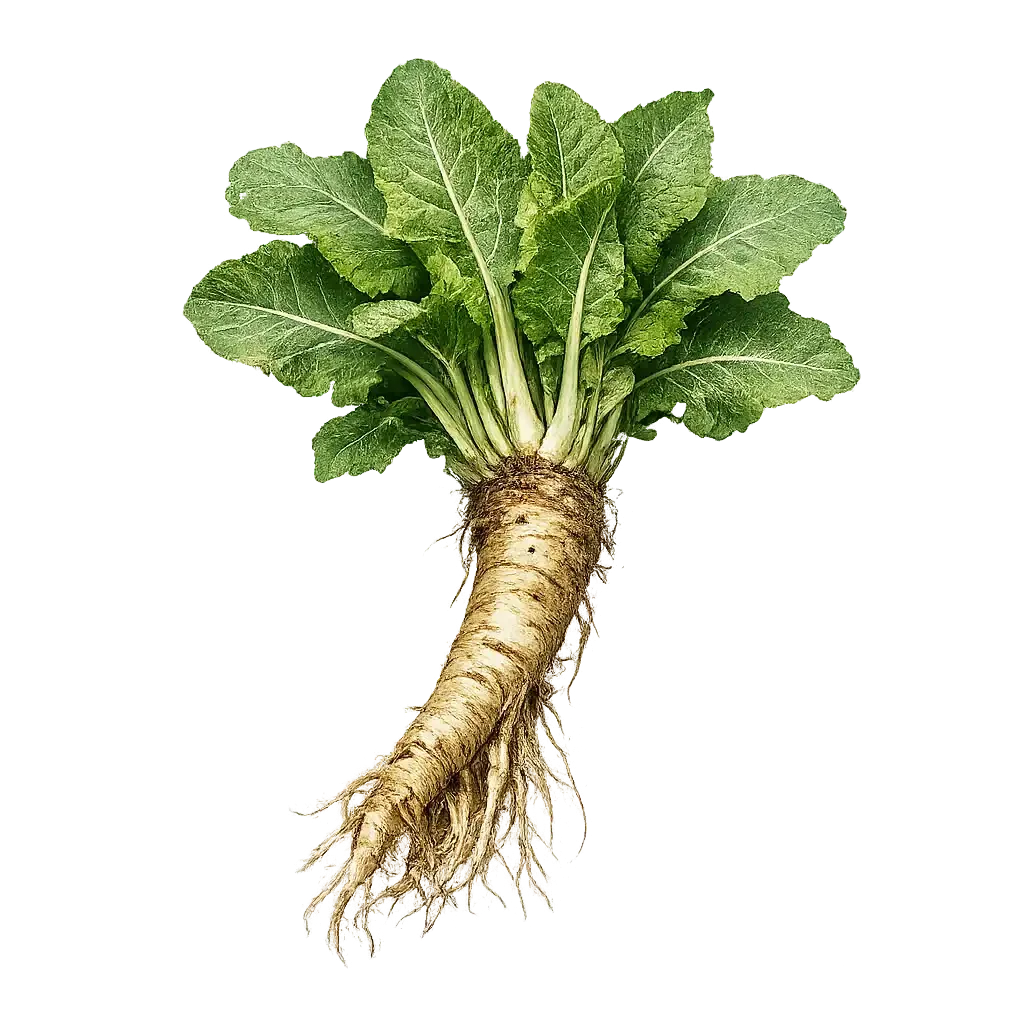
The fresh root is white to cream inside with a rough, light brown outer bark. It is odorless when undamaged; the pungency develops exclusively when the cellular structure is broken through cutting, grating, or chewing. This enzymatic production of allyl isothiocyanate from sinigrin is one of the plant kingdom's more elegant defensive mechanisms, analogous to the hydrogen cyanide production that some plants deploy on cell damage: the precursors are stored safely, the enzyme activates only when the cell wall is breached by a would-be consumer, and the resulting compound is intensely aversive to most animals. The irony is that humans, alone among the organisms the plant evolved to deter, have made the resulting compound central to a major condiment tradition.
How to Grow
Sun Requirements
Horseradish performs best in full sun, where it develops the largest, most pungent roots with the highest sinigrin content. It is more tolerant of partial shade than most herbs in this series, growing adequately in three to four hours of direct sun and producing usable roots even in dappled light beneath deciduous trees. In deep shade, however, the plant produces large leaves and thin, fibrous roots that are difficult to harvest and low in pungency. For a productive root harvest, full sun or at minimum morning sun with afternoon shade is the appropriate position.
Soil Requirements
Horseradish rewards deep soil preparation more than almost any other plant in this series. The thick fleshy roots, which can reach two feet or more in depth in a well-established planting, develop their best form and most abundant branching in deeply loosened, fertile, moisture-retentive soil. In shallow, compacted, or rocky soil the roots fork extensively, become difficult to harvest without breaking, and develop the irregular, multi-branched form that makes processing laborious. Loosening the soil to eighteen to twenty-four inches before planting, incorporating generous compost through the full depth, produces the clean, straight, large roots that are worth growing.
Horseradish is unlike most herbs in this series in actively benefiting from fertile, amended soil rather than lean conditions. It is a crop plant as much as an herb, and it responds to soil fertility the way vegetable crops do: with larger roots, more vigorous growth, and higher yield per plant. Annual top-dressing with compost in spring supports continuous productive growth.
Water Needs
Consistent moisture through the growing season supports the root development that is the whole point of growing horseradish. Dry conditions produce fibrous, hot-flavored but small roots; consistently moist soil without waterlogging produces the large, firm, juicy roots that grate easily and store well. Regular watering during dry spells through summer, maintaining even soil moisture without saturation, provides the growing conditions the root requires. Mulching the bed helps maintain soil moisture and reduces the watering frequency needed during the summer months.
Planting
Horseradish is established from root cuttings rather than seed, as the plant rarely sets viable seed in cultivation. Root cuttings, called sets or thongs, are sections of root eight to ten inches long and pencil-thick or thicker, cut from the lateral roots of an established plant during the autumn harvest. Plant sets at an angle of approximately 45 degrees, with the top of the cutting six to eight inches below the soil surface, in deeply prepared soil in early spring. Each set produces a new plant with a main taproot and lateral roots developing through the growing season.
Every fragment of root left in the soil after harvest produces a new plant the following spring, which is both the practical advantage of horseradish cultivation and its primary management challenge. A deliberately planted set and the fragments inadvertently left behind during harvest both produce vigorous new plants, meaning that a horseradish planting, once established, maintains itself indefinitely without any deliberate replanting. The implication for garden management is that the site chosen for horseradish should be one where persistent occupation is acceptable, or physical containment should be installed before planting.
Harvesting
Harvest Timing
The preferred harvest timing for horseradish is autumn after the first frost, which improves root flavor by concentrating sugars and reducing the sharpness of the raw pungency, and again in early spring before new top growth has begun. Roots harvested at either of these times are at their most developed and most flavorful. Summer harvest is possible but produces smaller roots with a less developed flavor, and the plant has not yet had the full growing season to accumulate the sinigrin content that drives pungency in the processed root.
For the annual harvest cycle, the standard approach is to lift the entire root mass in autumn, select the largest main roots for fresh use and storage, cut pencil-thick lateral root sections as sets for replanting, and replant the sets in the same or a new deeply prepared position for the following season's crop. This harvest-and-replant cycle maintains a productive planting indefinitely while providing a clean root harvest each autumn.
Harvest Method
Dig with a fork rather than a spade, working well out from the crown of the plant to avoid cutting through the deep roots that extend further than expected. Loosen the soil in a wide circle before attempting to lift, gently teasing the main root and its laterals free from the surrounding soil. The root breaks readily when pulled against resistance; patient digging that frees the root before lifting prevents the breakage that leaves fragments in the soil. After harvest, work back through the loosened soil to collect as many root fragments as practical; any piece left behind will regrow.
Harvested roots store well unwashed in a cool, humid environment such as a root cellar, packed in barely damp sand or sawdust, for two to four months. Washed and refrigerated roots keep for two to three weeks. The root should not be peeled until immediately before use, as exposure of the flesh to air begins the enzymatic process that dissipates the pungency over hours to days.
Making fresh horseradish sauce: The difference between fresh-grated horseradish sauce prepared at home and commercial prepared horseradish from a jar is the difference between the compound and the ghost of it. Fresh preparation takes ten minutes and the result is incomparably more pungent and complex. Peel the root and grate on the fine side of a box grater, working quickly in a ventilated space; the allyl isothiocyanate released is genuinely lachrymatory and the experience of grating a fresh root over a bowl is bracing in the way that cutting onions is bracing, but more so. For the mildest result, add white wine vinegar and a pinch of salt immediately after grating, which halts further enzymatic activity and fixes the pungency at its current level. For maximum heat, wait three to five minutes before adding the vinegar, allowing the enzymatic reaction to run further before fixing it. The ratio is roughly two tablespoons of vinegar and half a teaspoon of salt per cup of grated root; adjust to taste. Stir in a small amount of sugar if a sweeter condiment is preferred. For chrain, the traditional Ashkenazi preparation, fold in an equal volume of finely grated cooked beet, which moderates the heat with sweetness and earthiness and produces the characteristic deep red preparation. Fresh sauce keeps refrigerated for two weeks with some gradual loss of pungency; it does not keep indefinitely with full potency.
How to Use
Culinary Uses
The culinary tradition for horseradish is strongest in Central and Eastern Europe, Scandinavia, England, and the Ashkenazi Jewish kitchen, where it serves as the primary hot condiment for roast beef, boiled and smoked fish, sausages, and the fatty, rich preparations that benefit from a sharp, pungent counterpoint. The English tradition of horseradish sauce alongside roast beef is one of the classic flavor pairings in British cooking; the German tradition of Meerrettich alongside smoked fish and Tafelspitz (boiled beef) is equally well-established. In Scandinavia, gravlax and smoked salmon are frequently served with a horseradish cream that provides the sharpness that cuts through the rich, oily fish.
The flavor principle underlying all of these pairings is the same: allyl isothiocyanate's fierce, clean heat cuts through fat in a way that acid and salt alone do not, creating a sensation of freshness and contrast that enriches the overall eating experience of fatty preparations. The same principle explains why wasabi performs an analogous function in Japanese cooking with sashimi and why mustard accompanies sausage and charcuterie throughout European food culture: these are all isothiocyanate-producing plants performing the same culinary function through the same chemistry.
Young horseradish leaves have a mild, peppery character and can be used fresh in salads or cooked as a spring green in the first weeks after they emerge, before the leaf becomes too large and fibrous. This secondary culinary use is largely forgotten in modern cooking but was common in traditional Central European kitchens where the spring emergence of horseradish leaves provided an early peppery green before other vegetables were available.
Respiratory and Sinus Uses
Allyl isothiocyanate is a powerful and immediate nasal decongestant through a direct mechanism: the compound, when inhaled or consumed, stimulates the TRPA1 receptor in the nasal mucosa, producing the reflex secretion that clears mucus from the nasal passages and sinuses. Anyone who has experienced the sudden, involuntary sinus-clearing sensation of eating fresh horseradish or wasabi understands this mechanism from direct experience: the effect is immediate, short-lived, and reliable. It is the same mechanism by which fresh wasabi clears the sinuses in Japanese restaurants and by which smelling salts produce their rousing effect.
The traditional European use of horseradish preparations for sinus congestion, head colds, and the blocked nasal passages of upper respiratory infection is mechanistically straightforward: fresh-grated horseradish consumed as a condiment or as a preparation mixed with honey or vinegar provides the allyl isothiocyanate stimulus that mechanically clears the nasal passages. The effect does not treat the underlying infection but provides genuine symptomatic relief from nasal congestion through the reflex response, and the antimicrobial properties of the isothiocyanate may provide some additional benefit at the nasal mucosa.
A traditional preparation for sinus congestion is horseradish syrup: combine finely grated fresh horseradish with an equal volume of raw honey, mix well, and take a teaspoon at a time for symptomatic relief of nasal congestion. The honey moderates the intensity while the allyl isothiocyanate provides the decongestant action. This preparation is immediately effective for acute congestion and can be repeated several times daily through the acute phase of a head cold.
Antimicrobial Uses
Allyl isothiocyanate has broad-spectrum antimicrobial activity against bacteria, fungi, and some viruses at concentrations achievable from standard culinary and medicinal preparations. Laboratory research has demonstrated inhibitory activity against Escherichia coli, Staphylococcus aureus, Listeria monocytogenes, Helicobacter pylori, and a range of other human pathogens, with the isothiocyanate's mechanism of action involving disruption of bacterial cell membranes and inhibition of key metabolic enzymes.
The traditional German and Central European use of horseradish preparations for urinary tract infections reflects this antimicrobial activity in the context of urinary tract pathogens, most commonly E. coli. The isothiocyanate compounds are partially absorbed from the gastrointestinal tract and excreted through the kidneys, creating antimicrobial concentrations in the urinary tract that have led to the development of combination pharmaceutical preparations in Germany (Canephron N contains horseradish root alongside nasturtium herb) for urinary tract infection treatment and prevention. This is one of the stronger translational bridges between traditional herbal use and modern clinical application in this series.
For respiratory infections, the combination of the physical decongestant effect with the antimicrobial activity of the volatile isothiocyanate at the nasal and bronchial mucosa provides a dual-mechanism support for upper respiratory illness that is practical, immediate, and available from a fresh root preparation requiring no specialized equipment or processing.
Containing the Spread
Horseradish spreads aggressively through its root system and is effectively impossible to eradicate completely from a garden bed once established. Any root fragment left in the soil produces a new plant, and the deep, far-reaching lateral roots ensure that harvest always leaves fragments behind regardless of thoroughness. The practical approaches to containing this spread are worth planning before the first planting rather than managing afterward.
The most reliable containment method is a physical root barrier sunk to eighteen to twenty-four inches depth around the planting area, the same approach used for mint containment but requiring a deeper barrier given horseradish's more extensive root system. Corrugated metal roofing sheets, thick polypropylene root barrier fabric, or large containers sunk into the ground with the bottom removed all work. The barrier must extend above the soil surface by two to three inches to prevent roots growing over the top during wet conditions when the soil is soft.
Alternatively, treating horseradish as an annual or biennial crop rather than a permanent perennial resolves the spread problem at the cost of more intensive management: plant sets each spring in deeply prepared soil, harvest everything completely in autumn, and do not replant in the same position. This approach requires thorough root extraction and is only practical in soils loose enough to allow complete harvest. In heavy or stony soil, complete removal is not achievable and the containment barrier approach is more reliable.
Container growing in large, deep containers, a minimum of eighteen to twenty-four inches deep and twelve to sixteen inches wide, provides complete containment and allows harvest by simply tipping the container. The restriction of root space limits root size compared to open-ground planting but produces usable roots from a space that can be moved, managed, and completely cleared each season.
Storage
Whole unpeeled roots store for two to four months in cool, humid conditions: packed in damp sand in a root cellar, or wrapped in damp newspaper in the coldest part of the refrigerator. The root should never be stored peeled or cut; exposure of the flesh initiates enzymatic activity that gradually dissipates the pungency and allows oxidative browning.
Prepared fresh horseradish sauce keeps refrigerated for two weeks. For longer preservation, freeze grated horseradish in small portions immediately after preparation before the vinegar is added; the frozen root retains reasonable pungency for three months and can be thawed and finished with vinegar and salt immediately before serving. The texture softens slightly on freezing but the pungency is preserved better than in refrigerated prepared sauce.
Lifespan of the Plant
Horseradish, once established, is effectively permanent in most temperate garden conditions. The perennial root system survives severe winter cold and re-sprouts vigorously each spring from the crown and from root fragments. The question is not how long the plant lives but how its spread is managed through the harvest cycle. A planting managed with annual harvest and controlled replanting remains productive and contained indefinitely; an unmanaged planting expands year by year as the root system extends further into the surrounding soil.
Handling and cautions: Allyl isothiocyanate released during grating is a potent lachrymatory and respiratory irritant: work in a well-ventilated space, avoid leaning directly over the bowl while grating, and rinse the grater and work surfaces with cold water immediately after use. Contact with skin for extended periods can cause irritation; wash hands thoroughly after handling cut or grated root. Horseradish is contraindicated in people with hypothyroidism or taking thyroid medication, as the glucosinolates in the root can interfere with thyroid hormone synthesis at high intake levels, the same concern that applies to large amounts of raw brassica vegetables. It is contraindicated in people with kidney disease, as the allyl isothiocyanate's renal excretion pathway could irritate inflamed kidney tissue. Avoid in pregnancy at medicinal doses; culinary use as a condiment in normal quantities presents no documented concern. People with gastric ulcers or gastroesophageal reflux should use cautiously, as the compound's gastric irritant activity may worsen symptoms at high doses. Do not confuse with aconite (monkshood), which has somewhat similar large leaves; horseradish is identifiable by its distinctive root aroma when a small piece is scratched, and its leaves lack the deeply palmate lobing of monkshood.
Pros and Cons
Advantages
Provides an irreplaceable condiment compound that no other temperate garden plant duplicates at the same intensity; fresh-grated horseradish is dramatically superior to any commercial product
Allyl isothiocyanate's immediate decongestant action on the nasal mucosa is one of the most practically effective and fastest-acting medicinal actions available from any herb in this series
Well-documented antimicrobial activity supports traditional urinary and respiratory infection use with a modern pharmacological evidence base
Among the most cold-hardy plants in this series; reliably perennial to zone 3 with no winter protection required
Once established, essentially self-maintaining; requires no annual replanting and continues to provide harvest without ongoing care
Young leaves provide a useful peppery spring green from one of the earliest-emerging plants in the garden
One or two plants produce more root than most households need through the year
Limitations
Spreads aggressively by root fragment and is effectively impossible to eradicate completely once established; requires deliberate containment planning before planting
Requires deep soil preparation to produce clean, straight, easy-to-harvest roots; in shallow or rocky soil, the forked irregular roots are difficult to process
Allyl isothiocyanate is intensely lachrymatory during grating; requires ventilated workspace and careful handling
Contraindicated in thyroid disease and kidney disease; caution with gastric ulcers and reflux
Pungency is destroyed entirely by cooking; the compound works only in fresh preparations added after heat
Fresh sauce has a limited shelf life of two weeks; does not provide a long-lived preserved product without loss of its primary value
Common Problems
Turnip mosaic virus and other viral infections produce mottled, distorted leaves on horseradish and reduce root yield in severely affected plants. The virus is spread by aphids; controlling aphid populations in and around the horseradish bed reduces transmission. Infected plants cannot be cured; removing and disposing of heavily affected plants outside the compost pile and replanting from clean, healthy root sections in a different position reduces the buildup of virus inoculum in the planting area.
Flea beetles produce the characteristic small round holes in horseradish leaves that are their feeding signature. Damage is rarely severe enough to threaten a well-established plant, and the adult beetles are most problematic on young seedlings and transplants rather than on established perennials. Row cover over new plantings until they are established and tolerating regular watering to maintain vigorous growth, which outpaces flea beetle damage, are the primary management strategies.
Forked, multi-branched roots that are difficult to harvest and process result from planting in unimproved shallow or stony soil, from replanting sets too shallowly, or from root damage during the growing season. Deep soil preparation before planting and careful harvesting that minimizes root cutting are the preventive measures; the condition cannot be corrected in an established planting without lifting and replanting in improved soil.
Root hollowness or sponginess in harvested roots indicates either harvesting too late in the season after the root has begun to deteriorate, or growing in excessively dry conditions that caused uneven root development. Harvesting at the optimal autumn-after-first-frost timing and maintaining adequate soil moisture through summer prevents most root quality problems.
Final Thoughts
Horseradish occupies an unusual position in this series as an herb whose primary active compound does not exist in the plant until the moment of preparation, is destroyed by cooking, and degrades within hours of production. The window in which fresh-grated horseradish is at its most powerful and most useful is measured in minutes to days rather than weeks and months. This makes it categorically different from dried herbs that retain their character over seasons of storage, and it means that growing your own is the only reliable path to the fresh preparation that makes the medicinal and culinary applications meaningful.
Plant it once, contain it from the start, harvest it in autumn, and grate it fresh whenever the roast beef or the blocked sinuses call for something that nothing else provides. The management is not complicated. The result is worth considerably more than the effort.