
Lovage
Written By Arthur Simitian
QUICK FACTS
Common Name
Lovage, Love Parsley, Sea Parsley
Scientific Name
Levisticum officinale
Plant Type
Hardy herbaceous perennial
Hardiness Zones
3 to 8
Sun Requirements
Full sun to light partial shade
Soil Type
Deep, moist, fertile, well-drained; pH 6.0 to 7.5
Plant Height
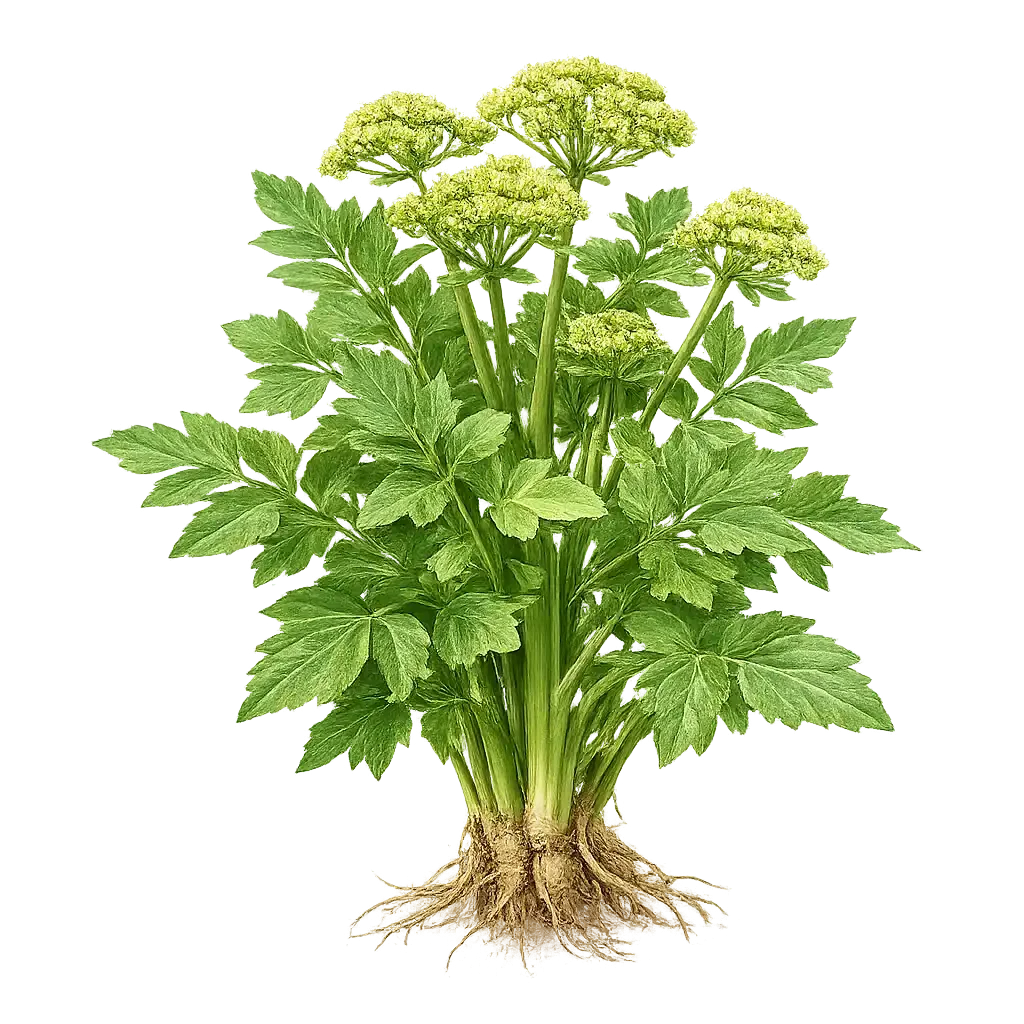
3 to 4 feet in leaf; 5 to 6 feet in flower
Spacing
24 to 36 inches; one or two plants sufficient for most households
Harvest Parts
Leaves and stems (primary culinary harvest); seeds (spice); roots (medicinal, autumn of year two onward)
Primary Aroma Compounds
Phthalides (ligustilide, butylphthalide), terpenes; responsible for the intense celery-like aroma more concentrated than celery itself
Uses
Celery substitute and intensifier in stocks, soups, stews, and braises; leaves as a salad and cooking herb; seeds as a spice; digestive carminative; mild diuretic; traditional kidney and urinary support
Lovage is the herb that makes you wonder why the garden center devotes twenty feet to basil varieties and keeps lovage, if it stocks it at all, in a single four-inch pot near the back. One lovage plant in a permanent position delivers more culinary utility per square foot than almost anything else in the perennial herb garden. It produces celery flavor at two to three times the intensity of the vegetable itself, from leaves and hollow stems that appear from early spring through autumn without any of the blanching, hilling, and careful management that celery cultivation requires. A single leaf dropped into a pot of stock while it simmers transforms the broth. A stem hollowed out makes a straw for a Bloody Mary that is functionally different from anything sold in a bottle. The seeds dried from the second-year flower heads provide a celery-flavored spice that outperforms commercial celery seed. The root harvested in autumn carries medicinal applications for the digestive and urinary systems that have been used across Europe for a thousand years. Lovage is not a novelty or a specialty crop. It is simply a plant that most modern gardens have forgotten.
Introduction
Levisticum officinale is native to the mountains of Iran and Afghanistan, naturalized across southern Europe, and long cultivated throughout the temperate world as a kitchen and medicinal herb. It is a member of the Apiaceae family, the same family as celery, parsley, dill, fennel, and carrot, and the family resemblance is immediately apparent in the umbel flower heads, the compound divided leaves, and the characteristic pungent aromatic character common to the group. What distinguishes lovage from its relatives is scale and intensity: it is considerably larger than any of them, reaching five to six feet in flower from a permanent clump that returns more vigorously each year, and its essential oil content produces a celery-like aroma and flavor significantly more concentrated than the vegetable it most closely resembles.
The name lovage is believed to derive from the Old French levesche and ultimately from the medieval Latin levisticum, a corruption of ligusticum, meaning of Liguria, a reference to the Ligurian region of northern Italy where the plant was widely grown. The common folk-etymology connecting the name to love is not supported by the botanical record but has attached itself to the plant in European herbal tradition, where it appeared in love philters and charms in the medieval period. The practical kitchen tradition is less romantic and more useful: lovage was a standard pot herb and broth herb across medieval and Renaissance European cooking, present in the kitchen garden of every household that maintained a garden, and fell out of common cultivation only in the nineteenth and twentieth centuries as fresh celery became widely available year-round.
The primary aromatic compounds responsible for lovage's characteristic flavor are phthalide lactones, particularly ligustilide and butylphthalide, which are also the compounds responsible for celery's aroma but present in lovage at significantly higher concentrations. These same phthalide compounds have been studied for cardiovascular, anti-inflammatory, and central nervous system activity in the broader research on Apiaceae family herbs, though the primary traditional and practical uses of lovage are culinary and digestive rather than pharmacological.
How to Grow
Sun Requirements
Lovage grows best in full sun to light partial shade and is more tolerant of afternoon shade than most culinary herbs in this series, reflecting its origin in mountain meadow habitats with variable light. In full sun it grows to its full potential height and produces the most intensely aromatic leaf. In partial shade it grows taller and more slender, with slightly larger but less concentrated leaves, and benefits from the reduced water stress that shade provides in hot summer climates. In zones 7 and warmer, a position with afternoon shade prevents the wilting and bolting that sustained midsummer heat can cause.
Soil Requirements
Lovage is one of the few culinary herbs in this series that actively benefits from deep, rich, moist soil rather than the lean, dry conditions that maximize essential oil concentration in Mediterranean herbs. It is a large, vigorous plant with a substantial root system, and deep fertile soil with good moisture retention supports the sustained vegetative growth that provides abundant leaf harvest through the full growing season. Incorporating generous compost to a depth of eighteen inches before planting and mulching to retain moisture produces the most productive lovage bed.
Drainage must accompany the moisture retention: lovage wants consistent soil moisture but not waterlogged conditions, and crown rot in poorly drained heavy clay is a risk in wet winters. A deep raised bed or a position with good natural drainage provides the combination of moisture and aeration that suits the plant well.
Water Needs
Lovage requires more consistent moisture than most herbs in this series and is not particularly drought-tolerant once the heat of summer arrives. In dry conditions the leaves become smaller, tougher, and more bitter, and the plant may bolt to flower prematurely, ending the vegetative harvest earlier than ideal. Regular watering to maintain even moisture through the growing season, particularly through midsummer, supports the continuous production of tender, well-flavored leaf from late spring through early autumn.
Planting
Lovage is grown from fresh seed sown in late summer or early autumn, when the seed is naturally ripe and germinates most reliably. Seeds lose viability quickly and are best sown within a few months of harvest; commercial seed packets more than a year old have significantly reduced germination rates. Sow half an inch deep in a prepared seedbed or in deep cells indoors, and keep consistently moist until germination occurs in one to three weeks. Autumn-sown seedlings that emerge before frost can be overwintered with protection or transplanted to their permanent position the following spring.
For growers who cannot source fresh seed, division of an established crown in early spring is the most reliable way to establish a new plant with known aromatic quality. Carefully lift a portion of the crown with a generous root section and replant immediately in a deeply prepared permanent position, watering in well and maintaining moisture through establishment.
Because lovage is a large, long-lived perennial that does not move well once established and that most households need in small numbers, choosing the permanent position carefully before planting matters more than for most herbs. The position should have deep, moisture-retentive soil, full sun to light shade, and adequate space for the plant to reach its full mature spread of two to three feet at the base without crowding adjacent plantings. One or two well-sited plants produce more lovage than most households can use through the season.
Harvesting
Leaf and Stem Harvest
Lovage leaf harvest begins as soon as the new spring growth reaches a usable size, typically in late March or April depending on climate, and the plant is among the earliest herbs to provide fresh material in spring before most other herbs have emerged. This early availability is one of its practical advantages in the spring kitchen, where the first fresh aromatic herb of the season arrives weeks before basil, dill, or any of the warm-season herbs are available.
Harvest outer leaves and stems from throughout the plant, cutting cleanly at the base of the stem. The flavor intensity of lovage means that the quantities harvested for culinary use are small relative to the plant's total output: a handful of leaves provides enough lovage for a large pot of stock, and one or two leaves serve the same role as a full stalk of celery in many preparations. Regular harvesting of outer growth keeps the plant producing tender new leaves and prevents the bolting that ends the prime harvest season.
The hollow stems harvested before the plant flowers are thick-walled and firm, suitable for use as edible straws for tomato-based drinks or as a vegetable in their own right when young and tender. Blanching the young stems by mounding soil or wrapping with cardboard for a week before harvest reduces the bitterness and produces stems milder in flavor, closer to blanched celery in character, though the lovage intensity remains present.
Seed Harvest
The flower umbels that appear in midsummer of the second year produce seed heads that ripen progressively through late summer. Harvest the entire seed head when the majority of seeds have turned from green to tan-brown, cutting the stem and placing it upside down in a paper bag to catch seeds as they ripen and shed. The dried seeds are aromatic, deeply flavored with the lovage-celery note, and suitable as a spice in the same applications as commercial celery seed but with noticeably more complexity and intensity.
Lovage seed used as a spice in bread baking, in salad dressings, in pickling brines, and in the spice blends for sausage and cured meats provides a flavor contribution distinct from and more interesting than the commercial celery seed that is usually specified in these applications.
Root Harvest
The root, harvested in autumn of the second year or later after the above-ground growth has died back, is the primary medicinal part of the plant. The large, fleshy, cream-colored taproot is cleaned, sliced, and dried for use in digestive and diuretic preparations. Root harvest reduces the plant's vigor for the following season; a partial harvest taking a portion of the root while leaving the crown intact allows the plant to continue growing in subsequent years.
Lovage in the stock pot: The most transformative application of lovage in the kitchen is also the simplest: add one or two fresh or dried leaves to any stock or broth during the simmering period, and remove before serving. The phthalide compounds extract readily into hot liquid and contribute a depth of savory, celery-forward flavor that makes the difference between a stock that tastes like hot water with meat and one that tastes like it belongs in a professional kitchen. The effect is noticeable even with the plant's intensity diluted across a large volume of liquid. For vegetable stock, lovage is particularly valuable, providing the savory backbone that vegetable stocks often lack without meat. For chicken stock, it accentuates the natural celery note already present and adds complexity. For beef stock, it plays the same role celery root plays in classic French cooking, grounding and anchoring the other flavors. Keep a jar of dried lovage leaves in the kitchen alongside bay and thyme for this application through the months when fresh lovage is not available.
How to Use
Culinary Uses
The key to using lovage well in the kitchen is understanding that it is an intensifier and a background herb rather than a present, recognizable flavor in the finished dish. Used correctly, lovage makes everything around it taste more deeply savory, more fully itself, without announcing its own presence. Used incorrectly, with too much leaf in a delicate preparation or added too early to a dish where the volatile oils evaporate completely, it either overwhelms or disappears.
In stocks, soups, and braises where the liquid simmers for an extended time, lovage is most effective when added for the last thirty to sixty minutes of cooking rather than at the beginning. Extended simmering volatilizes the phthalide compounds responsible for its characteristic note, and a leaf added near the end contributes the fresh, vivid quality that makes lovage distinctly useful. For cold preparations including salad dressings and cold soups, a small amount of finely minced fresh leaf provides more impact than a larger quantity added to a hot preparation.
The leaves, finely chopped, are appropriate in any preparation where celery leaf would be used and in many where the intensity of lovage provides something celery leaf cannot. Potato salad, where a small amount of lovage replaces or supplements the celery that is classic in many versions, benefits considerably from the substitution. Cold chicken salad with lovage, tarragon, and a light mayonnaise dressing is one of the best simple demonstrations of the herb's value. Lovage and potato soup, using the herb in the way that Eastern European cooking has used it for centuries in zurek and other fermented rye or grain soups, shows what the herb does in the context it was bred for.
The young stems, before the plant becomes too fibrous, can be used as celery substitutes in Waldorf salads, vegetable crudites, and braised vegetable preparations. The hollow stems stripped of their outer layer and cut into short sections can be added to pickling brines for cucumber and other pickles, where the lovage note is subtle and complementary rather than dominant.
In Central and Eastern European cooking, where lovage has been a kitchen garden staple rather than a forgotten specialty, it appears in the herb blends for roast meats, in the stuffings for poultry, in the marinades for smoked and cured fish, and in the seasoning for traditional fermented preparations including sauerkraut variants and fermented grain porridges. The herb's deep affiliation with the cooking of the Czech Republic, Slovakia, Hungary, and Romania in particular is worth exploring for cooks interested in these traditions.
Digestive Uses
Lovage has traditional use as a digestive carminative and stimulant, reducing bloating and gas and stimulating the digestive secretions that improve digestion of heavy, fatty, or protein-rich meals. The phthalide and terpene compounds in the essential oil provide antispasmodic activity on gastrointestinal smooth muscle and mild stimulation of bile secretion, mechanisms consistent with the traditional use of the plant across European folk medicine as an after-meal digestive herb.
A simple preparation for digestive use is lovage seed tea, made by lightly crushing a teaspoon of seeds in a mortar, pouring over boiling water, covering, and steeping for ten minutes before straining. The resulting tea is strongly aromatic and noticeably digestive-stimulating, appropriate after heavy meals where bloating and fullness are anticipated. The same seed infusion, at a lower dilution, has been used traditionally for flatulence and intestinal cramping.
Urinary and Kidney Uses
Lovage has traditional and pharmacologically plausible use as a mild diuretic and urinary tract supportive herb. The phthalide compounds are excreted significantly through the kidneys and impart their characteristic aroma to the urine, which is the most immediate confirmation that the relevant compounds are reaching the urinary system in active form. European herbal tradition has used lovage root decoctions for urinary gravel, kidney support, and the general flushing of the urinary system that is a traditional preventive measure for kidney stone formation.
This application is less well-studied than the digestive uses but is consistent with the plant's phytochemical profile and with the broader use of Apiaceae family plants, several of which share diuretic activity. For the homestead application, lovage seed or leaf tea as a mild diuretic flush during periods of low fluid intake is a traditional and low-risk supportive practice with a mechanistic basis, distinct from the more potent pharmaceutical diuretics and without their electrolyte management concerns at normal herbal use levels.
Storage
Fresh lovage leaves keep for five to seven days refrigerated, wrapped loosely in a slightly damp paper towel in a sealed container. For longer preservation, drying is straightforward: strip leaves from stems and dry on mesh racks at room temperature for four to five days, or in a food dehydrator at 95 degrees Fahrenheit for two to three hours. Dried lovage leaf retains good flavor for one year in airtight dark glass containers, with some loss of the fresh volatile character but retention of the deep savory note that makes it useful as a stock and braise herb.
Freezing fresh leaves in ice cube trays with a small amount of water provides the closest-to-fresh character for use in hot preparations through the winter months. The frozen cubes added directly to simmering stock or soup release the volatile compounds as they melt, providing nearly the effect of fresh leaf in these applications.
Dried lovage seeds store for two years in airtight glass containers. The seeds are harder and drier than the leaf and retain their essential oil content more stably over time, making them the most reliable long-term preserved form of lovage flavor from the annual harvest.
Lifespan of the Plant
Lovage is a long-lived perennial that becomes progressively more vigorous and more productive through its first several years in a permanent position, developing an increasingly large and deep root system that supports earlier, more abundant spring growth with each passing season. A well-established lovage plant in its fourth or fifth year, growing in deep fertile soil, is a genuinely impressive plant: the emerging spring growth in March or April, when much of the garden is still bare, provides the most abundant early-season harvest of any herb in this series.
The plant dies back completely to the ground each autumn and re-emerges reliably each spring from the crown, with the dead hollow stems from the previous year breaking down at the base. Cutting the old stems back in late autumn keeps the bed tidy and removes the material that would otherwise form a messy mat over the crown. No other annual maintenance is required beyond a top-dressing of compost in spring to support the vigorous growth through the season.
Established plants can be divided every five to six years to prevent the center of the crown from becoming unproductively woody and to maintain the vigorous peripheral growth that provides the most productive leaf harvest. Division in early spring before significant new growth has emerged is the correct timing; the plant re-establishes quickly from crown divisions with generous watering through the first season.
Cautions and look-alike note: Lovage's membership in the Apiaceae family places it in a group that contains several seriously toxic plants including poison hemlock (Conium maculatum) and water hemlock (Cicuta species), which share the family's compound leaves and umbel flowers. Never harvest any wild Apiaceae plant unless identification is absolutely certain; the consequences of misidentification in this family are potentially fatal. Cultivated lovage in a known garden planting presents no identification risk. Medicinally, lovage is contraindicated in pregnancy due to its emmenagogue activity, and concentrated root preparations should not be used in kidney inflammation or acute kidney disease. The diuretic activity makes adequate fluid intake important during extended use. People with Apiaceae family allergies should approach lovage cautiously. At culinary quantities in cooking, lovage is safe for general use.
Pros and Cons
Advantages
Provides the most intense celery flavor available from a garden plant, replacing commercial celery across stocks, soups, braises, and salads with a depth the vegetable cannot match
All parts of the plant are useful at different seasons: leaves and stems from spring through autumn, seeds in late summer, root in autumn of the second year onward
One of the earliest herbs to emerge in spring, providing fresh aromatic leaf weeks before most warm-season herbs are available
Genuinely long-lived perennial that requires almost no management once established and becomes more productive with each passing year
Hardy to zone 3; one of the most cold-tolerant culinary perennials available
One or two plants produce more than most households need, making it an exceptionally productive use of garden space per plant
Tolerates more shade than most culinary herbs; useful in partially shaded positions
Virtually pest and disease free in appropriate conditions
Limitations
Intensity requires restraint: too much lovage overwhelms a dish entirely, and the learning curve for calibrating quantities can produce some memorably overpowered meals
Large plant requiring generous permanent space; not suitable for small or container herb gardens
Requires deep, moisture-retentive, fertile soil and consistent watering, unlike the lean-soil drought-tolerant Mediterranean herbs in this series
Contraindicated in pregnancy; not appropriate for concentrated medicinal use in kidney inflammation
Apiaceae family membership requires careful identification hygiene if foraging or if toxic look-alikes grow nearby
Relatively uncommon in garden centers; may require sourcing from a specialist herb nursery or growing from fresh seed
Dies back completely in winter, leaving a gap in the herb bed from autumn through early spring
Common Problems
Lovage is among the least problematic plants in this series in appropriate conditions. The most common cultivation failure is planting in dry, shallow, or poorly prepared soil, which produces a stunted plant with small, tough, intensely bitter leaves rather than the large, tender, abundantly aromatic growth that a well-sited plant in deep fertile soil provides. The solution is preparation before planting, not remediation after the fact.
Leaf miners occasionally tunnel through lovage leaves, leaving the characteristic pale meandering tracks visible on the leaf surface. The damage is cosmetic and does not affect the edibility or flavor of unaffected leaves; removing and disposing of heavily affected leaves is adequate management. Leaf miner populations are controlled naturally by parasitic wasps and do not typically reach levels that threaten a well-established plant.
Premature bolting to flower in the first or second year, before the plant has developed sufficient root mass to support sustained leaf production, can result from insufficient moisture, excessive heat, or root disturbance during transplanting. Removing flower stalks as soon as they appear extends the vegetative leaf-producing season by redirecting the plant's energy from seed set back into leaf growth, and is standard practice for maintaining the productive harvest through the full growing season.
Crown rot from winter waterlogging is a risk in heavy clay soils with poor drainage. The same preparation that produces good root development, deep loosening and organic matter incorporation, also improves drainage enough to prevent most crown rot problems. In reliably wet positions, growing lovage in a deep raised bed eliminates the risk entirely.
Final Thoughts
Lovage fell out of the European kitchen garden over the course of a century as celery became a reliable commercial crop, and its disappearance was a straightforward case of a useful plant being displaced by a more convenient substitute. The substitute is inferior in intensity, available only as a vegetable rather than a perennial herb, and entirely absent from the garden through the winter months when lovage's dried leaves and seeds can still be working in the stock pot and the spice blend.
A single well-placed lovage plant in deep, moist soil is one of the more consequential additions a kitchen gardener can make to the perennial herb bed, providing returns that compound with each passing year from something requiring almost no annual effort. Plant it once, in the right position, and it repays the decision for a decade or more. The Central and Eastern European cooking traditions that never abandoned it have the better of the argument.