
Marshmallow (Althaea officinalis)
Written By Arthur Simitian
QUICK FACTS
Common Name
Marshmallow, White Mallow, Sweet Weed
Scientific Name
Althaea officinalis
Plant Type
Hardy herbaceous perennial
Hardiness Zones
3 to 9
Sun Requirements
Full sun to light partial shade
Soil Type
Moist, deep, well-drained; tolerates clay; pH 6.0 to 8.0
Plant Height
4 to 6 feet in flower
Spacing
24 to 36 inches
Harvest Parts
Root (primary medicinal harvest, autumn of year two onward); leaves and flowers (culinary and tea, throughout the season)
Primary Active Compound
Mucilage polysaccharides (approximately 25 to 35 percent of dry root weight); also flavonoids, pectin, tannins
Uses
Demulcent for irritated mucous membranes throughout the digestive and respiratory tracts, dry cough soothing, leaky gut and IBS support, urinary tract comfort, culinary vegetable and historical confection
The marshmallow confection that children roast over campfires has nothing to do with the plant anymore, but it did once. The original marshmallow sweet was made by whipping the mucilaginous root extract of Althaea officinalis with sugar and egg white into a foam that set firm, and the extraordinary slipperiness of the root, which is its defining medicinal character, is precisely what made the confection work before gelatin replaced it in the nineteenth century. That same slipperiness, produced by the mucilage polysaccharides that make up roughly a quarter of the dry root weight, is the mechanism behind one of the most gentle, broadly applicable, and consistently useful medicinal plants in the entire herb garden. Marshmallow root coats, soothes, and protects irritated mucous membranes wherever it contacts them: the mouth, the throat, the esophagus, the stomach, the intestinal tract, the urinary passages. It does not fight, stimulate, or intervene in a pharmacological sense. It simply reduces friction, calms inflammation, and gives irritated tissue the physical protection it needs to heal.
Introduction
Althaea officinalis is native to the salt marshes, wet meadows, and riverbanks of Europe, western Asia, and North Africa, with a distribution that tracks the damp, fertile, slightly alkaline conditions it prefers. The genus name Althaea derives from the Greek word for healing, and the species has been in continuous medicinal use since ancient Egyptian, Greek, and Roman times, where it appeared in preparations for coughs, sore throats, digestive complaints, and skin inflammation. The officinalis designation, shared by dozens of herbs in this series, indicates a plant with an established history of pharmaceutical use: in marshmallow's case, a history that extends from ancient medical papyri through medieval European herbalism to its current listing in the European Medicines Agency's traditional herbal medicine guidelines.
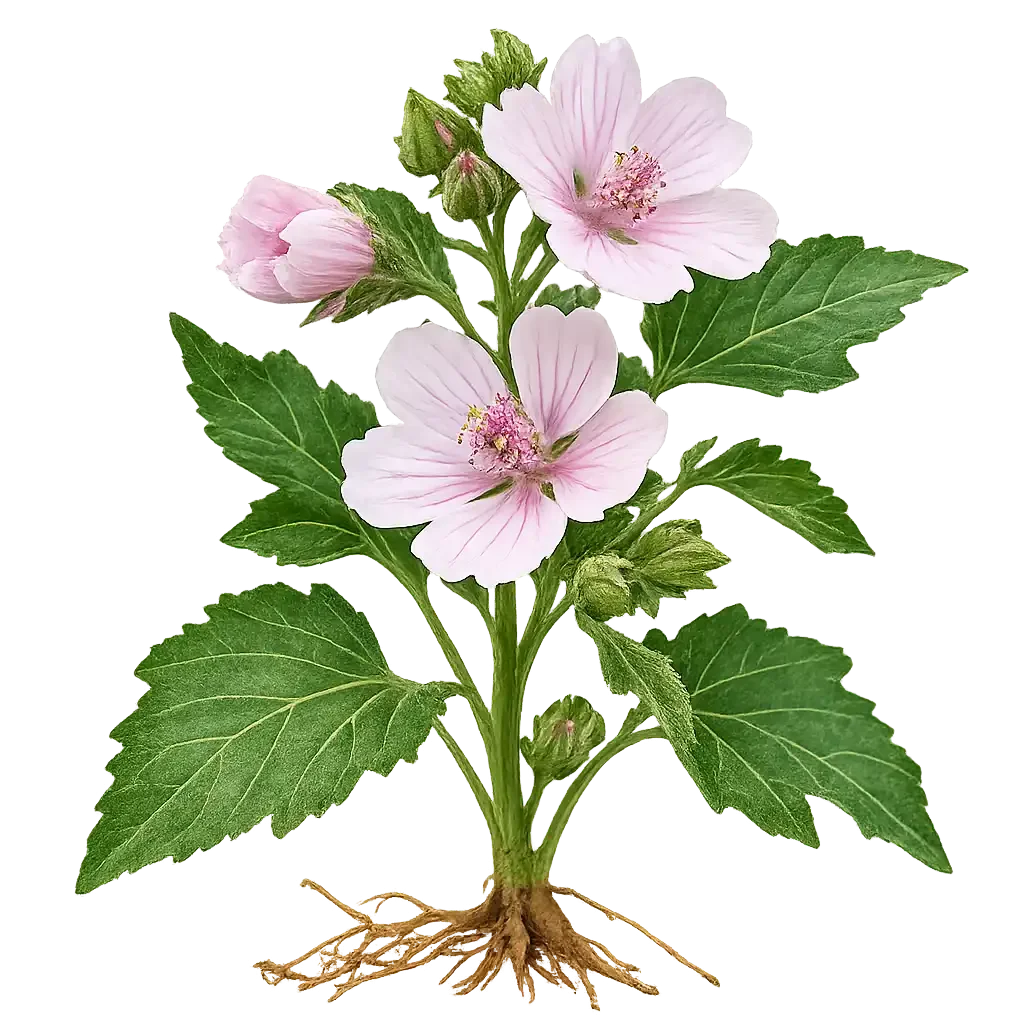
The plant is a large, soft, hairy perennial with an unmistakable velvety texture to every above-ground surface. The leaves are broadly palmate and lobed with fine hairs that give the whole plant a grey-green cast. In midsummer through early autumn it produces pale pink five-petaled flowers at the leaf axils along the upper stems, smaller and simpler in form than its ornamental relatives in the Malvaceae family but genuinely attractive, followed by the wheel-shaped seed pods that are also edible at the immature green stage. The whole plant is soft, non-spiny, and pleasant to handle, which makes it a welcome contrast to many of the medicinal plants in this series.
The mucilage that defines marshmallow's medicinal action is produced most abundantly in the root, where polysaccharide chains form a viscous gel when hydrated. The leaves and flowers also contain mucilage, at lower concentration, and are used in teas and topical preparations for the same demulcent effect. The mechanism is straightforward and physical: the mucilage coats mucous membranes with a slippery, protective film that reduces friction, calms the nerve endings that produce the sensation of irritation, and creates a barrier between the inflamed tissue and whatever is irritating it.
How to Grow
Sun Requirements
Marshmallow grows best in full sun, where it reaches its full height and produces the most abundant flowering and the most vigorous root development. In light partial shade it grows adequately but with somewhat reduced vigor and a taller, more open structure that may require staking in exposed positions. Given that the root is the primary medicinal harvest and root size is directly related to the plant's photosynthetic capacity over the growing season, full sun is strongly preferable for a production planting.
Soil Requirements
Marshmallow is one of the more accommodating plants in this series regarding soil. It tolerates clay, loam, and sandy soils across a pH range from mildly acid to alkaline, and in its native habitat it colonizes the seasonally wet, heavy soils of marsh margins and floodplain edges that most plants avoid. Deep, moisture-retentive soil is ideal because it supports the development of the deep fleshy taproot that is the medicinal harvest; the root follows moisture downward, and in shallow or dry soil it remains small and branchy rather than developing the large, clean, harvest-worthy form that a well-prepared deep bed produces.
Preparing the planting bed to at least eighteen inches depth by double-digging or broadfork loosening, and incorporating generous organic matter, provides the conditions that produce the most productive root harvest. A permanent raised bed prepared this way and planted with marshmallow for multi-year root production is the most efficient homestead setup for this herb.
Water Needs
Marshmallow prefers consistently moist soil and is less drought-tolerant than many herbs in this series. Regular watering through dry periods, particularly in the first year of establishment when the root system is developing, supports the sustained vegetative growth that builds the root mass harvested in autumn of the second year. In subsequent years, an established marshmallow plant with a deep root system accesses subsoil moisture effectively and requires less supplemental irrigation than a first-year plant, but it performs best with regular moisture rather than extended dry spells.
Planting
Marshmallow is grown from seed or from division of established crowns. Seeds have a hard coat that benefits from scarification before sowing: nick the seed coat lightly with sandpaper or a nail file, or soak in warm water for twelve to twenty-four hours before sowing. Sow directly in the prepared bed in early spring after the last frost, or start indoors six to eight weeks before the last frost date in deep cells that accommodate the taproot. Germination takes one to three weeks at soil temperatures above 60 degrees Fahrenheit.
Division of an established crown in early spring before significant new growth, or in autumn after the stems die back, provides established root sections that develop more quickly into productive plants than seed-grown seedlings. Each division should include a section of root crown with viable buds and a portion of the taproot. Plant divisions at the same depth they were growing.
For root harvest purposes, the standard approach is to establish plants in their permanent position, allow the first growing season to build root mass without harvest, and begin harvesting in autumn of the second year when the root has developed sufficient size. A rolling planting of new divisions or seedlings each year provides a continuous annual harvest from the two-year-old plants while younger plants are developing.
Harvesting
Root Harvest
The root harvest takes place in autumn of the second year or later, after the above-ground stems have died back and the plant's energy has returned to the root. At this stage the root contains the maximum concentration of mucilage polysaccharides accumulated through the growing season. Roots of first-year plants are too small to harvest productively; second-year roots are the practical minimum and third-year roots provide substantially more material per plant.
Dig around the plant with a garden fork, working outward from the crown to avoid breaking the long taproot where possible, and lift the entire root mass. Wash the roots thoroughly, then peel the outer bark to expose the white, mucilaginous inner root. The peeled root can be used fresh, or sliced into half-inch rounds and dried at 95 to 100 degrees Fahrenheit in a food dehydrator, or air-dried on mesh racks in a warm, well-ventilated space.
After harvesting, replant a portion of the root crown with viable growth buds to regrow the plant for future harvests. Marshmallow can regrow from a small crown section and established plants that are partially harvested continue to produce for many years.
Leaf and Flower Harvest
Young leaves can be harvested throughout the growing season as the plant develops, taking the youngest, most tender leaves from the upper portions of the stems. The leaves are most mucilaginous when young and fresh. Flowers are harvested as they open, used fresh in salads or dried for tea. The immature green seed pods, called cheeses for their wheel shape, are edible fresh as a mild, slightly mucilaginous snack.
Cold-infused marshmallow root tea: Cold water extracts more mucilage from marshmallow root than hot water, because high temperatures can degrade the polysaccharide chains responsible for the slippery, coating quality that makes the preparation medicinally active. Place two tablespoons of dried, sliced marshmallow root in a glass jar with two cups of cold or room-temperature water. Cover and leave to infuse for four to eight hours or overnight. Strain through a fine cloth, pressing the softened root firmly to extract the maximum mucilaginous liquid. The resulting infusion is noticeably viscous, slightly sweet, and distinctly slippery on the lips and tongue; this physical quality is the indication that the mucilage is present and active. Drink one to three cups daily for sore throat, dry cough, gastric irritation, or urinary tract discomfort. The cold infusion can be gently warmed if desired without losing most of its activity, though boiling should be avoided.
How to Use
Respiratory Uses
Marshmallow root is the herb of first choice for dry, irritating cough where the cough reflex is driven by irritation of the mucous membranes of the throat and upper airway rather than by productive mucus that needs to be expelled. The mucilage coats the inflamed mucosal surfaces of the pharynx, larynx, and trachea, reducing the friction and irritation that trigger the cough reflex and providing a physical barrier that allows the tissue to calm and heal while protected from further drying and irritation.
This application is supported by a clinical trial published in Complementary Medicine Research examining a marshmallow root syrup preparation for dry cough, with participants reporting significant reductions in cough frequency and throat irritation after one week of use. The mechanism is straightforwardly physical, which means it works for dry cough from any cause: post-viral airway irritation, dry indoor air, vocal strain, or the persistent dry cough that sometimes follows respiratory infections after the infection itself has resolved.
The cold infusion preparation is particularly appropriate for respiratory applications. A thermos of cold-infused marshmallow root tea carried through a day of vocal demands, taken in small sips rather than large glasses, provides continuous coating and protection of the mucosal surfaces through the periods of use that would otherwise cause irritation.
Digestive Uses
The demulcent action of marshmallow root extends through the entire digestive tract, coating and soothing inflamed mucous membranes from the esophagus through the stomach and intestines. This makes it one of the most broadly applicable herbs for digestive irritation, relevant for acid reflux and esophageal irritation, gastritis, peptic ulcer, inflammatory bowel conditions including Crohn's disease and ulcerative colitis in periods of flare, and the intestinal permeability associated with leaky gut syndrome.
For gastric applications, the cold infusion taken before or with meals provides the most relevant clinical effect: the mucilage contacts the gastric mucosa in its most concentrated form before it is diluted by food and stomach acid. For lower bowel applications, the mucilage that survives gastric acid passage and reaches the intestines in a still-active form provides the protective coating needed in the small and large intestine, and splitting the daily dose across multiple small servings throughout the day maximizes the continuous presence of mucilage at the mucosal surface.
The evidence base for digestive uses is primarily traditional and mechanistic rather than from large randomized trials. The demulcent mechanism is well-understood and consistent with the clinical applications, and the safety profile of marshmallow root is excellent with no significant adverse effects or interactions reported in normal use. This combination of plausible mechanism, long traditional use, and good safety makes it an appropriate first-line herb for digestive irritation before considering more potent interventions.
Urinary Tract Uses
The same mucilage that coats the digestive mucous membranes is excreted into the urine to a significant degree, and this urinary excretion produces a demulcent, soothing effect on the mucous membranes of the urinary tract including the bladder and urethra. Marshmallow root tea is a traditional and clinically plausible remedy for the burning and urgency of urinary tract irritation, urethritis, cystitis, and the discomfort of urinary tract infections as a supportive soothing measure alongside appropriate medical treatment.
For urinary tract use, adequate fluid intake alongside the marshmallow preparation is important: the mucilage works most effectively when the urine is well-diluted, reducing the concentration of irritants in contact with the mucosal surfaces. High fluid intake with marshmallow root cold infusion is the most effective approach for urinary comfort.
Topical Uses
Marshmallow root and leaf preparations applied topically provide the same demulcent and anti-inflammatory effect on skin that the internal preparations provide on mucous membranes. A poultice of fresh crushed leaf or a concentrated root decoction cooled and applied to dry, irritated, or mildly inflamed skin provides soothing and moisturizing relief for dry eczema, sunburn, minor abrasions, and the chapped skin of hands and lips exposed to cold or dry air. The mucilage acts as a natural emollient and skin-protective film, and it is non-irritating and gentle enough for use on sensitive skin including in young children.
Culinary Uses
Marshmallow leaves are edible throughout the growing season and have been used as a pot herb and salad green in Mediterranean and Middle Eastern cooking for centuries. The young leaves have a mild, pleasant flavor without significant bitterness and the characteristic slight slipperiness from the mucilage content, which integrates naturally into cooked preparations. In France, the young leaves were historically used in the same way as spinach or sorrel in spring cooking. The Levantine kitchen uses mallow leaves, including those of common mallow and related species, in soups and stews where the mucilage contributes body and a silky texture to the broth.
The immature seed pods harvested while still bright green and tender are one of the more unusual edible discoveries available to the marshmallow grower: mild, slightly crisp, with a faint mucilaginous quality that disappears in cooking, they can be eaten raw as a garden snack or added to mixed vegetable dishes. The flowers, with their clean mild flavor and attractive pale pink coloring, are appropriate for fresh salads and as an edible garnish.
For those interested in the original confection that gave the modern sweet its name: the basic preparation involves extracting the mucilage from roots by simmering in water, straining, reducing, and then beating with sugar and egg white until the foam sets. The result is genuinely different from the commercial gelatin-based marshmallow, with a more complex, slightly herbal sweetness and a texture that is softer and more slowly melting. It is a historical curiosity worth making once from a home harvest.
Storage
Dried marshmallow root stores well for two years in airtight glass containers in a cool, dark location. The mucilage polysaccharides are stable in dried root form and do not degrade significantly over this period, provided the root was properly dried to a low moisture content before storage. Underdried root is susceptible to mold development in storage; fully dried pieces should be brittle and snap rather than bend.
Dried leaves retain good mucilage activity for one year stored in airtight containers away from light. Flowers are best used fresh or dried promptly after harvest for tea use. Cold-infused root preparations should be made fresh as needed and consumed within twenty-four hours; the high mucilage content makes the infusion a good medium for microbial growth and it does not keep well even refrigerated.
Lifespan of the Plant
Marshmallow is a long-lived perennial that persists in the same position for many years with minimal management, dying back to the ground each winter and re-emerging from the crown each spring. Established plants in appropriate moist, deep soil grow more vigorously and produce larger roots with each successive year until they reach a mature size of four to six feet in flower with a correspondingly substantial root mass.
The plant does not spread aggressively but self-seeds moderately where seed heads are left to mature, producing seedlings that can be transplanted to new positions or thinned to prevent crowding. The combination of perennial crown regrowth and self-seeding means that a single well-sited planting tends to maintain itself across years without deliberate replanting.
Drug absorption note: The mucilage of marshmallow root can slow the absorption of orally administered medications by coating the gastrointestinal mucosa and delaying the passage of drugs across the intestinal wall. People taking prescription medications should allow at least two hours between medication doses and marshmallow root preparations to avoid this interference with absorption. This is particularly relevant for medications with narrow therapeutic windows. Marshmallow has mild hypoglycemic activity in some studies; people with diabetes on medication should monitor accordingly. No significant adverse effects or toxicity have been reported from normal use. Safe and appropriate in pregnancy and for children at culinary and mild tea use levels.
Pros and Cons
Advantages
One of the safest and most broadly applicable herbs in the series, with no significant toxicity concerns and a gentle mechanism appropriate for extended daily use
Addresses a category of complaint, irritated mucous membranes, that few other herbs in the garden target as directly or as effectively
Active at all three harvest parts: root for concentrated mucilage, leaves for cooking and tea, flowers for fresh use
Long-lived perennial that establishes permanently and produces increasingly large root harvests with each successive year
Ornamentally attractive; the soft velvety foliage and pale pink flowers make it a genuinely beautiful garden plant as well as a productive medicinal one
Cold infusion preparation is simple, requires no heat, and produces a noticeably mucilaginous result that provides clear sensory confirmation of the active preparation
Tolerates clay and seasonally moist soil positions that other herbs avoid, filling a difficult site productively
Historical confectionery connection provides a genuine culinary project from the root harvest
Limitations
Root harvest requires at least two years of growth before plants are productive enough to harvest without eliminating the planting
Large plant requiring generous spacing; not suited to small or intensive beds
Mucilage can slow absorption of orally administered medications; a two-hour separation window is required for medicated individuals
Cold infusion preparations do not keep and must be made fresh daily
The demulcent action is soothing and supportive rather than curative; it addresses the symptom of mucosal irritation without treating underlying causes
Prefers consistent moisture; less drought-tolerant than many herbs in this series and requires more attentive watering during establishment
Common Problems
Marshmallow is generally problem-free in appropriate conditions. The most common cultivation issue is poor root development resulting from insufficient soil depth, low soil moisture, or root competition from adjacent plants. In shallow or compacted soil the root remains small and branchy rather than developing the large, clean taproot that is the valuable medicinal harvest; thorough bed preparation before planting is the solution, not a remedy after the fact.
Rust fungus occasionally appears on marshmallow leaves as orange pustules on the undersides, more cosmetically unpleasant than damaging to the plant's productivity. Removing affected leaves and improving air circulation by thinning crowded growth manages the problem without further intervention. The root harvest is unaffected by leaf rust.
Hollow, large plants in wet summers can develop crown rot where the stem bases remain wet. A slight mounding of the soil away from the crown base, ensuring water drains away from rather than pooling at the crown, prevents this in most cases. Adequate spacing to allow air movement around the base of each plant also reduces humidity at the crown.
Japanese beetles and other foliar feeders occasionally graze the large, soft leaves. The damage is generally cosmetic and does not meaningfully reduce the root harvest from well-established plants. Hand-picking in the morning when beetles are less mobile is adequate control for homestead-scale plantings.
Varieties and Related Plants
Althaea officinalis is the primary medicinal marshmallow species, with no named varieties in common cultivation. The plant sold simply as marshmallow root from reputable herb nurseries is the correct species for the applications described in this guide.
Common mallow (Malva sylvestris) is a closely related species with overlapping medicinal properties and a more widespread naturalized presence in disturbed ground and roadsides across temperate regions. Its leaves and flowers are used in the same demulcent applications as marshmallow and in Mediterranean cooking as a cooked green; the root provides less mucilage than Althaea officinalis but is similarly soothing. Where marshmallow grows as a garden cultivar and common mallow appears as a volunteer, both are useful and edible.
Hollyhock (Alcea rosea) is a tall ornamental relative in the same family with edible flowers and modest mucilaginous activity in the root and leaves, but it is primarily grown for ornamental purposes rather than for medicinal use and its mucilage content is significantly lower than Althaea officinalis.
Final Thoughts
Marshmallow does one thing with exceptional reliability: it soothes. The range of conditions that benefit from that soothing, the breadth of the mucous membrane surfaces it can reach, and the gentleness with which it achieves its effect make it one of the most consistently useful plants in the herb garden for household health management. It is not dramatic. It does not provide the kind of clinical evidence that milk thistle's silymarin or peppermint's IBS trials produce. What it provides is physical protection and relief for the irritated tissues that dry coughs, acid reflux, gastric inflammation, urinary tract discomfort, and inflamed skin all share in common, delivered by a plant that is safe enough to use without concern in children and adults at any frequency the situation warrants.
Plant it in deep, moist soil in a permanent position. Give it two years before the first root harvest. Keep a jar of dried root in the kitchen for the cold infusion preparation that should be made the night before any day where a cough, sore throat, or gastric irritation is expected to be a problem. The slipperiness of the prepared infusion against the lips and tongue is the clearest possible sensory confirmation that the active compound is present and ready to do the work it has been doing for two thousand years.