
Plantain (Plantago)
Written By Arthur Simitian
QUICK FACTS
Common Name
Broadleaf Plantain, Ribwort Plantain, Common Plantain, Englishman's Foot
Scientific Name
Plantago major (broadleaf), Plantago lanceolata (ribwort)
Plant Type
Hardy perennial; behaves as annual or biennial in some conditions
Hardiness Zones
3 to 9 (both species)
Sun Requirements
Full sun to full shade; exceptionally adaptable
Soil Type
Tolerates almost all soils; prefers moist, fertile loam
Plant Height
4 to 12 inches for leaf rosette; flower spikes to 18 inches
Spacing
If deliberately cultivated, 6 to 12 inches
Uses
Wound care, drawing poultice, respiratory expectorant, digestive astringent, urinary support, edible green, livestock forage
Plantain is growing in your garden right now, and almost certainly in your lawn, and probably in every crack in every path on your property. It has been following human settlement for so long, spreading with such consistency wherever disturbed soil and foot traffic occur, that Indigenous North Americans named it Englishman's Foot after observing that it appeared everywhere European settlers walked. That tenacity, that absolute refusal to be absent from human spaces, is not an accident. Plantain is one of the most useful first-aid herbs in the world, and it has stationed itself next to people with the dedication of a plant that understood, long before we did, that proximity to human activity was the most advantageous place it could possibly be.
Introduction
The plantains covered in this guide are Plantago major, broadleaf plantain, and Plantago lanceolata, ribwort or narrowleaf plantain. Both species are members of the Plantaginaceae family, both are native to Europe and western Asia, both have naturalized so thoroughly across every inhabited continent that they are now considered cosmopolitan weeds of global distribution, and both share the same active compound profile and the same medicinal applications, differing primarily in leaf shape and in the minor differences in compound concentration that make ribwort plantain the preferred choice for respiratory applications and broadleaf plantain the more commonly used species for wound care and poultice preparations.
The plant is not related to the edible cooking banana also called plantain, which is Musa paradisiaca and an entirely different genus and family. The name collision is unfortunate but consistent enough in the herbal literature to require this clarification upfront, as confusion between the two plants appears with notable frequency in popular herbal writing.
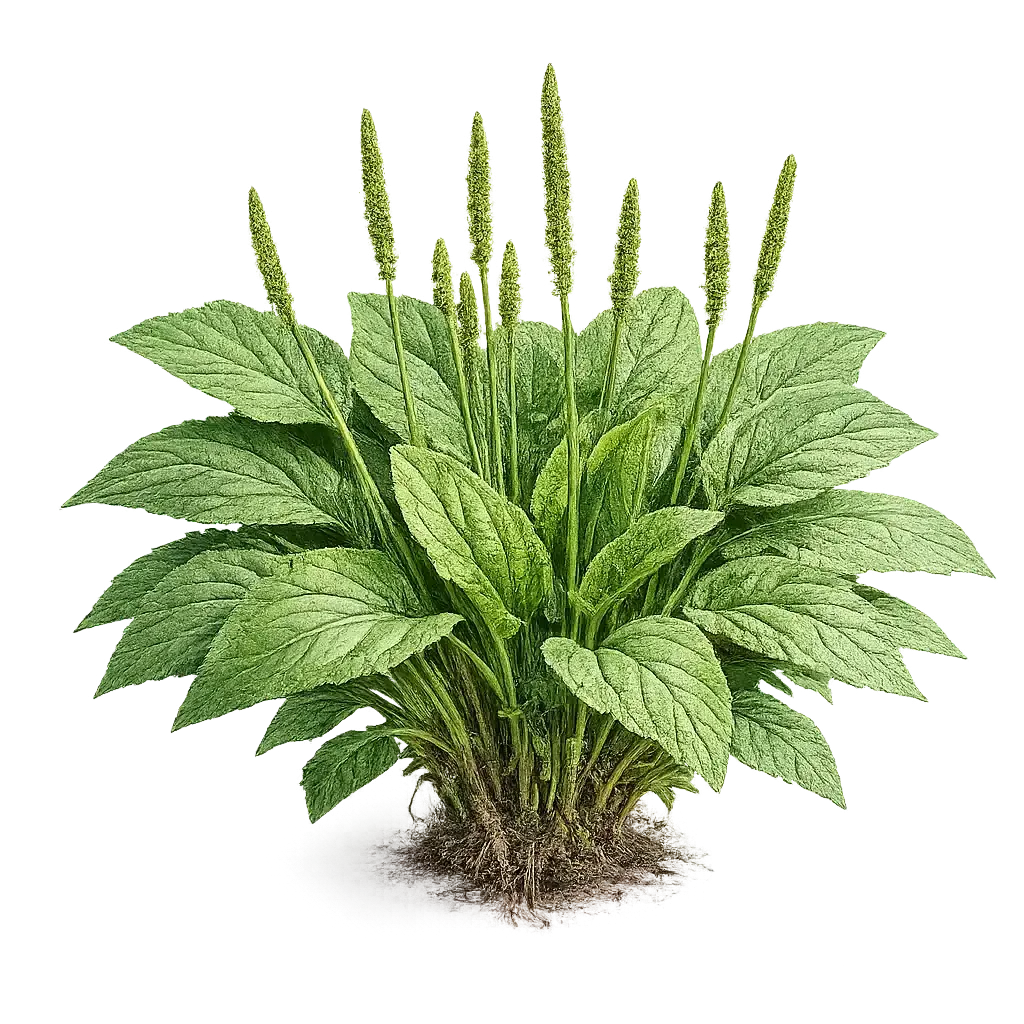
Both Plantago species grow as low basal rosettes of leaves from which tall, slender flower spikes emerge in summer. Broadleaf plantain produces broad, oval to egg-shaped leaves with prominent parallel veins, five to seven veins pressed against the leaf surface in the characteristic ribbed pattern that gives the plant its other common name, ribwort, though that name is more properly applied to the narrowleaf species. Ribwort plantain produces narrower, lanceolate leaves with three to five parallel veins and a more upright leaf habit than the pressed-flat rosette of broadleaf plantain. Both produce the cylindrical flower spikes with tiny white flowers that are characteristic of the genus.
The active compounds present in both species include aucubin, an iridoid glycoside with anti-inflammatory and wound-healing activity; allantoin, which promotes cell proliferation and tissue regeneration; mucilage polysaccharides that provide the soothing, coating, demulcent activity relevant to respiratory and digestive applications; tannins providing astringent and antimicrobial activity; and the flavonoids luteolin and apigenin with additional anti-inflammatory effects. This combination of wound-healing, anti-inflammatory, demulcent, and astringent compounds in a single leaf is what makes plantain one of the most broadly useful first-aid herbs in the world.
How to Grow
A Note on Cultivation
Plantain is almost certainly already present on or near your homestead without any deliberate effort on your part. For most growers, the management question is not how to establish plantain but how to harvest it thoughtfully from existing wild populations while maintaining productive stands for ongoing use. Deliberately cultivating plantain as a garden crop is less common than harvesting it from the lawn and field edges where it grows freely, and this guide addresses both approaches.
If your property is free of plantain and you wish to establish it, or if you want a cultivated stand in a specific location for reliable, clean-harvest access, the growing information below applies directly. If plantain is already present, the harvesting and use sections are the most immediately relevant.
Sun Requirements
Plantain is one of the most light-adaptable plants in this entire series, growing vigorously in full sun, coping adequately in partial shade, and surviving in conditions of fairly deep shade where most other herbs would fail entirely. This extraordinary light tolerance is part of what makes it such a successful companion to human settlement: it grows in the sunny vegetable bed and in the shaded path edge with equivalent determination. For deliberate cultivation aimed at maximum leaf production, full sun produces the most vigorous growth and the largest leaves. For harvesting from established wild stands, the plant will be found in whatever light conditions are available at the site.
Soil Requirements
Plantain tolerates an extraordinary range of soil conditions, from compacted clay to sandy loam to moist fertile garden soil, from acidic to mildly alkaline, from nutrient-poor disturbed ground to the rich soil of the vegetable bed. This tolerance reflects its evolutionary specialization as a ruderal and disturbance-adapted plant, and it is part of why the plant is so universally present wherever humans disturb soil.
For deliberate cultivation, moist, fertile loam in the pH range 5.5 to 7.5 produces the largest, most vigorous leaves with the best medicinal compound concentration. Broadleaf plantain in particular tends to produce its largest, most useful leaves in the moderately fertile, consistently moist soil conditions of a well-maintained garden bed rather than on the compacted, nutrient-poor paths where it also grows.
Water Needs
Plantain prefers consistent moisture and performs best in conditions where the soil does not dry out completely between rains or irrigations. It tolerates drought by reducing its leaf size and becoming temporarily dormant, recovering rapidly once moisture returns. For harvesting purposes, plants in consistently moist conditions produce larger, more succulent leaves than drought-stressed plants, and the medicinal mucilage content is higher in adequately watered material.
Planting from Seed
If establishing from seed, surface-sow in early spring or autumn, pressing seed lightly into moist soil without covering, as the tiny seeds require light for germination. Germination occurs within one to three weeks at temperatures of 60 to 70 degrees Fahrenheit. Thin seedlings to six to twelve inches for a productive cultivated bed, or allow to self-sow freely for a naturalized planting in a designated area.
Plantain self-seeds prolifically once established, and a deliberately planted stand will spread to fill the available space over successive seasons. Containing the planting to a designated area by removing flower spikes before seed set, or by edging the bed, is appropriate if spread into other garden areas is not desired.
Harvesting
Harvest Time
Plantain leaves are harvested from spring through autumn, with the best quality material being the young, fully expanded but not yet aged leaves of spring and early summer. These spring leaves are most tender for fresh use and carry the highest allantoin and aucubin concentration before the accumulation of the tannins that increases through the season as the leaves mature and harden.
For drying, the main harvest is taken as the plant comes into flower in early to midsummer, when the full complement of active compounds is present at its seasonal peak. A second harvest from fresh basal regrowth after the summer flowering season provides additional fresh material of good quality.
Harvest Method and Location
Harvest leaves from the outer part of the rosette, leaving the central growing point and the youngest inner leaves to continue the plant's development. From each rosette, taking three to five outer leaves leaves the plant fully capable of continued growth and repeated harvesting through the season.
For wild-harvesting from lawn and path populations, the critical consideration is harvest location cleanliness. Plantain growing in lawns treated with herbicides, on road verges subject to vehicle exhaust and road contamination, in areas with chemical or pesticide drift, or in soil with known contamination history should not be harvested for medicinal use. The plant's capacity for heavy metal accumulation from contaminated soil is significant, and harvesting from clean, untreated ground is non-negotiable for safe medicinal use. The deliberately cultivated bed or the known-clean corner of the homestead lawn provides the reliable clean source that roadside harvesting cannot guarantee.
For drying, spread harvested leaves in a single layer on drying racks in a warm, well-ventilated location. Plantain leaves are thicker and more moisture-retentive than many herbs and may take two to three weeks to dry completely at room temperature. Ensure leaves are completely dry before storage; partially dried plantain moldsreadily. A food dehydrator at 95 degrees Fahrenheit dries plantain reliably within four to six hours.
The field poultice: Plantain's most immediate and most universally applicable use requires no preparation whatsoever. For an insect sting, bee sting, nettle sting, minor cut, or skin irritation encountered outdoors away from the medicine cabinet, identify a clean plantain growing nearby, pick one or two leaves, chew them briefly until a pulpy mass forms, and press the chewed pulp directly against the affected area. Hold in place for five to ten minutes. The immediate drawing, anti-inflammatory, and soothing activity of the allantoin and aucubin in the fresh leaf provides relief within minutes. This is the application that made plantain the universal field medicine of every pre-pharmaceutical culture that grew it, and it works precisely as described whenever you need it and happen to be standing near the plant, which on most homesteads is always.
How to Use
Wound Care and First Aid
Plantain's primary and most immediately useful application is topical wound care, where the combination of allantoin, aucubin, tannins, and mucilage provides a remarkably complete first-aid action from a single leaf. Allantoin promotes the proliferation of new skin cells and accelerates wound healing; aucubin provides anti-inflammatory activity that reduces swelling and redness; tannins provide antimicrobial activity and the astringent drawing action that makes plantain effective for drawing out splinters, venom, and irritants from the skin; mucilage provides soothing, coating activity that reduces pain and prevents the wound from drying out too rapidly.
For minor cuts and scrapes, a fresh plantain leaf applied directly to the cleaned wound, secured with a bandage, provides the initial healing environment while more thorough wound care is prepared. For insect stings, particularly bee stings and wasp stings, the fresh chewed leaf poultice applied immediately reduces swelling and pain significantly within minutes, with the drawing action helping to extract residual venom from the sting site.
Plantain-infused oil prepared by cold infusion, packing dried plantain leaves into a jar of olive oil and allowing to infuse for four to six weeks before straining, provides a shelf-stable topical preparation appropriate for salves, creams, and first-aid preparations. Combined with beeswax in standard salve proportions, plantain oil produces one of the most broadly useful wound-care salves available from a single garden herb.
Respiratory Uses
Ribwort plantain in particular has a well-established traditional and clinical record as an expectorant and respiratory mucous membrane herb. The mucilage in the leaf soothes inflamed respiratory membranes; the aucubin provides anti-inflammatory activity in the bronchial mucosa; and the overall action of the herb on the respiratory tract has been described clinically as reducing the viscosity of bronchial secretions while simultaneously soothing the irritated membranes that produce the dry, spasmodic cough that accompanies upper respiratory infections.
Plantain leaf tea, particularly from ribwort plantain, is a traditional and effective remedy for dry cough, bronchitis, and the persistent irritating cough that follows upper respiratory infections. One to two teaspoons of dried ribwort plantain per cup of just-boiled water, steeped covered for ten minutes, produces a mildly flavored, pleasantly mucilaginous tea that coats and soothes the respiratory tract with each cup. Several cups daily through the acute phase of a respiratory infection is the traditional dosing pattern, consistent with contemporary herbal respiratory practice.
Plantain is approved as a traditional herbal medicine for the relief of cough associated with upper respiratory tract conditions in several European countries, reflecting the strength of the traditional evidence base and the safety profile of the plant at reasonable medicinal doses.
Digestive Uses
The same mucilage and tannin combination that makes plantain effective for respiratory applications provides complementary activity in the digestive tract. As a digestive demulcent, plantain tea soothes the irritated mucous membranes of the stomach and intestine in gastritis, ulcer conditions, and inflammatory bowel disease. As an astringent, the tannin content reduces excessive secretion and tightens the intestinal mucosa in diarrhea and the loose stools associated with digestive inflammation.
Plantain's combination of demulcent and astringent activity, which might seem contradictory, is actually what makes it particularly valuable for inflammatory digestive conditions where both excessive secretion and mucosal irritation are present simultaneously. The mucilage soothes while the tannins tone, and the net effect is a normalizing action on the inflamed digestive mucosa that neither purely demulcent nor purely astringent herbs achieve as completely.
Urinary Uses
Plantain leaf tea has a traditional application as a diuretic and urinary anti-inflammatory, with the mucilage providing soothing activity on the inflamed urinary tract mucosa relevant to mild cystitis and urinary irritation. The antibacterial activity of aucubin and the tannins provides modest direct activity against common urinary tract pathogens alongside the soothing and anti-inflammatory effects.
For mild urinary tract irritation without systemic infection, plantain tea as part of a high-fluid-intake approach is a reasonable supportive measure, with the understanding that established urinary tract infection requires medical evaluation and treatment rather than herbal management alone.
Culinary Uses
Young plantain leaves are edible and have been used as a cooked green vegetable and salad ingredient across European and North American folk food traditions. The young spring leaves have a mild, slightly bitter, faintly earthy flavor that is pleasant in small quantities in mixed green salads or as a cooked green wilted briefly in butter or olive oil. Older leaves become tough and more strongly flavored, better suited to cooking than raw use.
The seeds of Plantago major and particularly Plantago ovata, the psyllium plantain, are the source of psyllium husk, a well-known soluble fiber supplement with documented cholesterol-lowering and digestive health benefits. While the seeds of the common garden plantains are not identical to commercial psyllium, they share the same mucilage character and have been used similarly in traditional medicine as a gentle bulk laxative and digestive regulator.
Livestock Uses
Plantain is a valuable livestock forage plant, widely included in modern regenerative grazing mixes and recognized in contemporary pasture management as a species that improves the mineral balance and palatability of mixed swards. It is high in minerals including calcium, magnesium, and potassium, and livestock of all kinds including cattle, sheep, goats, pigs, and poultry graze it readily when it is available in the pasture. The same compounds that make it medicinally useful in human applications provide digestive and anti-inflammatory activity in livestock, and its presence in the pasture is considered beneficial rather than problematic in well-managed grazing systems.
Storage
Dried plantain leaf stores for one to two years in airtight dark glass containers with adequate quality retention for most medicinal applications. The mucilage polysaccharides that provide the demulcent activity are relatively stable in properly dried and stored material, and the aucubin and tannin content is similarly well-preserved under appropriate storage conditions.
Plantain-infused oil stores for one year at room temperature in sealed dark glass, and plantain salve made from the infused oil stores for one to two years with the preservative activity of the beeswax extending the shelf life of the oil base. Fresh plantain for immediate poultice use is obviously available directly from the garden whenever the plant is present.
Lifespan of the Plant
Both Plantago major and Plantago lanceolata are perennial herbs that persist for multiple years from a persistent root crown in zones 3 through 9. In practice, they behave more like freely self-seeding biennials in many garden conditions, with parent plants persisting for two to three years while continuously producing new generations from self-sown seed that maintains the population indefinitely without deliberate replanting.
Once established in a location, plantain is essentially permanent in the landscape, reproducing through both the persistent crown and through the prolific seed production that gives each plant the capacity to establish new individuals across the surrounding area. Managing the extent of spread is more typically the management challenge than maintaining the population.
Pros and Cons
Advantages
Likely already present on the homestead requiring no establishment effort; the most accessible medicinal herb available to most growers
Immediate field first-aid applications for stings, bites, cuts, and skin irritation require no preparation beyond finding the plant
Exceptional breadth of application across wound care, respiratory, digestive, and urinary systems from a single plant
Hardy to zone 3 and tolerant of virtually all soil and light conditions
Entirely free where it grows wild; among the lowest-cost herbs available to the homestead
Edible as a food green in spring; useful as livestock forage year-round
No significant toxicity at any reasonable use level; one of the safest medicinal herbs available
Approved as a traditional medicine in several European countries for respiratory applications
Limitations
Wild-harvested material must come from known-clean, uncontaminated locations; roadside and chemically treated lawn harvesting is not appropriate
Spreads aggressively by seed; deliberately cultivated plantings require containment management
Leaves dry slowly due to moisture content; careful drying and storage is required to prevent mold
Often overlooked or dismissed as a weed by growers unfamiliar with its medicinal value, leading to its removal from gardens where it would be most useful
Not a visually attractive ornamental; contributes nothing to the decorative herb garden
Seed identification required to distinguish from superficially similar non-medicinal plants in wild harvest situations
Common Problems
Plantain grown in appropriate conditions is essentially problem-free, which is consistent with its status as one of the most resilient and adaptable plants in the temperate flora. The challenges are management rather than horticultural.
Powdery mildew affects plantain leaves in crowded, humid conditions with poor air circulation, producing the characteristic white powdery coating that reduces the harvest quality and the appearance of affected leaves. In a deliberately cultivated bed, appropriate spacing and removal of severely affected outer leaves manages the problem. In wild populations, the mildew is cosmetic rather than plant-threatening and affected leaves should simply be bypassed at harvest in favor of clean, unaffected material.
Slug and snail feeding on the broad leaves of Plantago major, particularly in moist conditions, produces irregular holes and ragged leaf margins that reduce harvest quality without threatening the plant. Evening slug patrols, copper barrier tape around cultivated beds, and iron phosphate slug bait where appropriate manage slug pressure in cultivated plantings.
Containment of self-seeding spread is the primary management challenge in established plantings. Removing the flower spikes before seed dispersal is the most effective prevention; once seed has been shed, the resulting seedlings require hand-weeding from areas where plantain growth is not desired.
Species and Varieties
Plantago major, broadleaf plantain, is the most commonly encountered species in North American gardens and lawns, producing the broad, oval, prominently ribbed leaves with parallel venation that make it immediately recognizable. It is the primary species used for topical wound-care applications and is the plantain most likely to be already present on the homestead.
Plantago lanceolata, ribwort or narrowleaf plantain, produces the longer, narrower, more upright leaves with three to five parallel veins and the characteristic cylindrical flower heads on long, angular stems. It is the species preferred in European phytotherapy for respiratory applications, and its slightly higher mucilage content makes it the more appropriate choice for cough and bronchial preparations. It is equally common as a lawn and path weed in most of North America and Europe.
Plantago media, hoary plantain, is a European native less common in North American gardens but worth knowing as a species with equivalent medicinal properties and attractive, softer, downy leaves that lie flatter to the ground than the other common species.
Plantago ovata, psyllium plantain, is the commercial source of psyllium husk fiber and is a distinct species grown as an annual crop in warm climates for its seed husk, which has the most concentrated mucilage of the genus and the most thoroughly documented digestive and cholesterol-lowering clinical record of any plantain species.
Final Thoughts
The relationship between plantain and human habitation is one of the oldest and most consistently mutual in the plant world. It followed us out of Europe and across every continent we settled, establishing itself at our feet as if it understood that where humans go, injuries happen, and where injuries happen, plantain belongs.
That is not a romantic exaggeration. The compound profile of the plantain leaf, the allantoin and aucubin and mucilage and tannins working together, is as complete a first-aid kit as any single plant produces. Every culture that encountered it used it for the same things, independently, because the plant works.
The task for the homestead grower is simply to stop treating it as a weed and start treating it as the medicine that it is. Let a corner of the lawn go unweeded. Keep a jar of the dried leaf in the medicine cabinet alongside the conventional first aid supplies. Learn to identify it at a glance so that the next time a sting or a cut happens in the garden, the remedy is already underfoot.
It usually is.