
Rue
Written By Arthur Simitian
QUICK FACTS
Common Name
Rue, Common Rue, Herb of Grace
Scientific Name
Ruta graveolens
Plant Type
Hardy semi-evergreen perennial subshrub
Hardiness Zones
4 to 9
Sun Requirements
Full sun to light partial shade
Soil Type
Well-drained, lean to average; tolerates poor, dry soils
Plant Height
18 to 36 inches
Spacing
18 to 24 inches
Uses
Companion planting and pest deterrence, ornamental, historical medicinal, insect repellent, limited traditional culinary use
Important safety note before planting: Rue contains furanocoumarins that cause severe phototoxic skin reactions upon contact with the sap in sunlight. The reaction, called phytophotodermatitis, produces blistering and long-lasting hyperpigmentation on exposed skin and can affect people who handle the plant while gardening. Wear gloves and cover skin when working with rue, particularly in sunny conditions. Ingestion of significant quantities is toxic, causing vomiting, liver damage, and in historical use as an abortifacient, severe internal injury. Rue is not a culinary herb for everyday kitchen use. Plant it knowing what it is, use it for what it genuinely excels at, and handle it with appropriate care.
Rue is one of the oldest cultivated plants in the Western herbal tradition, present in every significant European garden from antiquity through the Renaissance, celebrated by Pliny, prescribed by Dioscorides, planted at the gates of medieval monasteries, and scattered across the floors of courtrooms to ward off jail fever. It fell from common use as its toxicity became better understood and as safer alternatives replaced it in the medicine garden. What remains of its value today is genuine but specific: as a companion plant it has few equals for deterring cats, dogs, Japanese beetles, and several other garden pests; as an ornamental it produces some of the most distinctive blue-green glaucous foliage and bright yellow flowers in the perennial herb border; and as a piece of living garden history, it connects the grower to a tradition that runs unbroken from ancient Greece to the present.
Introduction
Ruta graveolens is native to the dry, rocky hillsides of the Balkan peninsula and the broader Mediterranean region, growing naturally as a compact, woody-based subshrub on thin, well-drained soils in full sun. The species name graveolens means heavy-scented, and the sharp, intensely pungent, somewhat medicinal aroma of the crushed foliage is the plant's most immediately recognizable characteristic, distinctly unpleasant to most people on direct contact but less intrusive at a distance, where it reads as sharply aromatic rather than offensive.
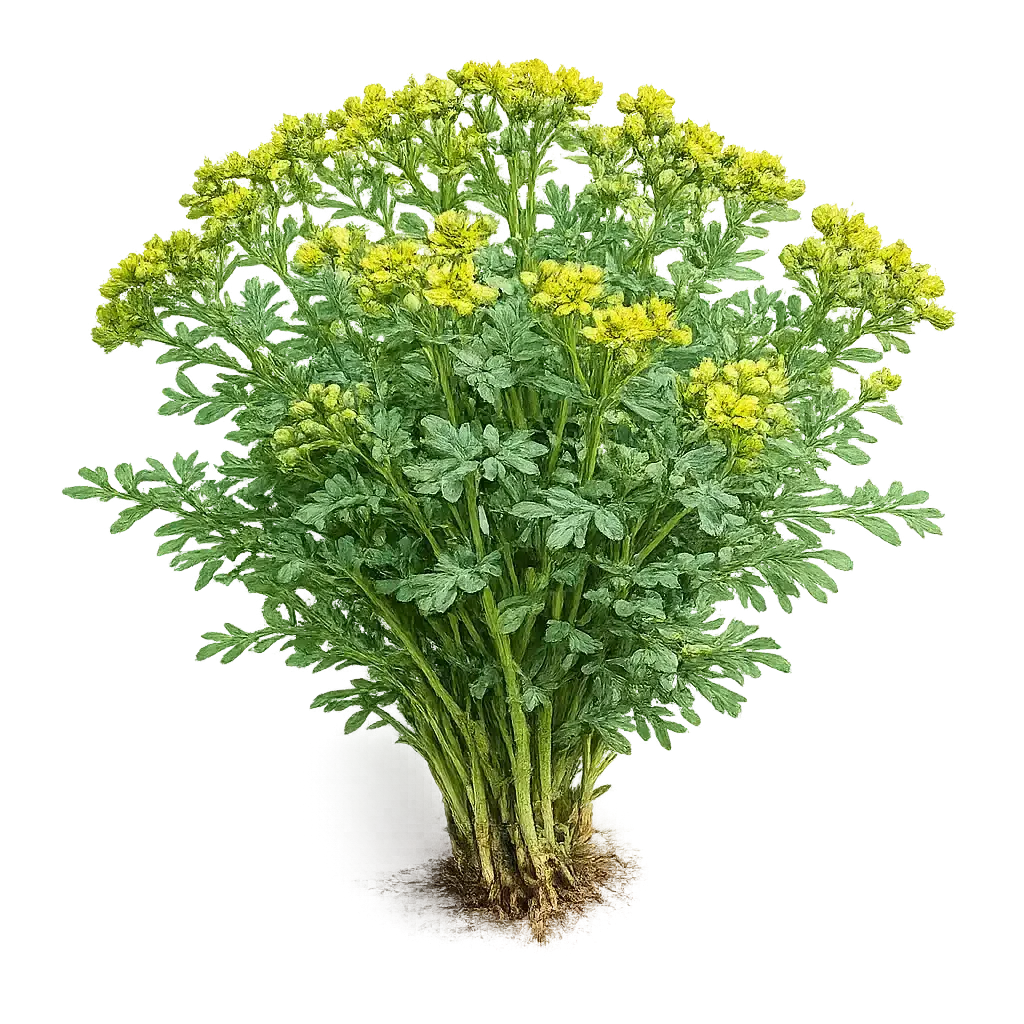
The plant grows to 18 to 36 inches with upright, much-branched stems rising from a woody base and clothed in deeply divided, blue-green, glaucous leaves with a waxy surface that gives them the distinctive frosted appearance characteristic of the species. The flat-topped clusters of small, bright yellow flowers with characteristically fringed petals appear from June through August and attract a range of beneficial insects including parasitic wasps that are valuable predators of common garden pests. The combination of the blue-green foliage and the bright yellow flowers makes rue one of the most visually striking plants available for the herb border, and the ornamental value of the plant in the garden is entirely genuine regardless of any other uses.
Historically, rue's medicinal applications were extraordinarily broad, reflecting a tradition in which the plant was considered a near-universal remedy for conditions ranging from eye strain and headache through plague prevention, insect bite treatment, and the induction of abortion. This breadth of historical claim is itself a warning: plants applied to everything are typically evidence of a tradition that is reaching beyond what the plant genuinely does well, and in rue's case the genuine antimicrobial and antispasmodic activity that underlies some traditional uses is accompanied by a toxicity profile that makes the historical applications largely obsolete from a modern safety perspective.
How to Grow
Sun Requirements
Rue grows best in full sun, where the foliage develops its most intense blue-green color, the plant maintains the most compact and well-structured habit, and the aromatic intensity that gives the species its name reaches its peak. It tolerates light partial shade without significant decline, and in climates with very hot summers a position with afternoon shade reduces heat stress while maintaining adequate light for productive growth. Below four to five hours of direct daily sunlight the plant becomes open and less attractive, with reduced aromatic intensity and a looser habit that makes it less effective as a structural border plant.
Soil Requirements
Rue is among the more soil-tolerant perennial herbs in this series, adapting to a wide range of soil types from lean, rocky, alkaline soils similar to its native Balkan hillside habitat through average garden loam. The consistent requirements are reasonable drainage and the absence of the persistently waterlogged conditions that cause root rot, which rue is susceptible to in the same way as most Mediterranean-origin perennials.
Rich, heavily fertilized soils encourage lush, soft vegetative growth that is less structurally compact and somewhat less aromatic than growth on leaner ground. Average soil without supplemental fertilizing is appropriate, with the same understanding that applies to thyme, sage, and the other Mediterranean perennial herbs in this series: lean conditions favor the aromatic intensity and structural compactness that make the plant most attractive and most useful.
Soil pH from 6.0 to 8.0 is tolerated, with rue's native limestone habitat suggesting genuine tolerance of alkaline conditions. No regular fertilizing is needed for established plants; an annual topdressing of compost in spring is adequate nutrition for sustained healthy growth.
Water Needs
Established rue is highly drought tolerant, reflecting its origin on the dry, rocky hillsides of the Balkans where summer rainfall is limited and the plants that thrive have developed strong drought adaptation. The deep woody root system of established plants accesses subsoil moisture effectively through extended dry periods, and supplemental irrigation is rarely needed beyond the establishment year.
In the establishment year, moderate watering supports root development. From the second year, rue manages its own moisture requirements in most temperate and Mediterranean climates without intervention. The greater risk in temperate gardens with moderate summer rainfall is that rue in poorly drained soil will experience root problems from excess moisture rather than drought stress, and the drainage requirement takes priority over any watering management in those conditions.
Planting
Rue establishes readily from seed sown indoors six to eight weeks before the last frost date or directly outdoors after frost risk has passed. Seeds germinate within two to three weeks at room temperature. Seedlings grow relatively slowly and benefit from being started indoors in cool climates to give them a full growing season to establish before winter.
Established plants can be propagated by stem cuttings taken from softwood growth in early summer, rooted in well-drained gritty medium under light shade, and the resulting rooted cuttings transplanted to their permanent positions in autumn or the following spring. Cuttings are the more reliable approach for preserving the characteristics of named ornamental varieties such as Jackman's Blue.
Rue self-seeds in the garden under appropriate conditions, and established plants typically produce volunteer seedlings nearby that can be transplanted while small. The volunteers are true to the species form rather than to ornamental varieties and provide a self-perpetuating supply of replacement plants at no cost, useful given that older rue plants become increasingly woody and benefit from periodic replacement.
Plant Spacing
Space plants 18 to 24 inches apart to allow the mature subshrub to develop its full rounded form. At maturity, a well-grown rue plant with annual pruning fills its allotted space with dense, structural blue-green mounding growth that is among the most visually effective low-border plants in the perennial herb garden. The wider 24 inch spacing is preferable where individual plant form is part of the garden design; the closer 18 inch spacing creates a continuous dense hedge of foliage more quickly.
Companion Planting
Rue's most consistently documented and most practically useful contemporary application in the garden is as a pest and animal deterrent, where its sharply pungent aromatic compounds are highly effective at repelling a range of unwanted visitors.
Cats, which dislike the strong scent of rue and consistently avoid areas where it is growing, making it one of the most effective and most garden-friendly deterrents for cat fouling in vegetable beds and newly planted areas; planting rue at the perimeter of areas where cat activity is a problem provides reliable deterrence without physical barriers
Dogs, similarly repelled by the scent, making rue useful as a garden border plant in properties where dog access to planting areas is a management concern
Japanese beetles, which avoid plants growing near rue and show reduced feeding damage on susceptible plants interplanted with or bordered by rue; this is one of the more consistently reported and practically useful companion planting relationships for rue in North American gardens where Japanese beetle pressure is significant
Aphids and various flying insects repelled by the volatile compounds, with rue traditionally planted near roses and other aphid-susceptible plants to reduce infestation pressure
Flea beetles, which are deterred by rue's volatile compounds in the same way as other pest insects sensitive to the aromatic profile of the plant
Rue has documented allelopathic effects that inhibit nearby plants, and it should not be planted in direct proximity to basil, sage, or brassicas, which are reported to grow poorly in rue's immediate vicinity. The deterrent planting should be positioned at the border of beds rather than interplanted directly among susceptible companion crops.
Harvesting
Harvest Time and Method
Where rue is harvested at all for contemporary use, the primary application is as a cut foliage element in flower arrangements, where the distinctive blue-green glaucous leaves provide unusual color and texture. Stems for cutting are harvested from the outer growth of the plant, wearing gloves to protect against the furanocoumarins in the sap.
Harvesting for companion planting applications, such as placing cut stems near susceptible garden plants to deter pests, is done as needed through the growing season. The fresh stems and foliage are more potent deterrents than dried material, and the aromatic compounds that drive the deterrent effect dissipate gradually after cutting. Fresh replacement material every one to two weeks maintains effective deterrence.
An annual pruning in early spring, cutting the plant back by one third to remove old woody growth and stimulate fresh growth from the base, maintains the compact rounded form and prevents the open, woody, less productive habit of unpruned older plants. This pruning is best done with gloves, in overcast conditions or in the morning before the sun is high, to minimize phototoxic exposure.
Handling rue safely: The furanocoumarins in rue sap are activated by UV light and cause phytophotodermatitis, a chemical burn reaction that produces redness, blistering, and severe long-lasting hyperpigmentation on skin exposed to the sap and then to sunlight. The reaction can be severe and the hyperpigmentation can persist for months. Always wear long gloves and cover exposed skin when pruning, harvesting, or otherwise handling rue, particularly in bright conditions. Wash any inadvertent skin contact with soap and water immediately and keep the area covered from sunlight. Children should not handle rue unsupervised.
This is not a theoretical risk. Rue causes significant phototoxic reactions in a meaningful proportion of people who handle it without protection, and the cases are well documented in dermatological literature. The precautions are straightforward and make the plant entirely safe to grow and use as a companion plant and ornamental. They simply require awareness and consistent application.
How to Use
Contemporary Uses
The practical contemporary uses of rue on the homestead are primarily the companion planting and pest deterrence applications described above, combined with its ornamental value in the herb border. As a structural plant with exceptional blue-green foliage and bright yellow flowers, it earns its place in any ornamental herb garden design on aesthetic grounds alone, with the companion planting applications adding functional value to a plant that is already worth growing for its appearance.
In dried flower arrangements and wreaths, rue stems and seed heads provide distinctive structural material. The seed pods that follow the flowers are interesting architecturally, and dried rue stems hold their blue-green color reasonably well through drying, making them useful in decorative arrangements where the foliage color is part of the design.
As an insect repellent worn or applied topically, rue has a long folk tradition of use against fleas, lice, and biting insects. Rubbing fresh leaves on the skin provides some deterrent activity against insects, though the phototoxic risk of doing this in sunlight makes it an approach that requires careful consideration of exposure timing and thorough washing afterward.
Historical Culinary Uses
Rue was used sparingly in ancient Roman cooking, appearing in the recipes of Apicius as a bitter flavoring agent in small quantities. It remains in very limited use in a small number of traditional preparations, most notably as one of the herbs used in the Italian digestive liqueur Grappa con Ruta, where a single sprig of rue is traditionally placed in the bottle. Ethiopian cuisine uses small amounts of rue as a flavoring in coffee preparations in certain regional traditions.
These are historical and cultural curiosities rather than recommendations for general kitchen use. Rue is not a culinary herb appropriate for regular cooking. The compounds that make it medicinally active are toxic at culinary quantities, and the tradition of using it in cooking reflects an era when the risks were not understood rather than a tradition that should be continued.
Historical Medicinal Uses
Rue's historical medicinal applications were extraordinarily extensive, reflecting its status as one of the most important medicine plants of antiquity and the medieval period. It was prescribed for eye conditions, headaches, hysteria, worms, poisons and antidotes, menstrual regulation and abortion, plague prevention, and insect bites, among many other uses. Dioscorides and Galen both wrote extensively about its properties, and it was one of the primary components of the ancient antidote Mithridate, considered a universal antidote to poison.
The antimicrobial, antispasmodic, and emmenagogue activities that underlie some of these traditional claims are real and chemically well-characterized in the compounds rutin, rutamarin, and the alkaloids present in the plant. The problem is that the doses required for therapeutic effect are close to the doses that cause toxicity, making rue a plant with a narrow therapeutic window that has been superseded by safer alternatives for every application where it might have genuine utility.
Rue is not recommended as a medicinal herb for self-treatment. The historical record is worth knowing as part of the plant's story, but it should not be read as a guide to contemporary use.
Storage
Fresh rue stems for companion planting use are most effective used immediately, with the volatile aromatic compounds that provide deterrent activity at their highest concentration in fresh material. For cut stem applications around the garden, harvesting fresh material as needed from the living plant is preferable to storing cut stems.
Dried rue retains aromatic activity for use in sachets, pot pourri, and moth-deterrent applications in stored clothing and linen, where the traditional use of rue as a moth repellent has practical basis in the plant's volatile compounds. Dried bundles of rue placed in storage areas provide modest but genuine insect-deterrent activity in enclosed spaces.
Lifespan of the Plant
Rue is a long-lived perennial subshrub that persists for many years on appropriate well-drained sites in zones 4 through 9. The woody base structure becomes increasingly substantial with age, and established plants show good winter hardiness and drought resilience that improves over successive seasons as the root system deepens and expands.
Annual spring pruning by one third maintains the compact, productive form and extends the useful life of each plant. Without pruning, rue becomes increasingly woody and open over successive seasons, eventually reaching a state where the lower woody structure dominates and productive leafy growth is limited to the branch tips. Propagating replacement plants from cuttings or self-sown seedlings every five to eight years, while the parent plants are still healthy enough to provide cuttings, ensures continuity of the planting.
Pros and Cons
Advantages
One of the most effective companion plants for deterring cats, dogs, Japanese beetles, and aphids from nearby plantings
Exceptional ornamental value with distinctive blue-green glaucous foliage and bright yellow summer flowers among the most visually striking in the perennial herb border
Hardy to zone 4, surviving most temperate winters without protection
Highly drought tolerant and soil-adaptable once established
Flowers attract parasitic wasps and other beneficial insects that prey on common garden pests
Long-lived perennial with minimal management requirements beyond annual pruning
Rich historical and cultural significance connecting the garden to a deep tradition
Limitations
Furanocoumarins cause severe phototoxic skin reactions; gloves and skin covering required for all handling
Not appropriate as a culinary herb; historical food uses reflect a tradition that predates understanding of its toxicity
Not appropriate for internal medicinal use; safer alternatives exist for every application
Allelopathic compounds can inhibit growth of nearby plants including basil, sage, and brassicas
Sharp, pungent scent is unpleasant to many people at close range
Requires annual pruning to maintain compact, productive habit
Not appropriate for households with young children who might handle it without supervision
Common Problems
Rue is a robust, largely trouble-free plant on appropriate well-drained soil. The primary problems are the phototoxic handling risks that are not plant health issues but grower safety concerns addressed above, and the cultural management issues of inappropriate siting and insufficient pruning.
Root rot from waterlogged or persistently wet soil is the primary cause of plant death and is entirely preventable by appropriate site selection. Rue on heavy clay without drainage improvement or on low-lying sites that collect water after rain fails reliably, and the dramatic collapse of an apparently healthy plant after a wet period is almost always root rot from drainage failure rather than cold damage or disease.
Spider mites in hot, dry conditions can cause stippling and bronzing of the foliage, particularly on plants in very exposed, hot positions against reflective walls. Improving air circulation and occasional water sprays manage mite pressure in most garden situations. The strongly aromatic compounds in rue that deter many insect pests do not provide reliable deterrence against spider mites, which are arachnids rather than insects and respond differently to aromatic plant defenses.
In very humid climates and in overcrowded plantings without adequate air circulation, fungal spotting of the lower leaves can occur. The appropriate management is improved spacing and airflow rather than fungicide application; rue on appropriate lean, well-drained soil in full sun with adequate spacing is essentially free of significant foliar disease.
Varieties
Ruta graveolens in the standard species form produces the typical blue-green, deeply divided foliage and bright yellow flowers described throughout this guide. It is the most widely available form and the most cold-hardy.
Jackman's Blue is the most commonly grown ornamental selection, with more intensely blue-gray glaucous foliage than the standard species and a more compact, mounded growth habit that makes it particularly effective as a structural border plant. It is considered the finest ornamental form of rue by most gardeners who grow the plant primarily for its visual character, and it retains the full aromatic and companion planting properties of the species.
Variegata, the variegated form, produces leaves splashed with cream and white alongside the characteristic blue-green, creating a more visually complex foliage effect than the solid forms. It is somewhat less vigorous than the standard species and is grown primarily as an ornamental curiosity rather than for any functional application where the species or Jackman's Blue would be preferred.
Final Thoughts
Rue is an honest plant if you approach it honestly. It will not season your food, it will not reliably cure your ailments, and it will blister your hands if you handle it carelessly in the sun. What it will do is keep the neighbor's cat out of the vegetable bed, reduce Japanese beetle pressure on nearby susceptible plants, fill a corner of the herb border with some of the most distinctive and beautiful foliage available to the temperate gardener, and connect the garden through an unbroken line of cultivation to the ancient world that first grew it.
That is a more limited profile than most herbs in this series. It is also an entirely genuine one, and for a gardener who understands what rue is and what it is for, it earns its place in the herb garden as clearly as any plant here.
Wear gloves. Plant it at the border. Enjoy the blue-green. Let the cats find somewhere else to go.