
Saffron Crocus
Written By Arthur Simitian
QUICK FACTS
Common Name
Saffron Crocus, Saffron, Autumn Crocus
Scientific Name
Crocus sativus
Plant Type
Hardy corm-forming perennial
Hardiness Zones
6 to 9 in ground; zones 3 to 5 with mulching or container culture
Sun Requirements
Full sun to light partial shade
Soil Type
Well-drained, sandy loam to loam; dislikes heavy or wet soils
Bloom Time
Autumn, typically October to November
Spacing
3 to 4 inches between corms
Uses
Culinary spice and colorant, medicinal antidepressant and antioxidant, dye plant, ornamental autumn bulb
Saffron is the most expensive spice in the world by weight, and every thread of it is harvested by hand from the three stigmas of a single flower, one flower at a time, during a blooming window that lasts only two to three weeks in autumn. The economics of commercial saffron production, which requires around 150 flowers to produce a single gram of dried spice, explain the price. They also explain why growing your own saffron crocus is one of the most rewarding and most practical things a serious kitchen gardener can do: a modest bed of a few hundred corms, tended carefully and harvested attentively through the brief October flowering season, produces a personal saffron supply of genuine quality that no commercial product at any price reliably matches for freshness and aromatic intensity.
Introduction
Crocus sativus is a sterile triploid cultivated plant that does not occur in the wild, derived from the wild Crocus cartwrightianus of the Aegean region through selection over thousands of years for the elongated stigmas that produce the spice. Because it is sterile and sets no viable seed, it can only be propagated vegetatively through the cormlets that the parent corm produces each year, meaning that every saffron crocus grown anywhere in the world is a direct vegetative descendant of the original cultivated selection that began in the eastern Mediterranean or the Middle East somewhere between three and four thousand years ago.
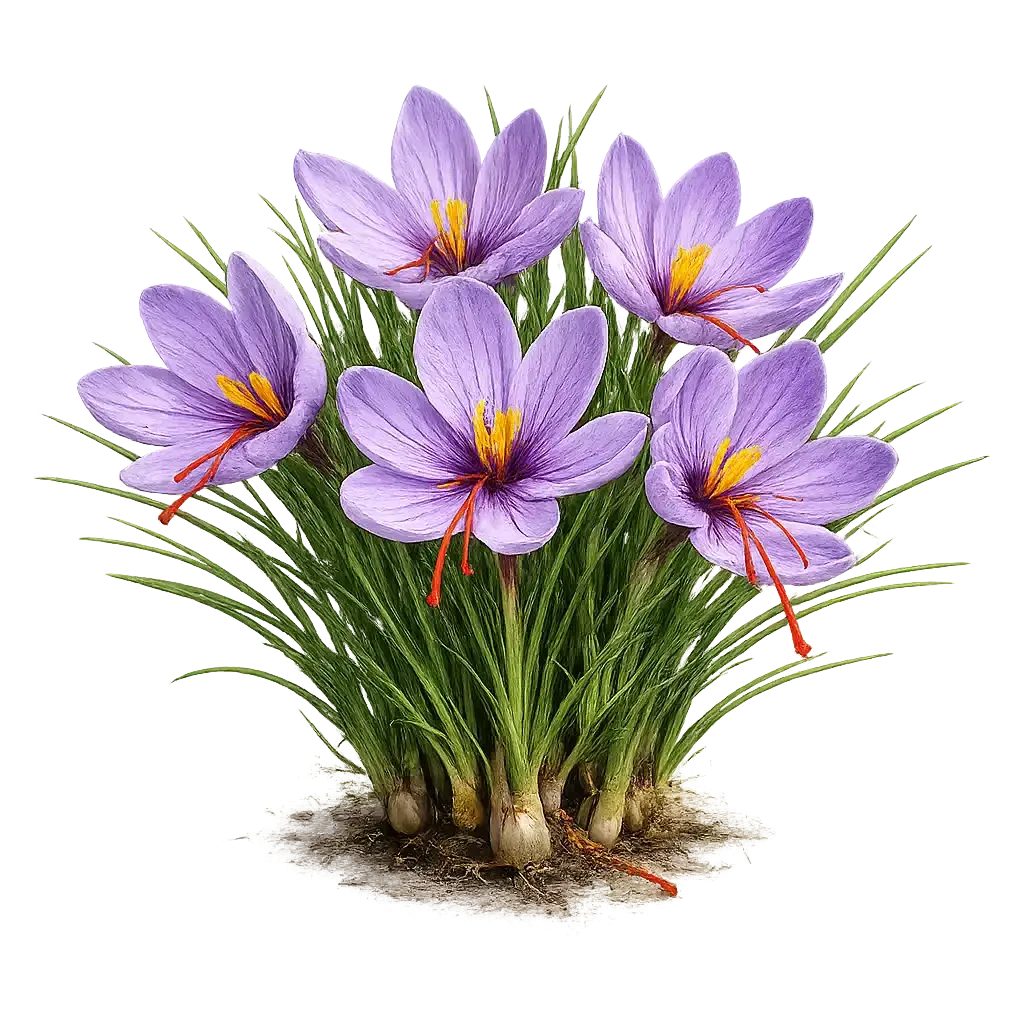
The plant itself is modest in appearance for most of the year. The corms go fully dormant through summer, showing no above-ground growth from May through September. In October, the pale lilac-violet flowers emerge directly from the ground without any foliage preceding them, each flower carrying three vivid deep red-orange stigmas that are the saffron. The narrow, grass-like leaves with their characteristic white central stripe emerge alongside or just after the flowers and persist through winter and spring before dying back in late spring as the corm enters its summer dormancy.
The active compounds in saffron that produce its characteristic golden color, flavor, and medicinal activity are the carotenoids crocin and crocetin, responsible for the vivid yellow coloring power, and the volatile aldehyde safranal, responsible for the distinctive honeyed, slightly metallic, intensely aromatic flavor that makes saffron irreplaceable in paella, risotto Milanese, bouillabaisse, and the dozens of other preparations across Middle Eastern, South Asian, and Mediterranean cuisines that have been built around this single ingredient for millennia.
How to Grow
Sun Requirements
Saffron crocus grows best in full sun to light partial shade, with the corm's summer dormancy period in full sun being particularly important for the corm ripening and energy storage that supports the autumn flowering and the following year's corm multiplication. The flowering period itself is less dependent on intense sun than the summer ripening period, and in climates with hot, dry summers, a position with morning sun and afternoon shade can protect the dormant corms from excessive heat stress while still providing adequate light for proper corm development.
In the growing season, from flowering in October through the foliage period of winter and spring, adequate light supports photosynthesis in the leaves that builds the carbohydrate reserves the corm needs for the following year's flowering. Deep shade during the growing season produces weak, non-flowering corms that exhaust their reserves without adequately replenishing them, leading to declining flower production over successive seasons.
Soil Requirements
Well-drained soil is the single most critical requirement for saffron crocus. The corms are highly susceptible to the fungal rot that develops in waterlogged or persistently moist soil, and this susceptibility is greatest during the summer dormancy period when the corms are most vulnerable and when they cannot actively defend against pathogen pressure through the metabolic activity of growth. Sandy loam to loam soil that drains freely after rain and dries down somewhat during summer dormancy is the most appropriate soil type.
Incorporating coarse grit or sand into heavy clay soils before planting, or growing in raised beds where drainage can be fully controlled, addresses the drainage limitation on difficult soils. The depth of drainage is as important as the surface drainage: saffron corms planted in soil that drains at the surface but retains water at the planting depth of three to four inches are as vulnerable to rot as corms in uniformly wet soil.
Moderate fertility supports healthy corm development and multiplication. Incorporating compost at planting time and topdressing with a balanced fertilizer in autumn after flowering and again in early spring when the foliage is actively growing provides the nutrients that support corm growth and offset the nutrient depletion of the annual flowering and leaf production cycle.
Water Needs
The seasonal water requirements of saffron crocus follow its unusual growth cycle precisely. During summer dormancy from May through September, the corms prefer dry to moderate soil conditions and benefit from the natural summer drought that characterizes their Mediterranean origin. Excessive moisture during dormancy is the primary cause of corm rot, and in climates with wet summers, positioning corms under a roof overhang, covering the bed with a cloche, or growing in containers that can be moved to a dry location during dormancy all reduce rot risk significantly.
Watering in early autumn, approximately two to three weeks before the expected first bloom, triggers the flowering response and can be used to time and advance the bloom in gardens where natural autumn rainfall is unreliable or delayed. This deliberate triggering watering is a standard technique in saffron cultivation and represents one of the more satisfying examples of understanding and working with a plant's physiology rather than simply following a general watering schedule.
Through the winter and spring growing season, moderate consistent moisture supports leaf development and the photosynthetic activity that builds the corm's reserves. The natural rainfall of temperate winters and springs is usually adequate without supplemental irrigation.
Planting
Saffron corms are planted in late summer or early autumn, from July through September, before the autumn flowering begins. Planting depth of three to four inches, measured from the top of the corm to the soil surface, provides adequate insulation against temperature extremes while placing the corm close enough to the surface for the short, slender flower stems to emerge without difficulty.
The pointed tip of the corm faces upward. Plant with the papery tunics intact rather than removing them before planting, as they provide some physical protection against soil pathogens during establishment. If the corms have been stored since purchase, inspect each one for softness or visible rot before planting and discard any that show compromise; one rotting corm in the bed can spread to neighbors.
For gardens in zones 5 and colder where reliable in-ground winter survival is uncertain, planting in containers that can be moved to a sheltered but cold location during the coldest months, or applying a deep mulch of straw over the bed before hard frost, extends the growing range significantly. Saffron crocus is genuinely perennial and multiplies reliably in zones 6 through 9 in ground, and with protection in zones 4 and 5.
Plant Spacing
Corms are planted three to four inches apart in all directions for a dense planting that maximizes saffron yield per square foot of bed. Over successive seasons, each corm produces multiple cormlets that gradually increase the density of the planting. When the bed becomes visibly crowded, typically after four to five years, the corms should be lifted in summer dormancy, separated, and replanted at the original spacing to restore vigorous flowering. This division simultaneously refreshes the planting and provides additional corms to expand the bed or share.
Harvesting
Harvest Time
The harvest window for saffron is one of the most precisely timed harvests in the entire kitchen garden. Each flower opens for one day, and the stigmas must be harvested on the day the flower opens, before the flower wilts, or at the very latest in the morning of the following day while the stigmas are still intact and before degradation begins. The entire flowering period lasts two to three weeks in most climates, with the peak flush typically occurring over five to seven days within that window.
Checking the planting daily during the flowering period is not optional; it is the fundamental management practice that determines whether the harvest is captured or lost. A morning walk through the saffron bed each day of the flowering season, which typically runs through October and into early November, should be a fixed part of the daily homestead routine during this period.
Harvest Method
The three stigmas, the vivid deep red-orange threads extending from the center of each flower, are harvested by pinching them at the base with the fingernails or with fine tweezers and pulling gently upward. The stigmas should be separated from the yellow style below the point where the red color begins, as the style contributes no flavor or color and adds unnecessary weight and moisture to the harvest. Some growers harvest the entire flower and then extract the stigmas indoors; others extract them directly in the garden at harvest. Either approach is effective.
The harvested stigmas, wet and fragrant, are collected into a small bowl or tray for immediate drying. The quantity from a morning's harvest of a well-established bed is typically modest, measured in milligrams to a few grams, and the accumulation of multiple days' harvests through the flowering season builds the season's total.
Drying the harvest: Fresh saffron stigmas contain significant moisture and must be dried before storage to prevent mold. The simplest method is spreading the stigmas in a single layer on a small piece of paper or a fine mesh screen and placing over a barely warm heat source such as a radiator, a very low oven with the door ajar, or a food dehydrator set to its lowest temperature, for fifteen to thirty minutes until the threads are completely dry and brittle. They lose approximately 80 percent of their fresh weight during drying, so the dried yield from any harvest is significantly smaller in volume than the fresh harvest appears. Store in an airtight glass vial in a cool, dark location.
How to Use
Culinary Uses
Saffron's culinary role is unique among all the herbs and spices in this series: it simultaneously provides flavor, vivid golden-yellow color, and a transformative aromatic quality that changes the character of the dish it enters rather than simply adding to it. The safranal responsible for the aroma is unlike any other culinary compound, producing the characteristic honey-metallic, slightly floral, deeply complex fragrance that makes saffron-containing dishes identifiable at a distance before tasting.
Blooming saffron before use, by steeping the threads in a small amount of warm water, warm broth, or warm milk for fifteen to thirty minutes before adding the infused liquid to the dish, releases the crocin and safranal more completely than adding dry threads directly. This simple step noticeably improves color development and flavor intensity compared to dry addition, and it is the single most important technique for getting full value from a modest harvest.
Paella valenciana, the Spanish rice dish that is one of the most internationally recognized saffron applications, uses the spice both for its golden color and for the flavor it contributes to the cooking liquid that the rice absorbs. The saffron is bloomed in warm water and added to the pan along with the stock, coloring the entire dish a vivid golden yellow while the safranal permeates every grain of rice through the cooking process.
Risotto alla Milanese, the classic Milanese preparation of rice with saffron, bone marrow, and Parmesan, is perhaps the most refined European saffron dish, where the spice's color and flavor are the defining character of the preparation rather than one element among many. The golden color of a properly made saffron risotto, achieved with good quality saffron used generously, is one of the most visually satisfying preparations in the Italian kitchen.
Persian cuisine uses saffron more extensively than any other culinary tradition, dissolving bloomed saffron into rice during steaming to create the characteristic golden crust of the tahdig, flavoring lamb and chicken stews, sweetening ice cream and rice puddings, and incorporating it into the syrup-soaked sweets of the Persian dessert tradition. The Persian culinary relationship with saffron is one of the deepest in any food culture, and growing your own saffron brings a meaningful connection to this tradition.
Saffron milk, prepared by dissolving a pinch of bloomed saffron in warm whole milk with honey, is both a pleasant drink in its own right and the simplest way to experience the spice's full aromatic complexity without the distraction of other strong flavors. It is a useful calibration preparation when using a new harvest for the first time, allowing the quality of the saffron to be assessed before committing it to a complex dish.
Medicinal Uses
Saffron has one of the more impressive emerging clinical research profiles of any culinary spice, with multiple randomized controlled trials investigating its effects on mood disorders, cognitive function, and several other conditions with broadly positive results.
For mild to moderate depression, several clinical trials have found saffron supplementation comparable in efficacy to standard antidepressant medications including fluoxetine and imipramine over eight-week treatment periods, with a favorable side effect profile. The active compounds crocin and safranal appear to influence monoamine neurotransmitter systems in ways that may explain these effects, though the full mechanism is not yet established. This evidence base, while preliminary relative to St. John's Wort's larger trial record, is among the strongest available for any culinary spice in a psychiatric indication.
For premenstrual syndrome, a clinical trial found saffron supplementation significantly reduced both psychological and physical PMS symptoms compared to placebo, with the effect particularly pronounced for mood-related symptoms including irritability and depression.
The antioxidant activity of crocin and crocetin, the carotenoid pigments responsible for saffron's color, is among the highest of any dietary antioxidant compounds, and these compounds have been studied for potential neuroprotective effects in models of age-related cognitive decline. The research is promising but not yet at the stage of definitive clinical recommendations.
At culinary use levels, saffron is entirely safe and has an excellent safety profile. Large supplemental doses, defined as several times the culinary amount, are not appropriate during pregnancy due to documented uterine-stimulating activity at high doses, but normal culinary use is safe throughout pregnancy.
Storage
Dried saffron threads store for two to three years in airtight glass vials or small glass jars kept in a cool, dark, dry location. Light degrades the crocin pigments and reduces both color and flavor potency over time, making dark storage conditions essential rather than merely preferable. The small quantities typically harvested from a home garden make small, airtight amber glass vials the most practical storage container.
Saffron absorbs moisture readily from the air and from humid storage environments, and moisture absorption accelerates both mold development and flavor degradation. Ensuring the threads are completely dry before sealing for storage, and using containers with tight-fitting lids rather than open dishes or paper envelopes, prevents the moisture-related quality loss that most commonly reduces home-dried saffron quality below its potential.
Ground saffron loses potency more quickly than whole threads due to increased surface area exposure to air, and grinding should be done immediately before use rather than in advance. The traditional technique of lightly toasting threads in a dry pan for thirty seconds before grinding concentrates the safranal and makes grinding easier, and it should be applied only to fully dry threads.
Lifespan of the Plant
Saffron crocus is a long-lived perennial that multiplies vegetatively through cormlet production each season, with each parent corm generating one to three daughter corms annually. A planting that begins with a modest number of corms increases in density over successive seasons, producing more flowers and more saffron each year until the bed becomes too crowded for optimal individual corm development, at which point division and replanting restores vigor and productivity.
In zones 6 through 9, well-planted saffron corms in free-draining soil essentially manage themselves from year to year once established, requiring only the annual harvest, the occasional fertilizer topdressing, and the periodic division every four to five years that maintains productive flower size and stigma quality. The investment of initial establishment pays dividends that compound over many seasons.
In zones 4 and 5, the additional management of winter mulching or container overwintering adds effort but remains entirely feasible for a committed kitchen gardener. Container-grown saffron in well-drained medium, overwintered in a cold but frost-free location such as an unheated garage, and moved outdoors in autumn to experience the cool temperatures that trigger flowering, produces reliable harvests in climates considerably colder than the in-ground growing range.
Pros and Cons
Advantages
Produces home-grown saffron of superior freshness and aromatic quality compared to any commercially available product
Corms multiply vegetatively each season, expanding the planting and increasing yield without additional purchase
Unusual autumn bloom fills the garden calendar gap between summer herbs and spring bulbs with spectacular pale violet flowers
Once established in appropriate conditions, requires minimal management beyond the annual harvest
Emerging clinical evidence for antidepressant and antioxidant activity at the levels consumed in culinary use
Long storage life of two to three years for properly dried threads
Year-on-year return on the initial corm investment as the planting multiplies
Limitations
Very short harvest window of two to three weeks requiring daily monitoring and same-day harvesting
Yield per plant is tiny; meaningful quantities require hundreds of corms and consistent management
Summer dormancy makes the bed unusable for other crops and requires dry conditions that conflict with summer irrigation of surrounding plants
Corm rot in poorly drained or wet summer soils is the primary cause of planting failure
Not reliably hardy below zone 6 without winter protection
Initial corm cost is higher than most herb seeds or transplants; quality corms from reputable suppliers represent a meaningful investment
Counterfeit and adulterated commercial saffron is widespread; sourcing genuine corms requires care
Common Problems
Corm rot from excess moisture during summer dormancy is by far the most consistent and most damaging problem in saffron cultivation, responsible for the majority of planting failures. It is entirely preventable by appropriate site selection and drainage management, and the most productive approach is to treat drainage as the primary site criterion rather than an afterthought. Any garden position where water stands or soil stays wet after rain for more than a few hours is unsuitable for saffron without raised bed construction or other drainage intervention.
Narcissus bulb fly occasionally infests saffron corms, with the larvae feeding inside the corm and causing the soft, hollowed corm that does not flower and eventually collapses. Inspecting lifted corms for the characteristic tunnel damage before replanting and discarding affected material prevents the spread of infestation through the planting. Covering the bed with fine mesh during the adult fly's egg-laying period in late spring reduces infestation rates in gardens where the pest is present.
Rodents, particularly squirrels, mice, and voles, will dig and eat saffron corms reliably if they discover the planting. Hardware cloth laid flat over the planting at corm depth during the dormant season, or planted in wire mesh baskets that protect against burrowing, is the most effective physical deterrent in gardens with significant rodent pressure.
Declining flower size and reduced stigma length over successive seasons without division indicates corm crowding rather than a disease problem. Lifting, separating, and replanting at appropriate spacing during summer dormancy, with the addition of fresh compost and fertilizer to the replanted bed, restores vigor and flower quality reliably within one to two seasons.
Varieties
Crocus sativus is a single cultivated species without named botanical varieties, though commercial production regions including La Mancha in Spain, Kashmir in India, and the Khorasan region of Iran produce saffron of distinctly different quality characteristics due to climate, soil, and post-harvest processing differences. For garden cultivation, the source and quality of the corms is more important than variety designation, and purchasing from specialist bulb suppliers who can confirm the origin and quality of their corms produces better results than purchasing from general garden center stocks where corm quality and true-to-type identity are less certain.
Crocus cartwrightianus, the wild ancestor of saffron crocus, is fertile and occasionally available from specialist bulb suppliers. It produces smaller, shorter stigmas than the cultivated Crocus sativus but is fully functional as a garden plant and produces usable, genuinely flavored saffron from its stigmas. It is more appropriate as a botanical curiosity and an educational companion to the cultivated saffron than as a primary saffron-producing plant, but it is worth knowing as the wild relative from which the cultivated spice crop was derived.
Final Thoughts
There is something genuinely affecting about the saffron harvest. You go out in the October morning, the air cold, the light low, and the pale violet flowers are open across the bed, each one holding three threads of a color so vivid it seems wrong for nature to have produced it. You pick each thread by hand, one flower at a time, accumulating a modest pile in a small bowl. You dry them over gentle heat. You seal them in a tiny glass jar.
Weeks later, bloomed in warm water, those threads turn an impossible golden color and fill a paella or a risotto with a fragrance that no dried packet from a grocery store, regardless of price, has ever quite matched. The difference between fresh-dried home-grown saffron and commercial saffron that has been sitting in a warehouse and then on a shelf is not subtle. It is the difference between the thing itself and a memory of it.
That is what a few hundred corms in a well-drained bed produces. Plant them in late summer, harvest them in October, and understand why this single flower has been worth more by weight than gold for most of recorded human history.