
Summer Savory
Written By Arthur Simitian
QUICK FACTS
Common Name
Summer Savory, Garden Savory
Scientific Name
Satureja hortensis
Plant Type
Annual
Hardiness Zones
All zones as annual; self-seeds in zones 6 and warmer
Sun Requirements
Full sun
Soil Type
Well-drained, average to lean; dislikes heavy or wet soils
Plant Height
12 to 18 inches
Spacing
9 to 12 inches
Uses
Culinary, bean and legume cooking, poultry seasoning, medicinal digestive and antimicrobial, herbes de Provence, companion plant, pollinator support
Summer savory is the bean herb. Every culinary tradition that grows beans has a savory to go with them, and in the case of summer savory and legumes, the pairing is so old and so consistently observed across European cooking that the German word for savory, Bohnenkraut, translates simply as bean herb. The peppery, thyme-adjacent warmth of fresh summer savory is the flavor that makes a pot of beans taste finished rather than merely cooked, and the plant that produces it is one of the fastest, most obliging annuals in the herb garden: sow it in spring, harvest it all summer, dry what you cannot use fresh, and start again next year. It is exactly as uncomplicated as it sounds.
Introduction
Satureja hortensis is native to the sunny, dry, rocky hillsides of southeastern Europe and western Asia, particularly the Mediterranean coastal regions and the Balkans where its close relative winter savory, Satureja montana, also grows. It has been cultivated as a culinary and medicinal herb since at least Roman times, appearing in the writings of Virgil and Pliny as a valued garden herb, and it was among the first herbs brought by European settlers to North America, where it naturalized in some regions and became a staple of kitchen gardens wherever European culinary traditions took root.
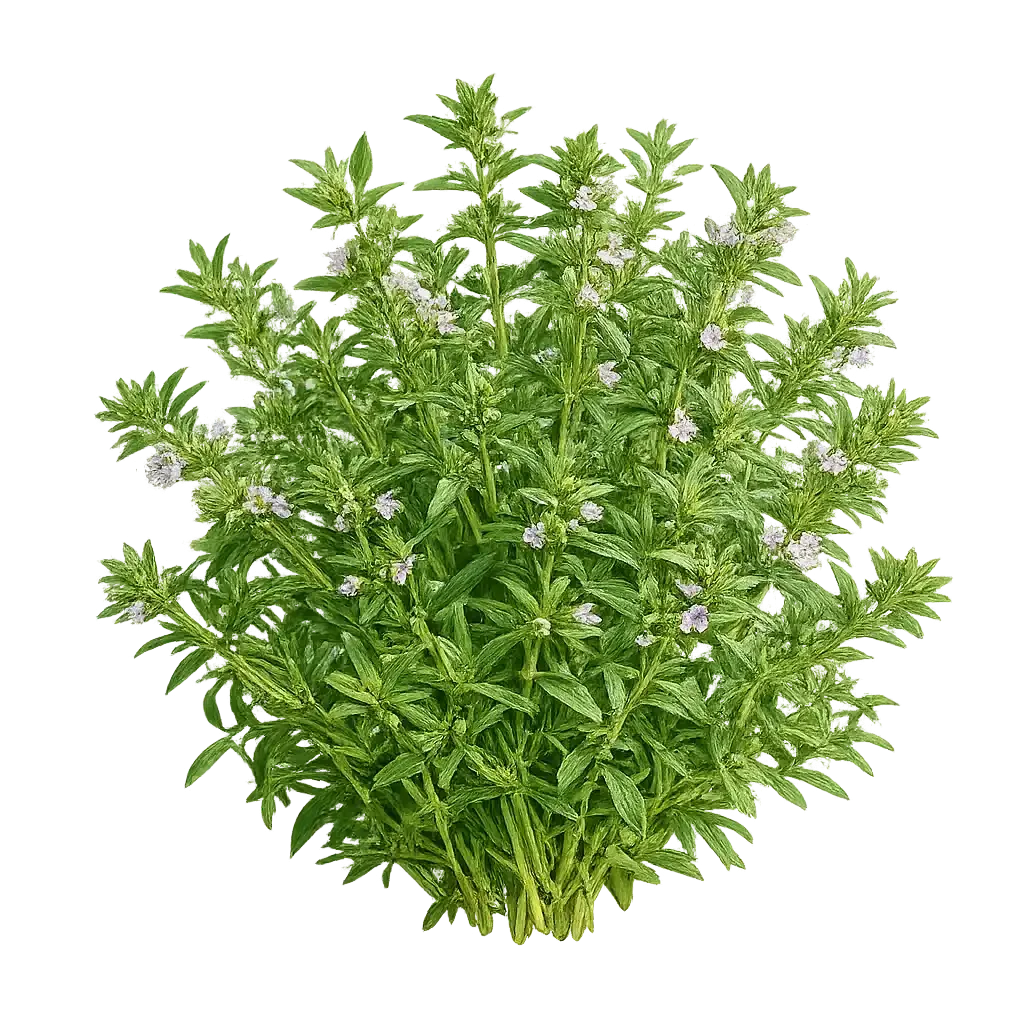
The plant is a fast-growing annual reaching twelve to eighteen inches, with upright, much-branched stems clothed in narrow, linear, dark green leaves that are intensely aromatic when crushed, releasing a flavor complex combining thyme-like carvacrol with a peppery warmth and a slightly resinous depth that is distinct from any of the individually more famous culinary herbs. The small pale pink to white flowers that appear in the leaf axils from midsummer onward attract bees reliably and are themselves edible, carrying the same peppery flavor as the leaves in a more delicate form.
The name Satureja has been etymologically connected to the satyrs of classical mythology, with the suggestion that the herb was associated with the satyrs' appetite and vigor, and this association with enhancement of appetite and physical energy appears consistently in the plant's historical medicinal profile alongside its better-documented carminative and antimicrobial properties. Whether or not the mythological connection is anything more than a naming coincidence, the herb's genuine digestive-stimulating effects align well enough with the traditional reputation to make the association memorable if not literally true.
How to Grow
Sun Requirements
Summer savory demands full sun and performs poorly in anything less than six hours of direct daily sunlight. Its Mediterranean origin on dry, sun-exposed rocky hillsides translates directly into a sun requirement that is non-negotiable for the compact, intensely aromatic growth that makes the herb most useful. In partial shade it grows tall, open, and weakly flavored, with diluted essential oil content that reduces both culinary and medicinal value. The sunniest available position in the herb garden is the right position for summer savory, with no qualification.
Soil Requirements
Summer savory shares the lean, well-drained soil preference of its Mediterranean relatives thyme and oregano, and performs at its aromatic best on soils that would disappoint more fertility-dependent crops. Average to moderately poor, well-drained soil produces the most compact, most intensely flavored plants, while rich, heavily amended soil encourages lush vegetative growth at the expense of essential oil concentration and the peppery warmth that distinguishes savory from milder culinary herbs.
Well-drained soil is the primary requirement. Summer savory does not tolerate waterlogged conditions or heavy clay that retains moisture around the roots, and the root rot that results from overly wet soil is the most consistent cause of plant loss in humid climates. On heavy garden soils, growing summer savory in a raised bed or incorporating coarse grit to improve drainage produces reliably better results than attempting to grow it in unamended clay.
Soil pH from 6.0 to 7.5 is appropriate. No fertilizing is needed or beneficial once the plant is established from seed; the lean conditions that limit vegetative growth simultaneously concentrate the volatile oils that represent the herb's value.
Water Needs
Established summer savory is notably drought tolerant and one of the most water-independent annual herbs available for the temperate garden. Once the seedlings are past the establishment stage, the plant manages well with occasional deep watering during extended dry periods and requires no irrigation management beyond awareness that extended severe drought will reduce growth rate and flower production.
Consistent overwatering, particularly in combination with poorly drained soil, is more damaging to summer savory than drought. The dry conditions that most temperate kitchen gardens experience through July and August suit the plant well, and a summer savory growing in lean, well-drained soil in full sun during a dry summer is producing the most intensely flavored herb that site is capable of yielding.
Planting
Summer savory is direct-sown from seed, making it one of the simplest annual herbs to establish without the indoor starting and hardening-off process that more tender annuals require. Sow directly outdoors after the last frost date when soil temperatures have reached at least 60 degrees Fahrenheit, scattering seed thinly and covering with a thin layer of fine soil or simply pressing into the soil surface. Germination occurs within seven to fourteen days at warm soil temperatures, and the seedlings grow quickly enough in warm conditions to reach harvestable size within six to eight weeks of sowing.
Succession sowing every three to four weeks from the last frost date through midsummer provides a continuous supply of tender young growth through the season and prevents the entire planting from reaching peak harvest simultaneously. A small bed or row sown at intervals produces more consistently useful herb across the full summer than a single large sowing.
Summer savory self-seeds freely in zones 6 and warmer, and gardens where it has been grown for several seasons typically develop a reliable self-sown population that requires no deliberate replanting. Allowing some plants to flower and set seed rather than deadheading the entire planting ensures a self-perpetuating supply without annual seed purchase.
Plant Spacing
Thin seedlings to 9 to 12 inches apart once large enough to handle, using the thinnings in the kitchen as the first harvest of the season. The branching habit of summer savory fills its allotted space well at this spacing, creating a productive, dense planting that provides a substantial harvest surface while maintaining enough air circulation to prevent the fungal disease that can affect crowded plantings in humid conditions.
Companion Planting
Summer savory has one of the most clearly established and most consistently reported companion planting relationships in the kitchen garden, centered on its traditionally documented beneficial effect when grown alongside legumes.
Beans of all kinds, where summer savory is the most traditional companion plant in European kitchen gardens, with consistent traditional reports of improved bean growth and flavor and some documented deterrence of the black bean aphid that commonly colonizes broad beans and climbing French beans
Peas, which benefit from the same aromatic deterrence of aphid pests that makes savory valuable alongside beans, and whose cool-season growing window overlaps with the early establishment period of summer savory sown alongside them
Onions and alliums, alongside which savory is traditionally grown in central and eastern European kitchen gardens, where the combination is considered mutually beneficial for both pest deterrence and culinary proximity
Brassicas, where the aromatic volatile oils may provide some deterrent effect against cabbage white butterfly in proximity to the planting, consistent with the general companion planting value of strongly aromatic Mediterranean herbs in the brassica bed
Other Mediterranean herbs including thyme, oregano, and marjoram, with which summer savory shares growing requirements and can be grouped in a single well-drained, sunny herb bed without competition
Harvesting
Harvest Time
Summer savory is harvested from the time plants reach six to eight inches tall, typically six to eight weeks after sowing, through the entire growing season until the first autumn frost. The essential oil concentration and flavor intensity are highest just before and during the early flowering period, making the late summer harvest of plants coming into bloom the most flavorful material for drying and long-term storage.
For fresh use, harvesting young stem tips throughout the season provides the most tender material with the brightest, most nuanced flavor. For drying, the main harvest is taken during the flowering period when carvacrol and other volatile oil concentrations peak, producing dried herb with the intensity needed to carry flavor through the cooking process.
Harvest Method
Cut stem tips four to six inches long with sharp scissors, harvesting from the outer growth and leaving the center of the plant to continue developing. Taking no more than one third of the plant's total growth in a single harvest allows rapid regrowth and continuous production through the season. Regular harvesting prevents the plant from committing fully to flowering and seed production, extending the vegetative harvest season by several weeks compared to unharvested plants that complete their annual lifecycle more quickly.
For drying, bundle cut stems loosely and hang in a warm, well-ventilated location away from direct light. Summer savory dries more quickly than thick-stemmed herbs, typically within one to two weeks at room temperature. Strip the dried leaves from the stems once completely dry and store in airtight glass containers. The dried herb retains good flavor for one to two years, though the first-year harvest is noticeably more vibrant than older stored material.
Savory in the bean pot: A sprig or two of fresh summer savory added to the cooking water when preparing dried beans serves two purposes simultaneously. The carvacrol and other volatile oils in the herb provide flavor that integrates deeply into the beans during the long cooking time, and the carminative compounds in the same oils reduce the gas-producing fermentation of the oligosaccharides in legumes that causes digestive discomfort. This is the oldest and most practically useful application of summer savory, and it works both as a flavor contribution and as a genuine digestive aid in the same preparation.
How to Use
Culinary Uses
Summer savory's culinary applications center on its affinity for legumes, its role in the classic herbes de Provence blend, and its general usefulness as a peppery, aromatic herb for meat, poultry, and egg preparations where a warm, slightly resinous depth is appropriate.
With beans, both fresh and dried, summer savory is the defining companion: added to the pot during cooking, incorporated into bean soups and stews, used fresh in bean salads, and included in the seasoning blends for dried bean dishes across central and eastern European, French, and German cooking traditions. The flavor affinity between savory and legumes is one of those pairings that improves the individual ingredients beyond what either achieves alone, and it appears across multiple culinary traditions that arrived at the same pairing independently.
Herbes de Provence, the dried herb blend defining the cooking of southern France, includes summer savory alongside thyme, marjoram, oregano, and lavender as one of its core components. The savory's peppery warmth provides a depth and edge in the blend that thyme alone does not achieve, and in the best quality herbes de Provence blends made from carefully proportioned fresh-dried ingredients, the savory is the component most clearly distinguishable and most clearly contributing to the overall character.
Poultry stuffing and seasoning is one of the most straightforward and most rewarding applications of fresh summer savory, where a generous addition of chopped fresh herb to a bread or rice stuffing, or rubbed under the skin of a chicken before roasting, provides a flavor that the dried herb approximates but cannot fully replicate. The volatile compounds in fresh savory that are partially lost during drying contribute a brightness and freshness to the cooked dish that justifies keeping the herb growing through the summer rather than relying exclusively on dried stock.
Grilled meats, particularly lamb and pork, benefit from summer savory in marinades and rubs where its peppery warmth and resinous depth complement the rich flavor of the protein without overpowering it. The herb holds up to high-heat cooking better than more delicate herbs, making it appropriate for the grill and the roasting pan where basil and chervil would be lost.
Summer savory vinegar, prepared by packing fresh stems into white wine vinegar for two to three weeks before straining, produces a pleasantly peppery, aromatic vinegar excellent for salad dressings, bean dishes, and as a component in marinades.
Medicinal Uses
Summer savory's medicinal reputation is primarily carminative and digestive, with its volatile oils stimulating digestive secretions, reducing intestinal gas and cramping, and providing mild antimicrobial activity in the digestive tract. The traditional use of savory with beans as described above is as much a practical digestive measure as a culinary pairing, and the carminative effect of carvacrol and other volatile oils on the gas-producing fermentation of legume oligosaccharides has a genuine biochemical basis.
As a general digestive tonic, summer savory tea prepared from fresh or dried herb is a pleasant, warming preparation useful for sluggish digestion, mild bloating, and the digestive discomfort of overeating. One to two teaspoons of dried herb or a generous sprig of fresh herb per cup of just-boiled water, steeped covered for five to eight minutes, produces an aromatic, mildly peppery tea with genuine carminative activity.
The carvacrol and thymol content of summer savory, compounds shared with thyme and oregano, provide antimicrobial activity that has been studied extensively in those better-known relatives and applies to summer savory as well. Savory tea as a gargle for mild sore throat and mouth irritations provides both antiseptic and anti-inflammatory activity through these compounds.
Topically, a strong infusion of summer savory applied to insect stings and minor skin irritations provides immediate cooling and anti-inflammatory relief, a traditional application that appears across central and eastern European folk medicine and that the antimicrobial and anti-inflammatory properties of the plant's volatile oils support chemically.
Livestock and Poultry Uses
Summer savory has a traditional use as a digestive supplement for poultry and small livestock, where the carminative volatile oils provide the same gas-reducing and digestive-stimulating effects as they do in human use. Adding fresh or dried savory to poultry feed provides antimicrobial activity in the digestive tract consistent with the general value of aromatic herb supplements for poultry health, and the carvacrol content of savory has been studied specifically in poultry feeding research as part of the broader investigation into thymol and carvacrol as natural alternatives to antibiotic growth promoters.
Storage
Fresh summer savory stems store for five to seven days refrigerated, wrapped in a slightly damp paper towel inside a sealed bag. For longer preservation, drying is the most appropriate method for this herb, which dries to a highly concentrated, strongly flavored product that retains good quality for one to two years in airtight glass containers kept cool and dark.
The dried herb is considerably more concentrated than fresh, and the ratio of dried to fresh in recipes is approximately one to three: one teaspoon of dried savory is equivalent in flavor intensity to approximately one tablespoon of fresh. This concentration means that a relatively modest dried harvest from a summer garden provides a substantial supply of useful seasoning through the winter months.
Summer savory-infused oil and vinegar both store well at room temperature for up to six months and provide convenient ways to use the herb's flavor in preparations where the whole dried leaf is less practical. The vinegar particularly keeps for twelve months or longer and maintains the peppery, aromatic character of fresh savory better than most other preservation methods.
Lifespan of the Plant
Summer savory is an annual that completes its lifecycle from germination to seed set in a single growing season, dying with the first hard frost. This annual nature is the primary practical distinction from winter savory, Satureja montana, which is a woody perennial but with a stronger, coarser flavor considered less refined for delicate preparations.
The annual lifecycle means that summer savory must be re-sown each spring, either from purchased seed or from saved seed collected from plants allowed to set seed at the end of the season. Seed saving is straightforward: allow a portion of the planting to flower fully and set seed, collect the dry seed heads before they shatter, dry completely in a paper bag, and store in a cool, dry, dark location through winter for sowing the following spring.
In zones 6 and warmer with appropriate self-seeding conditions, summer savory frequently re-establishes from self-sown seed without deliberate intervention, and a garden that has grown the herb for several seasons may develop a reliable volunteer population that reduces or eliminates the need for annual sowing.
Pros and Cons
Advantages
Direct-sown annual requiring no indoor starting; one of the simplest culinary herbs to establish from seed
Exceptional flavor affinity with legumes, providing both culinary improvement and genuine carminative digestive benefit in the same preparation
Drought tolerant once established; suits the dry summer conditions of typical temperate kitchen gardens
Key component of herbes de Provence and central European herb blends, making it indispensable for authentic regional cooking
Self-seeds freely in zones 6 and warmer, reducing annual replanting effort
Long harvest season from early summer through first frost
Dries to a highly concentrated, long-keeping seasoning herb with one to two year shelf life
Genuine carminative and antimicrobial medicinal value supporting the culinary applications
Limitations
Annual requiring re-sowing each spring in zones 5 and cooler where self-seeding is not reliable
Demands full sun without compromise; unsuitable for shaded or partially shaded positions
Culinary applications somewhat narrower than the most versatile dual-use herbs like thyme and parsley
Less familiar to many contemporary cooks than the more prominent Mediterranean herbs, requiring some discovery to be used regularly
Requires well-drained soil; declines in heavy, wet garden beds without soil improvement or raised bed culture
Common Problems
Summer savory is one of the most trouble-free annual herbs in the kitchen garden, with almost no significant pest or disease problems under appropriate growing conditions. The strongly aromatic volatile oils that make it valuable culinarily serve simultaneously as a deterrent to most insect herbivores, and the plant is rarely seriously affected by the aphids, caterpillars, and beetle feeding that trouble less aromatic crops in the same garden.
Damping off of seedlings in cold, wet spring soil is the most consistent early-season problem and is entirely preventable by waiting to sow until soil temperatures are genuinely warm. Summer savory seed sown into cold, wet soil germinates slowly if at all and the emerged seedlings are susceptible to the fungal damping-off that kills young seedlings at or just below the soil surface. Sowing into warm, well-drained soil at the appropriate time eliminates this problem entirely.
Legginess and poor flavor in shaded or overly fertile conditions is the most consistent quality problem rather than a health problem. Summer savory planted in partial shade or grown in heavily amended, nitrogen-rich soil produces tall, open, weakly flavored growth that lacks the peppery intensity that makes the herb worth growing. Relocating to a sunnier position or resisting the urge to fertilize resolves both issues immediately in subsequent sowings.
Varieties
Satureja hortensis in the standard species form is the culinary summer savory described throughout this guide and the plant available from most herb seed suppliers. Flavor variation between seed sources is modest, and any reputable culinary herb seed supplier's summer savory will perform adequately.
Satureja montana, winter savory, is the perennial relative worth knowing as a distinct herb. It has a stronger, more camphor-forward flavor than summer savory, woody stems that persist through winter in zones 5 through 9, and a more intense but somewhat less refined aromatic character suited to robust meat dishes and long-cooked preparations. For the homestead herb garden where a perennial savory is preferred to annual replanting, winter savory is the practical choice, with the understanding that its flavor is bolder and more assertive than the summer variety that has traditionally been considered finer for delicate preparations.
Satureja thymbra, Za'atar savory or thyme-leaved savory, is a Mediterranean species used in the traditional Middle Eastern za'atar spice blend and worth noting as a culinary relative with distinct applications in that culinary tradition.
Final Thoughts
Summer savory is one of those herbs that rewards the cook who takes the time to learn what it is actually for. Its role alongside beans is ancient, consistent across multiple culinary traditions, and genuinely better than any alternative. Its position in herbes de Provence is not decorative. Its carminative properties, which the traditional bean pairing has always implicitly acknowledged, are real.
It is not a herb that announces itself. It does not have the immediate fragrance recognition of basil or the iconic status of thyme. What it has is a specific, irreplaceable function in specific preparations, performed without fuss, year after year, from a few feet of sunny, well-drained bed that it asks almost nothing from in return.
Sow it alongside the beans. Use it generously in the bean pot. Dry what you cannot use fresh and put it in the pantry for winter. That is the entire program, and it is one of the most practical and most historically grounded herb garden programs available.