
Vervain
Written By Arthur Simitian
QUICK FACTS
Common Name
Vervain, Common Vervain, Herb of Grace, Simpler's Joy, Holy Herb
Scientific Name
Verbena officinalis
Plant Type
Hardy perennial (often grown as annual in zones 3 to 5)
Hardiness Zones
5 to 9 as perennial; zones 3 to 4 as annual or with mulch protection
Sun Requirements
Full sun to partial shade
Soil Type
Well-drained, average to poor; tolerates dry and disturbed soils
Plant Height
12 to 36 inches
Spacing
12 to 18 inches
Uses
Medicinal nervine, digestive herb, fever remedy, pollinator plant, traditional protective herb
Vervain is one of the most sacred and most storied herbs in the Western herbal tradition. It was gathered at midsummer by Druids before sunrise, used in Roman religious ceremony, carried as a protective talisman in medieval Europe, and listed in the Anglo-Saxon Nine Herbs Charm as one of the plants capable of fighting poison and infection. That extraordinary cultural weight attached to a plant with unremarkable flowers and modest stature says something important: the people who lived closely with plants across many centuries and many cultures kept returning to vervain because it worked, consistently and reliably, for the nervous system conditions and digestive complaints that are as universal to human experience now as they were two thousand years ago.
Introduction
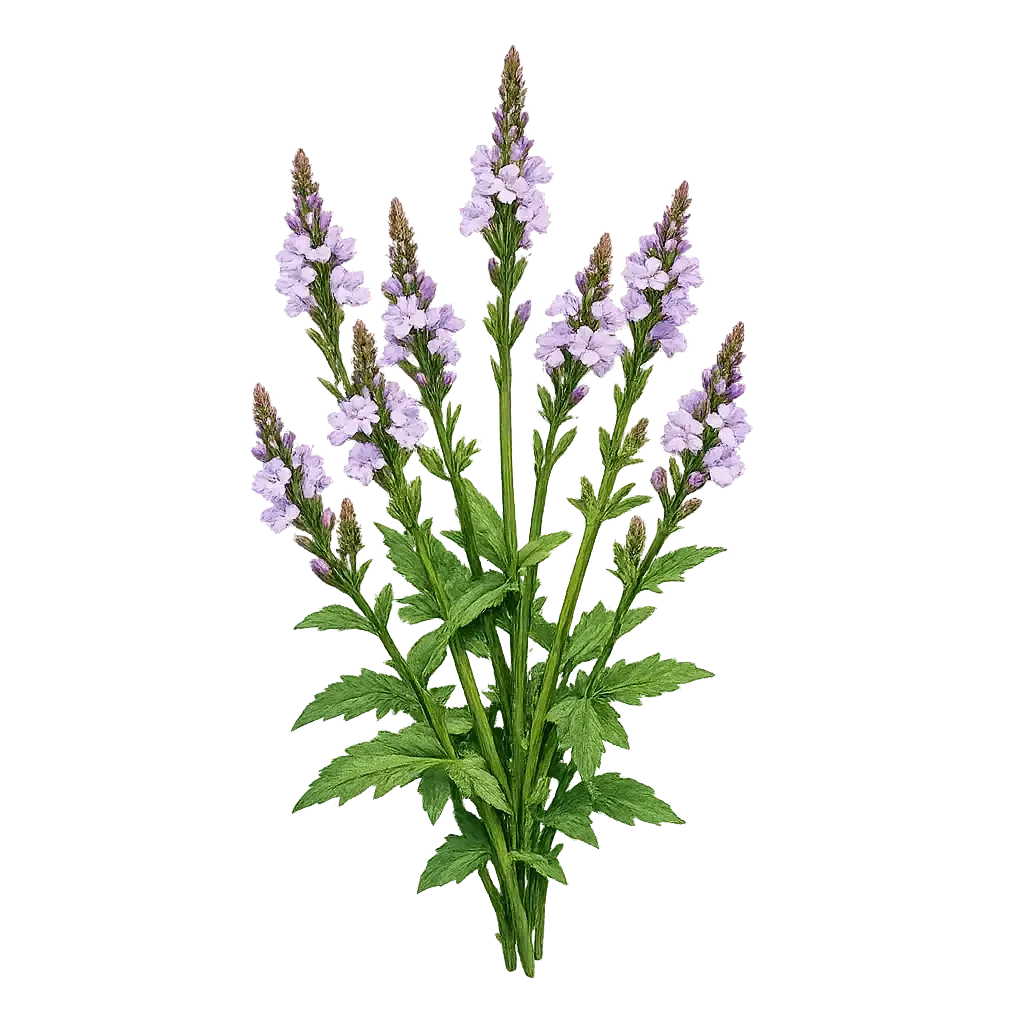
Verbena officinalis is native to the Mediterranean region and western Asia, growing naturally on roadsides, disturbed ground, field margins, and waste places across a range that has expanded through human movement to include naturalized populations throughout Europe, Asia, and North America. It is a slender, upright, branching plant with wiry stems, lance-shaped toothed leaves, and long, sparse spikes of tiny pale lilac to blue flowers that are individually small but collectively attractive to a wide range of small native bees, butterflies, and hoverflies across a very long summer flowering season.
The plant is not showy. That is worth stating directly. Vervain in the garden does not command attention the way angelica or echinacea or even wood betony does, and a grower expecting a dramatic ornamental display from it will be disappointed. What vervain offers is a long season of quiet, reliable contribution: the thin flower spikes open progressively from the base upward from June through September, attracting small pollinators steadily across the season, while the root and aerial parts accumulate the bitter iridoid glycosides, verbascoside, and volatile compounds that give the plant its documented pharmacological activity.
On the homestead, vervain earns its place primarily as a medicinal herb with a specific and well-defined application profile centered on the nervous system and the digestive system, and secondarily as a long-season pollinator plant that fills the mid-border with quiet, persistent flowering across the weeks when many showier plants have finished. It requires very little, tolerates considerable neglect on appropriate dry soils, and self-seeds reliably enough to maintain itself without annual replanting once established. These are not dramatic virtues but they are durable ones.
How to Grow
Sun Requirements
Vervain grows best in full sun and produces its most compact habit, most abundant flowering, and highest medicinal compound concentration in direct sunlight for six or more hours daily. It tolerates partial shade of three to four hours of direct sun reasonably well, growing somewhat more openly and flowering slightly less abundantly than in full sun but remaining healthy and medicinally useful.
Its natural habitat on open roadsides, disturbed ground, and field margins reflects a consistent preference for exposed, sunny positions, and the open, airy character of these sites, with good air movement and no overhead competition, is the appropriate model for cultivation. Enclosed, still-air positions in partial shade are associated with powdery mildew, reduced flowering, and the soft, lax growth that is less medicinally potent than the compact growth of full-sun plants.
Soil Requirements
Vervain shares the lean-soil preference of yarrow and wormwood, performing at its best on average to poor, well-drained soils without amendment or fertilization. Its native disturbed-ground and roadside habitat translates directly to a tolerance for compacted, rocky, and nutrient-depleted soils where more demanding herbs fail, and actively prefers these conditions over the rich, moisture-retentive soils that benefit vegetables and many culinary herbs.
Well-drained soil is the most important requirement. Vervain does not tolerate persistent waterlogging and declines quickly in heavy clay that holds water through winter. Sandy loam, gravelly soils, and the naturally well-drained conditions of raised beds and south-facing slopes are all appropriate. pH tolerance is wide, from 5.5 to 7.5, and no soil amendment is needed or beneficial beyond ensuring drainage is adequate before planting.
Water Needs
Established vervain is moderately drought tolerant and rarely requires supplemental irrigation in climates with occasional summer rainfall once the root system is well developed. In its first growing season, consistent moderate moisture supports root establishment. From the second year onward, deep watering during extended drought is sufficient, and regular irrigation that keeps the soil consistently moist is more likely to cause root problems than to improve the plant's performance.
In hot, dry summer climates, particularly in zones 8 and 9, some supplemental irrigation during the peak summer months prevents the premature dormancy that can cause vervain to stop flowering mid-season on the driest sites. A deep watering every two weeks during the driest period is usually adequate to maintain active growth without creating the wet conditions that promote root disease.
Planting
Vervain is most easily established from seed, which it produces abundantly and which germinates reliably given appropriate cold stratification. Seeds require four to six weeks of moist cold at 35 to 40 degrees Fahrenheit to break dormancy, and the most reliable approach for most growers is to sow seeds outdoors in autumn and allow the natural winter to provide the stratification period, with germination occurring in spring as soil temperatures rise. Indoor sowing in late winter with a period of refrigerator stratification before placing seeds under lights is the alternative for growers who want transplant-sized plants ready for spring placement.
Established plants self-seed freely in most garden settings, and once a vervain planting is established it typically maintains itself without annual intervention. Managing the self-seeding by removing unwanted seedlings when they are small is easier than preventing it, and the freely produced seedlings are useful for expanding the planting or filling gaps elsewhere in the garden.
Nursery transplants are available from specialist herb suppliers and establish readily at any point in the growing season with adequate watering. Division of established clumps in early spring is also straightforward and produces flowering plants quickly.
Plant Spacing
Plants should be spaced 12 to 18 inches apart to allow the slender, branching habit to develop without overcrowding and to maintain the good air circulation that prevents powdery mildew on the foliage in humid conditions. Vervain's naturally open, wiry habit means it never becomes visually dense even at the lower end of this spacing range, and the 12 inch spacing is appropriate for creating a continuous border planting that provides uninterrupted pollinator habitat from the first plants to the last.
Companion Planting
Vervain is a valuable companion plant primarily for its long-season pollinator contribution and for the specific diversity of small native bees, hoverflies, skippers, and small butterflies that its flower structure attracts. The tiny individual flowers of vervain, positioned along long wiry spikes, are structured for small-bodied pollinators that cannot access the larger, more complex flowers of plants like foxglove or monarda, and this complementary pollinator community serves garden plants that benefit from small-bee pollination.
Good companion plants include:
Yarrow, whose flat-topped flowers attract a complementary suite of predatory insects alongside vervain's small-bee visitors, creating a more diverse beneficial insect community than either plant supports alone
Echinacea and rudbeckia, which share the open, sunny, well-drained site preferences and provide larger pollinator flowers alongside vervain's small-flower spikes
Thyme, oregano, and marjoram, which share the lean-soil, full-sun requirements and contribute to a highly productive medicinal and pollinator herb border
Lavender, which occupies the same dry, sunny conditions and provides complementary summer flowering with a different pollinator community focus
Fruit trees and berry bushes, where the extended season of small-bee attraction provided by vervain supports consistent pollination of crops that rely on small native bee species
Harvesting
Harvest Time
Aerial parts, including the flowering stems and upper leaves, are harvested for medicinal use from the beginning of flowering in June through August, when the concentration of the principal active compounds, particularly verbascoside, the iridoid glycoside verbenalin, and the volatile oils, is at its seasonal peak. Harvesting in the morning after the dew has dried and before the heat of the day reduces volatile oil concentration produces the most potent dried herb.
For preparations where the maximum concentration of verbenalin and related iridoids is the goal, harvesting at the beginning of the flowering period rather than at peak bloom captures the highest levels of these compounds before they are partially metabolized in support of seed development. For dried herb and tea use, harvest throughout the flowering period as the gradual, progressive nature of vervain's bloom means there is rarely a single peak moment but rather a long, consistent harvest window.
Harvest Method
Cut stems four to six inches below the lowest open flowers with sharp scissors or shears, taking no more than one third of the plant's total growth in any single harvest. Vervain's wiry stems dry quickly and evenly when bundled loosely and hung in a well-ventilated space out of direct sunlight, completing the drying process in seven to ten days at room temperature. The tiny flowers retain their color reasonably well when dried quickly, producing an attractive dried herb that stores usably for one to two years in airtight glass containers.
The plant typically produces two to three cutting cycles per season when the first harvest is taken promptly and the remaining stems are allowed to continue their progressive upward flowering before a second cut. This management both maximizes the harvest and prevents the self-seeding that would otherwise become excessive on productive sites.
How to Use
Medicinal Uses
Vervain's primary and most consistently documented medicinal application is as a nervine herb for the relief of nervous tension, stress-related exhaustion, and the particular kind of wound-up, over-stimulated state that contemporary herbalists often describe as the vervain type: the person who cannot switch off, who drives themselves relentlessly, who holds tension in the neck and shoulders, and who experiences the digestive complaints of chronic stress including irritable bowel, nausea, and poor appetite alongside the mental symptoms of anxiety and insomnia.
This nervine profile distinguishes vervain from the more broadly sedating nervine herbs like valerian and hops. Vervain does not sedate. It does not produce drowsiness or impair function. It is better understood as a relaxant nervine that reduces excessive nervous tension and the physical symptoms associated with it while leaving mental clarity and function intact. This makes it particularly useful for daytime use during periods of sustained stress and for the specific presentation of tension headaches, neck stiffness, and jaw clenching that accompany prolonged stress in many people.
As a bitter digestive herb, vervain's iridoid glycosides stimulate bile production and gastric secretion in the same manner as other bitter herbs, improving fat digestion, reducing bloating, and supporting liver function. It is particularly appropriate for the digestive presentation that accompanies chronic nervous tension, where sluggish digestion, nausea, and irritable bowel symptoms occur alongside the nervous system symptoms rather than in isolation.
As a diaphoretic fever herb, vervain shares the sweat-promoting properties of several traditional fever herbs and is used in combination with elderflower and peppermint in the classic European fever tea blend that remains one of the more practically useful homestead preparations for the early stages of feverish illness.
Vervain is contraindicated in pregnancy due to the uterine-stimulating effects of verbenalin. It should not be used in large quantities alongside pharmaceutical medications for anxiety, depression, or seizure disorders without guidance from a qualified healthcare provider. These are appropriate cautions for a medicinally active herb rather than reasons to avoid it entirely in ordinary homestead use at traditional tea and tincture doses.
Tea Uses
Vervain tea prepared from dried aerial parts is the standard preparation for all the internal medicinal applications described above. One to two teaspoons of dried herb per cup of boiling water, steeped covered for ten to fifteen minutes, produces a mildly bitter infusion with a faintly astringent, slightly vegetal flavor that is unremarkable rather than unpleasant. The flavor improves with honey, and combining vervain with more pleasant-tasting nervine herbs such as lemon balm, passionflower, or skullcap produces a blend that is both more palatable and more broadly effective than any single herb alone.
For the specific nervine and digestive applications where vervain is most indicated, drinking the tea two to three times daily during periods of sustained stress produces the most consistent results. The effects of nervine tonic herbs are cumulative and gradual rather than immediate, and regular use over several weeks produces more reliable outcomes than occasional use at the onset of acute symptoms.
Tincture Uses
Tincture of vervain in 40 to 60 percent alcohol is the most concentrated and most stable preparation, appropriate for longer-term use during extended periods of stress and exhaustion where a consistent, reliable daily dose is more practical than preparing fresh tea multiple times daily. The standard dose of two to four milliliters of tincture two to three times daily is the typical recommendation in contemporary Western herbal practice.
Homestead tincture preparation follows the same straightforward maceration process described for wood betony: dried or fresh herb packed into a jar, covered completely with appropriately strength alcohol, sealed and macerated for four weeks with daily shaking, then strained and bottled in dark glass for storage. Vervain tincture stores for three to five years without significant deterioration in potency.
Topical Uses
A strong infusion of vervain used as a compress or topical wash has a traditional application for wound healing, bruising, and joint inflammation where the astringent tannins and anti-inflammatory verbascoside provide a genuinely useful topical effect. Applied as a warm compress to the back of the neck and shoulders, a vervain infusion is a practical topical application for the muscle tension and headache that are among the plant's primary internal indications, combining the physical warmth of the compress with the topical absorption of the active compounds.
Storage
Dried vervain aerial parts store adequately for one to two years in airtight glass containers kept cool, dark, and dry. The iridoid glycosides that carry the primary nervine and digestive activity are relatively stable compared to volatile oils, and properly stored dried vervain retains useful medicinal potency through a full year of storage without significant deterioration.
Tincture is the most stable and most potent long-term preparation, preserving the full spectrum of active compounds at consistent concentration for three to five years in sealed dark glass. For growers who want a reliable, ready-to-use medicinal preparation available through the year without preparing fresh tea, tincture made from the summer harvest provides year-round access to the plant's medicinal benefits.
Lifespan of the Plant
Vervain is a perennial in zones 5 through 9, returning reliably from its root system each spring and persisting for several years on appropriate well-drained sites. In zones 3 and 4 it is often treated as an annual or short-lived perennial, with survival through cold winters variable depending on drainage, snow cover, and the specific microclimate of the planting site. A deep winter mulch of straw or wood chips over the root crown significantly improves winter survival at the cold edge of its perennial range.
The plant self-seeds freely and reliably in most garden settings, and even where the parent plant does not survive the winter, self-sown seedlings typically fill the gap in spring without any intervention. This self-seeding habit effectively makes vervain self-perpetuating in the garden regardless of whether any individual plant survives as a true perennial, which is part of what makes it so reliably available year after year with minimal management attention.
Cutting plants back by half after the first flush of flowering is complete encourages fresh growth and a second wave of bloom in late summer, extending both the harvest season and the pollinator contribution of the planting through September.
Pros and Cons
Advantages
One of the most historically significant nervine herbs in the Western tradition, with a consistent cross-cultural use record spanning two thousand years
Specific and well-defined medicinal application for stress-related nervous tension, tension headaches, and the digestive complaints of chronic stress
Long-season pollinator plant attracting small native bees, hoverflies, skippers, and small butterflies from June through September
Tolerates dry, poor, well-drained soils with minimal maintenance once established
Self-seeds freely, maintaining itself without annual replanting
Hardy as a perennial to zone 5 and self-perpetuating through self-seeding in zones 3 and 4
Non-sedating nervine appropriate for daytime use during periods of sustained stress
Combines well with other nervine herbs to create effective medicinal blends
Limitations
Contraindicated in pregnancy due to uterine-stimulating verbenalin content
Visually modest and easily overlooked in mixed plantings without understanding its value
Bitter flavor makes the plain tea less palatable than more aromatic nervine herbs
Self-seeding can become excessive on productive sites without management
Less reliably perennial in zones 3 and 4 without winter mulch protection
Medicinal effects are gradual and cumulative rather than immediately dramatic
Easily confused with ornamental Verbena hybrids that do not share the medicinal properties of Verbena officinalis
Common Problems
Vervain on well-drained soil in full sun is generally healthy and requires minimal pest or disease management. Powdery mildew is the most common problem, appearing on the foliage in humid conditions, overcrowded plantings, or still-air positions without adequate air circulation. Appropriate spacing and full sun siting prevent it in most situations, and cutting affected plants back hard after the first flush of bloom removes mildewed growth and stimulates clean new growth for the second flowering period.
Aphids occasionally colonize the stem tips of new growth in spring, particularly on young transplants before they are fully established. Natural predator populations typically manage them adequately once the plants and the surrounding garden insect community are established, and the beneficial insects that vervain itself attracts from its first flowering contribute to this natural aphid management over time.
Root rot from waterlogged or poorly drained soils is the most reliable cause of plant loss and is entirely preventable by appropriate siting. Vervain planted in heavy clay that holds winter water invariably declines and is not worth attempting without significant drainage improvement first.
Identification confusion with ornamental Verbena hybrids is worth noting as a cultivation rather than pest problem. The large-flowered, brightly colored ornamental verbenas sold as bedding plants at garden centers are hybrids that do not share the medicinal properties of Verbena officinalis. When sourcing plants or seeds for medicinal use, confirming the botanical name Verbena officinalis is essential.
Varieties
Verbena officinalis is the medicinal species and is available as the straight species from specialist herb nurseries and medicinal herb seed suppliers. There are no named medicinal cultivars in wide commercial availability, as the plant's value lies in its consistent chemical profile rather than any ornamental characteristic that would reward selection and named variety development.
Verbena hastata, blue vervain, is the North American native species closely related to common vervain and native to wet meadows, stream banks, and disturbed moist soils from Quebec south through the eastern United States. It grows in consistently wetter conditions than Verbena officinalis and is the appropriate choice for moist and riparian homestead sites within its native range. Several Indigenous peoples of eastern North America used it medicinally for nervous system and respiratory applications that parallel the European uses of common vervain, and contemporary North American herbalists often use it interchangeably with or instead of the European species.
Verbena stricta, hoary vervain, is a native prairie species of the central United States with greater drought tolerance than either common vervain or blue vervain, appropriate for dry-site homestead plantings in the Great Plains and Midwest where native ecological relationships with local pollinators and soil communities are a priority.
European vs. North American vervain: Verbena officinalis (European vervain) and Verbena hastata (North American blue vervain) are related but distinct species with somewhat different growing requirements and overlapping but not identical medicinal profiles. Both are used as nervine and digestive herbs in their respective herbal traditions. For growers within the native range of Verbena hastata in moist-site eastern North American settings, the native species is the ecologically appropriate choice. For dry-site, well-drained herb garden applications across a wider range, Verbena officinalis is the more adaptable option.
Final Thoughts
Vervain will not be the most impressive plant in the herb garden. It will not stop visitors in their tracks the way a towering angelica or a broad lavender in full bloom will. What it will do, reliably and year after year, is flower from June through September, attract a steady population of small native bees and butterflies, set seed freely enough to maintain itself without attention, and sit in the medicine cabinet as a tea or tincture for the specific and very common presentation of stress-driven nervous tension and its accompanying digestive complaints.
Two thousand years of consistent use across cultures that had no reason to maintain plants that did not work is a reasonably compelling endorsement. The homestead herb garden that includes vervain alongside the more visually prominent herbs has access to a medicine that is genuinely suited to the particular kind of stress that comes with managing land, animals, and a household simultaneously. That is not a coincidence. It is one more example of an herb that became traditional because it was useful, and that remains useful now for the same reasons it always was.