
Wood Betony
Written By Arthur Simitian
QUICK FACTS
Common Name
Wood Betony, Betony, Bishop's Wort, Lousewort (North American species)
Scientific Name
Stachys betonica (syn. Betonica officinalis); Pedicularis canadensis (North American wood betony)
Plant Type
Hardy perennial
Hardiness Zones
4 to 8 (Stachys betonica); 3 to 8 (Pedicularis canadensis)
Sun Requirements
Partial shade to full sun
Soil Type
Well-drained, average to poor; tolerates dry and rocky soils
Plant Height
12 to 24 inches in bloom
Spacing
12 to 18 inches
Uses
Medicinal, nervine, digestive tonic, pollinator plant, woodland garden herb
Wood betony is one of the most highly regarded medicinal herbs of the European herbal tradition and one of the least known in the contemporary garden. It was listed in early medieval herb gardens as an essential plant for virtually every ailment, carried the reputation in folklore of protecting against evil and misfortune, and was described by the Roman physician Antonius Musa as a remedy for no fewer than forty-seven conditions. That enthusiasm has not survived into modern herbal practice in the same intensity, but the plant's genuine value as a nervine tonic, digestive herb, and headache remedy is well supported by both its traditional use record and by modern phytochemical understanding of its bitter and tannin-rich constitution.
Introduction
The name wood betony applies to two distinct plants depending on the context and the continent. In European herbal tradition, wood betony refers to Stachys betonica, also known as Betonica officinalis, a member of the mint family Lamiaceae native to the meadows, woodland edges, and open grasslands of Europe and western Asia. In North American botanical and wildflower contexts, wood betony more commonly refers to Pedicularis canadensis, a native hemiparasitic wildflower of eastern woodland edges with a completely different growth habit and a distinct though overlapping medicinal use profile. This guide covers both, with the primary focus on the European Stachys betonica as the species with the deeper documented medicinal history and the more straightforward cultivation requirements.
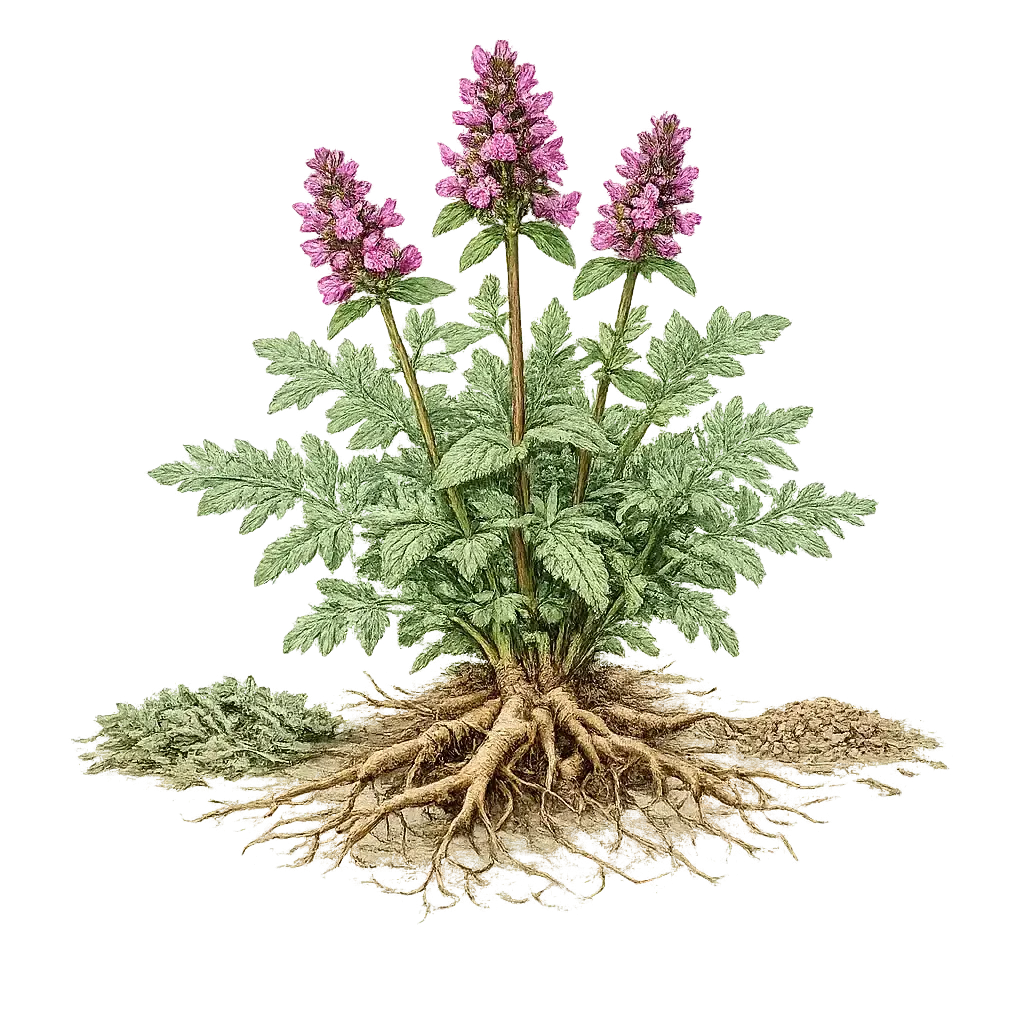
Stachys betonica produces spikes of rich magenta to purple hooded flowers from June through August above a rosette of deeply textured, wrinkled, dark green leaves with scalloped margins. The plant is handsome enough to earn its place in any perennial border on ornamental grounds alone, and the flowers are reliably attractive to bumblebees and other long-tongued native bees through the summer flowering period. It is a modest-sized, well-behaved perennial that neither spreads aggressively nor requires any particular management attention, making it one of the more agreeable medicinal herbs to incorporate into an established herb garden.
The medicinal reputation of wood betony in European tradition centers primarily on three applications: as a nervine tonic for stress, tension headaches, and nervous exhaustion; as a bitter digestive herb for sluggish digestion, liver support, and gastric complaints; and as a topical wound herb with astringent tannins that support tissue healing. These applications align well with the plant's known chemical constituents, which include betaine, stachydrine, tannins, bitter iridoid glycosides, and rosmarinic acid, the same anti-inflammatory compound found in rosemary and other mint family herbs.
How to Grow
Sun Requirements
Wood betony is one of the more flexible herbs for light conditions and performs well across a range from full sun to partial shade, reflecting its natural habitat on woodland edges and open meadows where light levels vary considerably. In full sun it produces the most compact habit, the most abundant flowering, and the deepest flower color. In partial shade of three to four hours of direct sun it grows somewhat more openly but remains healthy and flowers reliably, making it one of the more useful medicinal herbs for partially shaded homestead sites where full-sun herb plantings are already committed to other species.
In dense shade it grows slowly and flowers sparsely, and it is not appropriate for deep woodland positions. The partial shade of a building's east face, a fruit tree canopy edge, or a position that receives morning sun and afternoon shade represents the lower useful light threshold and produces good results in warmer climates where afternoon shade is genuinely beneficial.
Soil Requirements
Wood betony prefers well-drained, average to moderately poor soil and shares the lean-soil preference of many medicinal herbs whose active compound concentration is highest on unfertilized, well-drained ground. Rich, heavily amended soils produce lush vegetative growth with reduced medicinal compound concentration and a more floppy habit than the compact, upright plants grown on appropriate lean soils.
It tolerates a wide pH range from 5.5 to 7.5 and grows on soils from sandy loam through clay loam provided drainage is adequate. It performs particularly well on the thin, somewhat rocky or gravelly soils of meadow edges and open woodland margins that represent its native habitat, and these conditions are the appropriate model for cultivation. Heavy, waterlogged clay is not suitable, and root rot from poor drainage is the most common cause of plant loss in cultivation.
Water Needs
Established wood betony is moderately drought tolerant and rarely requires supplemental irrigation in climates with regular summer rainfall once the root system is established in its second and subsequent years. During establishment in the first growing season, consistent moderate moisture supports root development and helps the plant transition to self-sufficiency through summer dry periods.
It performs well in the naturally moist but well-drained conditions of woodland edge soils where it grows natively, and it is more tolerant of occasional dry periods than it is of consistently wet or waterlogged conditions. In dry summer climates, the partial shade positioning that suits it in warmer zones also reduces moisture demand by lowering soil surface temperature and reducing evapotranspiration.
Planting
Wood betony is most reliably established from nursery transplants or from division of established clumps. Seed germination is possible but variable, often requiring cold stratification of four to six weeks at 35 to 40 degrees Fahrenheit to break dormancy reliably. Fresh seed sown in autumn directly onto a prepared seedbed and left to overwinter naturally achieves good germination rates without artificial stratification, as the natural winter cold cycle provides the required treatment.
Division of established clumps in early spring or early autumn is the most reliable and practical propagation method, producing divisions that establish readily and flower in their first or second season. The clumps divide easily and the divisions transplant well, making wood betony one of the simpler perennial medicinal herbs to multiply once an initial planting is established.
Spring planting after the last frost date is the standard approach for transplants, with early autumn planting also successful in zones 5 through 7 when the plants have adequate time to establish before hard frost.
Plant Spacing
Plants should be spaced 12 to 18 inches apart to allow the basal rosette to develop to its full extent and to ensure good air circulation between plants. Wood betony forms gradually expanding clumps rather than spreading aggressively by runners or rhizomes, and the spacing that suits the plant at planting remains appropriate for several years before division is needed to manage clump size.
In a mixed medicinal herb border, wood betony pairs well with other woodland edge and meadow herbs at the same spacing, creating a layered mid-border planting that provides a long and ecologically productive flowering season when combined with plants that bloom before and after wood betony's summer peak.
Companion Planting
Wood betony is a valuable companion plant primarily through its pollinator attraction function. The hooded, tubular flowers are structured specifically for bumblebees and other long-tongued native bees, and a well-established planting in full summer bloom draws these pollinators in numbers that benefit adjacent flowering herbs, vegetables, and fruit plants.
Good companion plants include:
Yarrow, which shares the meadow edge habitat preference and provides complementary flat-topped flowers that attract a different suite of beneficial insects alongside wood betony's bumblebee visitors
Echinacea, which blooms in the same summer period and together with wood betony creates a highly productive pollinator corridor in the medicinal herb garden
Valerian, which occupies a similar partial shade to full sun range and provides tall background structure behind wood betony's mid-border presence
Foxglove, which shares the woodland edge preference and provides spring flowering before wood betony comes into bloom, extending the pollinator food season
St. John's Wort, which occupies similar light and soil conditions and flowers in the same summer window, creating a complementary yellow and purple color combination alongside wood betony's magenta spikes
Harvesting
Harvest Time
Aerial parts, including the upper leaves and flowering stems, are harvested for medicinal use during the flowering period from June through August, when the concentration of the active bitter compounds, tannins, and rosmarinic acid is at its seasonal peak. For preparations where foliage alone is desired, the young leaves from the basal rosette can be harvested through the growing season, though the bitterness and medicinal compound concentration are highest in leaves harvested during the flowering period.
Root harvest for the most concentrated medicinal preparations is done in autumn of the second or third year, when the root system is well developed and the alkaloid and tannin content is at its highest before the plant enters winter dormancy. Roots are harvested after the aerial parts have died back, washed, sliced, and dried promptly.
Harvest Method
Cut flowering stems six to eight inches below the flower spike with sharp scissors or shears, taking no more than one third of the plant's stems in a single harvest to maintain vigor and allow regrowth. Bundle stems loosely and hang upside down to dry in a well-ventilated space out of direct sunlight. Wood betony dries readily within one to two weeks at room temperature.
For fresh poultice use, leaves are harvested directly as needed and either bruised between the fingers or gently chewed before application to the affected area. The astringent tannins in the fresh leaf provide effective wound care and anti-inflammatory action without any preparation beyond harvest.
How to Use
Medicinal Uses
Wood betony's primary medicinal reputation in European herbal tradition is as a nervine tonic, and this is the application that has attracted the most sustained attention in contemporary herbal practice. A nervine tonic in herbal medicine terminology is a herb that nourishes and supports the nervous system over time, reducing the effects of chronic stress, nervous exhaustion, and tension, rather than producing an acute sedative or stimulant effect. Wood betony is classified in this category alongside herbs like skullcap, oat straw, and lemon balm, and is considered by herbalists to be particularly appropriate for the combination of mental tension and digestive complaints that frequently accompany chronic stress.
For tension headaches specifically, wood betony has one of the more consistent traditional use records of any European medicinal herb. The combination of muscle-relaxing alkaloids, anti-inflammatory rosmarinic acid, and bitter compounds that improve circulation to the digestive organs and head is theorized to address the vascular and muscular tension components of tension headaches simultaneously. An infusion of the dried aerial parts drunk at the onset of a tension headache is the traditional preparation, and the clinical experience of contemporary medical herbalists largely supports this application.
As a bitter digestive herb, the iridoid glycosides and tannins in wood betony stimulate bile production and gastric secretions, improving the digestion of fats and proteins, reducing bloating, and supporting liver function in a manner consistent with other bitter tonics in the European herbal tradition. It is considered a gentler and better-tolerated bitter than some of the more intense digestive herbs such as gentian or wormwood, making it appropriate for people with sensitive digestion who cannot tolerate the stronger bitters.
Topically, the astringent tannin content of wood betony leaves supports wound healing, reduces inflammation in minor cuts and abrasions, and has been used in traditional European practice for mouth ulcers, sore throats as a gargle, and inflamed gums as a mouth rinse. The prepared infusion used as a topical rinse or the fresh leaf bruised and applied as a poultice are both practical approaches for these applications.
Tea Uses
Wood betony tea prepared from the dried aerial parts is the standard traditional preparation for all of the internal medicinal applications described above. One teaspoon of dried herb per cup of boiling water, steeped covered for ten to fifteen minutes, produces a mildly bitter, pleasantly aromatic infusion with a flavor that is more accessible than many medicinal herbs of comparable potency. Honey improves the flavor considerably without reducing the medicinal value of the preparation.
The tea is traditionally drunk two to three times daily for digestive support and as a nervine tonic during periods of sustained stress or exhaustion. For tension headache management, a stronger infusion of two teaspoons per cup drunk hot at the onset of symptoms is the traditional approach.
Wood betony blends well with other nervine herbs. A combination of wood betony, skullcap, and lemon balm produces a well-rounded nervine tea with complementary active compounds and a more pleasant flavor profile than wood betony alone. Combined with chamomile and fennel it makes an effective digestive tea that addresses both the upper and lower digestive tract simultaneously.
Tincture Uses
A tincture of dried or fresh wood betony in 40 to 60 percent alcohol is the most concentrated and most shelf-stable preparation, preserving the full spectrum of the plant's active compounds in a form that stores for three to five years without significant deterioration. The standard dose of two to four milliliters of tincture three times daily is the typical recommendation in contemporary Western herbal practice for nervine tonic and digestive applications.
Tincture preparation at the homestead scale is straightforward: pack a clean glass jar with dried or chopped fresh wood betony, cover completely with vodka or a mixture of food-grade alcohol and water to the desired strength, seal tightly, and macerate for four weeks in a cool, dark location, shaking daily. Strain through cheesecloth and bottle in dark glass for storage.
North American Wood Betony
Pedicularis canadensis, the North American wood betony, is a native wildflower of eastern woodland edges and open forests from Quebec and Ontario south through the Appalachians and across the Midwest. It is a hemiparasite, meaning it supplements its own photosynthesis by tapping the roots of neighboring grasses and other plants for water and nutrients, which makes it difficult to cultivate in isolation and unsuitable for conventional herb garden planting without the presence of suitable host plants.
In a naturalistic woodland edge planting that includes native grasses and wildflowers, Pedicularis canadensis establishes successfully and provides excellent early spring pollinator support, with its yellow and reddish hooded flowers opening in April and May before most other native wildflowers. Several Indigenous peoples of eastern North America used it medicinally for muscle relaxation and as a love medicine, and contemporary herbalists use it for muscle spasm and tension with some supporting traditional evidence.
For the homestead herb garden in a formal or semi-formal setting, Stachys betonica is the more practical choice. For a naturalistic woodland edge or native plant restoration planting in eastern North America, Pedicularis canadensis is the ecologically appropriate option and provides early season pollinator habitat of genuine value.
Storage
Dried wood betony aerial parts store well for one to two years in airtight glass containers kept cool, dark, and dry. The bitter compounds and rosmarinic acid that carry the primary medicinal activity are relatively stable compared to the volatile oils of more aromatic herbs, meaning that properly stored wood betony retains useful potency well through a full year of storage and beyond.
Dried root stores for two to three years under the same conditions and maintains higher concentrations of the alkaloid compounds than the aerial parts. For long-term medicinal preparation, tincture is the most stable option, preserving full potency for three to five years in sealed dark glass at room temperature.
Lifespan of the Plant
Wood betony is a reliably long-lived perennial that returns consistently from its root system each spring and persists for many years on appropriate well-drained sites without replanting. Individual plants commonly live for ten years or more, slowly expanding their basal clump without aggressive spreading or self-seeding in the manner of more vigorous perennials.
Division every four to five years is beneficial to maintain vigor in the center of older clumps, which can become somewhat less floriferous as the crown ages. Division in early spring produces the most reliable results and simultaneously multiplies the planting at no cost. The divided portions establish quickly and flower in the same or following season.
Pros and Cons
Advantages
One of the most historically significant medicinal herbs in the European tradition, with a consistent record across nervine, digestive, and wound care applications
Beautiful magenta-purple flower spikes with genuine ornamental value in a mixed perennial border
Excellent bumblebee and long-tongued native bee pollinator plant through the summer flowering period
Tolerates partial shade, making it practical for sites where full-sun herb space is limited
Well-behaved, non-spreading perennial that does not require aggressive management
Hardy to zone 4, suitable for cold-climate homestead herb gardens
Gentler medicinal profile than many bitter herbs, well tolerated by sensitive digestion
Easy to divide and propagate once established
Limitations
Relatively obscure in the nursery trade, requiring sourcing from specialist herb nurseries
Seed germination is variable and requires cold stratification for reliable results
North American species (Pedicularis canadensis) is hemiparasitic and difficult to cultivate in isolation
Medicinal applications are less extensively researched in clinical studies than many mainstream herbs
Not appropriate for use during pregnancy without guidance from a qualified herbalist
Modest in scale, lacking the dramatic visual presence of larger medicinal plants like angelica or elecampane
Common Problems
Wood betony is one of the most trouble-free perennial medicinal herbs in cultivation and rarely experiences significant pest or disease problems on well-sited, well-drained soils. Its membership in the mint family Lamiaceae gives it some of the same aromatic deterrence to insect herbivores that protects other mint family herbs, though it is less strongly aromatic than many of its relatives.
Root rot from poorly drained soils is the most consistent problem in cultivation and the primary cause of plant loss. It is entirely preventable by appropriate site selection and soil preparation before planting. Symptoms of root rot, wilting despite adequate surface moisture and blackening of the stem base at soil level, appear quickly once established and there is no recovery. Improving drainage before replanting is essential.
Powdery mildew can appear on the foliage in humid, still-air conditions in late summer, particularly on plants in dense shade or overcrowded positions. Adequate spacing and at least partial sun exposure are the most effective preventive measures. On otherwise healthy plants approaching the end of their flowering season, late summer mildew is cosmetic rather than threatening and does not require treatment.
Slugs and snails feed on the young emerging foliage in spring and can cause significant damage to newly planted transplants before the plants are established. Protection through the first season in gardens with heavy slug pressure is worthwhile.
Varieties
Stachys betonica in the straight species form with the typical magenta-purple flowers is the medicinal standard and the appropriate choice for all the applications described in this guide. It is available from specialist herb nurseries, native plant suppliers for European growers, and from seed through a limited range of heritage and medicinal herb seed companies.
Stachys betonica Alba is a white-flowered selection that retains all the medicinal properties of the species alongside a softer, more understated flower display. It is particularly attractive in moon garden plantings and in white-themed herb borders where the deep green, textured foliage and clean white flower spikes make a strong visual statement.
Stachys betonica Rosea produces rose-pink flowers of a lighter tone than the typical species, offering a middle ground between the intense magenta of the straight species and the white of Alba. All three color forms share the same growing requirements and medicinal properties.
Name confusion to be aware of: Wood betony (Stachys betonica) is sometimes confused with hedge betony (Stachys sylvatica), a related but distinct species with a stronger, less pleasant odor and a different medicinal profile. It is also occasionally confused with lousewort (Pedicularis sylvatica), the European species related to the North American wood betony. When sourcing seed or plants for medicinal use, confirming the botanical name Stachys betonica or Betonica officinalis ensures you have the correct species.
Final Thoughts
Wood betony is the kind of medicinal herb that rewards the grower who takes the time to look past the more familiar names in the herb garden. It is not lavender or echinacea or valerian. It does not have the market visibility or the consumer recognition of those herbs. What it has is a longer documented history of consistent use by knowledgeable herbalists across more cultures and more centuries than most of the herbs that currently dominate the popular medicinal plant conversation, and a chemical profile that supports rather than contradicts that history.
The magenta flower spikes in July are genuinely beautiful. The bumblebees agree. The tea for a tension headache on a stressful afternoon is genuinely useful. The plant asks for well-drained soil, reasonable light, and to be divided every few years. That is a modest request for a herb that has been considered essential in a serious garden for the better part of two thousand years.