
Butte Almond Tree
The California Powerhouse of Commercial Almond Production
The Butte almond (Prunus dulcis 'Butte') represents one of California's most significant contributions to modern almond cultivation - a variety specifically bred for exceptional productivity, late bloom timing, and reliable performance across the Golden State's diverse growing regions. Developed through the University of California's breeding program in the mid-20th century, Butte quickly earned its reputation as "the highest yielding almond variety" and became a cornerstone of California's multi-billion dollar almond industry. Named for Butte County, one of California's historic almond-growing regions, this variety blooms four days after the industry-standard Nonpareil, making it ideal for extending pollination windows and reducing frost risk. With its moderately vigorous spreading growth habit, medium to small plump kernels, and semi-hard well-sealed shells, Butte almonds are prized for both commercial processing and home orchard cultivation. The distinctive short, wide, rounded shape with heavily wrinkled skin makes Butte almonds particularly well-suited for roasting with seasonings, while their slightly earthy, crunchy flavor profile provides excellent versatility in culinary applications from snacking to baking.
GROWING TIMELINE: FROM PLANTING TO HARVEST
Time to First Fruit
Standard Rootstock (Lovell peach, Nemaguard): 5-6 years to first significant harvest
Semi-Dwarf Rootstock: 3-4 years to productive bearing
Grafted trees on Krymsk 86 or Hansen 536: 3-5 years to first commercial crops
Growth Rate
Butte almond trees exhibit moderate to moderately vigorous growth with a characteristic spreading canopy that distinguishes them from more upright varieties like Mission or Aldrich. Young trees typically add 18-30 inches of new growth annually under optimal conditions. The spreading habit makes training and pruning more manageable than extremely upright varieties, though consistent pruning is essential for maintaining tree structure and maximizing production. Trees reach productive maturity within 5-7 years from grafted nursery stock.
Tree Lifespan
A well-maintained Butte almond orchard can remain productive for 20-25 years in commercial settings, with some exceptional trees producing for 30+ years. Peak production typically occurs between years 8-18, after which yields may gradually decline though the trees continue bearing. In ideal conditions with excellent management, individual trees can live 40-50 years, though most commercial orchards are replanted before this age to maintain optimal yields.
Mature Tree Size
Standard (on peach or almond rootstock): 15-20 feet tall, 15-20 feet wide
Semi-Dwarf (on size-controlling rootstock): 12-15 feet tall, 12-15 feet wide
Dwarf (on special rootstock): 8-12 feet tall, 10-12 feet wide
Butte's spreading growth habit creates a broader, more horizontal canopy compared to upright varieties, making harvest easier and improving light penetration throughout the tree.
Annual Production
A mature Butte almond tree produces 20-50 pounds of in-shell nuts annually, with the highest-yielding trees exceeding 50 pounds under ideal conditions. Commercial orchards consistently achieve 2,000-3,000 pounds per acre, with some well-managed operations reaching 3,500+ pounds per acre. Butte's reputation as the highest-yielding almond variety stems from its consistent heavy cropping and excellent "shakability" - the nuts release easily during mechanical harvesting, reducing labor costs and hull damage.
GROWING REQUIREMENTS
USDA Hardiness Zones
Zones 7-9 are optimal for Butte almond cultivation, with Zone 8 being ideal. The variety requires 200-500 chill hours (temperatures below 45°F) during winter dormancy, with most sources citing 400-500 hours for optimal production. Butte's late bloom timing (4 days after Nonpareil, typically late February to early March in California) provides significant frost protection compared to earlier-blooming varieties. This later bloom is one of Butte's greatest advantages, particularly in areas prone to late spring frosts. Zone 7 plantings need protection from extreme cold below 5-10°F.
Sunlight
Full sun is absolutely essential - minimum 8 hours of direct sunlight daily for optimal production. Butte almonds bloom relatively late compared to early varieties but still require maximum sunlight during the February-March bloom period to encourage pollinator activity. Southern or southeastern exposure helps maximize early spring warmth and extends the effective growing season.
Soil Requirements
Well-drained, sandy loam to loamy soils with pH 6.0-7.5 produce the best results, though Butte tolerates a wider range than some varieties. The tree performs well in the deep, fertile alluvial soils of California's Central Valley but also adapts to lighter, less fertile soils better than many fruit trees. Excellent drainage is critical - almonds are extremely susceptible to crown rot and root diseases in waterlogged conditions. Avoid heavy clay or poorly draining areas. Butte shows good compatibility with common rootstocks including Lovell peach, Nemaguard, Krymsk 86, and Hansen 536, though it may show some sensitivity to union mild etch on certain plum rootstocks (Marianna 2624) when grown in excessively wet soils.
Water Needs
Moderate to high water requirements during the growing season, with mature trees needing 36-48 inches of water annually in California's Central Valley climate. Butte requires consistent deep irrigation from bloom through hull split (February through August), with peak water demand during nut fill (May-July). The variety is reasonably drought-tolerant once established but yields suffer significantly without adequate moisture during critical development periods. Modern micro-sprinkler or drip irrigation systems deliver water efficiently. Reduce irrigation substantially after harvest to promote dormancy and conserve water during California's dry season.
Pollination
Butte almonds are completely self-incompatible and require cross-pollination from compatible varieties. The classic California almond planting pattern pairs Butte with Padre (blooming 5 days after Nonpareil) in alternating rows, as both bloom in the same late window. Other excellent pollinizers for Butte include:
Padre (ideal - synchronized bloom and harvest)
Mission (traditional late pollinizer)
Monterey (compatible late bloomer)
Fritz (mid-bloom but overlaps with Butte)
Plant compatible varieties within 50 feet maximum, though closer spacing (alternating rows) ensures better pollination. Honeybees are the primary pollinators - commercial orchards rent 2-3 hives per acre during bloom. Butte's abundant, consistent bloom makes it an excellent pollen producer for other late varieties.
TREE APPEARANCE
Size and Form
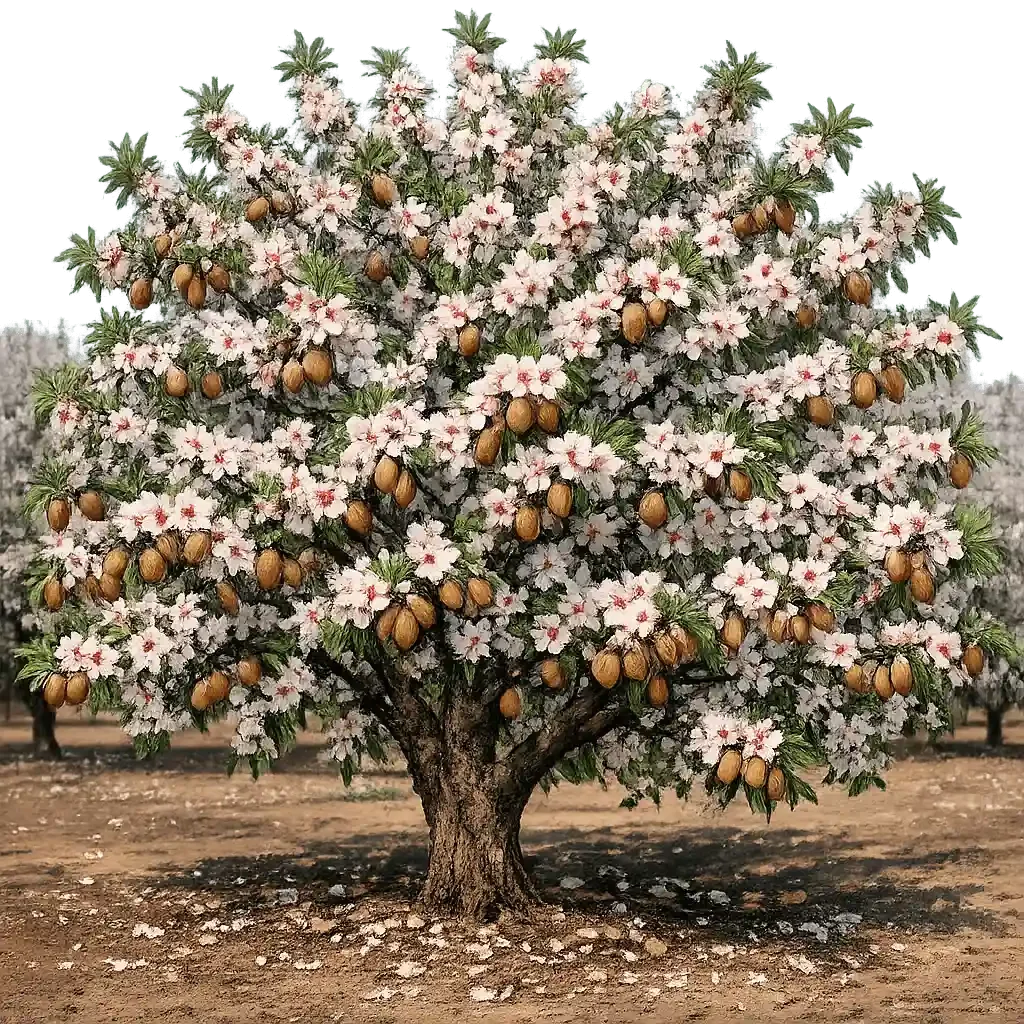
Butte almond trees develop a distinctive moderately vigorous spreading form with a rounded, broad canopy. Unlike upright varieties that grow tall and narrow, Butte naturally spreads horizontally, creating a more manageable tree structure. The spreading habit improves light penetration to interior branches and makes harvest easier. The trunk develops attractive gray-brown bark with vertical fissures as it matures. Branch structure is well-balanced and relatively easy to train compared to extremely vigorous upright varieties.
Leaves
Lance-shaped leaves emerge after flowering, measuring 3-5 inches long with finely serrated edges. The foliage is a medium to bright green that remains attractive throughout the growing season, turning yellow in fall before dropping. Leaf coverage is dense on the spreading branches, providing good shade for developing nuts.
Blossoms
Butte produces abundant white to pale pink five-petaled flowers in late winter to early spring, typically blooming 4 days after Nonpareil (usually late February to early March in California's Central Valley). The later bloom timing is one of Butte's greatest assets, significantly reducing frost damage risk that often devastates earlier varieties. Flowers appear in clusters directly on branches before leaves emerge, creating a spectacular display that lasts 10-14 days. The blossoms are sweetly fragrant and highly attractive to honeybees. Butte's consistent heavy bloom makes it an excellent pollen source for other late-blooming varieties.
Nuts
Butte produces medium to small-sized almonds with a distinctive appearance that makes them instantly recognizable to almond processors. The nuts have a characteristically short, wide, rounded shape with heavily wrinkled, dark brown skin - quite different from the smooth, elongated appearance of Nonpareil. The shell is semi-hard and well-sealed, providing excellent protection against navel orangeworm damage and maintaining kernel quality during storage. Inside, the kernels are notably plump despite their small to medium size, with an attractive light color after blanching. The nuts develop in fuzzy gray-green hulls that split open 20 days after Nonpareil (typically mid-September in California), signaling harvest readiness.
FLAVOR AND CHARACTERISTICS
Butte almonds offer a distinctive flavor profile that differs noticeably from the mild sweetness of Nonpareil. The nuts have a darker appearance, crunchier texture, and slightly earthy taste with subtle bitterness that adds complexity. This flavor profile makes Butte particularly excellent for roasting - the heavily wrinkled skin holds seasonings beautifully, making these almonds ideal for flavored roasted nut products (BBQ, honey-roasted, spiced, etc.). The crunchy texture holds up exceptionally well in baking applications, trail mixes, and as a topping where you want nuts that maintain their bite. While not as universally sweet as Nonpareil, Butte's richer, more complex flavor has a devoted following among those who prefer a "nuttier" almond taste. The plump kernels provide satisfying substance in every bite, and the good shell seal means consistently high-quality nuts with minimal defects.
BENEFITS AND USES
Commercial Production
Butte dominates California's late-harvest almond category, representing millions of acres of commercial plantings. The variety's exceptional productivity - consistently topping yield charts in university trials - makes it a favorite among commercial growers seeking maximum returns per acre. The semi-hard shells and excellent seal reduce pest damage (particularly from navel orangeworm), lowering rejection rates and increasing sellable crop percentages. Butte's famous "shakability" - the ease with which nuts release during mechanical tree shaking - significantly reduces harvest labor costs compared to varieties that require multiple shaking passes. This characteristic was highly valued by early Butte County growers and remains a key commercial advantage today.
Culinary Applications
Butte almonds excel in applications where texture, flavor, and appearance matter:
Roasted and seasoned almonds (the wrinkled skin holds coatings beautifully)
Trail mixes and snack blends (provides crunchy texture and rich flavor)
Almond butter (produces rich, complex flavor profiles)
Baking (maintains crunch in cookies, cakes, and pastries)
Chocolate-covered almonds (good size and excellent crunch)
Salads and grain bowls (adds substantial texture)
Asian cuisine (the firmer texture stands up to stir-frying and sauces)
Processing and Manufacturing
The semi-hard shell makes Butte ideal for in-shell almond products. The well-sealed shells protect kernels during shipping and storage, extending shelf life. Food manufacturers value Butte for products where flavor complexity enhances the final product rather than requiring the neutral taste of Nonpareil.
Home Orchard Value
For backyard growers, Butte offers exceptional productivity in limited space due to its spreading form and heavy bearing habit. The later bloom timing provides insurance against frost losses in marginal climates. Trees begin producing earlier than many varieties (often by year 3-4) and require less intensive pruning than extremely vigorous upright varieties. The nuts are excellent for home roasting projects and provide a distinctively flavorful homegrown product.
STORAGE AND SHELF LIFE
In-Shell Storage
Butte's semi-hard, well-sealed shells make these almonds excellent candidates for long-term storage. In cool (40-50°F), dry conditions with low humidity, in-shell Butte almonds store for 12-18 months without significant quality loss. The tight shell seal prevents rancidity and maintains kernel freshness better than poorly-sealed varieties. Store in breathable containers or bags to prevent moisture buildup.
Shelled Kernel Storage
Once shelled, Butte almond kernels should be stored in airtight containers in cool, dark conditions. Refrigerated kernels remain fresh for 6-9 months; frozen kernels maintain quality for up to 2 years. The relatively higher oil content in almonds means they will eventually turn rancid if stored too long at room temperature - use refrigeration for long-term storage of shelled nuts.
Processing and Drying
After harvest, almonds must be dried to 6-8% moisture content to prevent mold growth and ensure proper storage. Commercial operations use forced-air drying systems; home growers can spread nuts in single layers on screens in hot, dry conditions for 7-10 days. Properly dried Butte almonds have excellent keeping qualities due to their superior shell seal.
POPULARITY AND CULTIVATION
Butte stands as the third or fourth most widely planted almond variety in California (after Nonpareil, Monterey, and sometimes Carmel), with hundreds of thousands of acres in commercial production. The variety dominates the "late bloom" category and is nearly always planted in combination with Padre, its perfect pollination partner. California's Butte County - the variety's namesake - maintains a proud connection to this cultivar, with local growers celebrating its productivity and ease of harvest.
Globally, Butte represents a relatively small percentage of production since California grows approximately 80% of the world's almonds and most other almond-producing regions (Spain, Australia, Iran) focus on different varietals suited to their climates. However, within California, Butte is essential to the industry's success, providing a reliable late-harvest complement to early and mid-season varieties. This diversification helps spread pollination requirements, harvest labor, and market risk across a longer season.
The variety's development through UC Davis breeding programs showcases California's agricultural research excellence. Butte represents successful collaboration between university researchers, commercial nurseries, and practical growers who identified the need for high-yielding late varieties and brought this cultivar from experimental plots to industry standard within a few decades.
VARIETIES AND RELATED CULTIVARS
Butte is one specific named cultivar, not a type with multiple sub-varieties. However, it exists within a family of related late-blooming California almonds developed during the same era:
Padre: Often planted alternately with Butte for cross-pollination. Very similar bloom and harvest timing (blooms 5 days after Nonpareil vs Butte's 4 days). Slightly more upright growth habit. Medium-small kernels, hard shells.
Monterey: Another late bloomer often used with Butte-Padre plantings. Blooms 6-7 days after Nonpareil. Good yields and quality.
Mission (Texas Mission): Traditional late variety blooming 6 days after Nonpareil. Larger, more upright tree. Harvest 4 weeks after Nonpareil.
Ruby: Very late bloomer (8 days after Nonpareil) with late harvest (31 days after Nonpareil). Extends the season further.
Butte is specifically distinguished from these relatives by its exceptional yield consistency, spreading growth habit, and superior shakability during harvest.
FUN FACTS ABOUT BUTTE ALMOND TREES
Named for a County, Praised by a County: Butte County, California takes enormous pride in having this productive variety named after the region. Local growers were among the first to recognize and promote the variety's exceptional characteristics, particularly its easy harvest - they specifically valued the "shakability" that reduced harvest labor costs in the 1960s-70s when the variety was being established.
The Highest Yielder: Butte has consistently earned the title of "highest yielding almond variety" in University of California regional variety trials conducted across multiple locations over decades. This isn't marketing hype - it's documented scientific data showing Butte produces more pounds of almonds per acre than any other major commercial variety under comparable conditions.
Perfect Pairs: The Butte-Padre combination has become so standard in California almond orchards that many nurseries and growers simply refer to plantings as "Butte-Padre" as if they were a single entity. These two varieties bloom and harvest in nearly perfect synchronization, making them ideal companions for pollination and harvest efficiency. Some years they're so perfectly matched that growers can harvest both varieties in a single pass through the orchard.
Bloom Insurance Policy: Butte's 4-day delay after Nonpareil bloom might seem minor, but in frost-prone regions this timing difference can mean the difference between a full crop and a total loss. Late February and early March freezes are common in California's almond regions, and Butte's later bloom has saved countless crops that would have been devastated had they bloomed with the earlier varieties.
The Wrinkled Wonder: Butte's heavily wrinkled, darker skin isn't a defect - it's a feature that makes these almonds superior for one of the fastest-growing segments of the nut market: flavored, roasted almonds. The wrinkled surface has more surface area to hold seasonings, salts, and coatings, making Butte the preferred choice for companies producing BBQ almonds, honey-roasted almonds, spicy almonds, and other flavored products.
California Dreamin': While Nonpareil commands higher prices due to its mild flavor and attractive appearance, Butte represents the "California type" that includes most processing almonds. This category accounts for the majority of almond acreage because these varieties (Butte, Padre, Monterey, Carmel, etc.) are more productive, more pest-resistant, and more reliable under varying conditions than the premium but finicky Nonpareil.
UC Davis Success Story: Butte exemplifies the success of California's agricultural research system. Developed through systematic breeding at UC Davis in collaboration with USDA researchers, the variety represents careful selection for specific traits: high yield, late bloom, excellent shell seal, spreading growth habit, and harvest efficiency. This scientific approach to cultivar development has made California the dominant global almond producer.
The Shake Test: Butte earned its commercial reputation partly through a simple mechanical test: when commercial tree shakers vibrate the trunk, Butte almonds fall cleanly in one or two passes, while some varieties require multiple shaking sessions to fully harvest. This "shakability" translates directly to profitability - fewer passes means lower fuel costs, less labor, less time, and less damage to trees and equipment.
Rootstock Relationships: While Butte grows well on standard almond and peach rootstocks, it shows slight compatibility issues with some plum rootstocks (particularly Marianna 2624) when grown in excessively wet conditions. This sensitivity helped researchers understand rootstock compatibility and led to improved rootstock selections for California orchards.
Export Excellence: Though Butte doesn't command Nonpareil's premium prices, its consistent quality, good shell seal, and excellent storage characteristics make it highly valued in export markets, particularly in Asia where the darker color and richer flavor are often preferred over Nonpareil's mild sweetness. China, India, and Middle Eastern markets specifically request California-type almonds like Butte.
CONCLUSION: THE WORKHORSE OF CALIFORNIA'S ORCHARDS
The Butte almond tree represents everything that's right about practical, science-based cultivar development - a variety bred specifically to meet commercial needs while delivering exceptional performance year after year. While it may lack the romance of ancient bitter almonds or the premium pricing of Nonpareil, Butte provides the reliable productivity that forms the backbone of California's multi-billion dollar almond industry. For commercial growers, Butte offers proven yields, late bloom timing that reduces frost risk, easy harvest, and excellent pest resistance through superior shell seal. For home orchardists, it provides heavy production from a manageable tree, earlier bearing than many varieties, and delicious nuts perfect for roasting and cooking.
The spreading growth habit makes training easier, the consistent bloom provides excellent pollen for other late varieties, and the distinctive short, plump kernels with wrinkled skin offer superior texture and flavor for culinary applications where you want a "nuttier" almond taste. If you're planning an almond orchard in USDA zones 7-9 with sufficient chill hours, Butte deserves serious consideration as either a primary variety or a late-season complement to earlier cultivars. Pair it with Padre for optimal pollination, ensure excellent drainage, provide full sun and adequate irrigation, and you'll be rewarded with heavy crops of high-quality almonds year after year.
Whether you're a commercial grower maximizing return per acre or a homesteader wanting reliable production from a few backyard trees, Butte almond delivers. It's the workhorse variety that makes California almond production economically viable, the insurance policy against late frosts, and the flavor-rich nut that proves productivity and quality can coexist in a single outstanding cultivar.
Ready to explore more almond varieties and fruit tree options? Download our Complete Tree Directory to discover varieties perfect for your climate and needs.
Growing Knowledge, Cultivating Community