
Carmel Almond Tree
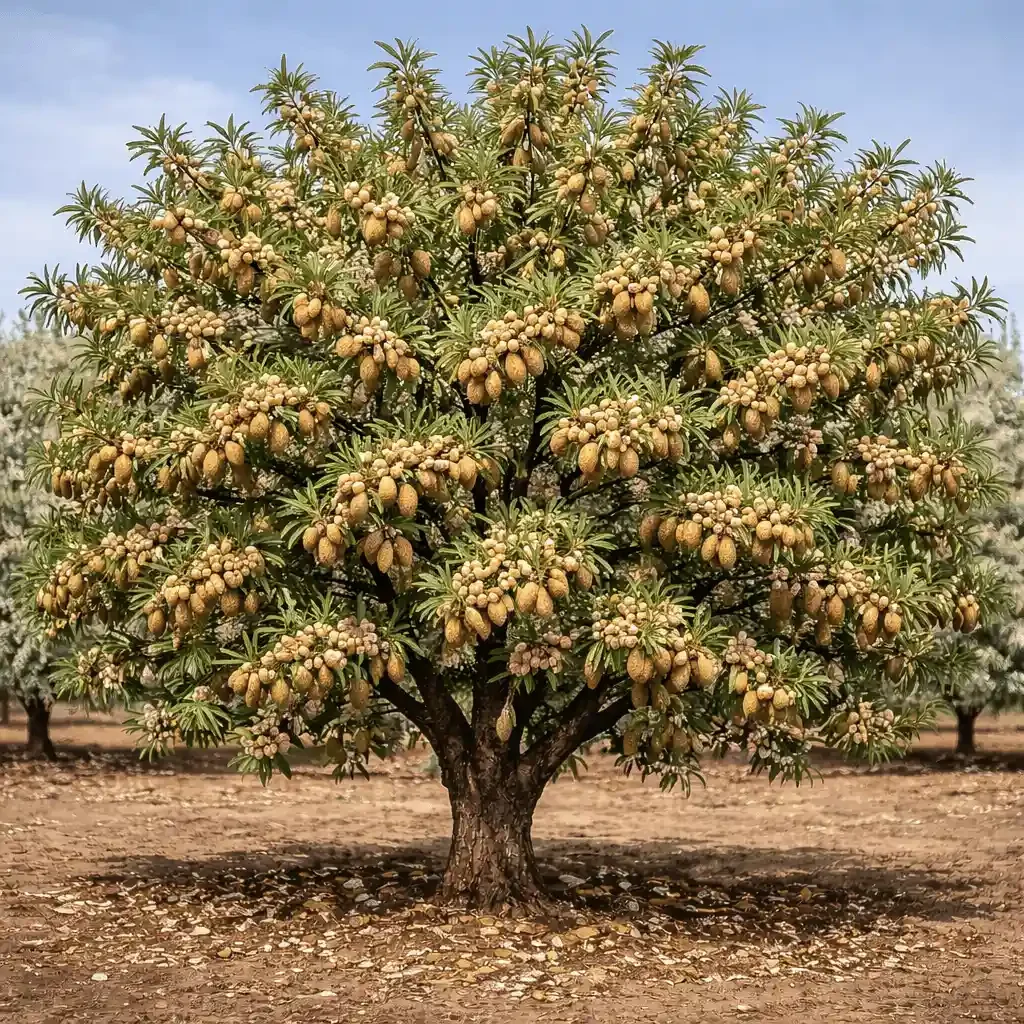
The California Classic - Sweet, Versatile, and Early Producing
The Carmel almond (Prunus dulcis 'Carmel') stands as one of California's most beloved mid-season almond varieties, renowned for its exceptional versatility, sweet flavor profile, and remarkably early production. Discovered as a chance seedling in Merced, California in 1966, Carmel quickly earned recognition as a natural cross between Nonpareil and Mission - combining the best qualities of both parents into a cultivar that became popular enough to warrant its own marketing classification. Introduced commercially from Le Grand, California that same year, Carmel revolutionized almond production by offering excellent quality nuts with superior shell seal, soft but well-sealed shells, and medium-sized elongated kernels with light color and sweet taste. The variety's distinctive characteristics - blooming 1-2 days after Nonpareil, harvesting in mid-September (17 days after Nonpareil), and producing heavy early yields - make it an ideal pollination partner and economic complement to Nonpareil orchards. With its compact, upright growth habit (more vertical than Nonpareil but smaller in stature), Carmel trees are naturally suited for home orchards and close commercial plantings. The soft-shell nuts excel in blanching, baking, roasting, and candy making, while the trees' excellent "knockability" ensures abundant harvests with minimal effort. Despite susceptibility to noninfectious bud failure (a genetic disorder that has challenged the variety), careful nursery selection and improved budwood sources have largely mitigated this issue, allowing Carmel to maintain its position as California's fifth most widely planted almond variety.
GROWING TIMELINE: FROM PLANTING TO HARVEST
Time to First Fruit
Standard Rootstock: 3-5 years to first significant harvest
Grafted trees on modern rootstock: 3-4 years to productive bearing
Carmel is notably an "early producer" - one of its defining characteristics
Carmel's reputation as a heavy and early producer means that grafted nursery trees often begin yielding commercial-quality nuts by year 3, with substantial production by year 4-5. This early productivity makes Carmel economically attractive for growers seeking quicker returns on orchard investments.
Growth Rate
Carmel exhibits low to moderate vigor compared to many almond varieties. The trees grow at a measured pace, typically adding 12-24 inches of new growth annually under ideal conditions. This restrained growth habit contributes to the tree's naturally compact size and makes training and maintenance more manageable than highly vigorous varieties. The upright, moderately spreading form develops predictably, reaching productive maturity within 5-6 years from planting.
Tree Lifespan
A well-maintained Carmel almond orchard can remain productive for 15-25 years, though this is somewhat shorter than longer-lived varieties like Mission or Nonpareil. The primary limiting factor for Carmel longevity is susceptibility to noninfectious bud failure, which can progressively reduce production over time in affected trees. However, trees sourced from carefully selected budwood lines (particularly second-generation "Carmel OS" selections developed to avoid bud failure expression) can achieve productive lifespans approaching 25-30 years. Peak production typically occurs between years 6-15.
Mature Tree Size
Standard (on peach or almond rootstock): 12-18 feet tall, 10-15 feet wide
Semi-Dwarf (on size-controlling rootstock): 10-14 feet tall, 8-12 feet wide
Dwarf (on special rootstock): 8-10 feet tall, 8-10 feet wide
Carmel is notably one of the smaller almond varieties, developing a compact form that doesn't spread as wide as it is tall. This upright growth pattern (more vertical than Nonpareil but less vigorous than Mission) makes Carmel ideal for home orchards with limited space and well-suited for high-density commercial plantings where maximizing trees per acre increases profitability.
Annual Production
A mature Carmel tree produces 15-40 pounds of in-shell nuts annually under favorable conditions. The variety's reputation as a "heavy producer" is well-earned - Carmel consistently ranks among the top yielders in university trials, particularly in early years of production. Commercial orchards typically achieve 1,800-2,800 pounds per acre, with well-managed high-density plantings reaching 3,000+ pounds per acre. The trees knock easily during mechanical harvest, ensuring efficient nut collection with minimal shaking passes.
GROWING REQUIREMENTS
USDA Hardiness Zones
Zones 7-9 are ideal for Carmel almond cultivation, with Zone 8 being optimal. The variety requires approximately 400 chill hours (temperatures below 45°F) during winter dormancy for proper bud development and flowering. Carmel's bloom timing - 1-2 days after Nonpareil (typically late February in California's Central Valley) - provides slightly more frost protection than the earliest varieties but still requires vigilance during late winter cold snaps. The tree is moderately susceptible to spring frost damage on open blossoms, so site selection should consider cold air drainage patterns. Zone 7 plantings need protection from extreme cold below 10°F.
Sunlight
Full sun exposure is absolutely essential - minimum 8 hours of direct sunlight daily, with more being better for optimal production. Carmel blooms in late February to early March in most California locations, so maximizing sunlight during the bloom period encourages pollinator activity and improves fruit set. Southern or southeastern exposure helps trees warm up earlier in spring and extends the effective growing season.
Soil Requirements
Well-drained soils with pH 6.5-7.5 produce the best results, with Carmel showing good adaptability to various soil types including sandy loams, loamy soils, and lighter clay loams. The key requirement is excellent drainage - like all almonds, Carmel is extremely susceptible to crown rot, root rots (Phytophthora), and other water-related diseases in poorly drained conditions. Avoid heavy clay, compacted soils, or areas with seasonal waterlogging. Carmel shows good compatibility with standard rootstocks but, like other varieties, may experience union mild etch on certain plum rootstocks in excessively wet conditions. The variety performs well in the deep alluvial soils of California's Central Valley but also succeeds in home orchard conditions with proper soil preparation.
Water Needs
Moderate to high water requirements during the growing season, with mature trees needing 36-48 inches of water annually in Central Valley climates. Carmel requires consistent irrigation from bloom through hull split (late February through late August/early September), with peak demand during kernel development (May-July). The variety is reasonably drought-tolerant once established but yields suffer significantly without adequate moisture during critical growth periods. Modern drip or micro-sprinkler irrigation systems provide efficient water delivery. Reduce irrigation after harvest to promote dormancy and prepare trees for winter. Proper water management helps minimize disease pressure, as Carmel is susceptible to fungal diseases including blossom brown rot and scab (particularly problematic in wet spring weather).
Pollination
Carmel almonds are completely self-incompatible and require cross-pollination from compatible varieties. This variety was developed specifically as an excellent pollinizer for Nonpareil and works beautifully in this role. Best pollinizer combinations for Carmel include:
Nonpareil (classic pairing - Carmel's primary purpose)
Aldrich (excellent early pollinizer)
Fritz (mid-bloom overlap)
Wood Colony (similar bloom timing)
Winters (overlapping bloom period)
The traditional California orchard design alternates rows of Nonpareil with rows of Carmel (or other compatible pollinizers) to ensure excellent pollination of both varieties. Plant compatible pollinizers within 50 feet, though closer spacing ensures better pollination success. Honeybees are the primary pollinators - commercial orchards rent 2-3 hives per acre during bloom. Carmel's heavy bloom and good pollen production make it one of the most reliable pollinizers for Nonpareil, covering the early to mid-bloom period effectively.
TREE APPEARANCE
Size and Form
Carmel almond trees develop a distinctive upright, moderately spreading form that stands more vertical than Nonpareil but remains notably smaller and more compact than most almond varieties. The tree is characterized as "low vigor" with "medium size" - it doesn't spread as wide as it grows tall, creating a somewhat columnar silhouette in maturity. This naturally compact growth habit makes Carmel particularly attractive for home orchards where space is limited and for commercial high-density plantings. The trunk develops attractive gray-brown bark with vertical fissures as it matures. The branch structure is well-balanced and relatively easy to train, though the upright habit requires attention during early pruning to develop good scaffold angles for optimal light penetration and fruit production.
Leaves
Lance-shaped leaves emerge shortly after flowering, measuring 3-5 inches long with finely serrated edges. The foliage is a bright medium green that remains healthy and attractive throughout the growing season, turning yellow-gold in fall before dropping. Leaf coverage is good but somewhat less dense than more vigorous varieties, allowing reasonable light penetration to interior branches. The foliage is susceptible to fungal diseases including scab (particularly problematic on Carmel), so monitoring during wet spring weather is important.
Blossoms
Carmel produces abundant white to pale pink five-petaled flowers in late winter (blooming 1-2 days after Nonpareil, typically late February to early March in California). The bloom is heavy and consistent, with flowers appearing in attractive clusters along branches before leaves emerge. Individual blossoms last 7-10 days under favorable conditions, with the entire bloom period extending 10-14 days depending on weather. The flowers are sweetly fragrant and highly attractive to honeybees. Carmel's bloom timing makes it an ideal pollinizer for Nonpareil - it covers the early to mid-Nonpareil bloom period perfectly, ensuring excellent pollination even when weather disrupts early bloom. The blossoms are moderately susceptible to brown rot (a fungal disease) during wet weather, requiring preventive fungicide applications in areas prone to spring rains.
Nuts
Carmel produces medium-sized almonds with an attractive elongated shape and light-colored, slightly wrinkled surface. The nuts are distinctly "Carmel-colored" (caramel brown) - darker than Nonpareil but lighter than Mission. The shell is soft but remarkably well-sealed, providing a good balance between ease of cracking (for processing) and protection against pest damage. This excellent shell seal makes Carmel notably resistant to navel orangeworm damage - a major advantage over poorly-sealed varieties like Nonpareil. The kernels inside are medium-sized (typically 20-25 kernels per ounce), elongated, and light-colored with a smooth to slightly wrinkled surface. The nuts develop in gray-green fuzzy hulls that split open to signal harvest readiness, typically in mid-September, about 17 days after Nonpareil (placing Carmel in the mid-season harvest window).
FLAVOR AND CHARACTERISTICS
Carmel almonds offer an exceptionally sweet, rich flavor with subtle hints of amaretto - a natural consequence of the variety's Mission parentage. The taste is noticeably sweeter and more complex than Nonpareil's mild nuttiness, making Carmel particularly popular among those who prefer a "nuttier," more full-bodied almond flavor. The kernels are tender with a pleasant crunch, excellent for eating fresh or lightly roasted. When roasted, the slightly wrinkled skin holds seasonings and coatings well (similar to Butte but less pronounced), making Carmel versatile for flavored nut products. The light kernel color and smooth surface make Carmel excellent for blanching - when the skin is removed, the underlying almond is pale and attractive, ideal for baking and confectionery where appearance matters. The soft shell cracks easily, yielding high percentages of intact kernels (typically 60-65% crack-out), making Carmel efficient to process. Food manufacturers appreciate Carmel's versatility - it can substitute for Nonpareil in applications requiring blanched almonds, and it can replace California-type almonds in uses requiring more robust flavor.
BENEFITS AND USES
Culinary Versatility
Carmel's exceptional adaptability makes it one of the most versatile almond varieties:
Blanching (the soft shell and smooth kernel make blanching easy and efficient)
Baking (sweet flavor enhances cookies, cakes, pastries, and breads)
Roasting (slightly wrinkled skin holds seasonings for flavored products)
Candy making (light color and sweet taste ideal for chocolates, brittles, toffees)
Slicing and slivering (elongated shape produces attractive slivers for garnish)
Almond milk and butter (rich amaretto-like flavor creates superior products)
Snacking (sweet taste and pleasant texture make excellent eating almonds)
General cooking (substitutes well for both Nonpareil and California types)
Commercial Production
Carmel ranks as California's fifth most widely planted variety with over 119 million pounds of kernel receipts annually. The variety's early production, heavy yields, compact growth, and excellent pollination characteristics make it economically valuable. The superior shell seal significantly reduces losses to navel orangeworm compared to Nonpareil, improving profit margins. Trees knock easily during mechanical harvest, reducing labor and equipment costs. The mid-season harvest (17 days after Nonpareil) spreads harvest labor across a longer window, reducing bottlenecks at hulling facilities.
As a Pollinizer
Carmel was essentially developed as the perfect pollinizer for Nonpareil, and it excels in this role. The bloom timing (1-2 days after Nonpareil) covers the critical early to mid-Nonpareil bloom period. Heavy pollen production ensures excellent pollination success. The variety's own commercial value as a quality nut (unlike some varieties grown purely for pollination) means growers profit from both Nonpareil and Carmel crops.
Home Orchard Excellence
For backyard growers, Carmel offers exceptional value:
Compact size fits limited spaces
Early production (bearing by year 3-4)
Heavy yields from small trees
Easy harvest (trees knock well)
Superior flavor for home use
Good disease resistance (except scab and bud failure)
Excellent fresh eating quality
STORAGE AND SHELF LIFE
In-Shell Storage
Carmel's soft but well-sealed shells create favorable storage characteristics. In cool (40-50°F), dry conditions with low humidity, in-shell Carmel almonds store for 12-18 months without significant quality deterioration. The superior shell seal (much better than Nonpareil) prevents rancidity and protects kernel integrity during storage. Store in breathable containers or burlap bags to prevent moisture accumulation.
Shelled Kernel Storage
Once shelled, Carmel kernels should be stored in airtight containers in cool, dark conditions to prevent rancidity. Refrigerated kernels maintain peak quality for 6-9 months; frozen kernels keep for up to 2 years. The light kernel color can darken slightly with prolonged storage, so use refrigeration or freezing for long-term storage of shelled nuts.
Processing and Drying
After harvest, almonds must be dried to 6-8% moisture content to prevent mold and ensure proper storage. Commercial operations use forced-air drying systems; home growers can spread nuts in single layers on screens in hot, dry conditions for 7-10 days. Properly dried Carmel almonds have excellent keeping qualities. The soft shell makes hulling and shelling straightforward, contributing to Carmel's popularity with processors.
Shelf Life Comparison
Carmel's approximately 2-year shelf life (in-shell, properly stored) equals or exceeds most California varieties. The well-sealed shell significantly extends freshness compared to poorly-sealed varieties like Nonpareil.
POPULARITY AND CULTIVATION
Carmel stands as California's fifth most widely planted almond variety with approximately 119 million pounds of kernel receipts annually (2019-20 data), following Nonpareil, Monterey, Butte/Padre, and Independence. Within the California almond industry, Carmel became so popular it earned its own marketing classification separate from the broader "California type" category - a distinction shared by only a handful of varieties. This separate classification reflects Carmel's unique quality profile and market demand.
The variety's development as a chance seedling discovered in Merced County in 1966 represents the golden era of California almond breeding when natural hybridization between Nonpareil and its pollinizers produced numerous valuable commercial varieties. Carmel's rapid adoption following its 1966 introduction from Le Grand, California demonstrates how well it met industry needs - combining excellent nut quality, reliable production, good pollination characteristics, and compact tree size in a single cultivar.
Globally, Carmel represents a small percentage of world almond production since it's grown almost exclusively in California (which produces about 80% of the world's almonds). However, within California's industry, Carmel plays a crucial role as both a profitable variety in its own right and as an essential pollinizer for the dominant Nonpareil. Many California orchards are designed around Nonpareil-Carmel alternating row patterns, making the two varieties an inseparable pair in commercial production.
The challenge of noninfectious bud failure has shaped Carmel's cultivation story. This genetic disorder, which causes progressive decline in affected trees, threatened the variety's future until nurseries developed improved selection protocols. Modern "Carmel OS" (orchard selection) trees propagated from second-generation budwood show dramatically reduced bud failure rates, ensuring Carmel's continued importance in California almonds.
VARIETIES AND RELATED CULTIVARS
Carmel is one specific named cultivar, not a type with multiple sub-varieties. However, improved selections have emerged:
Carmel OS (Orchard Selection): Modern nursery propagation from carefully selected second-generation budwood sources that show minimal expression of noninfectious bud failure. These trees represent the current standard for commercial Carmel plantings, offering the variety's excellent characteristics while largely avoiding the bud failure problems that plagued earlier plantings.
Related Chance Seedlings from the Same Era:
Monterey: Another Nonpareil x Mission chance seedling discovered in Merced County in 1962, introduced in 1974. Now California's second most planted variety. Blooms slightly later than Carmel.
Thompson: Similar origin (chance seedling, Nonpareil x Mission), developed in the same Merced County region. Smaller kernels but similar California type characteristics.
Price: Another chance seedling from natural Nonpareil hybridization, also producing California type almonds.
Merced: Early chance seedling from the same breeding paradigm that produced Carmel.
These varieties represent a family of successful cultivars that arose from the same basic cross (Nonpareil x Mission or similar) during the 1960s-1970s period, collectively creating the "California type" marketing category that transformed the industry.
FUN FACTS ABOUT CARMEL ALMOND TREES
A Happy Accident: Carmel, like many of California's best almond varieties, was a chance seedling - an accidental natural cross between Nonpareil and Mission that occurred in an orchard near Merced, California. Some ambitious bee carried pollen from a Mission tree to a Nonpareil blossom, and the resulting seed grew into what became one of California's most important almond varieties. This serendipitous origin represents the golden age of California almond development when natural hybridization produced more valuable varieties than planned breeding programs.
Namescape Connection: Carmel was discovered in Merced County but introduced commercially from Le Grand, California in 1966. The name "Carmel" itself is interesting - while it might seem like a reference to California's famous coastal town of Carmel-by-the-Sea, the almond variety is actually named for its distinctive caramel-brown kernel color. The spelling difference (Carmel vs. Caramel) creates a pleasant California connection while describing the nut's appearance.
Its Own Category: Carmel became so popular and distinctive that it earned its own marketing classification separate from the broader "California type" almonds - a distinction achieved by very few varieties. When you see "Carmel almonds" marketed separately from "California almonds," it reflects the variety's unique combination of characteristics that set it apart from other mid-season varieties with similar California type traits.
The Nonpareil's Best Friend: Carmel was essentially developed as the perfect pollinizer for Nonpareil, California's dominant variety. Its bloom timing (1-2 days after Nonpareil), heavy pollen production, and extended bloom period make it ideal for ensuring Nonpareil's pollination success. The fact that Carmel produces excellent commercial nuts in its own right (unlike varieties grown purely for pollination) makes the Nonpareil-Carmel pairing economically optimal - growers profit from both varieties.
Amaretto in Every Bite: Carmel's distinctive flavor profile - described as having "hints of amaretto" - comes from its Mission parentage. Mission almonds have higher concentrations of certain flavor compounds that create that characteristic almond liqueur taste. This natural amaretto flavor makes Carmel particularly prized for almond milk and almond butter, where the variety's rich taste shines through processing.
Early Bird Gets the Profit: Carmel's reputation as a "heavy and early producer" means grafted nursery trees often yield commercial quantities of nuts by year 3, with substantial production by year 4. This early productivity provides faster return on investment compared to varieties that take 5-7 years to reach commercial production. For growers financing orchard establishment, those 1-2 years of earlier revenue make a significant difference in overall economics.
The Bud Failure Challenge: Carmel's susceptibility to noninfectious bud failure (also called "crazy top" for the distinctive tangled, sparse branching it creates) nearly threatened the variety's future in California. This genetic disorder, triggered by stress (particularly heat stress in young trees), progressively reduces production over years. However, careful nursery selection of bud wood from trees that never expressed symptoms has largely solved the problem - modern "Carmel OS" trees show dramatically lower bud failure rates, securing the variety's continued importance.
Perfect for Close Quarters: Carmel is one of the smaller almond varieties, described as not spreading as wide as it grows tall - creating a somewhat columnar or upright form. This compact growth habit makes Carmel ideal for small home orchards (where space is limited) and for high-density commercial plantings where maximizing trees per acre increases profit per acre. Some growers plant Carmel at higher densities than spreading varieties like Butte.
Disease Detective: Carmel is especially susceptible to scab, a fungal disease that affects leaves and developing nuts during wet spring weather. This sensitivity actually makes Carmel useful as an "indicator variety" in university disease trials - when testing new fungicide programs or disease management strategies, researchers often include Carmel because its susceptibility quickly reveals whether treatments are effective. If Carmel stays clean, the program works!
Blanching Beauty: The soft shell and smooth, light-colored kernels make Carmel one of the easiest varieties to blanch - the process of removing almond skins by briefly boiling and then shocking in cold water. The skins slip off cleanly, revealing pale, attractive kernels ideal for candy making, baking, and products where visual appeal matters. This easy blanching characteristic, combined with good flavor, makes Carmel a favorite among confectioners and bakers who often specify "Carmel almonds" in their recipes.
CONCLUSION: THE VERSATILE COMPANION
The Carmel almond tree represents California almond breeding at its finest - a chance seedling that combined the best traits of both parents (Nonpareil's quality, Mission's flavor and disease resistance) into a cultivar that earned its own place in California's agricultural history. While developed primarily as a pollinizer for Nonpareil, Carmel quickly proved its value as a standalone commercial variety with exceptional versatility, sweet flavor, early production, and compact growth habit. For commercial growers, Carmel offers reliable heavy yields, mid-season harvest timing, superior shell seal (reducing pest damage), easy processing characteristics, and dual value as both a profitable crop and excellent pollinizer. The variety's economic importance is reflected in its ranking as California's fifth most planted almond and its unique separate marketing classification.
For home orchardists, Carmel provides exceptional value - compact trees that fit small spaces, early bearing (often by year 3), heavy production from young trees, easy harvest, superior flavor for fresh eating and home processing, and versatility in culinary applications from snacking to baking to candy making. The sweet, amaretto-tinged flavor makes Carmel almonds a treat whether eaten straight from the tree, lightly roasted with sea salt, or transformed into rich almond butter or milk.
The challenge of noninfectious bud failure, once threatening to limit Carmel's future, has been largely overcome through careful nursery selection, making modern Carmel OS trees reliable and long-lived. If you're planning an almond orchard in USDA zones 7-9, Carmel deserves serious consideration as either a Nonpareil pollinizer (its original purpose) or as a primary variety valued for its own excellent characteristics. Plant it with Nonpareil for the classic California pairing, ensure full sun and excellent drainage, manage carefully for scab and brown rot in wet springs, and you'll be rewarded with heavy crops of sweet, versatile almonds that excel in virtually every culinary application.
Whether you're a commercial grower maximizing pollination efficiency and harvest timing or a homesteader wanting productive, manageable trees with superior flavor, Carmel almond delivers. It's the versatile companion that makes Nonpareil orchards more profitable, the compact producer perfect for small spaces, and the sweet-flavored nut that proves excellent almonds don't require enormous trees or decades of waiting.
Ready to explore more almond varieties and fruit tree options? Download our Complete Tree Directory to discover varieties perfect for your climate and needs.
SimitianNest.com | Your Complete Guide to Tree Families