
Garden Prince Almond Tree
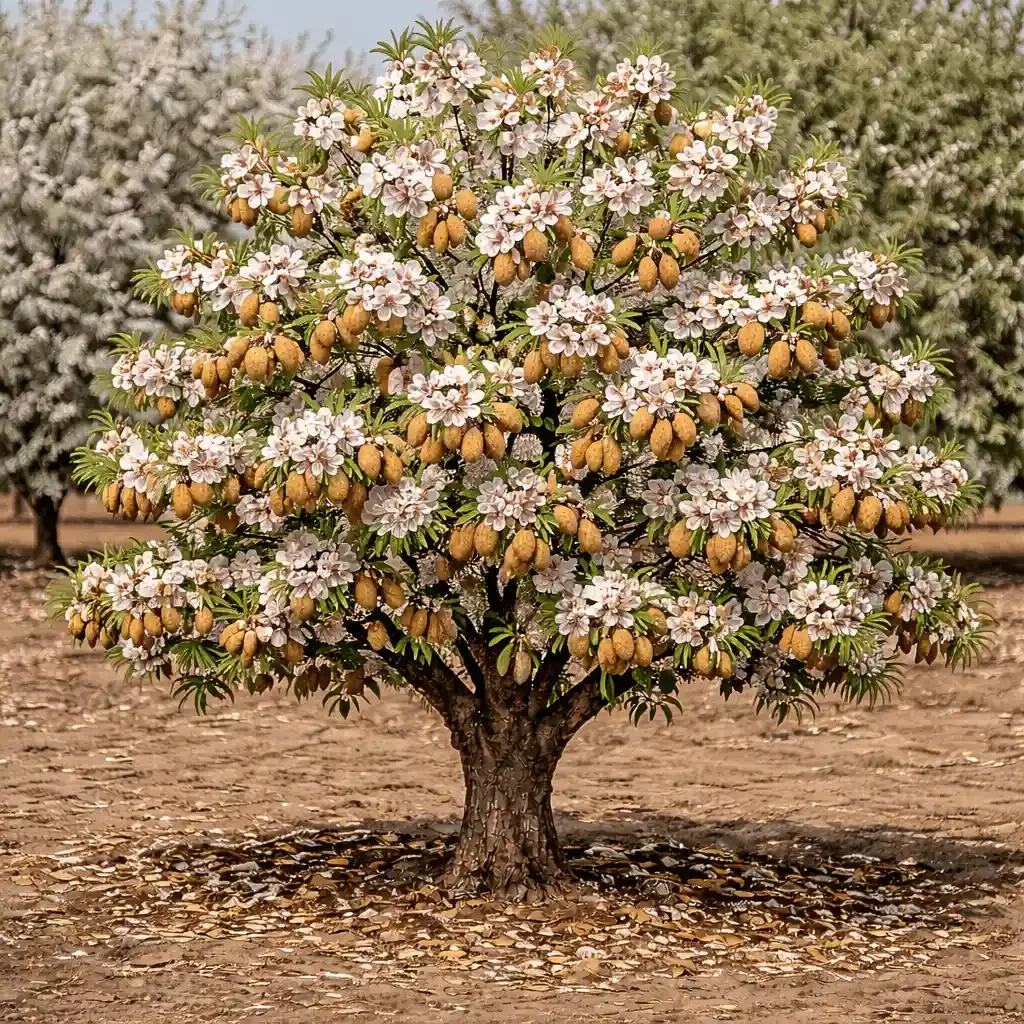
The Perfect Almond for Small Spaces - A Genetic Dwarf Revolution
The Garden Prince almond (Prunus dulcis 'Garden Prince') represents a breakthrough in home orchard fruit growing - a true genetic dwarf almond that produces full-sized, sweet, soft-shelled nuts on a compact 6-12 foot tree. Developed by the legendary Zaiger Genetics of Modesto, California and protected under U.S. Plant Patent No. 5146 (now expired), Garden Prince revolutionized backyard almond cultivation by making fresh, homegrown almonds accessible to urban and suburban gardeners with limited space. Unlike standard almonds grafted onto dwarfing rootstock (which still tend toward larger sizes), Garden Prince is a genetic dwarf - the dwarfing characteristic is bred into the tree itself, ensuring compact growth regardless of rootstock. This naturally small tree grows just 6-9 feet tall according to some sources, or 10-12 feet according to others, depending on growing conditions and pruning practices, but can be maintained at 8 feet with summer pruning. The lushly foliated tree produces large, showy, light pink blossoms in spring (March in most climates), creating exceptional ornamental value before yielding medium-sized soft-shelled almonds with exceptionally sweet and tasty kernels. Perhaps Garden Prince's most revolutionary characteristic is its self-fertility - unlike virtually all commercial almond varieties that require cross-pollination from compatible partners, Garden Prince sets a full crop from its own pollen, meaning gardeners need only one tree to enjoy fresh almonds. With a low chill requirement (250 hours below 45°F), early bearing (often by year 2-3), heavy production (10-20+ pounds annually from mature trees), and compact size perfect for patios, small yards, or high-density plantings, Garden Prince has earned its title as the "#1 almond for home orchards."
GROWING TIMELINE: FROM PLANTING TO HARVEST
Time to First Fruit
Standard planting: 2-3 years to first almonds
Container-grown trees: Sometimes bearing within 2 years
Full production: 3-5 years after planting
Garden Prince is notably precocious - one of the fastest-bearing almond varieties available. Many gardeners report seeing first nuts by year 2, with substantial harvests beginning year 3. This remarkably early production makes Garden Prince ideal for gardeners seeking quick returns and for those wanting to enjoy homegrown almonds without the 5-7 year wait typical of standard varieties.
Growth Rate
Garden Prince exhibits slow to moderate growth, adding 8-18 inches of new growth annually under favorable conditions. As a true genetic dwarf, the tree's restrained vigor is built into its DNA - it naturally grows slowly and compactly, making training and maintenance minimal compared to vigorous standard varieties. This measured growth habit contributes to Garden Prince's suitability for container culture, where it can thrive in large pots (minimum 15-20 gallon) for years with appropriate care.
Tree Lifespan
A well-maintained Garden Prince almond can remain productive for 15-25 years, with some trees exceeding 30 years under ideal conditions. The genetic dwarf characteristic doesn't shorten lifespan - these trees simply stay small throughout their productive years. Peak production typically occurs between years 5-15, though well-managed trees continue bearing heavily for two decades or more.
Mature Tree Size
Unpruned/minimal pruning: 10-12 feet tall, 8-10 feet wide
With regular pruning: 6-9 feet tall, 6-8 feet wide
Container culture: 6-8 feet tall, 6-8 feet wide
Controlled to 8 feet: Easily maintained at this height with summer pruning
Garden Prince's mature size varies somewhat depending on climate, soil fertility, water availability, and pruning practices. Trees grown in rich soil with ample water may reach the upper end of the range (10-12 feet), while those in leaner conditions or with regular pruning stay at the lower end (6-9 feet). The key advantage is that regardless of final size, Garden Prince remains genuinely compact - a "lushly foliated" tree with dense, attractive foliage on a small frame.
Annual Production
A mature Garden Prince tree produces 10-20+ pounds of in-shell almonds annually, with exceptional trees in ideal conditions yielding up to 25 pounds. While this is less than full-sized commercial varieties (which produce 30-50+ pounds), the production-to-tree-size ratio is remarkable - Garden Prince produces nearly as many nuts as trees twice its size. For home orchards where space is limited, the ability to harvest 15-20 pounds of fresh almonds from a tree that fits in a 10x10 foot space (or even in a large container) represents outstanding productivity.
GROWING REQUIREMENTS
USDA Hardiness Zones
Zones 6-10, with Zones 7-9 being optimal. Garden Prince has a low chill requirement of only 250 hours (temperatures below 45°F during winter dormancy), making it suitable for warmer climates than most almond varieties. This low chill requirement expands almond growing into regions previously considered too warm for reliable production. The tree blooms in March in most climates - later than many commercial varieties, providing good frost protection. However, open blossoms remain susceptible to late spring freezes, so site selection should consider frost risk. Zone 6 plantings need protection from extreme cold below 0°F, though Garden Prince shows better cold tolerance than many almonds.
Sunlight
Full sun is essential for optimal production - minimum 6-8 hours of direct sunlight daily, with 8-10 hours being ideal. Garden Prince tolerates partial shade (1/2 day sun) better than most almonds and will still produce nuts with 6 hours of sun, though yields decrease. This shade tolerance makes Garden Prince suitable for urban gardens where full sun all day may be difficult to achieve. Southern or southeastern exposure maximizes early spring warmth during bloom.
Soil Requirements
Well-drained soil is absolutely critical - Garden Prince, like all almonds, is extremely susceptible to root rot, crown rot, and other water-related diseases in poorly draining conditions. The variety adapts to various soil types including sandy loam, loamy soils, and even clay loams, provided drainage is excellent. Ideal pH range is 6.0-7.5, though Garden Prince tolerates slightly alkaline soils up to pH 8.0. The tree performs well in typical garden soils amended with compost for drainage improvement. Garden Prince shows good adaptability to container culture in quality potting mixes - use a well-draining professional mix (never garden soil) with added perlite or pumice for extra drainage. Avoid heavy clay, compacted soils, or any location with standing water.
Water Needs
Moderate water requirements during the growing season. Established Garden Prince trees need deep watering weekly during hot summer months (May-September), with frequency adjusted based on temperature, soil type, and rainfall. The small tree size means water needs are substantially less than full-sized varieties - a mature Garden Prince might need 10-15 gallons per week during peak summer compared to 25-40 gallons for standard trees. Container-grown trees require more frequent watering (potentially daily in hot weather) since pots dry faster than ground plantings. Reduce watering after harvest (September-October) to promote dormancy. Garden Prince shows reasonable drought tolerance once established but yields suffer without adequate moisture during kernel development (May-August).
Pollination
Garden Prince is gloriously self-fertile (also called self-fruitful) - it sets a full crop from its own pollen without requiring another almond variety for cross-pollination. This characteristic is revolutionary for home gardeners, as virtually all commercial almond varieties are self-incompatible and require compatible pollinizers planted nearby. With Garden Prince, you need only ONE tree to enjoy fresh homegrown almonds - no need to dedicate space to multiple varieties, no concerns about matching bloom times, and no worries about whether your pollinizer survived the winter. While Garden Prince can pollinate other almond varieties if planted nearby, it produces abundantly on its own. Honeybees and other pollinators appreciate Garden Prince's large pink blossoms and visit readily during March bloom.
TREE APPEARANCE
Size and Form
Garden Prince develops as a naturally compact, rounded to slightly spreading tree with a dense, bushy form. The genetic dwarf characteristic creates abundant branching and lush foliage on a small frame - the tree doesn't look sparse or stunted but rather appears as a perfectly proportioned miniature almond tree with full, attractive canopy coverage. The growth habit is moderately spreading rather than strongly upright, creating a pleasant rounded silhouette. The trunk develops attractive gray-brown bark with vertical fissures as it matures, though the smaller overall size means trunk diameter remains modest even on mature trees. Branch structure is well-balanced and naturally produces good scaffold angles without extensive training.
Leaves
Lance-shaped leaves measuring 2.5-4 inches long (slightly smaller than standard varieties) with finely serrated edges emerge shortly after bloom. The foliage is described as "lush" - dense, bright medium-green, and healthy-looking throughout the growing season. This abundant leaf coverage gives Garden Prince excellent ornamental value as a landscape specimen tree beyond its nut production. Leaves turn yellow-gold in fall before dropping, providing pleasant autumn color. The dense foliage creates good shade for developing nuts and contributes to the tree's bushy, full appearance.
Blossoms
Garden Prince produces abundant large, showy, light pink blossoms in spring (March in most climates). The flowers are notably larger and showier than many almond varieties - a deliberate breeding goal to enhance ornamental value. Five-petaled blossoms appear in attractive clusters along branches before leaves emerge, creating a spectacular springtime display that rivals ornamental flowering trees. Individual blooms measure 1-1.5 inches across, and their light pink color is particularly eye-catching. The heavy bloom lasts 10-14 days under favorable conditions, providing extended visual impact and ensuring good pollination opportunity. The flowers are sweetly fragrant and attract bees, butterflies, and other beneficial insects. Garden Prince's late bloom (March rather than February) reduces frost damage risk compared to earlier-blooming commercial varieties.
Nuts
Garden Prince produces medium-sized almonds with soft shells and exceptionally sweet, tasty kernels. The nuts are attractive and well-formed, comparable in size to commercial varieties despite the tree's small stature. Shells are soft (easy to crack by hand or with simple nutcrackers) but sufficiently sealed to protect developing kernels from pest damage. Inside, the kernels are plump, sweet, and flavorful - some growers describe them as "especially sweet" compared to commercial almonds, likely due to tree-ripened freshness. The nuts develop in gray-green fuzzy hulls that split open to signal harvest readiness, typically in late August through September (or September-October depending on climate), with ripening occurring later than early varieties like Nonpareil but earlier than very late varieties like Mission. The soft shells and sweet kernels make Garden Prince almonds excellent for fresh eating, easy home processing, and all culinary applications.
FLAVOR AND CHARACTERISTICS
Garden Prince almonds are celebrated for their exceptionally sweet, rich flavor that many home growers consider superior to store-bought commercial almonds. The sweetness comes partly from tree-ripened freshness (almonds harvested at peak ripeness and consumed soon after taste noticeably better than commercially processed nuts stored for months) and partly from Garden Prince's inherent flavor profile. The kernels are tender, moist, and flavorful with none of the bitterness sometimes found in certain commercial varieties. When eaten fresh from the tree, Garden Prince almonds reveal why homegrown nuts command premium prices at farmers markets - the difference is immediately apparent.
The soft shell makes processing easy for home use - unlike hard-shelled varieties that require mechanical crackers, Garden Prince shells crack cleanly with handheld nutcrackers, simple pliers, or even gentle hammer taps. This ease of processing is perfect for gardeners wanting almonds for daily snacking rather than commercial-scale production. The kernels blanch easily (skins slip off after brief boiling), roast beautifully, and work perfectly in baking, candy making, almond milk, almond butter, and all culinary applications. The natural sweetness means Garden Prince almonds need less added sugar in recipes compared to typical commercial almonds.
BENEFITS AND USES
Home Orchard Excellence
Garden Prince was specifically developed for home gardeners and excels in this role:
Perfect size for small yards, urban gardens, and suburban landscapes
Single tree produces full crop (no pollinator needed)
Early bearing (harvest almonds within 2-3 years)
Container-friendly for patios, balconies, and small spaces
Dual-purpose ornamental/edible (gorgeous spring flowers + delicious nuts)
Easy harvest and processing (soft shells, manageable tree height)
Low maintenance compared to vigorous varieties
Fits into edible landscaping designs
Culinary Applications
Garden Prince almonds excel in all home kitchen uses:
Fresh snacking (superior flavor tree-ripened)
Roasting (sweet flavor enhanced by roasting)
Baking (cookies, cakes, breads, pastries)
Candy making (especially good for chocolate-covered almonds)
Almond milk (rich, sweet homemade almond milk)
Almond butter (creamy, naturally sweet)
Salad toppings (adds flavor and crunch)
Trail mix and granola (perfect size and flavor)
Holiday baking (traditional almond-based cookies and pastries)
Ornamental Value
Garden Prince serves double duty as an ornamental flowering tree:
Large, showy pink blossoms in spring (spectacular display)
Compact size suits residential landscapes
Dense, attractive foliage all season
Pleasant yellow fall color
Fits near patios, entrances, as focal points
Works in mixed ornamental-edible borders
Attracts pollinators (bees, butterflies)
Container Culture
Garden Prince is one of few almond varieties genuinely suited to large container growing:
True genetic dwarf stays small naturally
Grows successfully in 15-20+ gallon containers
Perfect for patios, decks, balconies
Allows almond growing in non-ideal climates (move indoors during cold snaps)
Manageable root system fits container constraints
Produces meaningful harvests even in pots
Educational Value
Garden Prince provides excellent teaching opportunities:
Children can harvest, crack, and eat almonds they've watched grow
Demonstrates complete nut production cycle
Shows pollination process with attractive flowers
Teaches food growing in limited spaces
Connects urban/suburban dwellers to food production
STORAGE AND SHELF LIFE
In-Shell Storage
Garden Prince's soft shells make long-term in-shell storage less ideal than hard-shelled varieties - the shells don't provide maximum protection over extended periods. However, in cool (40-50°F), dry conditions with low humidity, in-shell Garden Prince almonds store for 6-12 months. Store in breathable containers (burlap bags, paper bags, or containers with ventilation) to prevent moisture accumulation. For home gardeners who consume their harvest within a season, storage duration is rarely an issue.
Shelled Kernel Storage
Once shelled, Garden Prince kernels should be stored in airtight containers in the refrigerator (6-9 month storage life) or freezer (up to 2 years). The sweet, moist kernels are more susceptible to rancidity at room temperature than drier commercial varieties, so refrigeration is recommended even for short-term storage. Properly frozen Garden Prince almonds retain excellent quality and can be used directly from the freezer in many applications.
Processing and Drying
After harvest, almonds should be dried to 6-8% moisture content to prevent mold and ensure proper storage. Home growers can spread nuts in single layers on screens in a hot, dry location (garage, attic, or sunny patio) for 5-7 days, turning daily. The small harvest size makes hand-drying practical. Once dried (shells should feel crisp, kernels should snap cleanly rather than bending), almonds can be stored in-shell or shelled based on intended use timeline.
Fresh vs. Stored Comparison
Garden Prince almonds taste noticeably better fresh (within 1-2 months of harvest) than after extended storage. The sweet, moist character that makes them delicious also means they're best consumed relatively fresh. Many home growers intentionally harvest Garden Prince for immediate use rather than long-term storage - enjoying almonds as a seasonal treat from August through late fall rather than trying to store a year's supply.
POPULARITY AND CULTIVATION
Garden Prince occupies a unique niche in almond cultivation - while not a major commercial variety, it dominates the home orchard genetic dwarf almond market. Developed by Zaiger Genetics (the legendary California fruit breeding firm responsible for pluots, apriums, and countless other successful cultivars), Garden Prince was specifically bred to solve a problem: making fresh almond growing accessible to gardeners with limited space. The variety's U.S. Plant Patent No. 5146 (now expired, allowing any nursery to propagate it) reflects its innovation and value.
Garden Prince is widely available through home garden nurseries, mail-order fruit tree companies, and retail garden centers throughout almond-growing regions and beyond. The variety's low chill requirement (250 hours) makes it suitable for warmer climates where traditional almonds struggle, expanding almond growing into Zones 9-10 where few other varieties succeed. Conversely, its reasonable cold hardiness (Zone 6 with protection) allows almond growing in cooler regions than typical for the crop.
The variety rarely appears in commercial almond production - its small size makes mechanical harvesting difficult, and yields per acre (due to small tree size) don't compete with full-sized varieties in land-intensive commercial operations. However, Garden Prince excels in the market it was designed for: home gardeners, small-scale growers, direct market farmers, and anyone wanting fresh almonds without dedicating large spaces to full-sized trees.
Garden Prince's success sparked development of other genetic dwarf almonds (like All-in-One, another Zaiger creation), but Garden Prince remains the most widely grown and proven variety in this category.
VARIETIES AND RELATED CULTIVARS
Garden Prince is one specific named cultivar. However, it exists within a small family of genetic dwarf and semi-dwarf almonds developed for home garden use:
All-in-One: Another Zaiger Genetics genetic semi-dwarf almond, growing 12-15 feet tall. Self-fertile, soft-shelled, sweet kernels. Slightly larger than Garden Prince but still compact compared to standard varieties. Good production, attractive pink flowers.
Hall's Hardy: Not a true genetic dwarf but a hardy late-blooming almond suitable for cold climates (Zone 5-8). Grows to standard size (15-20 feet) but valued for extended range. Self-fertile (rare for non-dwarf almonds). Pink flowers, sweet nuts.
Pixie-Cot: While technically an apricot-plum hybrid (Aprium®), this Zaiger genetic dwarf deserves mention as a companion plant for Garden Prince in small-space fruit gardens. Similar compact size and ornamental value.
Standard Commercial Almonds on Dwarfing Rootstock: Some nurseries sell commercial varieties (Nonpareil, Carmel, etc.) grafted onto dwarfing rootstock, marketing them as "dwarf almonds." These differ from Garden Prince - they're full-sized varieties restrained by rootstock and typically still grow 12-18 feet, requiring cross-pollination and maintaining commercial variety characteristics. True genetic dwarfs like Garden Prince are inherently small regardless of rootstock.
Future Developments: The success of Garden Prince and All-in-One suggests continued breeding interest in compact, self-fertile almonds for home gardens. Expect additional genetic dwarf releases as breeding programs recognize the substantial home garden market for space-efficient fruit trees.
FUN FACTS ABOUT GARDEN PRINCE ALMOND TREES
Zaiger Magic: Garden Prince was developed by Zaiger Genetics, the legendary Modesto, California fruit breeding firm responsible for some of the most innovative fruit varieties of the past 50 years. While Zaiger is most famous for creating pluots (plum-apricot hybrids) and apriums (apricot-plum hybrids), their work on genetic dwarf fruit trees for home gardens has been equally revolutionary. Garden Prince represents decades of selective breeding to incorporate dwarfing genes while maintaining nut quality, self-fertility, and ornamental beauty.
True Genetic Dwarf: Garden Prince is a true genetic dwarf, not a standard variety grafted onto dwarfing rootstock. The dwarfing characteristic is bred into the tree's DNA - if you grew Garden Prince from seed, the offspring would still be dwarf (though they might not inherit all other characteristics). This contrasts with most "dwarf" fruit trees sold commercially, which achieve small size through dwarfing rootstock rather than genetic dwarfing. The advantage: Garden Prince stays small regardless of rootstock, and the variety can be propagated on various rootstocks based on soil adaptation needs rather than size control.
The One-Tree Almond Orchard: Garden Prince's self-fertility revolutionized backyard almond growing. Before self-fertile varieties, home gardeners wanting almonds needed at least two trees (of compatible varieties with overlapping bloom times) to achieve pollination - doubling space requirements and complexity. Garden Prince needs only itself - one tree provides a full harvest, making almond growing accessible to even the smallest gardens. This single characteristic likely accounts for Garden Prince's overwhelming popularity in home orchards.
Container Superstar: Garden Prince is one of very few almond varieties genuinely suited to container culture. While many fruit trees are advertised as "container-friendly," most eventually outgrow pots or produce poorly in containers. Garden Prince truly succeeds in large pots (15-20+ gallons), producing meaningful harvests year after year. This opens almond growing to apartment balconies, urban patios, and situations where in-ground planting isn't possible. Container culture also allows gardeners in marginal climates to move trees under cover during extreme weather.
From Flower Show to Harvest: Garden Prince serves genuine double duty as ornamental and edible. The large, showy pink blossoms in spring create a display comparable to ornamental flowering trees - many landscape designers specify Garden Prince purely for spring color, with the nut harvest considered a bonus. This ornamental-edible fusion makes Garden Prince easy to justify in front-yard landscapes, near entrances, or anywhere homeowners associations might object to "fruit trees" but welcome "flowering trees."
Bred for Warmth: Garden Prince's low chill requirement (250 hours below 45°F) was specifically bred to expand almond growing into warmer regions. Most commercial almonds need 400-500+ chill hours, limiting them to areas with cold winters. Garden Prince thrives in Zone 9-10 where traditional almonds often fail to set crops due to insufficient chilling. This makes Garden Prince ideal for Southern California, coastal areas, low-elevation Southwest gardens, and similar warm-winter climates.
Patent Expired, Availability Increased: Garden Prince was protected by U.S. Plant Patent No. 5146, which restricted who could propagate and sell the variety. When the patent expired, any nursery could legally propagate Garden Prince, dramatically increasing availability and reducing prices. Today, Garden Prince is widely available from dozens of nurseries at reasonable prices - a win for gardeners wanting this excellent variety.
Size Surprise: Garden Prince's mature size varies surprisingly based on growing conditions. Trees in lean soils with minimal water and regular pruning may stay 6-8 feet tall, while those in rich soils with ample water can reach 12 feet. This variability isn't a flaw - it allows gardeners to influence final size through cultural practices. Want a truly tiny tree? Use lean soil, moderate water, and summer pruning. Want maximum production? Provide rich soil, regular water, and minimal pruning.
Soft Shell Shortcut: Garden Prince's soft shells make home nut processing dramatically easier than hard-shelled varieties. Commercial varieties like Padre or Mission have very hard shells requiring mechanical crackers or serious hand strength to open. Garden Prince shells crack easily with simple handheld nutcrackers (even cheap models), making nut processing accessible to children, elderly gardeners, or anyone wanting easy processing. This ease of use encourages actually eating homegrown almonds rather than letting them sit in storage.
Child-Friendly Nut Tree: Garden Prince makes an excellent choice for family gardens and teaching children about food growing. The tree's small size means children can participate in harvest (picking nuts is safe and easy at 6-8 foot tree height), the soft shells allow kids to crack nuts themselves without dangerous tools, and the sweet flavor appeals to children's palates. Growing Garden Prince creates memorable family experiences - children remember harvesting and eating almonds from "their" tree for years afterward, fostering appreciation for homegrown food and gardening.
CONCLUSION: THE GENETIC DWARF THAT CHANGED HOME ALMOND GROWING
The Garden Prince almond represents a milestone in fruit breeding - a variety that genuinely solved a real problem (how to grow almonds in small spaces) through innovative genetics rather than compromise. Before Garden Prince, home almond growing meant dedicating substantial garden space to two or more full-sized trees, waiting 5-7 years for production, and accepting that only those with larger properties could enjoy fresh almonds. Garden Prince changed everything: one small tree, productive in 2-3 years, suitable for tiny yards or even large containers, requiring no pollinator, and producing abundantly.
For home gardeners, Garden Prince delivers exceptional value: compact 6-12 foot size fits anywhere, beautiful ornamental qualities justify planting as landscape specimen, self-fertility eliminates complexity, early bearing provides quick gratification, low maintenance reduces work, and delicious soft-shelled nuts reward minimal effort. The variety's adaptability to containers, low chill requirement, partial shade tolerance, and ease of processing make it accessible to a wider range of gardeners than any other almond variety.
Garden Prince won't replace commercial varieties in agricultural production - its small size and soft shells don't suit mechanical systems. But in home orchards, small farms, educational gardens, and urban food forests, Garden Prince has no equal. It's the variety that makes fresh almond growing practical for apartment dwellers, suburban homeowners with modest yards, and anyone who thought almond growing required too much space or expertise.
If you're considering adding an almond tree to your garden in USDA Zones 6-10, Garden Prince deserves serious consideration as either your primary choice (in small spaces) or as a companion to standard varieties (in larger gardens). Plant it in full sun with excellent drainage, provide moderate water during summer, enjoy spectacular pink blossoms in spring, and harvest sweet, soft-shelled almonds in late summer - all from a tree that barely occupies more space than a large shrub.
Whether you're a space-limited urban gardener, a homesteader wanting easy-to-grow nuts, a parent teaching children about food production, or simply someone who loves fresh almonds and beautiful spring flowers, Garden Prince delivers. It's the genetic dwarf that proved small trees can produce big results, the one-tree almond orchard, and the variety that brought fresh homegrown almonds within reach of millions of gardeners previously excluded from almond growing.
Ready to explore more almond varieties and fruit tree options? Download our Complete Tree Directory to discover varieties perfect for your climate and needs.