
The Golden Delicious Apple Tree
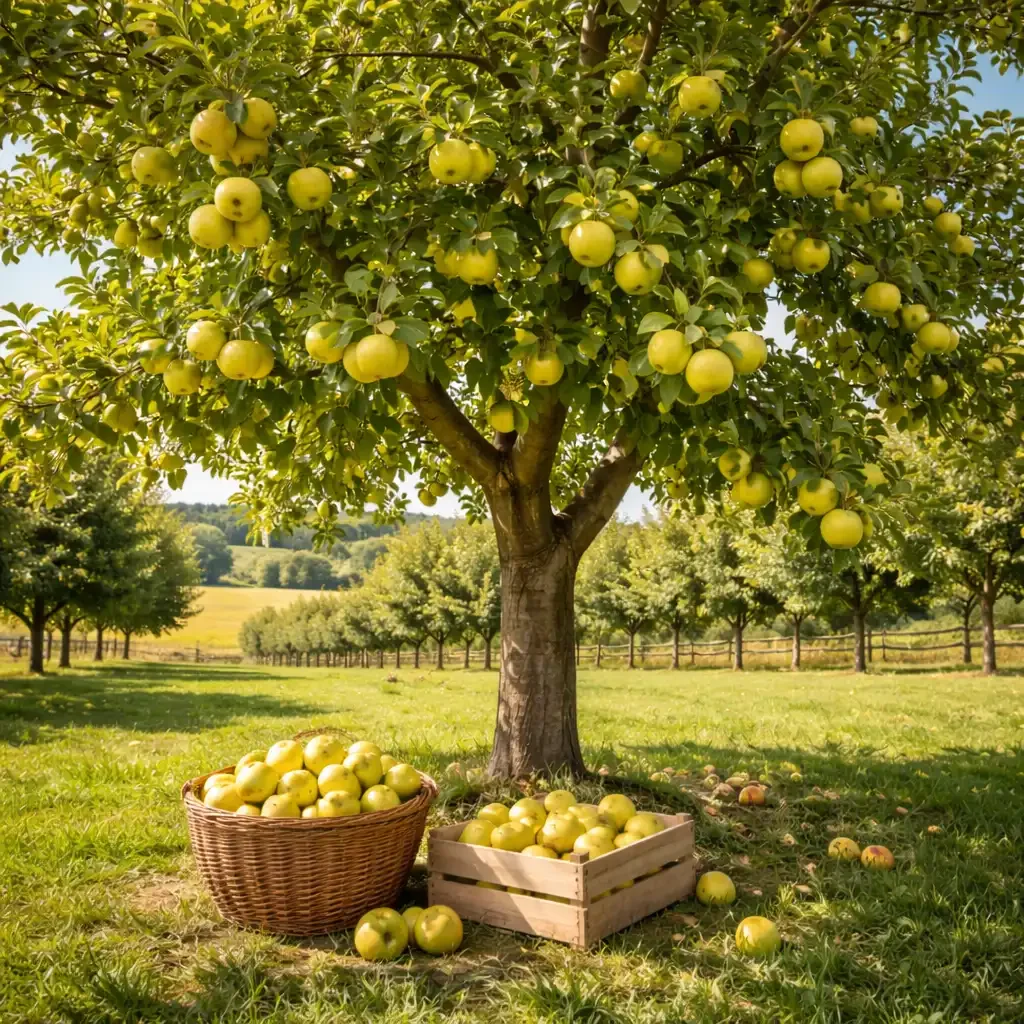
West Virginia's Golden Gift to the World
The first clue came on one April day in the early 1900s. Three wonderful yellow apples reached Stark Brothers Nursery from a West Virginia mountaineer-orchardist. Anderson Mullins wrote a modest letter explaining the characteristics of his "Mullins Yellow Seedling and Annit apple" - a chance seedling growing on his hillside farm near Porter Creek in Clay County, West Virginia.
Paul Stark Sr. and his brother Lloyd weren't particularly optimistic - red apples were the darlings of the market, and yellow apples had never been best sellers. But when they sliced the Clay County apples, they couldn't believe their taste buds. "We had never experienced such a spicy flavor before, especially from a yellow apple," Paul Stark later reported. The enthusiastic commotion rivaled only one other moment in Stark Brothers' history: when Clarence M. Stark discovered the Red Delicious.
What followed became legendary as "The Trail of the Golden Delicious Apple." Paul Stark traveled over 1,000 miles by railroad, then rode 20 miles on horseback through West Virginia mountain wilds to reach Anderson Mullins' farm. There, on a hillside by Porter Creek, stood a single tree producing the most delicious yellow apples anyone had tasted. Stark purchased the tree and 900 square feet of ground around it, built a 30-by-30-foot cage to protect it from thieves, and hired Bewel Mullins to guard and maintain it for 30 years. That tree produced quality apples for nearly 50 years and spawned one of the world's great apple varieties.
Growing Timeline: Your Journey to Harvest
Time to First Fruit
Dwarf trees: 2-3 years after planting
Semi-dwarf trees: 4-6 years after planting
Standard trees: 5-8 years after planting
Tree Lifespan
Standard-size Golden Delicious apple trees: 30-50 years with proper care. Dwarf and semi-dwarf varieties: 20-30 years. The original mother tree on the Mullins farm produced quality apples for nearly 50 years before dying in the late 1950s.
Time to Maturity
Dwarf trees reach full size in 4-6 years. Semi-dwarf varieties mature around 6-8 years. Standard trees achieve full height after 8-10 years. Trees typically reach about 8 feet tall when they begin producing fruit.
Mature Size
Dwarf: 8-10 feet tall and wide
Semi-dwarf: 12-15 feet tall and wide
Standard: 18-25 feet tall and wide
Annual Production
Golden Delicious is a highly productive variety. Once established, expect heavy, regular crops. Part of Golden Delicious care is thinning fruit in spring because branches can break under the weight of all that beautiful fruit. The tree is such a prolific producer that it's considered one of the best pollinators for other apple varieties.
Growing Requirements
USDA Hardiness Zones: 4-9 (some sources say 5-8). Golden Delicious is remarkably adaptable and widely grown. It's both cold-hardy and heat-tolerant, making it suitable for diverse climates across the United States and worldwide.
Sunlight: Full sun required - at least 6-8 hours of direct sunlight daily. The tree needs as sunny a location as possible for best fruit production and flavor development.
Soil: Well-drained soil is essential. Golden Delicious grows best in moist, chalky, and humus-rich soil. Average to loamy soil works, but the tree responds to enriched soil with better production. Slightly acidic soil pH 5.0-6.8 is ideal. The tree does not tolerate soggy, waterlogged soil.
Water: Regular watering to keep soil moist. Deep watering once a week is recommended, more often in hot weather. Water more frequently during the first year to help the tree establish. After establishment, water during dry spells. The tree prefers consistent moisture but not waterlogged conditions.
Pollination: Self-pollinating (partially self-fertile). Golden Delicious can produce fruit with only one tree, but yields are significantly better with a pollinator nearby. It's an ideal pollinator itself because it blooms over a long period with three different sets of blooms. Excellent pollinators include Gala, Elstar, Rubinette, Fuji, Honeycrisp, Granny Smith, and Red Delicious. Golden Delicious is one of the most dependable pollinators for other varieties.
Fertilizer: Apply fertilizer in spring before new growth appears. A little fertilizer in spring helps maintain tree health. Use apple-specific or balanced fertilizer and follow label instructions.
Frost Sensitivity: Golden Delicious is not frost-tolerant. Provide shelter if frost is a threat. The tree needs a frost-free, sheltered position. Without suitable conditions, Golden Delicious apples will not fully ripen and will lose much of their flavor.
Appearance
The Golden Delicious apple tree is beautiful in every season. In mid to late spring, the tree produces a profusion of fragrant white flowers. Draped in clusters along the hanging branches, they are truly a sight to behold. The flowers attract bees, butterflies, and hummingbirds, creating a buzzing garden spectacle.
The tree itself is medium-sized with wide-spreading, hanging branches that create a picturesque form, especially when old. The foliage is lush green throughout the growing season.
The apples are medium to large in size (5-8 centimeters in diameter) with a round to conical shape and flat, broad shoulders tapering to a wide base. They're slightly ribbed with smooth, thin, taut skin. The fruit starts out as pale green to greenish-yellow and becomes bright golden-yellow to brilliant gold as it ripens. On rare occasions, the fruits develop a slight reddish-pink blush under direct sunlight.
The skin has prominent lenticels (breathing pores) scattered across the surface. If left on the tree longer to ripen fully, the apple can develop slight russet around the stem and calyx ends, which is characteristic of fully mature fruit. The flesh underneath is white to ivory, fine-grained, aqueous, and semi-firm with a crisp but light, soft, and tender consistency.
Flavor & Characteristics
The Golden Delicious delivers an exceptional eating experience. Colonel Brackett, the late U.S. Pomologist, came hurrying into his office with a slice perched on his knife blade, exclaiming: "Taste this! Here's an apple with an even better flavor than Grimes Golden." That's high praise, as Grimes Golden was considered one of the finest apples of its era and is believed to be Golden Delicious's parent.
The flavor is exceptionally sweet with a hint of spice - that distinctive spicy taste is what stopped Paul Stark in his tracks. The apple has a balanced blend of sugar and mild acidity, creating a sweet and subtly tart taste with floral, honeyed, and fruity nuances. It's faintly aromatic with a flavor that really tastes like an apple should.
The texture is firm, crisp, and juicy with fine-grained flesh. While crisp, it has a softer, more tender bite than some varieties. The thin skin is smooth, making the apple easy to bite into. One remarkable characteristic: Golden Delicious flesh is slow to brown after cutting, making it perfect for salads and fresh preparations.
Important note: Most Golden Delicious apples in grocery stores are picked early before flavor has fully developed. When left on the tree to ripen fully, Golden Delicious develops an exceptionally sweet and rich flavor far superior to store-bought fruit. Home-grown Golden Delicious picked at peak ripeness is a revelation.
Storage: Golden Delicious has extended storage properties and can be kept into late spring. The apples will keep for 3-4 months in a cool room or refrigerator. However, the thin skin is prone to bruising and shriveling, so careful handling is essential.
Nutritional Benefits
A medium Golden Delicious apple (about 200 grams) contains approximately 95-96 calories, making it a perfect low-calorie snack. It provides about 15 grams of carbohydrates, 4 grams of dietary fiber (which supports digestive health), and minimal protein (about 0.3g).
Golden Delicious apples are virtually fat-free (0.2g total fat) and cholesterol-free. They're a good source of vitamin C, providing approximately 8% of the daily recommended intake, which strengthens the immune system and reduces inflammation. Eating one apple gives you 17% of the USDA recommended daily allowance of fiber.
The apples are a good source of potassium (169mg per apple, about 2-4% DV), which is helpful for blood pressure and heart health. They also contain small amounts of calcium, iron, magnesium, copper, manganese, folate, and vitamin K.
Golden Delicious apples are rich in antioxidants, particularly quercetin, which may provide protection against cardiovascular disease, improve mental health, and help with allergies such as asthma and hay fever. Quercetin may also protect liver and kidneys. The apples contain pectin, a soluble fiber that removes toxins from the gut and helps regulate blood sugar levels.
The high water content (about 85-93%) contributes to hydration. The natural sugars (about 11-12 grams per 100g) provide gentle energy without spiking blood sugar due to the fiber content.
Uses
Fresh eating: Golden Delicious excels for eating plain. The sweet flavor and tender-crisp texture make it perfect for snacking straight from the tree.
Salads: The flesh is slow to brown after cutting, making Golden Delicious ideal for salads. Slice and toss into green salads, chop into fruit medleys, or shred into slaws. The apples hold their shape beautifully.
Baking: Golden Delicious is one of the best apples for baking. America's Test Kitchen, Food Network, and Serious Eats all list it as one of the top choices for apple pie due to its balanced flavor and high pectin content. The apples hold their shape well during cooking. Perfect for pies, tarts, crisps, cobblers, and turnovers.
Applesauce and apple butter: Makes smooth, naturally sweet applesauce and rich apple butter with minimal added sugar needed.
Savory dishes: Adds sweetness to pork dishes. Try sauteing with onions, adding to sandwiches and burgers, or incorporating into grain side dishes.
Companion planting: Golden Delicious trees pair beautifully with fragrant herbs. Plant lavender, rosemary, and sage nearby - these low-maintenance perennials create an attractive bed and are wonderful in fall recipes.
Storage & Care Tips
Harvesting: Golden Delicious ripens in late September (mid-season to late). The fruit can be picked over a period of time. Look for bright golden-yellow color - the background should no longer be green. The apple should part readily from the branch with a gentle twist. Leave fruit on the tree longer for exceptionally sweet, rich flavor development. Handle carefully due to thin, delicate skin that bruises easily.
Storage: Store in a cool room or refrigerator for 3-4 months. Maintain temperatures around 32-45 degrees F. The thin skin is prone to shriveling, so maintain proper humidity. Use blemished or larger apples right away, as these will cause all apples to decay faster. Store away from strong-odored foods to prevent flavor transfer.
Pruning: Prune during dormancy (winter) when the tree is not actively growing. Make light to moderate pruning cuts. Remove vigorous upright stems, weak or damaged branches, and any dead wood. Shape the tree to maintain good structure. Golden Delicious requires less aggressive pruning than some varieties.
Fruit Thinning: CRITICAL - Golden Delicious is such a heavy producer that thinning is essential. In spring, thin out excess fruit to prevent branch breakage. This is a key part of Golden Delicious care. Heavy crops can literally break branches under the weight.
Disease Management: Golden Delicious is prone to apple scab. It may also be susceptible to powdery mildew, apple canker, and honey fungus. Monitor regularly and maintain good cultural practices. Remove fallen leaves and fruit to reduce disease pressure. Apply fungicides preventatively if needed.
Pest Control: Watch for aphids, woolly aphids, rosy apple aphids, fruit tree red spider mites, mussel scale, codling moths, and caterpillars. Use integrated pest management approaches.
Mulching: Apply mulch to retain moisture but avoid touching the trunk base to prevent rot.
Popularity & Regional Success
The Golden Delicious has achieved remarkable worldwide success. Introduced in 1914 by Paul Stark Sr. and heavily promoted by Stark Brothers Nursery, it quickly became one of America's most beloved apples. For much of the twentieth century, Golden Delicious, Red Delicious, and Granny Smith were the top three apple varieties in United States supermarket sales.
As of 2025, Golden Delicious remains in the top nine most popular varieties in the United States, according to the U.S. Apple Association. Even more impressively, two of its direct descendants - Gala and Honeycrisp - also rank in the top nine, testament to Golden Delicious's genetic superiority.
In Europe, Golden Delicious achieved even greater dominance. As of 2025, it's still one of the top apples in the European Union. It became so important that it was used as a progenitor for numerous breeding programs worldwide.
The variety achieved special recognition in its home state. On February 20, 1995, Golden Delicious was designated the official state fruit of West Virginia. Since 1972 (some sources say 1973), Clay County has hosted an annual Golden Delicious Festival every third weekend in September. The four-day celebration features baking contests, the Apple Dash 5K, a skillet flinging contest, clogging, car show, parade, fireworks, and live entertainment.
In 2013, Golden Delicious was honored by the United States Postal Service as one of four apple varieties featured on 33-cent stamps commemorating historic strains, joined by Northern Spy, Baldwin, and Granny Smith.
In 2010, an Italian-led consortium announced they had decoded the complete genome of the Golden Delicious apple. It had the highest number of genes (57,000) of any plant genome studied to date - a fitting achievement for such an important variety.
Varieties & Offspring
Golden Delicious is a defining trait in modern apple breeding. Most modern apple varieties since 1930 are descended from just three progenitors: Golden Delicious, Cox's Orange Pippin, and Jonathan. Dozens, if not scores of apples can count Golden Delicious somewhere in their family trees.
Notable offspring include:
Gala: A top apple variety worldwide, descendant of Golden Delicious
Jonagold: Developed in 1943 at New York State Agricultural Experiment Station by cross-breeding Golden Delicious and Jonathan. Released in 1968 and became the leading apple cultivar in Europe.
Elstar: Popular European variety descended from Golden Delicious
Honeycrisp: Modern favorite with Golden Delicious heritage
Important note: Despite the similar name, Golden Delicious is NOT related to Red Delicious. They are completely separate varieties that only share a name because Stark Brothers Nursery marketed them together. Golden Delicious arose from a chance seedling in West Virginia, possibly a hybrid of Grimes Golden and Golden Reinette.
Fun Facts
1. The legendary 1,000-mile quest! Paul Stark traveled over 1,000 miles by railroad, then rode 20 miles on horseback through West Virginia mountain wilds to find the Golden Delicious tree. This journey became known as "The Trail of the Golden Delicious Apple."
2. It was protected like gold - because it was! Stark Brothers built a 30-by-30-foot cage out of wood and woven wire that completely engulfed the tree. An electric alarm system stretched from the cage to the kitchen to detect thieves. The 900-square-foot plot was "the most valuable piece of real estate of its size in West Virginia."
3. The purchase price controversy! The sale is often reported as $5,000, but J.M. Mullins (who discovered the seedling) later claimed Stark Brothers only paid $50 initially and promised a "marketable price" for the fruit. The true amount remains disputed.
4. It has more genes than any plant studied at the time! In 2010, scientists decoded its complete genome and found it had 57,000 genes - the most of any plant genome studied to that date.
5. It's the parent of most modern apples! Most apple varieties developed since 1930 trace their ancestry back to just three apples: Golden Delicious, Cox's Orange Pippin, and Jonathan. Golden Delicious is in the family tree of Gala, Honeycrisp, Jonagold, Elstar, and dozens more.
6. It was discovered by a teenager! In 1891, 15-year-old J.M. Mullins discovered the wayward seedling while tending the field. He left it to grow, and the farm was later given to his uncle Anderson Mullins, who sent samples to Stark Brothers in 1914.
7. The tree had three names! Locally known as "Mullins Yellow Seedling and Annit apple," it was renamed "Golden Delicious" by Stark Brothers to market alongside their Red Delicious.
8. There's a historical marker! Though the original tree died in the late 1950s, a historical marker was placed along Route 1 near the farm for apple enthusiasts to visit. West Virginia proudly celebrates its golden gift to the world.
Why Choose a Golden Delicious Apple Tree
The Golden Delicious apple tree represents one of horticulture's greatest success stories. From a chance seedling on a West Virginia hillside to one of the world's most important apple varieties, Golden Delicious changed apple breeding forever. When you plant a Golden Delicious, you're growing the genetic foundation of modern apple cultivation.
For home orchardists, Golden Delicious offers exceptional advantages. It's easy to grow and adapts to various climates from zones 4-9. It's both cold-hardy and heat-tolerant, thriving where other varieties struggle. The tree is self-pollinating (partially self-fertile), meaning you can get fruit with just one tree - though yields improve dramatically with a pollinator nearby.
Better yet, Golden Delicious is one of the most dependable pollinators for other apple varieties. Because it blooms over a long period with three different sets of blooms, it can pollinate early, mid, and late-season varieties. Plant one Golden Delicious, and your entire orchard benefits.
The tree is highly productive - so productive that thinning fruit is essential to prevent branch breakage. That's a good problem to have! The apples ripen over an extended period, giving you fresh fruit for weeks. They store well for 3-4 months, providing golden apples through winter.
The fruit itself is exceptional. That spicy-sweet flavor that astonished Paul Stark still delights today. The flesh is slow to brown, making it perfect for salads. It's one of the best apples for baking, recommended by America's Test Kitchen and Food Network. And when you grow your own and let them ripen fully on the tree, the flavor is far superior to store-bought fruit picked early.
Golden Delicious trees are also beautiful landscape specimens. The wide-spreading form with hanging branches becomes picturesque with age. Spring brings fragrant white flower clusters that attract pollinators. The golden apples add ornamental value in fall.
Plant a Golden Delicious apple tree, and you're growing a piece of American agricultural heritage. You're growing West Virginia's state fruit, honored on postage stamps and celebrated at festivals. You're growing the parent of most modern apples - Gala, Honeycrisp, Jonagold, and dozens more trace their lineage back to that single hillside tree near Porter Creek.
You're growing the apple that proved yellow could compete with red. The apple that inspired Paul Stark to travel 1,000 miles by train and 20 miles on horseback. The apple that was caged and guarded and treasured for 50 years. The apple with 57,000 genes - more than any plant scientists had seen. You're growing gold.
___________________________________
SimitianNest.com | Your Complete Guide to Tree Families
Growing Knowledge, Cultivating Community