
Black Spanish Turkey
Quick Overview
Common Name: Black Spanish, Norfolk Black, Noir, Onyx
Breed Type: Heritage Turkey
Origin: Europe, brought to North America by Spanish explorers
Primary Use: Meat, Exhibition
Mature Tom Weight: 27 pounds
Mature Hen Weight: 14 pounds
Egg Production: Moderate, 50 to 90 eggs per year
Egg Color: Cream to light brown with brown speckling
Temperament: Active, alert, more independent than some heritage breeds
Conservation Status: Watch (Livestock Conservancy)
Lifespan: 5 to 10 years
Breed History and Origin
The Black Spanish turkey has one of the most historically remarkable and geographically complex origin stories of any domestic turkey breed in the world, with a history that spans continents, centuries, and the full arc of the European colonial encounter with the Americas. The breed's story begins with the original domestication of wild turkeys by indigenous peoples of Mexico and Central America, where the turkey had been a domestic animal for centuries before European contact. When Spanish explorers encountered domestic turkeys in Mexico in the early sixteenth century, they recognized the bird's food value and brought specimens back to Europe, where the turkey was received with considerable enthusiasm and rapidly adopted into European domestic animal keeping.
The turkeys that arrived in Europe in the early sixteenth century were the foundation stock from which the Black Spanish and several other European domestic turkey breeds were developed over the subsequent centuries. The black coloration that defines the Black Spanish and the related Norfolk Black of England appears to have emerged and been selectively maintained in European turkey populations during the sixteenth and seventeenth centuries, with the solid black plumage selected for its visual distinctiveness and its practical advantage of producing a clean, dark-pinfeather-free dressed carcass appearance when the bird's skin is naturally dark to match the feather pigmentation.
The Norfolk Black, developed in England and closely related if not identical in genetics to the Black Spanish, has the most thoroughly documented European heritage turkey history of the black-colored breeds. Norfolk and the surrounding English counties developed a significant turkey production industry during the seventeenth and eighteenth centuries that supplied the London market with turkeys walked to the city on foot in enormous flocks of thousands of birds, a practice that required the hardy, vigorous, active birds that the Norfolk Black represented. The Norfolk turkey tradition is among the most celebrated in English agricultural history and provides the most detailed documentation of the European heritage turkey keeping tradition that produced the Black Spanish.
When European settlers returned to North America with their domesticated European turkey stock, including the black-colored varieties that had been developed in Europe over the preceding century and a half, these birds encountered the Eastern Wild Turkeys native to the continent and the domestic turkey varieties that other settlers were maintaining. The Black Spanish in the American context represents the continuation of this European black turkey tradition in the New World, maintained as a distinct color variety through several centuries of American turkey keeping alongside the American-developed heritage breeds like the Bronze, Narragansett, and Bourbon Red.
The American Poultry Association recognized the Black Spanish in the Standard of Perfection, establishing its formal status as a distinct variety in American heritage turkey keeping. The breed is currently listed at Watch status by the Livestock Conservancy, reflecting a global population of fewer than 5,000 registered breeding birds but a somewhat better conservation situation than the Critical breeds that dominate this series.
Physical Characteristics
The Black Spanish is a medium to large heritage turkey with a well-proportioned, classically balanced body structure appropriate for genuine meat production. The body conformation is that of a naturally balanced, properly structured heritage turkey with a good broad chest, adequate muscling, a level back, and a strong frame that reflects genuine production capability without the artificial extreme proportions of commercial broad-breasted varieties. The overall appearance conveys the active, functional quality of a fully heritage turkey breed.
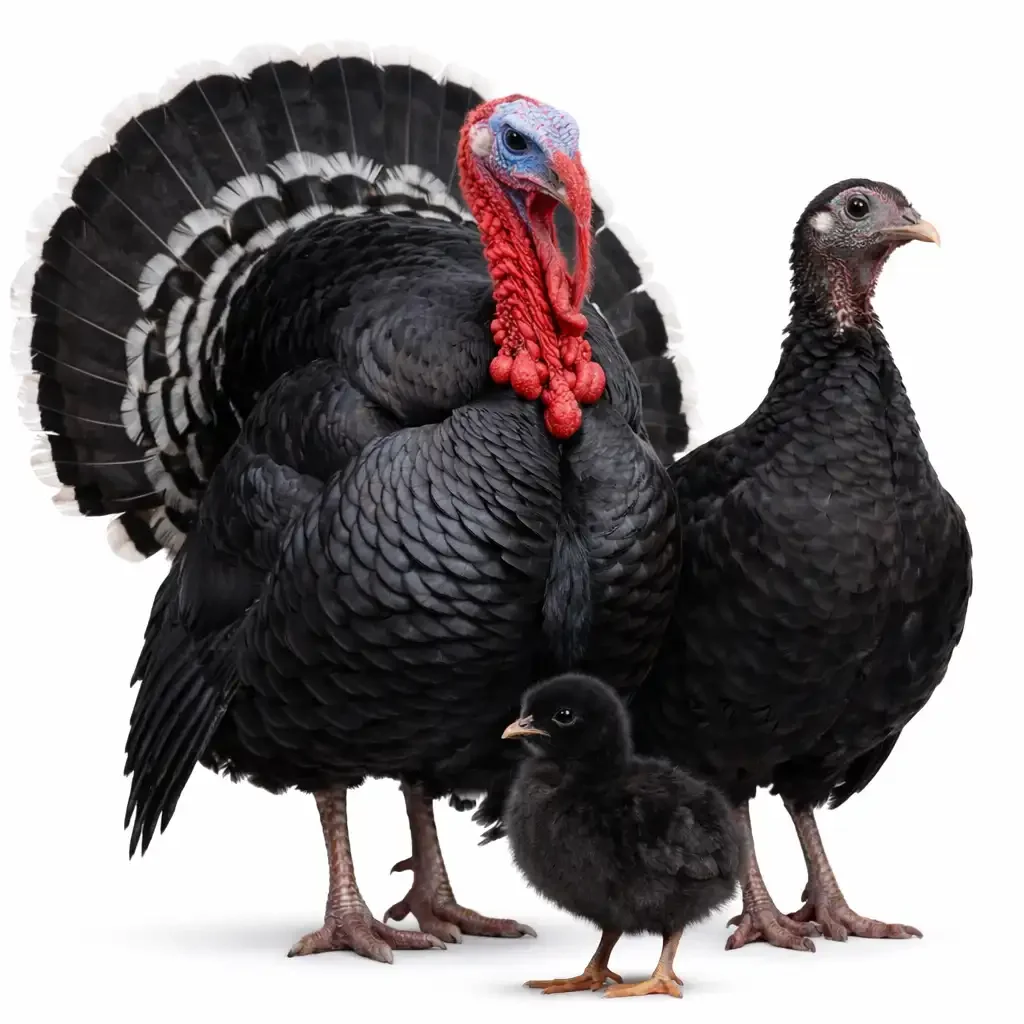
The defining characteristic of the Black Spanish is the uniformly solid, intensely black plumage that covers the entire body with the distinctive iridescent green to bronze sheen that is the most carefully evaluated quality element of the breed standard. The black plumage is not simply dark in the way that the Chocolate turkey is dark but is a pure, cool, glossy black with the iridescent sheen that catches direct light to reveal the characteristic green or bronze metallic reflection across the feather surface. This iridescent quality in the black plumage is what gives well-colored Black Spanish turkeys their most spectacular visual impact and what most clearly distinguishes the best exhibition quality birds from those with dull, non-iridescent black plumage.
The quality of the iridescent sheen is the primary color evaluation criterion for Black Spanish exhibition and conservation breeding assessment. The most desirable birds display the most vivid, clearly green to bronze iridescent sheen across the maximum surface area of the black plumage, with the reflection visible across the breast, back, wings, and tail in good lighting conditions. Dull, matte, or brownish black plumage indicates poor color quality and birds that display these characteristics should not be prioritized for conservation breeding regardless of body conformation quality.
The head and facial skin display the standard turkey characteristics that change color with emotional and hormonal state. The beard of mature toms is black. The legs are dark to black, the beak is dark horn colored, and the eyes are dark brown. The overall dark coloration of the Black Spanish, including the dark legs and beak that complement the black plumage, creates one of the most dramatically unified and visually striking overall appearances of any heritage turkey variety. Mature toms reach approximately 27 pounds and mature hens reach approximately 14 pounds, placing the Black Spanish in the medium heritage turkey size range smaller than the largest breeds like the Bronze and Narragansett.
Temperament and Behavior
The Black Spanish occupies the more active and independent end of the heritage turkey temperament spectrum, with a behavioral profile that reflects the long European history of the breed as a vigorous, self-sufficient farmyard and range turkey that was selected for hardiness and activity rather than docility and tractability. The breed is consistently described by experienced keepers as more alert, more independent, and more reactive to environmental stimuli than calmer breeds like the Narragansett, Bourbon Red, or Midget White.
This more active, independent temperament is not aggression in the sense of being dangerous or genuinely unmanageable, but it does mean that Black Spanish turkeys require a management approach that respects the breed's more reactive nature and provides the space and environmental complexity that active, alert heritage turkeys need for behavioral health. Keepers who approach Black Spanish management with the calm, consistent handling that heritage turkey breeds generally respond best to find that the breed is manageable and rewarding to work with, while keepers who expect the easy, approachable docility of the Narragansett or Midget White may find the Black Spanish's more alert temperament surprising.
The breed's active foraging instinct and genuine ranging behavior are among its most practically valuable characteristics for pasture-based production. Black Spanish turkeys on range are vigorous, purposeful foragers that cover ground actively and make genuine use of their pasture environment. The combination of active metabolism, varied forage diet, and the heritage genetics of a breed selected for centuries in the managed range environment of English and European turkey keeping produces excellent meat quality in birds managed with adequate outdoor access.
Toms display the full turkey behavioral repertoire during breeding season, with the solid black plumage and iridescent sheen creating a display of dramatic, unified visual impact quite different from the multi-toned displays of the Bronze, Bourbon Red, or Narragansett. A Black Spanish tom in full display, with the solid black tail fan spread to its full extent revealing the iridescent sheen across the dark feathers, is one of the most striking and most visually distinctive display presentations available from any heritage turkey variety.
Raising on a Homestead
Housing
Black Spanish turkeys require housing appropriate for medium to large heritage breeds. Provide a minimum of 6 square feet of indoor floor space per bird, with 8 square feet preferable for the behavioral health of these more active, alert birds. The active temperament of the Black Spanish means that adequate space is particularly important for this breed, as overcrowded conditions create stress and behavioral problems more readily in reactive, independently-minded birds than in more passive varieties.
Roost bars at appropriate heights for birds of this size support natural roosting behavior and contribute to the respiratory health benefits of getting birds off the ground and away from the moisture and ammonia accumulation that ground-level sleeping creates. Nest boxes at one box per three to four hens and good ventilation completing the standard housing requirements round out the Black Spanish housing management program.
The dark plumage of the Black Spanish creates a heat management consideration in warm summer climates similar to that noted for the Chocolate and Bronze. The black coloration absorbs maximum solar radiation, making shade provision in range areas and cool water access particularly important during peak summer heat periods for this variety.
Feeding
Black Spanish poults require the standard heritage turkey feeding program. Begin with 28 to 30 percent protein turkey or game bird starter for the first six to eight weeks, transition to 20 to 22 percent protein grower feed through 14 to 16 weeks, and provide a 16 to 18 percent protein finisher ration in the final growing period before processing. Breeding stock maintained year-round should receive a balanced maintenance ration with adequate vitamin E, vitamin A, and selenium supporting reproductive performance.
The active metabolism of the Black Spanish means that birds in range situations with access to good foraging resources will make genuine nutritional contributions from their ranging activity, supplementing their feed ration meaningfully and contributing to the flavor development that distinguishes heritage turkey from commercial alternatives.
Range and Foraging
The Black Spanish's active foraging instinct and vigorous ranging behavior make outdoor pasture access particularly important for this breed from both production quality and behavioral health perspectives. The breed's long European history as a managed range turkey, including the remarkable Norfolk Black tradition of walking thousands of birds overland to market, selected for precisely the vigorous, self-sufficient ranging capability that makes the Black Spanish such an effective pasture turkey when given appropriate range conditions.
Rotational management that provides access to fresh ground regularly reduces internal parasite load, maintains pasture quality, and gives birds the environmental variety that supports the full expression of their natural foraging behavior. The Black Spanish's more independent nature means it is well suited to less intensively managed range systems where birds are expected to cover more ground with less direct supervision than more docile breeds that remain closer to housing structures.
Brooding Poults
Black Spanish poults require the same careful early brooding management as all heritage turkey poults. The solid black coloration is visible in poults from the earliest feathering stages, providing early color quality assessment useful for preliminary selection in conservation breeding programs. Maintain brooder temperature at 95 to 100 degrees Fahrenheit for the first week, reducing by 5 degrees per week until fully feathered. Monitor closely for starve-out vulnerability during the critical first days using standard management practices of colored marbles in waterers and brightly colored starter feed.
Meat and Production Value
The Black Spanish produces genuine heritage turkey meat quality from a medium-sized carcass that positions it between the small heritage breeds and the largest heritage production breeds in the overall heritage turkey size range. A finished Black Spanish tom produces a dressed carcass of approximately 16 to 20 pounds and a finished hen produces approximately 9 to 12 pounds, making the Black Spanish suitable for medium to large family holiday meals and for the direct-to-consumer heritage turkey market segment that wants a substantial heritage bird without the very largest carcass sizes of the Bronze and Narragansett.
The active ranging lifestyle, European heritage genetics, and extended 26 to 28 week growing period of the Black Spanish produce the characteristic heritage turkey meat quality of richer flavor, better fat distribution, and greater complexity compared to commercial alternatives. The Black Spanish's long European heritage as a prized table bird, maintained through the Norfolk Black tradition and the broader European turkey keeping culture that valued the breed for its culinary quality as much as its production efficiency, has produced a turkey with genuine meat quality credentials that match its historical reputation.
The most significant practical consideration for Black Spanish dressed bird sales is the dark plumage and the exceptionally visible pinfeather staining it creates on the dressed carcass. The pure black feathering leaves the most dramatic dark pinfeather staining of any heritage turkey variety, creating a dressed carcass appearance that is very different from the clean, pale skin of white-feathered breeds and requires the most careful scalding technique and most thorough picking and candling of any heritage turkey in this series. Direct communication with customers about the natural appearance of dark-feathered heritage bird carcasses before purchase prevents the surprise and potential customer dissatisfaction that can result when buyers expecting a commercial-appearing dressed turkey receive a naturally dark-skinned heritage bird without prior explanation.
The Black Spanish's combination of distinctive European heritage story, the most dramatically iridescent plumage available from any heritage turkey variety, the genuine heritage flavor quality from the Norfolk Black tradition, and the relative accessibility of Watch-level conservation status compared to the Critical breeds creates a compelling product for the direct-to-consumer heritage food market when the product story is communicated effectively.
Conservation Status
The Black Spanish is listed at Watch status by the Livestock Conservancy, indicating a global population of fewer than 5,000 registered breeding birds with fewer than ten primary breeding flocks. The Watch status places the Black Spanish in the same conservation tier as the Bourbon Red, Standard Bronze, Narragansett, and Royal Palm in this series, reflecting a population level that requires active conservation attention but is better than the most urgently critical breeds.
The Black Spanish's Watch status reflects both the broader European distribution of the related Norfolk Black, which represents a parallel conservation population supporting the genetic diversity of the black turkey color type, and the breed's maintained interest among exhibition breeders who have valued the striking iridescent black plumage for show purposes through the decades that devastated primarily meat-oriented heritage breeds. This exhibition breeding community has provided a conservation pathway similar to the one that protected the Royal Palm, keeping the Black Spanish at Watch rather than Critical status while other heritage turkey breeds declined more severely.
The close relationship between the American Black Spanish and the English Norfolk Black creates an interesting transnational conservation dimension for this breed that is unique among the heritage turkey breeds in this series. Breeders on both sides of the Atlantic are effectively maintaining the same fundamental genetic heritage in their respective national traditions, and connections between American Black Spanish breeders and English Norfolk Black breeders provide potential genetic exchange opportunities that could benefit the conservation health of both populations.
Varieties and Color Patterns
The Black Spanish is recognized as a single variety with the solid, iridescent black plumage as the only accepted color expression. The breed standard specifies pure, solid black throughout the plumage with the characteristic iridescent green to bronze metallic sheen that is the most carefully evaluated quality element for exhibition and conservation breeding assessment.
The quality of the iridescent sheen is the primary and most important color evaluation criterion for Black Spanish breeding selection. Well-colored birds display a vivid, clearly defined iridescent reflection that is immediately visible in good natural light, with the green to bronze metallic quality of the sheen giving the solid black plumage the depth and visual complexity that distinguishes excellent Black Spanish coloration from simply dark or dull black plumage. The breast, back, and wing feathers should all display the characteristic sheen, with the best birds showing consistent iridescence across all body feathered areas.
Birds showing brown, bronze, or other color contamination in the plumage indicate genetic impurity and should not be used in conservation breeding programs. The pure, cool black of the Black Spanish standard should have no warm brown undertone that would suggest Chocolate turkey or Bronze influence in the breeding background. The distinction between the cool, iridescent black of the Black Spanish and the warm brown of the Chocolate turkey is the most important color distinction for breeders working with dark-colored turkey varieties.
The relationship between the American Black Spanish and the English Norfolk Black is primarily one of shared genetic heritage from the same European black turkey tradition rather than a formal variety distinction. Both maintain the same fundamental color standard of solid iridescent black plumage and share the same historical origin in the European turkey keeping tradition that developed this color type from the foundation stock brought from Mexico to Europe in the sixteenth century.
Common Health Issues
Blackhead Disease
Blackhead Disease is the primary health management concern for Black Spanish turkeys as for all domestic turkey breeds. Strict separation from chickens and all chicken ground is the essential preventive management practice. The Black Spanish's more independent ranging behavior and tendency to cover more ground than more docile heritage breeds means that maintaining meaningful physical separation between turkey and chicken range areas requires more deliberate management planning than for breeds that remain closer to housing structures.
Heat Management
The pure black plumage of the Black Spanish absorbs the maximum possible solar radiation of any turkey plumage color, creating the most significant heat load consideration of any heritage turkey variety in direct sunlight. This is particularly important to manage during peak summer heat periods when heat accumulation in dark-feathered birds can progress rapidly from discomfort to heat stress to potentially fatal hyperthermia. Providing generous shade structures throughout range areas, ensuring constant access to cool clean water, scheduling range access during the cooler morning and evening hours during the hottest weeks, and monitoring individual birds closely during heat waves are the most important seasonal management practices for Black Spanish flocks.
Respiratory Disease
Standard respiratory health management through good ventilation, dry litter management, appropriate stocking density, and acquisition from health-tested sources applies fully to the Black Spanish. The breed's more active metabolism and vigorous ranging behavior generally support better respiratory health than more sedentary management systems, but appropriate housing ventilation remains essential.
Parasites
The Black Spanish's vigorous ranging behavior and tendency to cover more ground than more docile breeds increases exposure to internal parasites relative to less active heritage turkey varieties. Regular fecal monitoring and targeted deworming based on results are particularly important management practices for actively ranging Black Spanish flocks.
Pinfeather Management for Dressed Birds
While not a health issue for the live bird, the management of dark pinfeather staining on the dressed carcass of Black Spanish turkeys is a significant ongoing production quality consideration. Precise scalding temperature control at approximately 140 to 145 degrees Fahrenheit for the appropriate duration, followed by thorough mechanical picking and careful hand candling to remove remaining pinfeather stubs, produces the cleanest possible dressed carcass from dark-feathered heritage birds. Investing in appropriate scalding and picking equipment and developing the technique specific to dark-feathered birds is an important production quality management practice for any homestead operation selling Black Spanish dressed birds directly to consumers.
FAQ
What is the relationship between the Black Spanish and the Norfolk Black turkey? The Black Spanish and Norfolk Black are effectively the same fundamental turkey variety maintained in separate national traditions on either side of the Atlantic, both descending from the European black turkey populations that were developed from the foundation stock brought from Mexico to Spain in the early sixteenth century and subsequently spread throughout Europe. The Norfolk Black specifically represents the English tradition of black turkey keeping that reached its most celebrated development in the East Anglian county of Norfolk, where the breed became associated with the remarkable tradition of walking thousands of turkeys overland to the London market during the eighteenth and nineteenth centuries. The American Black Spanish and the English Norfolk Black are maintained under different names in their respective national contexts but share the same fundamental genetic heritage and the same iridescent black plumage standard that defines the color type in both traditions.
Why does the Black Spanish have a European origin when most American heritage turkey breeds are American-developed? The Black Spanish is unique among the recognized American heritage turkey breeds in having its primary genetic development occur in Europe rather than in North America. The species itself originated in the Americas and was brought to Europe by Spanish explorers in the early sixteenth century, but the specific black coloration and the breed characteristics associated with the Black Spanish were developed and refined during the century and a half that European turkey breeding established the black color type as a distinct variety before those birds returned to North America with European settlers. The other heritage turkey breeds in this series, including the Bronze, Narragansett, Bourbon Red, and most others, were developed primarily in North America through crosses between the returning European domestic stock and the Eastern Wild Turkeys native to the continent. The Black Spanish represents the continuation of the specifically European black turkey tradition in the American context rather than a new American-developed variety.
How do I manage the pinfeather staining issue when selling Black Spanish dressed birds? Managing the dark pinfeather staining that is the primary presentation challenge of Black Spanish dressed birds requires a combination of precise scalding technique, thorough picking, and customer communication. Scalding at approximately 140 to 145 degrees Fahrenheit for the appropriate duration softens the pinfeathers sufficiently for thorough removal without over-scalding that tears skin. Mechanical picking removes the bulk of feathers, followed by careful hand candling in good lighting to identify and remove remaining pinfeather stubs. Wax dipping, where the dressed carcass is dipped in melted wax that is then peeled off removing remaining fine pinfeathers, is a technique used by some heritage turkey processors to achieve the cleanest possible dark-feathered carcass finish. Most importantly, proactive customer communication before purchase that describes the natural appearance of dark-feathered heritage bird carcasses prevents the disappointment that can occur when customers expecting commercial-appearing birds receive naturally dark-skinned heritage turkeys without prior explanation.
Is the Black Spanish suitable for warm climate homestead production? The Black Spanish can be raised in warm climates but requires the most attentive heat management of any heritage turkey variety due to its pure black plumage that absorbs maximum solar radiation. The breed's European origins in the relatively temperate climates of England and continental Europe suggest limited specific physiological adaptation to intense heat, making climate management more important for this variety than for breeds with Southern American or Gulf Coast heritage. For warm climate homestead operations that want to work with the Black Spanish, investing in generous shade infrastructure throughout range areas, providing constant access to cool water, and managing outdoor range access to the cooler parts of the day during peak summer heat creates the conditions that allow the breed to thrive despite the heat load challenge its plumage creates.
What is the historical significance of the Norfolk Black walking tradition? The Norfolk Black turkey's association with the English tradition of walking turkey flocks overland from the farms of East Anglia to the London market is one of the most remarkable documented examples of large-scale heritage livestock management in agricultural history. During the eighteenth and nineteenth centuries, flocks of thousands of turkeys were walked from their farm origins in Norfolk and surrounding counties to London for sale at the Christmas market, a journey that could take several weeks and covered distances of one hundred miles or more. The turkeys' feet were protected with small leather boots or tar and sand applications for the long walk, and the flocks were managed by drovers who kept the birds moving and contained along the road. This tradition required birds of exceptional hardiness, good feet, vigorous constitution, and the active, independent foraging capability that characterizes the Black Spanish and Norfolk Black temperament. The walking tradition is one of the most vivid illustrations of the genuinely functional heritage characteristics that distinguished traditional turkey breeds from the commercial varieties that replaced them and that homestead conservation breeders are working to preserve.