
Bourbon Red
Quick Overview
Common Name: Bourbon Red, Penny, Copper, Rusty
Breed Type: Heritage Turkey
Origin: Bourbon County, Kentucky, United States
Primary Use: Meat, Exhibition
Mature Tom Weight: 33 pounds
Mature Hen Weight: 18 pounds
Egg Production: Moderate to Good, 50 to 100 eggs per year
Egg Color: Cream to light brown with brown speckling
Temperament: Calm, friendly, active foragers
Conservation Status: Watch (Livestock Conservancy)
Lifespan: 5 to 10 years
Breed History and Origin
The Bourbon Red turkey is one of the most celebrated and most commercially successful American heritage turkey breeds of the modern era, with a history rooted in the agricultural traditions of the American Bluegrass region of Kentucky and a contemporary market presence that has made it the heritage turkey most familiar to the growing direct-to-consumer heritage food movement. The breed's origins trace to the post-Civil War period in Bourbon County, Kentucky, where a farmer named J.F. Barbee is credited with developing the distinctive reddish-chestnut coloration and the production characteristics that define the Bourbon Red through selective breeding from a foundation of Buff, Bronze, and White Holland turkey stock over the latter decades of the nineteenth century.
The genetic contributions of the foundation breeds are reflected in the Bourbon Red's characteristics in ways that make biological sense. The Buff turkey heritage, which connects the Bourbon Red genetically to the buff color family represented in this series by the Jersey Buff, contributed the warm reddish-brown base color that is the Bourbon Red's most immediately striking visual characteristic. The Bronze contribution brought the large body size, exceptional flavor development, and vigorous foraging instinct that give the Bourbon Red its production quality. The White Holland contribution brought the clean white markings in the wings and tail that are specified in the breed standard and that provide the visual contrast against the rich reddish-chestnut body coloring that makes the Bourbon Red one of the most visually striking heritage turkey breeds available.
The American Poultry Association admitted the Bourbon Red to the Standard of Perfection in 1909, a generation after the foundational 1874 group of recognized heritage turkey breeds, reflecting the time required for the breed to develop from J.F. Barbee's Kentucky breeding program into a sufficiently established and geographically distributed population to merit formal breed recognition. The 1909 recognition also coincided with the period of the Bourbon Red's growing commercial relevance, as the breed was recognized as a particularly desirable table bird whose flavor quality, manageable temperament, and attractive appearance made it popular with both commercial turkey growers and home turkey keepers across a wide geographic range.
The Bourbon Red's twentieth century history diverges somewhat from the most severely impacted heritage turkey breeds in this series, though it shares the general trajectory of displacement by broad-breasted commercial varieties. The breed maintained a somewhat larger population through the worst decades of the heritage breed crisis than many other heritage varieties, partly because of its broader geographic distribution and partly because the active heritage food movement that began growing in the 1990s and accelerated through the 2000s found the Bourbon Red to be one of the most compelling and most accessible heritage turkey breeds for the premium direct-to-consumer market. The combination of beautiful appearance, excellent flavor reputation, manageable temperament, and a compelling Kentucky origin story made the Bourbon Red the heritage turkey that most effectively captured the imagination of the emerging heritage food customer base.
Today the Bourbon Red is listed at Watch status by the Livestock Conservancy, with a global population of fewer than 5,000 registered breeding birds. While this still represents a population level requiring active conservation attention, the Bourbon Red's Watch status and its relative accessibility compared to the Critical breeds in this series make it one of the most practical starting points for homestead operations entering heritage turkey production for the first time.
Physical Characteristics
The Bourbon Red is a large, well-proportioned heritage turkey with a body conformation that combines genuine production capability with the balanced, naturally athletic structure of a fully functional heritage breed. The body is broad and well-muscled with a full, rounded breast, a level back, and a strong, substantial frame that conveys both the meat production potential and the active vitality that characterizes the best American heritage turkey breeds. The overall impression is of a turkey that is both genuinely impressive in its physical presence and naturally balanced in a way that clearly distinguishes it from the artificially proportioned commercial broad-breasted varieties.
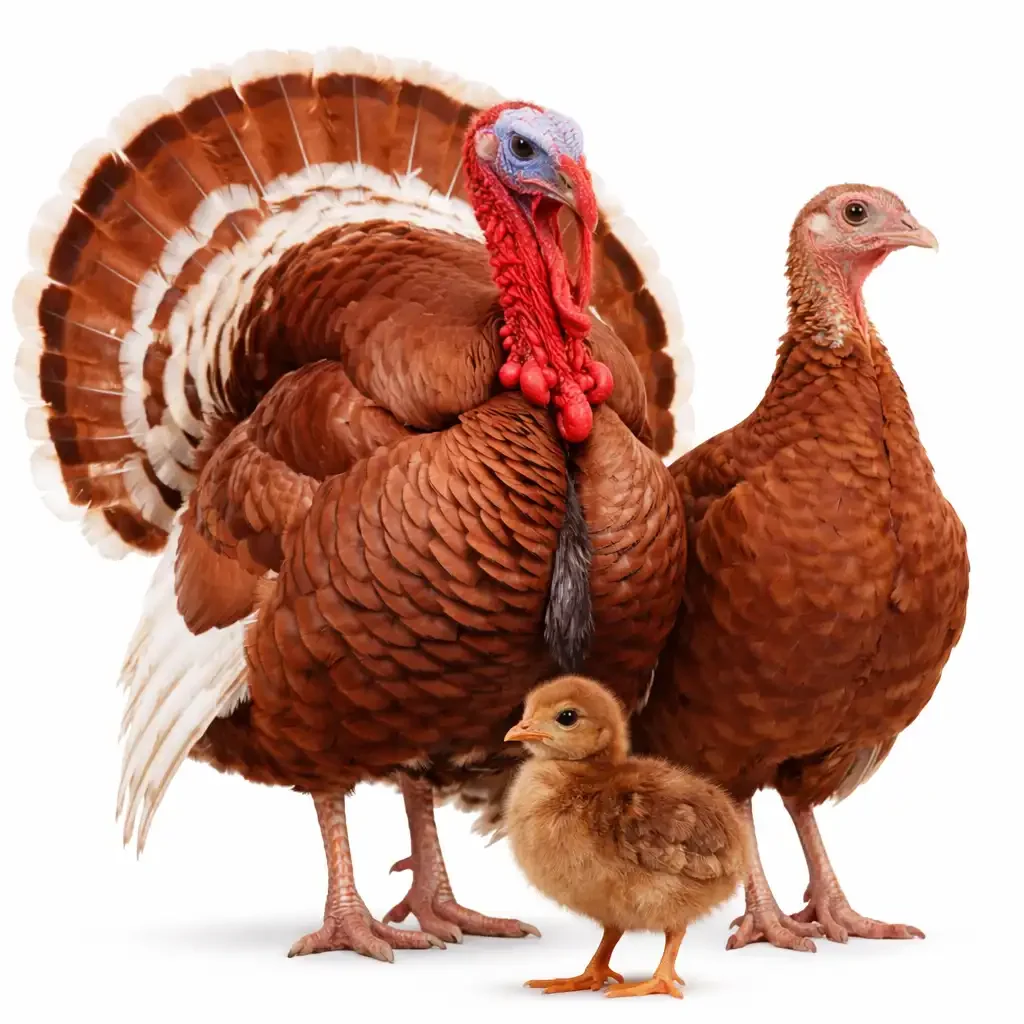
The plumage of the Bourbon Red is one of the most immediately striking and most widely admired of all the heritage turkey color patterns. The body feathering is a rich, dark reddish-chestnut to mahogany color with a warm, deep saturation that catches light beautifully and creates an impression of genuine visual luxury. The wing feathers display white primaries with a chestnut base, creating a clean white wing marking that provides vivid contrast to the deep reddish body color. The tail feathers are white with a soft reddish-buff suffusion, and the tail shows a terminal white band that is one of the most carefully evaluated elements in exhibition assessment of the breed.
The overall color effect of a well-colored Bourbon Red is one of the most beautiful in all of domestic turkey keeping, with the rich reddish-chestnut body, clean white wing markings, and softly marked white tail creating a color harmony of genuine sophistication. The combination has been compared to the warm, rich color palette of autumn, which reflects the breed's Bluegrass Kentucky origins and makes it one of the most naturally evocative of all the heritage turkey color patterns in terms of its seasonal and agricultural associations.
The head and facial skin display the standard turkey characteristics that change color with emotional and hormonal state. The beard of mature toms is black and well-developed. The legs are dark to reddish, the beak is light horn to reddish, and the eyes are dark brown with a distinctive reddish tinge that is considered characteristic of well-bred Bourbon Red stock. Mature toms reach approximately 33 pounds and mature hens reach approximately 18 pounds, placing the Bourbon Red in the large heritage turkey size category appropriate for the premium holiday direct-sales market.
Temperament and Behavior
The Bourbon Red occupies a favorable position in the heritage turkey temperament spectrum, with a calm, friendly, relatively approachable disposition that makes it one of the more manageable large heritage turkey breeds for homestead operations across a range of experience levels. The breed is consistently described by experienced keepers as less reactive and less flighty than the Bronze family while retaining the active, vigorous foraging instinct and genuine vitality that distinguish the best heritage turkey breeds from more passive commercial alternatives.
Toms display the full turkey behavioral repertoire during breeding season with the rich reddish-chestnut plumage creating one of the most visually impressive turkey displays available. The combination of large body size, the warm, deep color of the ruffled body feathers, the white wing flash visible in strutting display, and the white tail fan spread to its full extent creates a display of exceptional visual impact that makes Bourbon Red toms among the most celebrated display animals in American heritage poultry keeping.
The breed's active foraging instinct is one of its most practically valuable characteristics for homestead operations. Bourbon Red turkeys on range cover ground purposefully, seek out insects and protein sources with genuine energy, and make full use of their pasture environment in a way that contributes meaningfully to both the flavor quality of the meat and the cost efficiency of the production system. Homestead keepers consistently report that Bourbon Red turkeys are among the most rewarding to manage on pasture of any heritage turkey breed, combining the production benefits of active ranging with a temperament that remains manageable even in large, freely ranging flocks.
Raising on a Homestead
Housing
Bourbon Red turkeys require housing appropriate for large heritage breeds reaching mature weights of 18 to 33 pounds. Provide a minimum of 6 square feet of indoor floor space per bird, with 8 square feet preferable. Roost bars must be sturdy and positioned at appropriate heights for birds of this size. Nest boxes at one per three to four hens with dimensions appropriate for a large turkey hen support the Bourbon Red's good natural brooding instincts and maintain clean, well-managed egg collection for conservation hatching programs.
Good ventilation in housing is particularly important for large, actively metabolizing heritage turkey breeds. The Bourbon Red's large body size generates significant metabolic heat, making adequate air movement through the housing structure important for maintaining the respiratory health and comfort of the flock throughout the year including the warm summer months when heat accumulation in poorly ventilated turkey housing can become a significant health risk.
Feeding
Bourbon Red poults require the standard heritage turkey high-protein feeding program. Begin with 28 to 30 percent protein turkey or game bird starter for the first six to eight weeks. The large frame of the Bourbon Red means that adequate protein through the early growth phase is critical for building the muscular and skeletal foundation that supports the mature weight these birds achieve. Transition to 20 to 22 percent protein grower feed through 14 to 16 weeks and provide a finisher ration with 16 to 18 percent protein in the final growing period before processing.
Breeding stock maintained year-round should receive a balanced maintenance ration with adequate vitamin E, vitamin A, and selenium supporting reproductive performance and the natural mating capability that is one of the most important practical advantages of the Bourbon Red for homestead operations.
Range and Foraging
The Bourbon Red is one of the finest heritage turkey breeds for pasture-based production, with an active foraging instinct and genuine ranging behavior that makes it one of the most productive converters of pasture resources into heritage turkey meat quality available. Birds on good rotational pasture management that provides regular access to fresh ground produce meat of exceptional flavor complexity that represents heritage turkey production at a genuinely high level.
Providing adequate shade in range areas, particularly during peak summer heat, maintains bird comfort and health during the warmest production periods. The Bourbon Red's dark reddish-brown plumage absorbs solar radiation more than white-feathered breeds, making shade provision a meaningful health management consideration rather than an optional enhancement during hot summer weather.
Brooding Poults
Bourbon Red poults require the same careful early brooding management as all heritage turkey poults. The characteristic reddish coloration is visible from hatching in well-bred birds, providing early color quality assessment that is useful for preliminary selection in conservation breeding programs. Maintain brooder temperature at 95 to 100 degrees Fahrenheit for the first week, reducing by 5 degrees per week until fully feathered. Monitor closely for starve-out vulnerability during the critical first days using colored marbles in waterers and brightly colored feed.
Meat and Production Value
The Bourbon Red produces large heritage turkey carcasses of exceptional flavor quality that have established the breed as arguably the most commercially successful heritage turkey in the modern direct-to-consumer heritage food market. A finished Bourbon Red tom produces a dressed carcass of approximately 18 to 22 pounds and a finished hen produces a dressed carcass of approximately 10 to 14 pounds, placing the Bourbon Red fully in the large heritage turkey size range appropriate for the premium Thanksgiving and holiday market.
The flavor reputation of the Bourbon Red is among the finest of all the heritage turkey breeds and is one of the primary reasons the breed has become the most widely recognized heritage turkey in the contemporary heritage food movement. The combination of Bronze genetic heritage that contributes exceptional flavor development, the active foraging instinct that produces the most varied diet, the extended 28 to 30 week heritage growing period, and the warm, humid Bluegrass Kentucky climate adaptation that shaped the breed's genetics all contribute to a depth of flavor and quality of meat that consistently receives the highest ratings among heritage turkey varieties from food writers, chefs, and direct-to-consumer customers who have compared multiple heritage turkey breeds.
The dark reddish-brown plumage of the Bourbon Red produces pinfeather staining on the dressed carcass that is less dramatic than the Standard Bronze but more visible than white-feathered breeds. This is managed through careful scalding and picking technique and customer education about the natural appearance of heritage bird carcasses. For direct-to-consumer operations where the Bourbon Red's compelling product story is well communicated, the natural carcass appearance is not a significant commercial obstacle.
The Bourbon Red's combination of beautiful appearance, excellent flavor, manageable temperament, compelling Kentucky origin story, and Watch-level accessibility compared to the Critical breeds in this series makes it the single most recommended starting breed for homestead operations entering heritage turkey production for the first time. The growing direct-to-consumer heritage turkey market that has developed over the past two decades was built substantially on the Bourbon Red, and its established market recognition creates the most reliable customer base available for any heritage turkey breed.
Conservation Status
The Bourbon Red is listed at Watch status by the Livestock Conservancy, indicating a global population of fewer than 5,000 registered breeding birds with fewer than ten primary breeding flocks. The Watch status places the Bourbon Red in better conservation standing than the Critical breeds that dominate this series, reflecting the breed's broader historical distribution, larger founding population, and the active heritage food market support that has maintained breeding interest in the Bourbon Red through the decades since the heritage breed crisis of the late twentieth century.
The conservation progress that has maintained the Bourbon Red at Watch rather than Critical status is the direct result of the heritage food movement's embrace of this breed as its most accessible and most marketable heritage turkey variety. The commercial premium that Bourbon Red turkeys command in the direct-to-consumer holiday market has created genuine economic incentive for homestead operations to maintain breeding flocks, which has provided a market-driven conservation mechanism that purely conservation-motivated programs cannot always sustain over the long term.
This market-driven conservation success is an important lesson for the heritage turkey preservation community as a whole. The Bourbon Red's relative conservation health compared to Critical breeds like the Chocolate, Jersey Buff, and Beltsville Small White reflects what becomes possible when a heritage breed achieves genuine market recognition and premium pricing in the direct-to-consumer food market. Building similar market recognition for the more critically endangered heritage turkey breeds is one of the most important long-term strategies available for their conservation.
Varieties and Color Patterns
The Bourbon Red is recognized as a single variety under the American Poultry Association Standard of Perfection with the characteristic reddish-chestnut body color, white primary wing feathers with chestnut base, and white tail with reddish-buff suffusion as the defining color elements. The breed standard describes the rich, dark reddish-chestnut to mahogany tone of the body feathering, the clean white wing primaries that create the characteristic white wing flash visible in displaying birds, and the white tail with its terminal white band as the complete Bourbon Red color description.
Color quality varies between individuals and breeding lines, with the most desirable exhibition and conservation breeding birds displaying the richest, most deeply saturated reddish-chestnut body color, the cleanest and most sharply defined white wing markings, and the clearest white tail with well-defined banding. Birds showing bronze, buff, or other color contamination departing from the standard reddish-chestnut description indicate genetic impurity from crossing with other turkey varieties and should not be used in conservation breeding programs aimed at maintaining the authentic Bourbon Red color type.
The white wing and tail markings are the color pattern elements most frequently evaluated in exhibition assessment of the Bourbon Red, and maintaining the cleanliness and definition of these white markings against the rich reddish base color is one of the primary ongoing selection priorities for serious Bourbon Red breeders.
Common Health Issues
Blackhead Disease
Blackhead Disease is the primary health management concern for Bourbon Red turkeys as for all domestic turkey breeds. Strict separation from chickens and all chicken ground is the essential preventive management practice. The Bourbon Red's good constitutional vitality from Bronze genetic heritage does not provide specific resistance to Histomonas meleagridis, and all standard Blackhead prevention protocols apply fully.
Heat Management
The dark reddish-brown plumage of the Bourbon Red creates a heat management consideration in warm summer climates similar to that noted for the Chocolate and Bronze. Providing adequate shade in range areas, ensuring constant access to cool clean water, and monitoring birds during peak summer heat periods maintains flock health and comfort during the warmest production periods. The Bourbon Red's Kentucky origins in a warm, humid climate suggest some degree of physiological adaptation to heat and humidity that may benefit production in warm climate regions.
Respiratory Disease
Standard respiratory health management through good ventilation, dry litter management, appropriate stocking density, and health-tested sourcing applies fully to the Bourbon Red. The large body size of mature Bourbon Red birds creates significant metabolic heat that makes good ventilation particularly important for maintaining respiratory health during both winter and summer management periods.
Leg and Joint Health
Appropriate roost heights, non-slip flooring, adequate space, and a feeding program supporting steady rather than excessive early growth maintain leg and joint health in large heritage birds reaching mature weights of 18 to 33 pounds. The Bourbon Red's active ranging behavior generally supports better leg health through regular exercise than more sedentary management systems provide.
Parasites
Internal and external parasite management through regular monitoring, targeted treatment based on fecal examination results, and dust bathing provision are standard ongoing care practices. The Bourbon Red's active ranging behavior and wide ground coverage increase exposure to internal parasites compared to confined birds, making regular monitoring particularly important for outdoor flocks.
FAQ
Why is the Bourbon Red considered the best starting breed for first-time heritage turkey keepers? The Bourbon Red combines the characteristics most important for a successful first heritage turkey experience in a single breed more effectively than any other variety in this series. The calm, friendly temperament makes daily management and routine handling less intimidating than more reactive breeds. The active foraging instinct and good ranging behavior produce excellent meat quality with relatively straightforward pasture management. The Watch conservation status means that finding quality breeding stock is more practical than with the Critical breeds whose rarity makes sourcing genuinely challenging. The established market recognition of the Bourbon Red in the direct-to-consumer heritage turkey market provides the most reliable customer base for first-season sales. And the beautiful appearance and compelling Kentucky origin story create a product narrative that engages customers and supports premium pricing from the first production season.
What makes Bourbon Red meat so highly regarded among heritage turkey varieties? The Bourbon Red's exceptional flavor reputation reflects several compounding factors. The Bronze genetic heritage that contributed to the breed's development brings the exceptional flavor development characteristic of the Bronze turkey family. The active foraging instinct produces a genuinely varied diet that contributes aromatic complexity to the meat. The extended 28 to 30 week heritage growing period allows the full development of the marbling, fat distribution, and muscle fiber characteristics that produce the textural complexity and flavor depth that distinguish heritage turkey from commercial alternatives. The warm, humid climate adaptation of the Kentucky Bluegrass heritage may contribute specific physiological characteristics that influence the flavor profile of well-finished birds. Together these factors produce a meat quality that food writers and professional chefs who have evaluated multiple heritage turkey breeds consistently rank as among the finest available.
How does the Bourbon Red compare to the Standard Bronze for homestead meat production? Both the Bourbon Red and Standard Bronze are large, highly regarded heritage turkey breeds with exceptional flavor reputations, and the comparison between them is one of the most frequently discussed in the heritage turkey community. The Standard Bronze produces a somewhat larger dressed carcass and has an even longer heritage of commercial importance in American agriculture. The Bourbon Red is somewhat calmer in temperament, has a more immediately striking and visually distinctive color pattern, and has the advantage of greater market recognition in the modern heritage food movement. For a first-time heritage turkey keeper, the Bourbon Red's more manageable temperament and better market infrastructure make it the more practical starting choice. For experienced heritage turkey keepers who want to work with the most historically significant heritage turkey breed and who have the space and management experience for the Bronze's more demanding requirements, the Standard Bronze represents heritage turkey production at its historical pinnacle.
Is the Bourbon Red named after bourbon whiskey? The Bourbon Red takes its name from Bourbon County, Kentucky, where the breed was developed by J.F. Barbee in the latter decades of the nineteenth century, and Bourbon County itself was named after the French royal House of Bourbon in the late eighteenth century. The connection to bourbon whiskey is indirect: bourbon whiskey also takes its name from Bourbon County, Kentucky, where the distinctive corn-based whiskey style was developed. So the Bourbon Red turkey and bourbon whiskey share the same geographic nameplate without one being named after the other. Both names reflect the agricultural and cultural heritage of the Kentucky Bluegrass region where both the distinctive turkey breed and the distinctive whiskey style were developed during overlapping historical periods.
What is the ideal market strategy for Bourbon Red turkeys on a homestead? The Bourbon Red's established market recognition makes it the most straightforward heritage turkey breed to market directly to consumers. The most financially rewarding approach centers on the Thanksgiving and Christmas holiday window, where the combination of heritage flavor quality, the compelling Kentucky origin story, the beautiful appearance of the live and dressed bird, and the conservation significance of supporting a Watch-status heritage breed creates a premium product narrative that supports six to ten dollars per pound pricing in direct farm sales. Building a customer list early in the production year with advance deposits for confirmed Thanksgiving birds is standard practice for heritage turkey homestead operations. Social media documentation of the birds throughout the growing season, particularly the spectacular display behavior of toms and the active foraging behavior on pasture, builds the customer community and product narrative that sustains premium pricing and customer loyalty across multiple production seasons.