
Bronze Turkey
Quick Overview
Common Name: Bronze Turkey, Standard Bronze, Bronzie
Breed Type: Heritage Turkey
Origin: United States, developed from crosses between domestic and Eastern Wild Turkey
Primary Use: Meat, Exhibition
Mature Tom Weight: 36 pounds
Mature Hen Weight: 20 pounds
Egg Production: Moderate, 50 to 100 eggs per year
Egg Color: Cream to light brown with brown speckling
Temperament: Active, alert, strong natural instincts
Conservation Status: Watch (Livestock Conservancy)
Lifespan: 5 to 10 years
Breed History and Origin
The Bronze turkey is the most historically significant and most deeply rooted of all the American heritage turkey breeds, with a history that reaches back to the earliest decades of European settlement in North America and that encompasses a longer and more commercially important productive life in American agriculture than any other heritage turkey variety. The breed's origins lie in the natural crosses that occurred between the domestic turkeys brought to North America by European colonists in the sixteenth and seventeenth centuries and the Eastern Wild Turkeys native to the continent, particularly in the mid-Atlantic and New England regions where European settlement was most concentrated during the colonial period.
These initial crosses between European domestic stock and Eastern Wild Turkeys produced birds of exceptional vigor, hardiness, and adaptability that far exceeded the productive capability of either parent population in the challenging conditions of colonial American farming. The wild turkey contribution brought cold hardiness, active foraging instinct, disease resistance, and the genetic vitality of a wild population. The domestic turkey contribution brought the tractability, reproductive predictability, and production orientation that made the birds manageable for farm keeping. The combination proved extraordinary, and the Bronze turkey that emerged from these crosses became the dominant turkey breed in American agriculture for more than two centuries.
The metallic bronze iridescence that gives the breed its name is the most immediately recognizable characteristic of the Bronze turkey and the one that most clearly reflects the wild turkey heritage in the breed's genetics. The same bronze iridescence present in the Eastern Wild Turkey's plumage, produced by the structural properties of the feather barbules that create a metallic sheen across the dark base color, is the visual signature of the Bronze turkey and the characteristic that has made it one of the most immediately recognizable domestic turkey breeds in the world.
The American Poultry Association admitted the Bronze to the Standard of Perfection in 1874 as part of the foundational group of recognized American heritage turkey breeds, cementing its formal status as a distinct breed with established and reproducible characteristics. At the time of recognition, the Bronze was already the most commercially important turkey breed in the United States, forming the backbone of the American turkey industry during the era when heritage breeds defined the standard of production rather than competing against industrial alternatives.
The twentieth century history of the Bronze is more complicated than the histories of most other heritage turkey breeds because the Bronze name became applied to two fundamentally different types of turkey as the commercial industry developed. The Broad-Breasted Bronze, developed through selective breeding for extreme breast muscle development in the mid-twentieth century, took the Bronze name into commercial production while abandoning the natural mating capability, active ranging instinct, and genuine heritage characteristics that defined the Standard Bronze. The Broad-Breasted Bronze was itself eventually displaced by the Broad-Breasted White as the dominant commercial variety, but the period of Broad-Breasted Bronze commercial dominance created widespread confusion between the commercial type and the Standard Bronze heritage breed that persists to some degree today.
The Standard Bronze, the genuine heritage breed with natural mating capability and the full complement of heritage turkey characteristics, is listed at Watch status by the Livestock Conservancy with a global population of fewer than 5,000 registered breeding birds. This population level represents a significant decline from the Bronze's historical dominance of American turkey production but is better than the Critical status of several other heritage turkey breeds in this series, reflecting the benefit of the breed's broader historical distribution and larger founding population.
Physical Characteristics
The Standard Bronze is the largest of the recognized American heritage turkey breeds, with a mature body size that conveys the full weight and presence of the most substantial heritage turkey available. The body conformation is that of a classically proportioned, massively built heritage turkey with an exceptionally broad and deep chest, powerful muscling throughout the body, a level back, and the imposing physical presence that made the Bronze the commercial standard of the American turkey industry for more than a century.
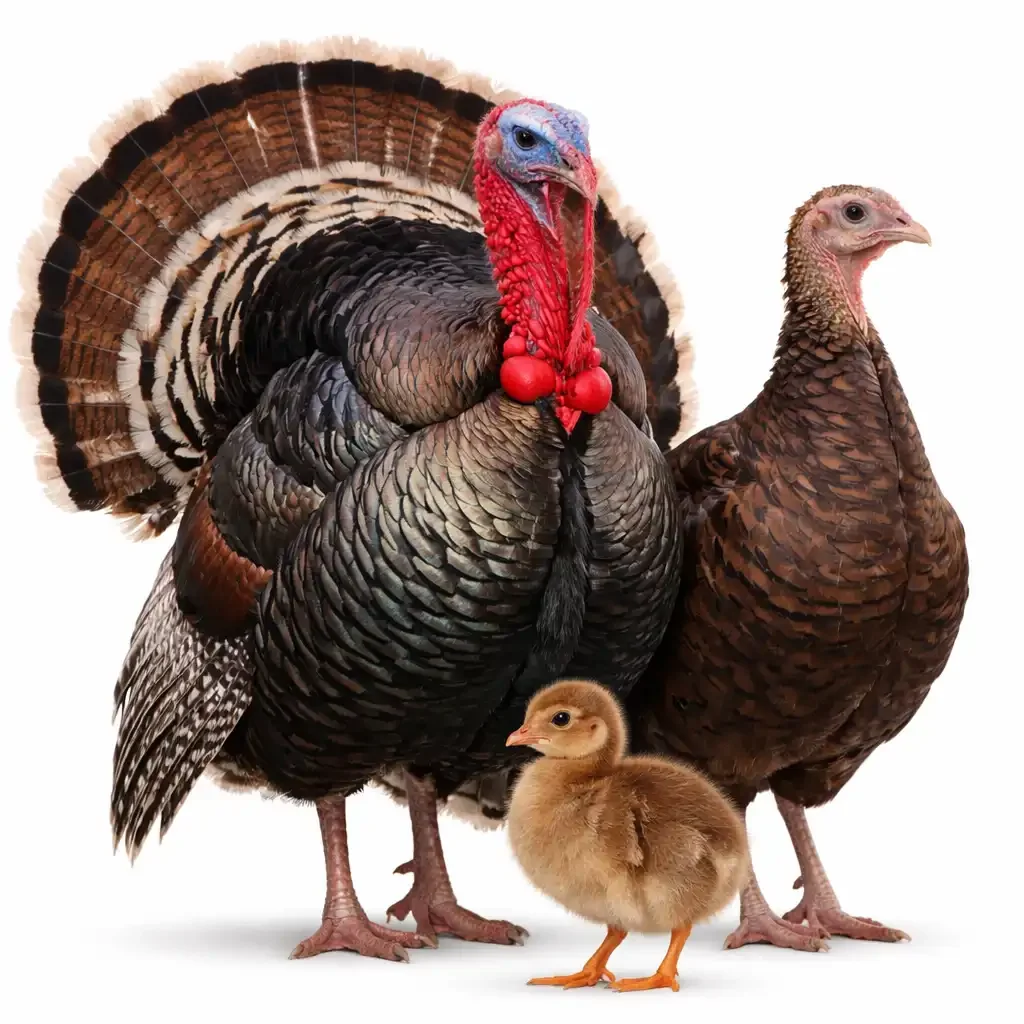
The plumage of the Standard Bronze is one of the most spectacular in the domestic turkey world, with the characteristic metallic bronze iridescence that gives the breed its name expressing itself across the body in a rich interplay of copper, gold, green, and brown tones that shifts and shimmers with the angle of light. The bronze iridescence is most dramatic in direct sunlight where the full range of metallic tones is visible simultaneously, creating a plumage effect of genuine visual magnificence that has made the Bronze turkey one of the most celebrated domestic poultry breeds in American agricultural history.
The breed standard describes the characteristic bronze iridescence covering the main body feathering, with the tail displaying a specific banding pattern of bronze and black with a terminal brown band edged in white or whitish buff. The wing feathers show the characteristic white barring that is one of the breed standard's most specific and most carefully evaluated color pattern elements in exhibition contexts. The overall effect of a well-colored Standard Bronze tom in full display is one of the most magnificent sights in all of domestic poultry keeping, combining the largest body size of any heritage turkey with the most spectacular iridescent plumage pattern available from any domestic turkey variety.
The head and facial skin display the full turkey characteristics of caruncles, wattles, and snood that flush to vivid red during excitement and display. The beard of mature toms is long, thick, and black, one of the most impressive beard developments available from any domestic turkey breed. The legs are dark pinkish to dark, the beak is horn-colored, and the eyes are dark brown. Mature toms reach approximately 36 pounds and mature hens reach approximately 20 pounds, making the Standard Bronze the heaviest of all the recognized heritage turkey breeds and a production bird of genuinely substantial commercial potential.
Temperament and Behavior
The Standard Bronze occupies an interesting middle position in the heritage turkey temperament spectrum, with an active, alert, and strongly instinct-driven behavioral profile that reflects the wild turkey genetic contribution more clearly than breeds with less direct wild heritage influence. The Bronze is not among the most docile heritage turkey breeds, and experienced keepers describe it as more reactive, more expressive, and more demanding of appropriate management conditions than calmer breeds like the Narragansett or Midget White.
This expressiveness is not aggression in the sense of being genuinely dangerous or unmanageable, but rather a heightened awareness and responsiveness to environmental stimuli that requires homestead keepers to approach Bronze turkey management with appropriate understanding of the breed's more active temperament. Toms during breeding season are particularly expressive, with the full Bronze turkey behavioral repertoire of strutting, gobbling, and territorial display creating an impressive and sometimes assertive management situation that requires confident, calm handling.
The wild turkey heritage that contributes to the Bronze's more active temperament is also the source of some of the breed's most valuable production characteristics. The exceptional foraging instinct, the strong ranging behavior, the disease resistance and constitutional hardiness, and the genuine vitality that distinguishes Standard Bronze turkeys from more domesticated heritage breeds all reflect the wild genetic contribution that makes the Bronze simultaneously more demanding and more rewarding to manage than many other heritage varieties.
Toms in full display are among the most spectacular birds in all of domestic poultry keeping, with the combination of massive body size, magnificent iridescent plumage, full tail fan spread, lowered wings scraping the ground, and the deep, resonant gobble creating a display experience that is genuinely extraordinary by any standard. Many keepers who have worked with multiple heritage turkey breeds describe the displaying Standard Bronze tom as one of the most magnificent animal displays available from any domesticated species.
Raising on a Homestead
Housing
Standard Bronze turkeys require the most robust and spaciously designed housing of any heritage turkey breed given their large mature size. Provide a minimum of 8 square feet of indoor floor space per bird, with 10 square feet preferable for birds reaching mature weights of 20 to 36 pounds. Roost bars must be genuinely sturdy with strong mounting hardware and positioned at heights that the largest birds can access safely. The combination of large body size and the active, assertive temperament of the Bronze means that adequate space is particularly important for behavioral health and flock management.
The impressive size of Standard Bronze turkeys means that housing structures must be designed with appropriate structural integrity for birds significantly heavier than most other poultry. Door heights, nest box dimensions, and general facility sizing that would be adequate for smaller heritage breeds may be marginal for Standard Bronze birds at full mature weight.
Feeding
Standard Bronze poults require the standard heritage turkey feeding program but with attention to the caloric and protein demands of a breed that will reach the largest mature size of any heritage turkey. Begin with 28 to 30 percent protein turkey or game bird starter for the first six to eight weeks. The large frame development of the Standard Bronze means that adequate protein through the early growth phase is particularly critical for building the skeletal and muscular foundation that supports the mature weight these birds are capable of achieving. Transition to 20 to 22 percent protein grower feed through 14 to 16 weeks and provide a finisher ration with 16 to 18 percent protein in the final growing period.
Breeding stock maintained year-round should receive a balanced maintenance ration. The large body size of breeding toms creates specific feeding management considerations as very large males can dominate feeding areas and prevent smaller hens from accessing adequate nutrition. Providing multiple feeding stations and monitoring individual bird body condition maintains appropriate nutrition across all flock members.
Range and Foraging
The Standard Bronze rewards outdoor range access more generously than perhaps any other heritage turkey breed, with the wild turkey genetic contribution creating exceptional foraging instinct and ranging capability that produces dramatic improvements in both meat quality and behavioral health when birds have access to genuine pasture. Bronze turkeys on good pasture cover ground extensively, seek out insects and protein sources with vigorous purposefulness, and produce a quality of meat that represents heritage turkey production at its absolute finest.
Rotational pasture management that provides Bronze turkeys with regular access to fresh ground maximizes both the foraging benefit and the internal parasite management that comes from moving birds away from heavily used ground. The active, ranging nature of the Bronze means that more generous space allocation than the minimum guideline of 25 to 30 square feet per bird is particularly beneficial for this breed.
Brooding Poults
Standard Bronze poults require the same careful early brooding management as all heritage turkey poults, with the specific consideration that Bronze poults often show stronger and more assertive behavior from early on than the more docile heritage breeds. The characteristic bronze iridescence begins developing in poults at a few weeks of age as adult feathering replaces the downy poult covering, providing early visual confirmation of color development in well-bred birds. Maintain brooder temperature at 95 to 100 degrees Fahrenheit for the first week, reducing by 5 degrees per week, and monitor closely for starve-out vulnerability during the critical first days.
Meat and Production Value
The Standard Bronze produces the largest dressed carcass of any recognized heritage turkey breed, with a finished tom producing a dressed carcass in the range of 20 to 26 pounds and a finished hen producing a dressed carcass of 12 to 16 pounds. These weights represent the upper end of the heritage turkey size range and position the Standard Bronze as the most substantial whole bird offering available in the premium heritage turkey market.
The flavor reputation of the Standard Bronze is among the finest of all heritage turkey breeds and reflects the combination of factors that produce the most exceptional heritage turkey eating experience available. The wild turkey genetic contribution to the breed's heritage, the exceptional foraging instinct that produces the most varied and nutritionally complex diet of any ranging heritage turkey, the large body size that produces the most substantial fat reserves and the richest marbling, and the extended 28 to 30 week growing period all combine to create a depth of flavor, richness of fat, and quality of texture that represents the pinnacle of heritage turkey production.
The dark feathering of the Standard Bronze produces significant pinfeather staining on the dressed carcass, which is the most commonly noted practical disadvantage of the breed for commercial dressed bird sales. This was one of the historical reasons the Broad-Breasted White displaced the Broad-Breasted Bronze in commercial production despite the Broad-Breasted Bronze's larger size, as supermarket customers responded more positively to the clean white skin of white-feathered birds. For direct-to-consumer homestead operations where customers are purchasing specifically for heritage quality and are prepared to accept the natural appearance of a bronze-feathered bird, this is a manageable presentation consideration rather than a genuine commercial obstacle.
Conservation Status
The Standard Bronze is listed at Watch status by the Livestock Conservancy, indicating a global population of fewer than 5,000 registered breeding birds with fewer than ten primary breeding flocks. The Watch status is less immediately critical than the Critical designation applied to the Beltsville Small White, White Holland, Slate, Midget White, Jersey Buff, and Chocolate turkey in this series, but it still represents a population level that requires active conservation attention for a breed that was once the most commercially important turkey in the United States.
The primary conservation challenge specific to the Standard Bronze is distinguishing authentic standard-bred heritage birds from the Broad-Breasted Bronze commercial type that shares the bronze plumage but has fundamentally different body structure and lacks natural mating capability. Visual assessment of body conformation, verification of natural mating ability, and acquisition from breeders with documented breeding records traceable to Standard Bronze rather than Broad-Breasted Bronze lineage are the essential safeguards for homestead keepers who want to contribute genuinely to Standard Bronze conservation rather than inadvertently maintaining commercial genetics under a heritage breed label.
Connecting with the American Poultry Association's heritage turkey breeding community, the Livestock Conservancy's Standard Bronze conservation program, and the Society for the Preservation of Poultry Antiquities provides access to the most reliable breeding stock and the community knowledge needed to work with this breed effectively in a conservation context.
Varieties and Color Patterns
The Standard Bronze is recognized as a single variety under the American Poultry Association Standard of Perfection, with the characteristic metallic bronze iridescence as the defining and most carefully evaluated color element. The breed standard specifies the bronze iridescent body feathering, the specific black and bronze tail banding with brown terminal band and white or buff edging, and the white barring in the wing feathers that together constitute the complete Standard Bronze color description.
The quality of the bronze iridescence varies significantly between individuals and breeding lines, with the most desirable exhibition and conservation breeding birds displaying the most vivid, richly saturated metallic iridescence across the body feathering. The white wing barring should be clean and well-defined against the bronze wing feather base. The tail banding should show the complete sequence of bronze, black, and terminal brown with clean, well-defined band edges.
The distinction between Standard Bronze and Broad-Breasted Bronze in terms of body conformation rather than color pattern is the most practically important variety distinction for conservation breeders. Standard Bronze birds have a naturally balanced, proportionate body structure that allows natural mating. Broad-Breasted Bronze birds have the extreme breast development of commercial birds that compromises natural mating and range movement. Any birds that cannot mate naturally should not be used in Standard Bronze conservation programs regardless of the quality of their plumage coloration.
Common Health Issues
Blackhead Disease
Blackhead Disease is the primary health management concern for Standard Bronze turkeys as for all domestic turkey breeds. The larger body size and greater vigorous constitution of the Bronze compared to smaller heritage breeds does not provide specific resistance to Histomonas meleagridis, and all standard Blackhead prevention management protocols apply fully. Strict separation from chickens and all chicken ground is the essential preventive practice.
Distinguishing Standard from Broad-Breasted Bronze
While not a health issue in the conventional sense, the risk of inadvertently incorporating Broad-Breasted Bronze genetics into a Standard Bronze conservation breeding program is one of the most significant management risks for homestead breeders working with this variety. Broad-Breasted Bronze birds that cannot mate naturally, that have difficulty moving actively on range, or that show extreme breast development inconsistent with the Standard Bronze body proportions should not be retained for breeding regardless of plumage quality. Regular evaluation of natural mating capability and body conformation is an ongoing management practice for Standard Bronze conservation breeding programs.
Heat Management
The dark, dense plumage of the Standard Bronze combined with the breed's large body size creates a heat management consideration in warm summer climates. Large, dark-feathered birds accumulate more heat than smaller or lighter-feathered birds in direct sunlight. Providing adequate shade in range areas, ensuring constant access to cool clean water, and monitoring individual birds during peak summer heat periods maintains flock health and comfort during the warmest production periods.
Leg and Joint Health
The largest body size of any heritage turkey breed creates the most significant leg and joint health management requirements of any variety in this series. Appropriate roost heights that large birds can access and land from safely, non-slip flooring, adequate space that prevents the crowding and stress behavior that can cause injuries, and a feeding program that supports steady rather than excessive early growth maintain leg and joint health in birds reaching mature weights of 20 to 36 pounds.
Respiratory Disease
Standard respiratory health management through good ventilation, dry litter management, appropriate stocking density, and acquisition from health-tested sources is important for Bronze turkeys as for all heritage turkey breeds. The Bronze's good constitutional hardiness from wild turkey genetic heritage provides some degree of natural disease resistance compared to more purely domesticated heritage breeds, but this resistance does not eliminate the need for appropriate housing and management practices.
FAQ
What is the difference between the Standard Bronze and the Broad-Breasted Bronze? The Standard Bronze and Broad-Breasted Bronze share the bronze iridescent plumage that gives both the Bronze name but are fundamentally different birds in body structure, production characteristics, and practical capabilities. The Standard Bronze is the genuine heritage breed with a naturally balanced, proportionate body structure that allows natural mating, active ranging, and the extended 28 to 30 week growing period that produces the exceptional heritage flavor quality for which the Bronze is historically celebrated. The Broad-Breasted Bronze was developed through selective breeding for extreme breast muscle development in the mid-twentieth century, producing a commercial bird that cannot mate naturally, moves poorly on range, and reaches processing weight in 16 to 18 weeks but lacks the flavor complexity of the Standard Bronze. Any turkey sold as a Bronze turkey that cannot mate naturally is a Broad-Breasted Bronze or a cross rather than an authentic Standard Bronze heritage bird.
Is the Bronze turkey the right choice for a homestead operation focused primarily on meat production? The Standard Bronze is an excellent choice for homestead meat production operations that can accommodate its large size requirements and manage its more active, assertive temperament appropriately. The breed produces the largest dressed carcass of any heritage turkey, the most exceptional flavor profile through its vigorous ranging lifestyle and wild genetic heritage, and a product story of extraordinary historical depth and commercial resonance. The management requirements are more demanding than calmer, smaller heritage breeds, and the dark plumage creates the most significant pinfeather staining of any heritage variety, but for homestead operations with the space, infrastructure, and management experience to work with large, active heritage turkeys the Standard Bronze represents heritage turkey production at its absolute highest level.
How long has the Bronze been recognized as a distinct breed? The Bronze was admitted to the American Poultry Association Standard of Perfection in 1874 as part of the foundational group of recognized American heritage turkey breeds, but its practical recognition as a distinct and commercially important turkey type in American agriculture predates the formal breed recognition era by many decades. The Bronze was the dominant commercial turkey breed in the United States through the nineteenth century and into the early twentieth century, a period spanning more than one hundred years during which the Bronze turkey was the standard against which all American turkey production was measured. This history of more than two centuries of commercial and agricultural significance makes the Standard Bronze the most historically important of all the American heritage turkey breeds and one of the most historically significant domestic animal breeds developed on American soil.
Why does the Standard Bronze have Watch rather than Critical conservation status compared to several other heritage turkey breeds? The Standard Bronze's Watch status rather than the more urgent Critical status of several other heritage turkey breeds in this series reflects the combination of a larger historical population, a wider geographic distribution across the United States, and a broader community of exhibition and heritage breed enthusiasts who maintained breeding interest in the Bronze through the decades of commercial turkey production that devastated other heritage breeds. The Bronze's historical dominance of American turkey production meant that when the commercial industry shifted away from heritage breeds the Bronze had the largest surviving population of any heritage variety, providing a more substantial foundation for the conservation era recovery than was available to smaller, more regionally concentrated breeds. The Watch status is not a reason for complacency as fewer than 5,000 registered breeding birds globally still represents a genuinely fragile population for a breed of this historical significance.
Can Standard Bronze turkeys be raised alongside other heritage turkey breeds? Standard Bronze turkeys can be physically housed and managed alongside other heritage turkey breeds with appropriate space and flock management, but several considerations argue for maintaining Standard Bronze birds as a dedicated breeding population rather than mixing them with other varieties. The large size and more assertive temperament of Standard Bronze toms can create competitive and potentially injurious dynamics with smaller heritage breeds during the breeding season. Mixed housing also creates cross-breeding risks for conservation programs that want to maintain breed integrity. And the specific conservation value of the Standard Bronze, including the critical importance of verifying natural mating capability and standard body conformation in breeding stock, is most effectively managed in a dedicated flock rather than in a mixed heritage turkey operation.