
Chocolate Turkey
Quick Overview
Common Name: Chocolate Turkey, Cocoa, Godiva
Breed Type: Heritage Turkey Color Variety
Origin: Southern United States
Primary Use: Meat, Exhibition
Mature Tom Weight: 33 pounds
Mature Hen Weight: 18 pounds
Egg Production: Moderate, 50 to 90 eggs per year
Egg Color: Cream to light brown with brown speckling
Temperament: Calm, docile, gentle
Conservation Status: Critical (Livestock Conservancy)
Lifespan: 5 to 10 years
Breed History and Origin
The Chocolate turkey is one of the most historically evocative and most genuinely rare heritage turkey varieties in American poultry keeping, with a history that reaches back to the antebellum South and a conservation situation today that makes it one of the most significant recovery priorities in American heritage turkey preservation. The breed's origins are rooted in the agricultural traditions of the American South, particularly in Louisiana and other Gulf Coast states, where the distinctive dark brown chocolate coloration was developed and maintained in domestic turkey flocks through the nineteenth century and into the early twentieth century.
The Chocolate turkey was well established as a distinct color type in Southern American turkey keeping well before the formal poultry breed recognition era of the late nineteenth century, and it achieved recognition in the American Poultry Association Standard of Perfection in 1874 as part of the foundational group of recognized American heritage turkey varieties that included the Bronze, Narragansett, White Holland, Slate, and Jersey Buff. The 1874 recognition reflects the established status of the Chocolate as a reproducibly consistent and geographically distributed color type in American turkey breeding at the time, not simply a recently noticed novelty.
The chocolate coloration in turkeys results from a specific genetic mechanism that modifies the standard black-based turkey pigmentation to produce a warm, dark brown chocolate tone throughout the plumage. The genetics of the chocolate color in turkeys are related to the brown gene that affects pigmentation in other poultry species and produce the characteristic uniform dark brown to milk chocolate tone that gives the variety its immediately descriptive common name.
The historical significance of the Chocolate turkey in American Southern agricultural culture is not fully captured by the brief Standard of Perfection entry that constitutes most of the formal historical record. The breed was a meaningful component of the small farm and homestead turkey keeping tradition of the antebellum and post-bellum South, valued for its distinctive appearance, its adaptation to the warm, humid climate of the Gulf Coast region, and the same combination of meat production capability and free-range management compatibility that characterized all the American heritage turkey varieties developed during the era of genuine farm-based turkey keeping.
The twentieth century decline of the Chocolate turkey was particularly severe. The breed's geographic concentration in the American South, where it had been most consistently maintained, combined with the broader displacement of heritage turkey breeds by commercial varieties, created the conditions for a population collapse that left the Chocolate as one of the most critically endangered heritage turkey varieties in existence. By the latter decades of the twentieth century the breed had declined to the point where finding authentic, genetically pure Chocolate turkey stock became genuinely difficult, and the population that survived into the heritage breed conservation era was small enough to represent a severe genetic bottleneck.
Today the Livestock Conservancy lists the Chocolate turkey as Critical, and the practical challenge of sourcing authentic breeding stock with adequate genetic diversity is one of the most significant ongoing challenges facing the breed's recovery.
Physical Characteristics
The Chocolate turkey is a large, well-proportioned heritage bird with the classic body structure of the American heritage turkey tradition. The body conformation is broad and well-muscled with a full, rounded breast, a level back, and a strong, balanced frame that reflects genuine meat-producing capability. The overall appearance conveys the substantial physical presence of a large heritage turkey while maintaining the natural balance and proportion that distinguishes heritage breeds from the artificially extreme conformation of commercial broad-breasted varieties.
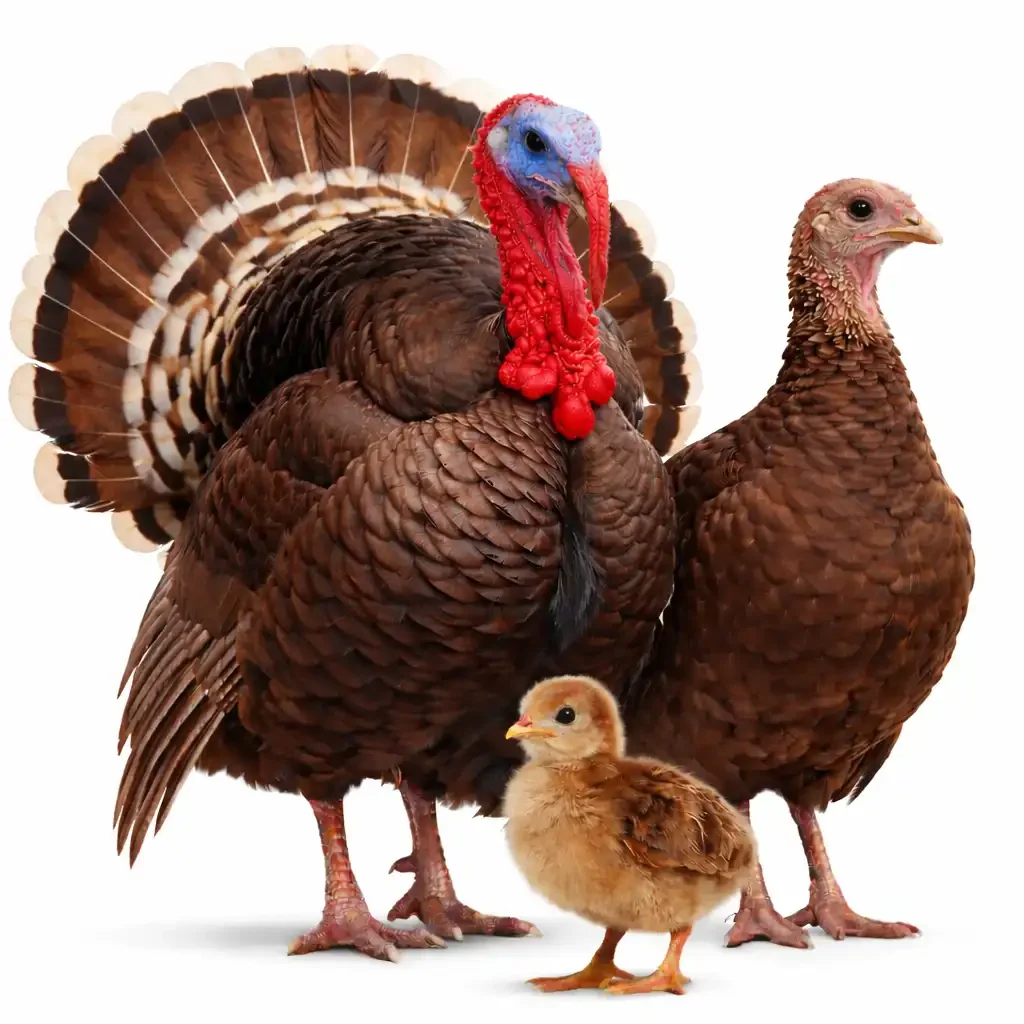
The defining characteristic of the Chocolate turkey is the uniform, warm dark brown to milk chocolate coloration of the plumage that covers the entire body. The chocolate color is one of the most immediately distinctive and visually striking of all heritage turkey plumage colors, creating an appearance that is simultaneously familiar in its reference to the universally recognized color of chocolate and genuinely unusual in the context of domestic turkey keeping where dark brown plumage of this specific tone is extremely rare. The chocolate coloration has a warm, rich quality in natural light that is quite different from the cool darkness of the Black Spanish or the metallic darkness of the Bronze, with the warm brown tones creating an impression of depth and richness that many observers find immediately beautiful.
The breed standard describes the characteristic chocolate brown coloration extending uniformly across the body feathering with the wings and tail displaying the same warm brown tones. Well-colored Chocolate turkey birds display the most uniform, richest chocolate tone throughout the plumage with minimal variation in shade between different body areas. The chocolate coloration may show a faint iridescent sheen in strong direct sunlight that adds additional depth to the warm brown base, creating a subtle luminosity in the plumage of the best-colored birds.
The head and facial skin display the standard turkey characteristics of caruncles, wattles, and snood that change color with emotional and hormonal state. The legs are typically dark to pinkish, the beak is horn-colored, and the eyes are dark brown. Mature toms reach approximately 33 pounds and mature hens reach approximately 18 pounds, placing the Chocolate turkey in the large heritage turkey size category appropriate for the premium holiday direct-sales market.
Temperament and Behavior
The Chocolate turkey is consistently described by breeders who have worked with the variety as calm, docile, and relatively gentle in its interactions with handlers, with a temperament that makes daily management and the regular handling required by conservation breeding programs straightforward. The calm temperament is not unique to the Chocolate among heritage turkey breeds, as several varieties in this series share a similarly manageable baseline disposition, but it is consistently reported as a genuine characteristic of the variety rather than an artifact of specific management conditions.
Toms display the full turkey behavioral repertoire during breeding season, with the chocolate brown plumage creating a display of distinctive visual character. The spread tail fan of a displaying Chocolate tom reveals the warm, uniform brown coloration across its full extent, creating a display that is immediately recognizable as different from any other heritage turkey variety and that generates genuine visual interest in any homestead setting. The combination of large body size and the unusual dark brown plumage makes Chocolate turkey toms among the most immediately striking display animals available from any domestic turkey variety.
The breed forages actively when given range access, expressing the natural behavioral repertoire of a fully functional heritage turkey. The foraging instinct and ranging behavior of well-managed Chocolate turkeys contribute to the meat quality benefits of heritage production and support the behavioral health and contentment of birds with genuine natural instincts.
Raising on a Homestead
Housing
Chocolate turkeys require housing appropriate for large heritage breeds reaching mature weights of 18 to 33 pounds. Provide a minimum of 6 square feet of indoor floor space per bird, with 8 square feet preferable for behavioral health and comfort. Roost bars must be sturdy enough to support large birds and positioned at heights that allow comfortable access without excessive jump heights that risk landing injuries in heavy heritage birds.
The dark chocolate plumage of the Chocolate turkey creates a specific housing and range consideration that is the opposite of the consideration noted for Lavender and Jersey Buff birds. The dark brown coloration absorbs more solar radiation than lighter-colored plumage, which can increase heat load on birds in hot, sunny conditions. Providing shade structures in range areas is particularly important for Chocolate turkey flocks in warm summer climates, and the breed's historical association with the Gulf Coast region of the American South suggests that careful heat management during midsummer periods is an important ongoing consideration for this variety.
Feeding
Chocolate turkey poults require the standard heritage turkey feeding program. Begin with 28 to 30 percent protein turkey or game bird starter for the first six to eight weeks, transition to 20 to 22 percent protein grower feed through 14 to 16 weeks, and provide a 16 to 18 percent protein finisher ration in the final growing period before processing. Breeding stock maintained year-round requires a balanced maintenance ration with adequate vitamin E, vitamin A, and selenium supporting reproductive performance.
The dark plumage coloration of the Chocolate turkey does not create specific nutritional requirements beyond the standard heritage turkey program, but the general principle that adequate range access and varied diet supports the fullest and most vivid expression of any turkey's plumage genetics applies to the Chocolate as it does to all heritage varieties.
Range and Foraging
Outdoor range access is strongly recommended for Chocolate turkey production for the standard heritage turkey reasons of production quality, flavor development, and behavioral health. The breed's historical origins in the managed range environments of the American South suggest a genuine adaptation to free-range management that expresses itself in active foraging behavior and good utilization of range resources.
Heat management in range situations is a specific ongoing consideration for Chocolate turkeys given the dark plumage and the breed's historical Gulf Coast associations. Providing adequate shade, ensuring constant access to cool clean water, and monitoring birds during the hottest periods of summer maintains flock health and comfort in warm growing environments.
Brooding Poults
Chocolate turkey poults require the same careful early brooding management as all heritage turkey poults. Maintain brooder temperature at 95 to 100 degrees Fahrenheit for the first week, reducing by 5 degrees per week until fully feathered. The chocolate coloration is present in poults from hatching in well-bred birds, making early color assessment possible for preliminary selection in conservation breeding programs. Monitor closely for starve-out vulnerability during the critical first days using standard management practices of colored marbles in waterers and brightly colored starter feed.
Meat and Production Value
The Chocolate turkey produces genuine large heritage turkey meat quality from a large body that is fully appropriate for the premium whole bird holiday market. A finished Chocolate tom produces a dressed carcass of approximately 18 to 23 pounds and a finished hen produces approximately 10 to 14 pounds, placing the Chocolate turkey in the same production range as the Narragansett, Bronze, and Slate for the large heritage turkey direct-sales market.
The active ranging lifestyle, heritage genetics, and extended 28 to 30 week growing period of the Chocolate turkey produce the characteristic heritage turkey meat quality of richer flavor, better fat distribution, and greater complexity compared to commercial broad-breasted alternatives. The warm, humid climate adaptation suggested by the breed's Gulf Coast history may contribute to specific characteristics of the finished carcass quality that differ subtly from the heritage breeds developed in cooler New England or mid-Atlantic environments, though this is an area of heritage turkey production lore rather than formally documented research.
The dark chocolate plumage of the Chocolate turkey produces pinfeather staining on the dressed carcass that is among the most significant of any heritage turkey variety, as the dark brown feather pigmentation leaves visible staining on the dressed skin. Managing this through careful scalding temperature control, thorough picking technique, and candling to remove remaining pinfeathers reduces the visual impact, and customer education about the natural appearance of heritage bird carcasses manages expectations effectively. The conservation and rarity story of the Chocolate turkey is compelling enough that customers who understand what they are purchasing are typically not deterred by the natural carcass appearance difference from commercial alternatives.
The extraordinary rarity of the Chocolate turkey creates a premium pricing opportunity that exceeds the standard heritage turkey premium. As one of the most genuinely rare recognized heritage turkey varieties in existence, with a Critical conservation status and a compelling history rooted in American Southern agricultural heritage, the Chocolate turkey carries a product story of exceptional resonance with direct-to-consumer heritage food customers who value both culinary quality and conservation significance.
Conservation Status
The Chocolate turkey is listed as Critical by the Livestock Conservancy, placing it among the most endangered domestic turkey varieties in existence. The Critical designation indicates a global population of fewer than 500 registered breeding birds with fewer than five primary breeding flocks maintaining the variety at a genetically meaningful level.
The conservation challenges facing the Chocolate turkey are compounded by the severity of the population bottleneck through which the variety passed in the latter decades of the twentieth century, which means that the surviving genetic diversity within the breed is very limited. The risk of inbreeding depression in the remaining small, fragmented breeding population is a genuine concern, and connecting with other Chocolate turkey breeders to exchange breeding stock and introduce unrelated genetics into individual programs is among the most important conservation management practices for anyone working seriously with this variety.
The Chocolate turkey's Critical status and its historical significance as a recognized American heritage variety since 1874 make it one of the most important conservation priorities in domestic turkey preservation. A homestead operation that establishes a quality Chocolate turkey breeding flock, maintains rigorous breeding records, practices careful genetic management, and actively participates in the heritage turkey conservation community contributes to preserving a piece of American agricultural heritage whose loss would be genuinely irreversible.
Connecting with the Livestock Conservancy's Chocolate turkey conservation program, the Society for the Preservation of Poultry Antiquities, and the American Poultry Association's heritage turkey breeder networks provides access to the most reliable sources of authentic breeding stock and the community support that makes long-term conservation breeding sustainable for individual homestead operations.
Varieties and Color Patterns
The Chocolate turkey is maintained as a single color variety with the uniform dark brown to milk chocolate plumage as the only accepted color expression for conservation breeding and exhibition purposes. The breed standard describes a consistent warm chocolate brown throughout the body plumage, with the wings and tail displaying the same warm brown tones and no white or other color contamination that would indicate genetic impurity.
The quality and richness of the chocolate coloration varies between individuals and breeding lines, with the most desirable birds displaying the most uniform, warmest, and most richly saturated chocolate brown tone throughout all feathered areas. Birds showing black, bronze, or other color contamination departing from the standard chocolate description indicate genetic impurity from crossing with other turkey varieties and should not be used in conservation breeding programs aimed at maintaining the authentic Chocolate color type.
A color distinction worth noting for breeders is the difference between the warm, brown-based chocolate color of the Chocolate turkey and the black-based dark coloration of the Black Spanish. The two dark-colored heritage turkey varieties are sometimes confused by observers unfamiliar with the specific tone differences, but the warm brown undertone of the Chocolate versus the cool, pure black of the Black Spanish is clearly distinguishable in good lighting conditions and with appropriate comparison reference. Well-colored Chocolate turkey birds display an unmistakably warm, brown quality in their plumage that has no resemblance to the glossy, cool black of the Black Spanish.
Common Health Issues
Blackhead Disease
Blackhead Disease is the primary health management concern for Chocolate turkeys as for all domestic turkey breeds. The Critical conservation status of the Chocolate turkey makes individual bird losses to preventable disease particularly significant, as each breeding bird in this small population represents a meaningful portion of the variety's genetic diversity. Strict ground separation from chickens and all chicken ground is the essential preventive management practice.
Heat Management
The dark chocolate plumage of the Chocolate turkey creates a specific heat management health consideration in warm climate production. Dark-colored plumage absorbs significantly more solar radiation than light-colored plumage, increasing the heat load on birds in direct sunlight during warm weather. Combined with the breed's historical Gulf Coast associations that suggest adaptation to warm, humid conditions, heat management requires specific attention for Chocolate turkey flocks during midsummer in warm climates. Providing adequate shade in range areas, ensuring constant access to cool, clean water, scheduling range access during the cooler parts of the day in peak summer heat, and monitoring individual birds for heat stress signs are important seasonal management practices.
Inbreeding Depression
The severe population bottleneck through which the Chocolate turkey passed creates a specific health concern regarding inbreeding depression from the limited genetic diversity in the surviving population. Reduced fertility, lower hatch rates, poorer immune function, and generally reduced vigor are the characteristic signs of inbreeding depression in small breeding populations. Proactive genetic management through exchange of breeding stock with other breeders and introduction of unrelated genetics into individual programs is the most important preventive approach.
Respiratory Disease
Standard respiratory health management through good ventilation, dry litter management, appropriate stocking density, and acquisition from health-tested sources applies fully to the Chocolate turkey. Given the conservation significance of each individual bird, early identification and treatment of respiratory disease is particularly important.
Parasites
Internal and external parasite management through regular monitoring, targeted treatment, and dust bathing provision are standard ongoing care practices. The dark plumage of the Chocolate turkey actually facilitates external parasite monitoring in one respect, as the contrast between light-colored lice or mite eggs and the dark feather background can make infestations more visible during physical examination than they would be against lighter plumage.
FAQ
Is the Chocolate turkey recognized by the American Poultry Association? Yes, the Chocolate turkey was recognized in the American Poultry Association Standard of Perfection in 1874, making it one of the original recognized American heritage turkey varieties alongside the Bronze, Narragansett, White Holland, Slate, and Jersey Buff. This recognition reflects the established status of the Chocolate as a distinct and reproducibly consistent color variety in American turkey breeding at the time of the first comprehensive poultry breed standardization in the United States. The 1874 recognition is historically significant documentation of the variety's genuine place in American agricultural heritage.
How does the Chocolate turkey's coloration differ from the Black Spanish? The Chocolate and Black Spanish are the two dark-colored heritage turkey varieties recognized in the American Poultry Association Standard of Perfection, and they are sometimes confused by observers unfamiliar with the specific tonal differences between them. The Chocolate turkey displays a warm, dark brown to milk chocolate tone throughout the plumage, with the brown undertone creating a warm, earthy quality clearly distinguishable from black in good lighting. The Black Spanish displays a pure, cool, glossy black throughout the plumage with an iridescent green or bronze sheen in strong light that is the characteristic plumage quality of that variety. In good natural lighting the distinction between the warm brown of the Chocolate and the cool black of the Black Spanish is clear and immediate to any observer who knows what to look for. In poor lighting conditions or with inexperienced observers the two dark colors can be confused, but side-by-side comparison or good photographic documentation eliminates ambiguity.
Where did the Chocolate turkey originate and why does this matter for homestead production? The Chocolate turkey's origins in the American South, particularly in the Gulf Coast states including Louisiana, reflect an adaptation to the warm, humid climate of that region that has practical implications for modern homestead production. The breed's historical development in a warm climate environment suggests genuine physiological adaptation to heat and humidity that may make it better suited to warm climate homestead turkey production than breeds developed in cooler New England or mid-Atlantic environments. This potential heat tolerance advantage is worth considering for homestead operations in warm climate regions where summer heat management is a significant production challenge. However, the dark plumage creates a solar heat load consideration that requires management through shade provision regardless of any underlying physiological heat tolerance.
What makes the Chocolate turkey a compelling conservation breeding project? The Chocolate turkey combines several characteristics that make it one of the most compelling conservation breeding opportunities in American heritage turkey preservation. The Critical conservation status reflects a genuine emergency that makes every breeding flock meaningful. The historical significance of formal recognition since 1874 establishes the variety's deep roots in American agricultural heritage. The genuinely unusual and immediately beautiful dark chocolate plumage creates visual and marketing distinctiveness that supports premium pricing in direct-to-consumer sales. The large body size and genuine heritage meat quality provide real production value alongside the conservation story. And the historical connection to Southern American agricultural heritage creates a regional and cultural significance that resonates with customers who value food with genuine historical and geographic provenance.
Can I raise Chocolate turkeys in a warm southern climate? Yes, the Chocolate turkey's historical origins in the warm, humid Gulf Coast region of the American South suggest genuine adaptation to warm climate production that makes it a reasonable choice for homestead operations in warm southern climates. The primary management consideration specific to warm climate production with this variety is the heat load created by the dark plumage, which absorbs significantly more solar radiation than light-colored plumage and requires adequate shade provision in range areas. Ensuring constant access to cool, clean water, monitoring birds during peak summer heat periods, and scheduling outdoor range access during the cooler morning and evening hours during the hottest summer weeks manages the heat load concern effectively while allowing the birds to express their natural ranging instincts throughout the growing season.