
Lavender Turkey
Quick Overview
Common Name: Lavender Turkey, Self-Blue Turkey, Lilac Turkey
Breed Type: Heritage Turkey Color Variety
Origin: United States, developed within domestic turkey color genetics
Primary Use: Meat, Exhibition, Ornamental
Mature Tom Weight: 33 pounds
Mature Hen Weight: 18 pounds
Egg Production: Moderate, 50 to 100 eggs per year
Egg Color: Cream to light brown with brown speckling
Temperament: Calm, gentle, moderately docile
Conservation Status: Not separately tracked (related to Slate population)
Lifespan: 5 to 10 years
Breed History and Origin
The Lavender turkey, also widely known as the Self-Blue turkey, occupies a specific and somewhat complex position in the heritage turkey world that is best understood in direct relationship to the Blue Slate turkey discussed earlier in this series. The Lavender is not a separately recognized breed under the American Poultry Association Standard of Perfection but rather a distinct color expression within the same genetic system that produces the Blue Slate, representing a lighter, more uniformly pale silvery-blue tone that results from specific homozygous combinations of the dilution gene responsible for the slate color family in domestic turkeys.
The distinction between the Blue Slate and the Lavender is fundamentally genetic rather than historical or geographic. Both color expressions arise from the same underlying turkey population and the same color dilution genetics, but the Lavender specifically results when a bird inherits two copies of the dilution gene in a homozygous combination that produces a more complete and more uniform lightening of the base black pigmentation than the heterozygous expression that produces the standard Blue Slate color. The result is a turkey with a consistently lighter, more uniformly pale silvery-blue to cool gray coloration that has a distinctly different visual character from the deeper, more vivid slate-blue of the standard Blue Slate.
The name Self-Blue is used interchangeably with Lavender by many breeders and reflects the genetic self-colored quality of the Lavender expression, where the color is uniform throughout the plumage without the darker tipping or banding that can appear in some Blue Slate birds. The term Lavender is used more commonly in general homestead and poultry enthusiast communities while Self-Blue is more commonly used in exhibition and genetics-focused breeding discussions, but both names refer to the same color expression.
The history of the Lavender turkey as a maintained color type is closely intertwined with the history of Slate turkey breeding programs. Breeders working with Slate populations who understood the underlying genetics recognized that the Lavender birds appearing in their flocks from Blue Slate crosses represented a genetically distinct and visually distinctive color expression worth maintaining separately. Over time, dedicated breeders began selecting specifically for the Lavender expression, maintaining breeding populations that consistently produce the lighter, more uniform pale coloration and treating Lavender as a distinct variant within the broader Slate color family rather than a reject or off-color bird from standard Blue Slate breeding.
Physical Characteristics
The Lavender turkey shares the fundamental body structure of the Slate turkey family from which it comes, with a medium to large, well-proportioned body appropriate for genuine heritage turkey meat production. The body conformation is that of a balanced, classically structured heritage turkey with a broad chest, good muscling, a level back, and the solid, substantial frame that reflects genuine production capability rather than the artificially extreme proportions of commercial broad-breasted varieties.
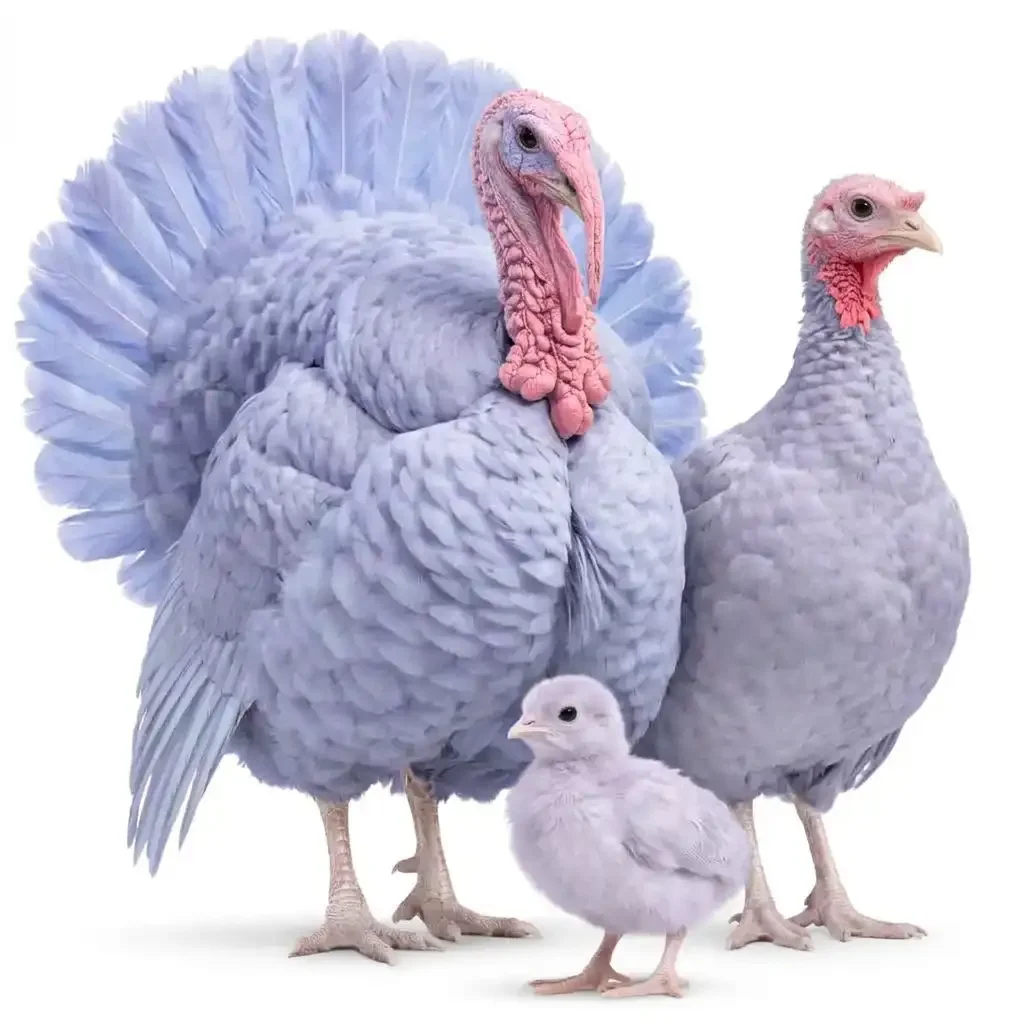
The defining characteristic that distinguishes the Lavender from the Blue Slate and from all other domestic turkey color expressions is the uniformly pale, silvery-blue to cool gray coloration of the plumage. Where the standard Blue Slate displays a deeper, more vivid slate-blue tone with some variation in shade across different parts of the plumage, the Lavender displays a more consistently pale, uniform coloration that is lighter throughout and has a distinctive soft, muted quality quite unlike the deeper tones of the Blue Slate or the warm earthiness of the Bronze and Narragansett families.
The Lavender color has a quality that many observers describe as soft, ethereal, or painterly, with the pale silvery-blue plumage creating an impression of gentle, washed-out color that is genuinely unlike any other domestic turkey variety. In strong sunlight the Lavender plumage can show a subtle iridescent quality that adds depth to the pale coloration, creating a shimmering effect that enhances the visual distinction of the color. In diffuse light the pale, even tone creates a quietly beautiful, almost smoky appearance that photographs exceptionally well and makes Lavender turkeys among the most visually distinctive and photographically compelling heritage turkey varieties available.
The head and facial skin display the standard turkey characteristics that change color with emotional and hormonal state. The legs are typically dark, the beak is horn-colored, and the eyes are dark brown. Mature toms and hens reach the same approximate weights as the Slate, approximately 33 pounds for mature toms and 18 pounds for mature hens, reflecting the shared genetic foundation of the two color expressions.
Temperament and Behavior
The Lavender turkey shares the temperament characteristics of the broader Slate turkey family, which as described in the Slate entry is consistently reported as one of the calmer and more approachable temperaments among the heritage turkey breeds. The calm, relatively gentle baseline temperament that characterizes the Slate family appears consistently in Lavender birds as well, reflecting the shared genetic heritage that underlies both color expressions.
Toms display the full turkey behavioral repertoire during the breeding season, including strutting, gobbling, and territorial displays, with the pale Lavender plumage creating a particularly striking visual display as the tail fan spreads to reveal the soft, uniformly pale coloration across its full extent. The Lavender tom in full display is one of the most quietly spectacular sights in the heritage turkey yard, with the pale, shimmering plumage fanned to its full extent creating a display of understated elegance quite different from the bold graphic impact of the Royal Palm or the metallic drama of the Bronze.
The breed forages actively when given range access, demonstrating the natural behavioral repertoire of a fully functional heritage turkey. Lavender turkeys show good foraging instinct and range utilization, contributing to the meat quality benefits of heritage turkey production when managed with adequate outdoor access.
Raising on a Homestead
Housing
Lavender turkeys require housing appropriate for medium to large heritage breeds, identical in its fundamental requirements to the housing described for the Slate. Provide a minimum of 6 square feet of indoor floor space per bird, with 8 square feet preferable. Roost bars must be sturdy enough to support mature birds reaching 18 to 33 pounds and positioned at appropriate heights for safe access and landing.
The pale plumage of Lavender turkeys creates a specific visual management consideration in the context of housing and range. The light coloration makes Lavender turkeys somewhat more visible to aerial predators in open range situations than darker-feathered breeds, which is a practical predator management consideration for operations with significant aerial predator pressure. Overhead cover in range areas and secure overnight housing with appropriate predator exclusion are standard requirements for all turkey breeds but particularly relevant for the more visually exposed Lavender.
Feeding
Lavender turkey poults require the standard heritage turkey feeding program. Begin with 28 to 30 percent protein turkey or game bird starter for the first six to eight weeks, transition to 20 to 22 percent protein grower feed through 14 to 16 weeks, and provide a 16 to 18 percent protein finisher ration in the final growing period before processing. Breeding stock maintained year-round requires a balanced maintenance ration with attention to the vitamins and minerals that support reproductive performance in conservation breeding programs.
A specific nutritional consideration relevant to maintaining the Lavender color is the role of carotenoid pigments in turkey plumage coloration. While the primary determinant of the Lavender color is genetic, adequate nutrition supports the health of the feather structure that allows the color genetics to express most fully and clearly. Good overall nutrition, including adequate access to the varied diet provided by range forage, supports the best possible expression of the Lavender plumage characteristics.
Range and Foraging
Outdoor range access is strongly recommended for Lavender turkey production for the same production quality and behavioral health reasons that apply to all heritage turkey varieties. The active foraging instinct of the Slate family is present in Lavender birds, and range access contributes meaningfully to both the flavor quality of the meat and the behavioral contentment of the flock.
The pale plumage of Lavender turkeys on range creates a visually striking image that has genuine value for farm marketing photography and social media content. The sight of Lavender turkeys foraging on green pasture is one of the most photographically compelling images available from any heritage turkey variety, and homestead operations that actively document their farming practices for marketing purposes will find Lavender turkeys provide exceptional visual content.
Brooding Poults
Lavender poults require the same careful brooding management as all heritage turkey poults. Maintain brooder temperature at 95 to 100 degrees Fahrenheit for the first week, reducing by 5 degrees per week until fully feathered. Monitor closely for starve-out vulnerability during the critical first days using colored marbles in waterers and brightly colored starter feed. The pale coloration of Lavender poults can make early developmental assessment slightly more challenging than with darker-feathered breeds where color and condition changes are more immediately visible, requiring attentive daily observation.
Meat and Production Value
The Lavender turkey produces meat of genuine heritage quality equivalent to the Slate turkey from which its color genetics derive, with the same combination of large body size, active ranging lifestyle, and extended 28 to 30 week heritage growing period that produces the rich, complex flavor profile that distinguishes heritage turkey from commercial alternatives. A finished Lavender tom produces a dressed carcass of approximately 18 to 23 pounds and a finished hen produces approximately 10 to 14 pounds, placing the Lavender fully in the large heritage turkey size range appropriate for the premium holiday direct-sales market.
The pale plumage of the Lavender turkey produces a notably cleaner dressed carcass appearance than the darker-feathered heritage breeds. The lighter feather pigmentation results in less pinfeather staining on the dressed skin than Bronze, Narragansett, or even Blue Slate birds, producing a dressed carcass that is closer in visual appearance to white-feathered breeds while retaining the full heritage flavor profile of the Slate genetic background. For homestead producers who sell whole dressed birds directly to customers, this clean dressed appearance is a practical marketing advantage.
The Lavender's combination of genuine heritage flavor quality, large carcass size, relatively clean dressed appearance, and the extraordinarily distinctive visual character of the live bird creates a comprehensive commercial value proposition for direct-to-consumer heritage turkey operations. The Lavender color is unusual enough and visually compelling enough that it consistently generates customer interest and conversation, providing a natural platform for communicating the heritage turkey conservation story that supports premium pricing.
Conservation Status
The Lavender turkey is not separately tracked as a distinct breed by the Livestock Conservancy but falls within the broader Slate turkey population, which as described in the Slate entry is listed at Critical status with fewer than 500 registered breeding birds globally. The Lavender color expression represents a specific subset of the already critically small Slate population, making its effective conservation population even smaller than the overall Slate numbers suggest.
The genetic relationship between the Blue Slate and Lavender means that conservation breeding programs for the Slate family inevitably involve managing both color expressions simultaneously. Breeders who understand the underlying genetics can predict with reasonable reliability which matings will produce Lavender offspring and which will produce Blue Slate offspring, allowing deliberate management of the ratio of the two color expressions within a breeding program. Maintaining both the Blue Slate standard color and the Lavender expression within a well-managed Slate family breeding program contributes to the overall genetic diversity of the Slate population while preserving the distinctive visual character of each color type.
For homestead keepers who specifically want to maintain and breed Lavender turkeys, connecting with Slate family breeders who understand and actively manage the Lavender color genetics is more productive than seeking out Lavender specialists in isolation, as the genetic management of this color requires understanding its relationship to the Blue Slate within the same breeding population.
Varieties and Color Patterns
The relationship between the Lavender and Blue Slate color expressions within the Slate turkey color genetics system is the most important variety and color pattern information for anyone working with these birds. The genetic mechanism can be understood practically as follows.
The slate color dilution gene in turkeys is incompletely dominant, meaning that birds with one copy of the dilution gene express the standard Blue Slate color, while birds with two copies of the dilution gene express the lighter, more uniform Lavender color. Birds with no copies of the dilution gene express the underlying black or dark coloration without any dilution effect.
When two Blue Slate birds are crossed, each parent contributes one copy of the dilution gene on average, and the resulting offspring statistically include approximately one quarter with two copies expressing Lavender, one half with one copy expressing Blue Slate, and one quarter with no copies expressing the undiluted dark color. This statistical expectation explains the color variation observed in Blue Slate breeding programs and provides the framework for deliberately producing Lavender birds by managing which breeding combinations are used.
When a Lavender bird carrying two copies of the dilution gene is crossed with a Blue Slate bird carrying one copy, approximately half the offspring will be Lavender and half will be Blue Slate, providing a relatively efficient way to produce Lavender birds once at least one parent carrying two copies is identified in the breeding population. Crossing two Lavender birds produces offspring that are all Lavender in color genetics, though variability in color expression quality still occurs based on other modifier genes in the population.
Common Health Issues
Blackhead Disease
Blackhead Disease is the primary health management concern for Lavender turkeys as for all domestic turkey breeds. Strict ground separation from chickens is the essential preventive practice. The Lavender turkey's color and body size provide no specific protection against Histomonas meleagridis, and all standard Blackhead prevention management protocols apply fully to this variety.
Plumage Condition Monitoring
The pale Lavender plumage, while visually beautiful, requires specific attention in health monitoring because color changes and feather condition deterioration that would be immediately obvious in darker-feathered birds can be more subtle in pale-feathered birds. Yellowing, browning, or dull, lifeless plumage that might indicate nutritional deficiency, parasitism, or chronic health problems can be less immediately noticeable against the pale Lavender baseline than against darker feather colors. Regular physical handling and examination supplements visual observation for maintaining health monitoring accuracy in Lavender flocks.
Genetic Management
As described in the conservation and color genetics sections, the management of the dilution gene expression within a Lavender breeding program requires a level of genetic understanding that is more demanding than working with breeds that breed more uniformly true to color. Homestead keepers new to Lavender turkey breeding should seek mentorship from experienced Slate family breeders and invest time in understanding the dilution gene mechanics before making breeding decisions that will affect the color consistency of their flock across multiple generations.
Respiratory Disease
Standard respiratory health management through good ventilation, dry litter, appropriate stocking density, and health-tested sourcing applies fully to the Lavender turkey. Any birds showing respiratory symptoms should be isolated immediately and evaluated promptly.
Parasites
Internal and external parasite management through regular monitoring, targeted treatment, and dust bathing area provision are standard ongoing care practices. The pale plumage consideration noted above applies equally to external parasite monitoring, where lice and mite infestations developing under the pale feather cover require deliberate physical examination rather than relying solely on visual observation from a distance.
FAQ
What is the difference between Lavender and Blue Slate turkeys? The Lavender and Blue Slate are two color expressions within the same genetic family, differing primarily in the number of copies of the slate color dilution gene each bird carries. Blue Slate birds carry one copy of the dilution gene and display the characteristic deeper, more vivid slate-blue to gray-blue coloration recognized in the American Poultry Association Standard of Perfection. Lavender birds carry two copies of the dilution gene and display a lighter, more uniformly pale silvery-blue to cool gray coloration that is distinctly different from the standard Blue Slate. Both are genuine expressions of the Slate turkey color genetics rather than one being correct and the other being a deviation, but they are visually and genetically distinct expressions that can be managed separately within a breeding program once the underlying genetics are understood.
Will breeding two Lavender turkeys always produce Lavender offspring? Breeding two Lavender birds, each carrying two copies of the dilution gene, will produce offspring that all carry two copies of the dilution gene in their color genetics. This means the offspring will all have the genetic makeup for Lavender color expression. However, the actual quality and consistency of the pale coloration in offspring still varies based on modifier genes and overall genetic background within the population, meaning that while all offspring from two Lavender parents will be Lavender in their fundamental color genetics, the specific shade, uniformity, and visual quality of the Lavender expression varies between individual birds. Consistent selection of breeding birds that display the most uniform, cleanest pale coloration over multiple generations improves the consistency of color expression within a dedicated Lavender breeding population.
Is the Lavender turkey recognized by the American Poultry Association? The Lavender turkey is not separately recognized as a distinct breed or variety in the American Poultry Association Standard of Perfection. The Standard recognizes the Blue Slate as the defined color type for the Slate turkey breed, and the Lavender represents a color expression within the same genetic family that falls outside the defined standard color description. This means Lavender birds cannot be exhibited in APA-sanctioned shows as a recognized variety, though they may appear in shows as part of the broader Slate population or in any-other-variety classes depending on show rules. The absence of APA recognition does not affect the Lavender's genuine beauty, conservation significance within the Slate family, or practical value for homestead production.
How do I identify a true Lavender turkey versus a pale Blue Slate? Distinguishing a true Lavender bird from a pale Blue Slate requires both visual assessment and ideally knowledge of the bird's genetic background from breeding records. True Lavender birds display a consistent, uniformly pale silvery-blue to cool gray coloration throughout the plumage with minimal variation in shade between different feathered areas of the body. Pale Blue Slate birds that are carrying one copy of the dilution gene but expressing it with lighter-than-average color due to modifier genetics will typically show more variation in shade across the plumage, with some areas appearing closer to standard Blue Slate color and others appearing lighter. In practice, the most reliable way to identify true Lavender genetics is through breeding records that document the bird's parentage and through test breeding that reveals the color genetics of offspring.
Can Lavender turkeys be raised alongside Blue Slate turkeys in the same flock? Lavender and Blue Slate turkeys can be physically housed and managed together without any specific management conflicts beyond standard heritage turkey requirements. However, for breeders who want to maintain and reliably produce either the standard Blue Slate color or the Lavender expression, managing birds as separate breeding groups during the breeding season prevents uncontrolled crosses that produce offspring of unpredictable color genetics. A homestead keeper who wants to maintain both color expressions reliably will achieve the best results by understanding the genetics of each breeding bird and managing the breeding pairings deliberately rather than allowing free mixing of Blue Slate and Lavender birds during the breeding season.