
Midget White
Quick Overview
Common Name: Midget White, Smalls, Tiny
Breed Type: Heritage Turkey
Origin: University of Massachusetts, United States
Primary Use: Meat, Small-Scale Production
Mature Tom Weight: 20 pounds
Mature Hen Weight: 10 pounds
Egg Production: Good, 80 to 100 eggs per year
Egg Color: Cream to light brown with brown speckling
Temperament: Exceptionally calm, docile, friendly, people-oriented
Conservation Status: Critical (Livestock Conservancy)
Lifespan: 5 to 10 years
Breed History and Origin
The Midget White turkey has one of the most specific and most academically documented origin stories of any heritage turkey breed in the American poultry tradition. The breed was developed in the 1960s at the University of Massachusetts by Dr. J. Robert Smyth, a poultry geneticist who set out to create a small-bodied, naturally mating turkey that would be genuinely practical for small-scale farm and homestead production at a time when the commercial turkey industry was already moving firmly toward the large broad-breasted varieties that would come to dominate the mainstream market. Dr. Smyth's goal was essentially the same as the goal that had motivated the USDA researchers who created the Beltsville Small White two decades earlier: a compact, efficient, naturally reproductive turkey sized appropriately for small-scale production and the smaller household market.
The genetics used to develop the Midget White drew primarily on the Royal Palm and the Broad-Breasted White, with the Royal Palm contributing its small body size and the natural mating capability that is one of the most important practical advantages of heritage over commercial turkey breeds, and the Broad-Breasted White contributing the pure white plumage and the improved meat yield of the broad-breasted body type in a form that could be scaled down without losing natural reproductive function. The crossbreeding program at the University of Massachusetts produced a bird that achieved the target combination of small mature size, white plumage, good meat yield relative to body size, and the natural mating capability that Dr. Smyth had identified as essential for practical small-scale production.
Despite the genuine practical advantages of the Midget White for the small-scale production market it was designed to serve, the breed never achieved the commercial adoption that its developers hoped for. The mainstream commercial turkey industry had by the 1960s fully committed to the large broad-breasted varieties and the industrial production model that required artificial insemination and controlled housing environments regardless of breed size. Small-scale farm production had declined significantly from its mid-century levels, and the consumer market that the Midget White was sized to serve was being increasingly supplied by commercial turkey parts and smaller commercial whole birds rather than heritage small breeds.
The result was that the Midget White remained a relatively obscure breed through the decades following its development, maintained by a small number of dedicated breeders and poultry enthusiasts rather than achieving the widespread adoption its practical qualities merited. The Livestock Conservancy currently lists it as Critical, with fewer than 500 registered breeding birds globally, making it one of the most endangered heritage turkey breeds despite being one of the most practically suited to the small-scale homestead production model that has grown significantly in consumer interest and market presence in recent years.
Physical Characteristics
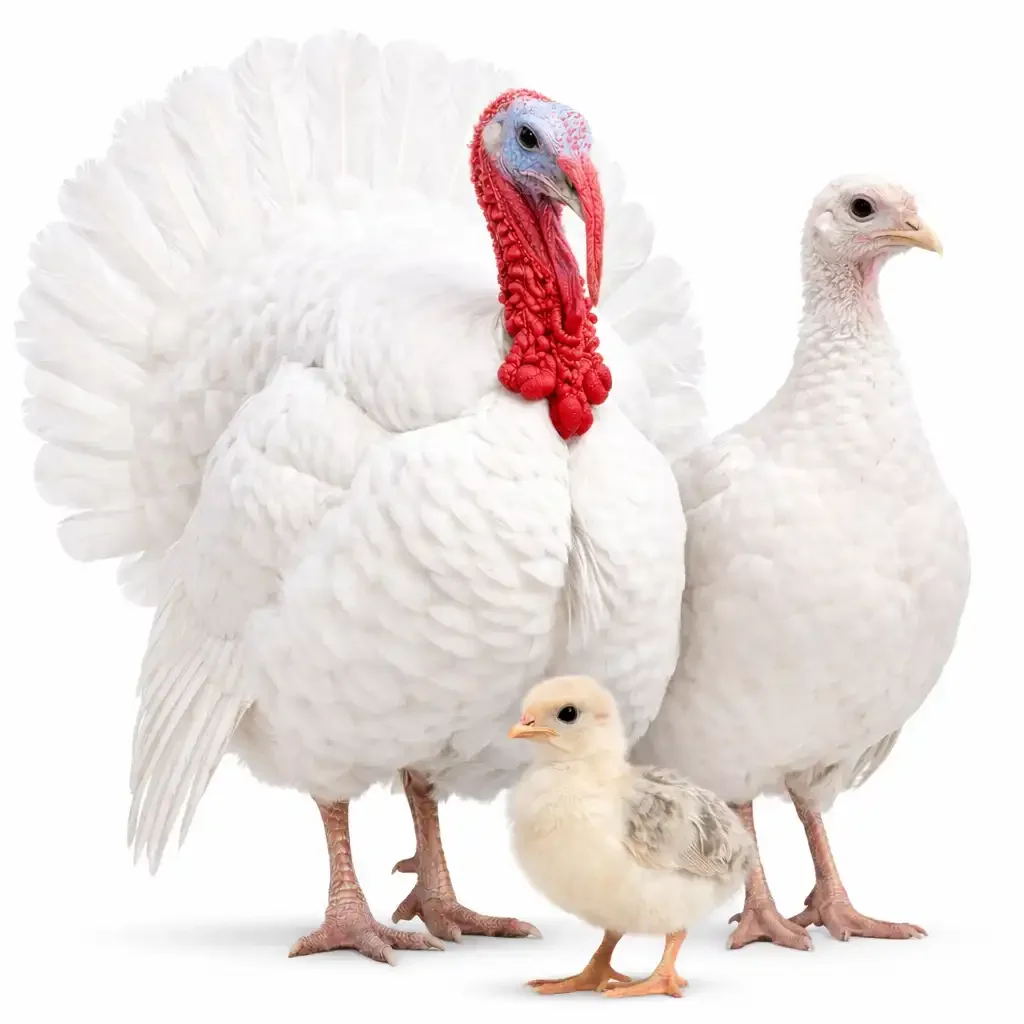
The Midget White is a compact, well-proportioned turkey with a body structure that visually suggests a miniature version of a broad-breasted commercial turkey while retaining the natural balance and proportion of a bird capable of natural mating and active ranging. The body is broad and well-muscled with a rounded, full breast, a level back, and a neat, compact appearance that conveys both genuine meat-producing capability and the manageability that comes with a smaller overall body size.
The plumage is pure white throughout with no colored feathers or markings, producing the clean, commercially attractive appearance associated with white-feathered turkey breeds. The white plumage creates a clean dressed carcass without dark pinfeather staining, which is one of the practical advantages that the Broad-Breasted White contribution to the Midget White's genetics brought to the breed. The overall appearance is of a neat, well-proportioned small turkey that immediately communicates both the practical utility and the genuine heritage character of the breed.
The head and facial skin display the standard turkey characteristics of caruncles, wattles, and snood that change color with the bird's emotional state. The legs are pink to flesh-colored, the beak is light horn colored, and the eyes are dark brown. Mature toms reach approximately 20 pounds and mature hens reach approximately 10 pounds, placing the Midget White as one of the smallest heritage turkey breeds alongside the Beltsville Small White, though with somewhat better breast meat yield per pound of body weight due to the Broad-Breasted White genetic contribution.
The Midget White is sometimes confused with the Beltsville Small White due to the shared combination of small size and white plumage, but the two breeds differ in their origin, their genetic composition, and their body conformation. The Midget White's Broad-Breasted White heritage gives it a somewhat broader, more rounded breast profile than the Beltsville Small White, which has a more traditionally proportioned heritage turkey body structure.
Temperament and Behavior
The Midget White is consistently described by breeders and homestead keepers as one of the most extraordinarily calm, docile, and people-oriented turkey breeds available, with a temperament that routinely surprises keepers who are more accustomed to the more reactive or less sociable behaviors of other heritage turkey breeds. The breed's reputation for exceptional gentleness and genuine engagement with people is one of its most consistently reported and most widely valued characteristics, and it appears to be a stable genetic trait rather than an artifact of specific management conditions.
Midget White turkeys are reported to actively seek human interaction, following their keepers around the homestead, responding to being called, and tolerating handling with a relaxed comfort that makes veterinary examination, breeding management, and daily care significantly easier than with more reactive breeds. This people-oriented quality makes the Midget White one of the most genuinely enjoyable heritage turkey breeds to keep from the perspective of daily human-animal interaction, and it makes the breed particularly well suited to homestead operations where turkeys are part of the visible, interactive farm experience rather than purely production animals managed at a distance.
The breed forages actively when given range access, expressing natural ranging and foraging behaviors appropriate to a fully functional heritage turkey. The Midget White's small body size means it is somewhat more agile and more wide-ranging in its foraging behavior than the large heritage breeds, covering ground efficiently for its size and making genuine use of range resources.
Raising on a Homestead
Housing
Midget White turkeys require housing appropriate for their small body size, which is one of the most practically convenient aspects of working with this breed. A minimum of 4 square feet of indoor floor space per bird is a reasonable baseline, with 6 square feet preferable for behavioral health. Roost bars at appropriate heights for smaller birds allow comfortable roosting without the jump height injury risk that is a consideration for large heritage breeds. The small body size reduces the physical demands on housing structures compared to breeds reaching 33 to 36 pounds, and the overall housing infrastructure requirements are proportionally reduced alongside the bird size.
Nest boxes for laying hens should be provided at one box per three to four hens. The Midget White's good egg production and the practical importance of egg collection for both conservation hatching programs and table use makes well-designed nest box provision particularly important for this breed.
The Midget White's small size increases predator vulnerability compared to larger heritage breeds, as a wider range of predators can successfully target smaller birds. Secure overnight housing with appropriate predator protection is important for any turkey breed but particularly relevant for the smallest heritage varieties.
Feeding
Midget White poults require the standard heritage turkey feeding program with one important consideration related to the breed's Broad-Breasted White heritage. Some breeders report that Midget White birds can show a tendency toward more rapid early growth than purely heritage-lineage breeds, and managing feed to support steady rather than accelerated growth reduces the leg and joint health risks associated with too-rapid weight gain in the young bird phase. Begin with 28 to 30 percent protein turkey or game bird starter for the first six to eight weeks, transition to 20 to 22 percent protein grower feed through 14 to 16 weeks, and provide a 16 to 18 percent protein finisher in the final growing period.
Breeding stock maintained year-round should receive a balanced maintenance ration with adequate vitamin E, vitamin A, and selenium to support the reproductive performance that is one of the most important practical advantages of the Midget White for homestead operations.
Range and Foraging
Outdoor range access is strongly recommended for Midget White production both for the production quality benefits and for the behavioral health of birds with active natural instincts. The breed's small size and good agility make it an active and effective range user, and the combination of ranging lifestyle and heritage genetics produces meat quality distinctly better than confined production can achieve.
The small size of Midget White turkeys does increase aerial predator vulnerability compared to larger heritage breeds, and range management that provides overhead cover, shelter structures, and predator deterrence is more important for this breed than for the large heritage varieties whose size provides some natural protection against smaller aerial predators.
Brooding Poults
Midget White poults require the same careful early brooding management as all heritage turkey poults. Maintain brooder temperature at 95 to 100 degrees Fahrenheit for the first week, reducing by 5 degrees per week until fully feathered. The small size of Midget White poults makes them particularly vulnerable to chilling during the brooding phase, and temperature management requires particular attention during the first week. Monitor closely for starve-out vulnerability during the critical first days and use colored marbles in waterers and brightly colored feed to attract poults to the resources they need during the most vulnerable early period.
Meat and Production Value
The Midget White was specifically designed to produce the most commercially practical small-scale heritage turkey meat product available, and it fulfills this design purpose with a combination of characteristics that make it genuinely well suited to the direct-to-consumer small heritage turkey market. The dressed carcass weight of a finished Midget White tom is approximately 10 to 14 pounds and a finished hen produces approximately 6 to 8 pounds, placing the Midget White firmly in the small heritage turkey category alongside the Beltsville Small White.
The practical advantage of the Midget White over the Beltsville Small White in the meat context is the somewhat better breast meat yield per pound of body weight that the Broad-Breasted White genetic contribution provides. Where the Beltsville Small White has a more traditional heritage turkey body proportion with relatively less breast meat development, the Midget White's partial Broad-Breasted White heritage produces a somewhat fuller breast profile that increases the dressed yield relative to body weight. This yield advantage is modest and does not approach the extreme breast development of commercial broad-breasted varieties, but it does provide a meaningful practical difference for customers purchasing small heritage turkeys for the table.
Heritage turkey meat quality in the Midget White combines the flavor and texture benefits of heritage production, including the active ranging lifestyle, extended 26 to 28 week growing period, and heritage genetics, with the slightly improved yield efficiency of the partial broad-breasted heritage. The result is a small heritage turkey that delivers genuine heritage flavor quality in a carcass size ideally suited to small family holiday meals and the growing direct-to-consumer market for small whole heritage birds.
The Midget White's small size and the premium that genuinely small heritage turkeys command in the direct-to-consumer market create a favorable commercial equation for homestead producers. Customers who want a genuine heritage turkey for a small family Thanksgiving without the overwhelming quantity of a large heritage bird represent a specific and underserved market segment that the Midget White serves better than any other heritage variety currently available.
Conservation Status
The Midget White is listed as Critical by the Livestock Conservancy, placing it alongside the Beltsville Small White, White Holland, and Slate as one of the most endangered heritage turkey breeds in the United States. The Critical designation indicates a global population of fewer than 500 registered breeding birds with fewer than five primary breeding flocks maintaining the breed at a genetically meaningful level.
The irony of the Midget White's Critical conservation status is particularly notable given that the breed was designed specifically for the small-scale homestead production market that has grown substantially in consumer interest and market presence since the breed was developed in the 1960s. The Midget White's practical advantages for homestead production, including its small size, exceptional temperament, natural mating capability, good egg production, and genuine heritage meat quality, represent exactly the combination of characteristics that the growing heritage food movement values. The breed that was ahead of its time in addressing the small-scale heritage turkey production market now needs the market that has finally arrived to discover and support it.
For homestead keepers who raise Midget Whites, maintaining accurate breeding records, registering breeding flocks with the Livestock Conservancy, and connecting with other Midget White breeders through heritage turkey networks contributes to the conservation effort and helps maintain the genetic diversity essential for the long-term health of a population this small.
Varieties and Color Patterns
The Midget White is a single-variety breed with pure white plumage as the only color expression. No colored feathers or markings are present in standard-bred Midget White birds. The white plumage produces the clean, commercially attractive dressed carcass appearance that was one of the design criteria Dr. Smyth incorporated from the Broad-Breasted White heritage used in the breed's development.
As with the White Holland, the visual similarity between Midget White turkeys and small Broad-Breasted White commercial birds creates a potential identification challenge. However, the size difference between a full Broad-Breasted White and a Midget White is substantial enough that confusion is primarily an issue in younger birds before size differences become fully apparent. More importantly, the natural mating capability and heritage body proportions of authentic Midget White breeding stock versus the artificial insemination dependence and extreme breast development of Broad-Breasted White birds provide functional distinctions that become clear in a managed breeding context.
Common Health Issues
Blackhead Disease
Blackhead Disease is the primary health management concern for Midget White turkeys as for all domestic turkey breeds. Strict ground separation between turkey and chicken flocks, with no access to shared ground that might carry infectious cecal worm eggs, is the essential preventive management practice. The Midget White's small size does not provide any specific protection against Blackhead and all standard ground separation protocols apply fully to this breed.
Growth Rate Management
The partial Broad-Breasted White heritage of the Midget White creates a specific health management consideration regarding growth rate. Some breeders report that Midget White birds can show faster early growth than purely heritage-lineage breeds, and managing this growth rate through appropriate feeding and adequate exercise space reduces the risk of leg and joint problems associated with too-rapid weight gain in growing birds. Providing adequate range access and avoiding ad libitum high-protein feeding beyond the appropriate developmental stage supports healthy growth rates.
Predator Vulnerability
The Midget White's small body size increases vulnerability to predators compared to large heritage breeds. Secure overnight housing with appropriate predator exclusion, aerial predator deterrence in range situations, and careful management of birds in the range environment are particularly important for this small breed.
Respiratory Disease
Standard respiratory health management through good housing ventilation, dry litter, appropriate stocking density, and acquisition from health-tested sources applies fully to the Midget White. Any birds showing respiratory symptoms should be isolated immediately and evaluated.
Parasites
Internal and external parasite management through regular monitoring, targeted treatment, and provision of dust bathing areas are standard care practices for any heritage turkey flock with outdoor range access. The small body size of the Midget White means that parasite burdens that a large heritage bird might tolerate with minimal production impact can have more significant health consequences in a small bird with less body reserve.
FAQ
How does the Midget White differ from the Beltsville Small White? The Midget White and Beltsville Small White are the two primary small heritage turkey breeds available to homestead producers and they are often compared given their shared combination of small size and white plumage. The most important differences between them are their genetic origin, body conformation, and meat yield characteristics. The Beltsville Small White was developed at the USDA from crosses between multiple heritage breeds including White Holland, Narragansett, and Wild Turkey, producing a bird with traditional heritage turkey body proportions. The Midget White was developed at the University of Massachusetts from Royal Palm and Broad-Breasted White crosses, producing a bird with a somewhat broader, fuller breast profile that provides slightly better dressed yield per pound of body weight. The Midget White also has a notably exceptional temperament reputation that exceeds even the Beltsville Small White's good temperament, with the Midget White consistently described as the most people-oriented and docile of all heritage turkey breeds.
Can Midget White turkeys breed naturally? Yes, natural mating capability is one of the most important design criteria Dr. Smyth incorporated into the Midget White during its development at the University of Massachusetts. The ability to mate naturally distinguishes the Midget White and all other heritage turkey breeds from the commercial Broad-Breasted White varieties that provided part of its genetic foundation, and maintaining this natural mating capability is both a conservation priority and a practical management advantage for homestead operations. Selecting breeding stock that demonstrates natural mating ability and maintaining the heritage body proportions that make natural mating physically practical are important considerations in Midget White breeding programs.
Why is the Midget White so rare given its practical advantages? The Midget White's Critical conservation status despite its genuine practical advantages for small-scale homestead production is one of the more puzzling conservation situations in heritage turkey breeding. The most significant factor is timing: the breed was developed in the 1960s when small-scale farm turkey production was declining rather than growing, and it never achieved the initial adoption that would have established a viable production population before the heritage breed conservation crisis of the 1980s and 1990s. The breed essentially missed its market window on the way up and was too small a population to weather the general heritage breed decline. The current growth of the heritage food movement and the direct-to-consumer small farm market represents the best opportunity the Midget White has had since its development to find the audience it was designed for.
What size family is the Midget White turkey best suited for? The Midget White's dressed carcass weight of 10 to 14 pounds for a finished tom and 6 to 8 pounds for a finished hen makes it ideally suited to small families of two to four people who want a genuine heritage turkey for Thanksgiving or other holiday meals without the overwhelming quantity that a large heritage bird produces. The small whole bird format also appeals to customers who want the full heritage turkey experience of roasting and carving a whole bird rather than purchasing turkey parts, but who find the 18 to 25 pound carcasses of large heritage breeds impractical for their household size. This specific market segment, the small family holiday heritage turkey customer, is genuinely underserved by most heritage turkey production operations that focus primarily on the large whole bird market, and the Midget White fills this niche better than any other heritage variety currently available.
Is the Midget White recognized by the American Poultry Association? The Midget White is not currently recognized in the American Poultry Association Standard of Perfection, which reflects both the relatively recent development of the breed in the 1960s and the small population that has limited the organized exhibition presence needed to support a formal recognition petition. The absence of APA recognition does not affect the breed's conservation significance or its practical value for homestead production, but it does mean that Midget White breeders working toward formal recognition face the challenge of building a sufficient exhibitor community and population base to support the recognition process. The Livestock Conservancy's Critical listing provides the most authoritative documentation of the breed's conservation status and the most reliable framework for connecting with serious breeding programs.