
Narragansett
Quick Overview
Common Name: Narragansett, Ganny, Rhodey, Narrie
Breed Type: Heritage Turkey
Origin: Narragansett Bay, Rhode Island, United States
Primary Use: Meat, Exhibition
Mature Tom Weight: 33 pounds
Mature Hen Weight: 18 pounds
Egg Production: Moderate to Good, 50 to 100 eggs per year
Egg Color: Cream to light brown with brown speckling
Temperament: Calm, gentle, excellent foragers, good mothers
Conservation Status: Watch (Livestock Conservancy)
Lifespan: 5 to 10 years
Breed History and Origin
The Narragansett turkey holds a genuinely distinguished place in American agricultural history as one of the oldest and most deeply rooted heritage turkey breeds developed on American soil. Its origins trace to the colonial period of New England history, when the domestic turkeys brought to North America by European settlers began crossing naturally with the Eastern Wild Turkeys native to the region around Narragansett Bay in what is now Rhode Island. These crosses between the domestic European turkey stock and the native wild turkeys produced birds with exceptional hardiness, strong foraging instincts, and the calm, manageable temperament that became the defining characteristics of the breed as it was developed and refined by New England farmers through the seventeenth, eighteenth, and nineteenth centuries.
The geographic specificity of the breed's name reflects the genuine regional character of its development. Narragansett Bay and the surrounding Rhode Island and southern New England farming communities were the primary centers where the distinctive turkey type that would become formally recognized as the Narragansett was developed through generations of careful selection by farmers who valued the specific combination of traits the breed offered. The Narragansett was ideally suited to the New England farming environment, with its cold winters, variable terrain, and the tradition of free-range poultry management that characterized the small mixed farms of the region. The breed's cold hardiness, active foraging capability, and calm manageable temperament made it the preferred turkey of New England farm families through the colonial and early national periods and well into the nineteenth century.
The American Poultry Association admitted the Narragansett to the Standard of Perfection in 1874, in the same group as the Bronze, White Holland, Slate, and other foundational heritage turkey breeds, recognizing its established status as a distinct and reproducibly consistent breed with a long history in American agriculture. At the time of its formal recognition the Narragansett was one of the most commercially important turkey breeds in New England, valued for its meat production, its adaptability to range management, and its reputation as one of the most manageable and least trouble-prone turkey breeds available to the working farmer.
The twentieth century decline of the Narragansett followed the broader pattern of American heritage turkey breeds as commercial broad-breasted varieties displaced heritage production from mainstream markets. The breed declined from its position as a regional agricultural staple to a critically low population level by the 1980s and 1990s when heritage breed conservation organizations began documenting the depth of the crisis. Conservation efforts through the Livestock Conservancy and dedicated breeder communities have improved the Narragansett's population sufficiently to move it from the more urgent Critical status to the current Watch listing, a conservation success story that reflects what dedicated heritage breed preservation programs can accomplish.
Physical Characteristics
The Narragansett is a large, well-proportioned heritage turkey with the classic combination of substantial body size, broad chest, level back, and strong frame that characterizes the best American heritage turkey breeds. The body conformation is that of a genuine working table bird, with the muscular depth and balanced proportions that produce carcasses of commercial quality and that reflect the centuries of selection by New England farmers who kept these birds primarily for meat.
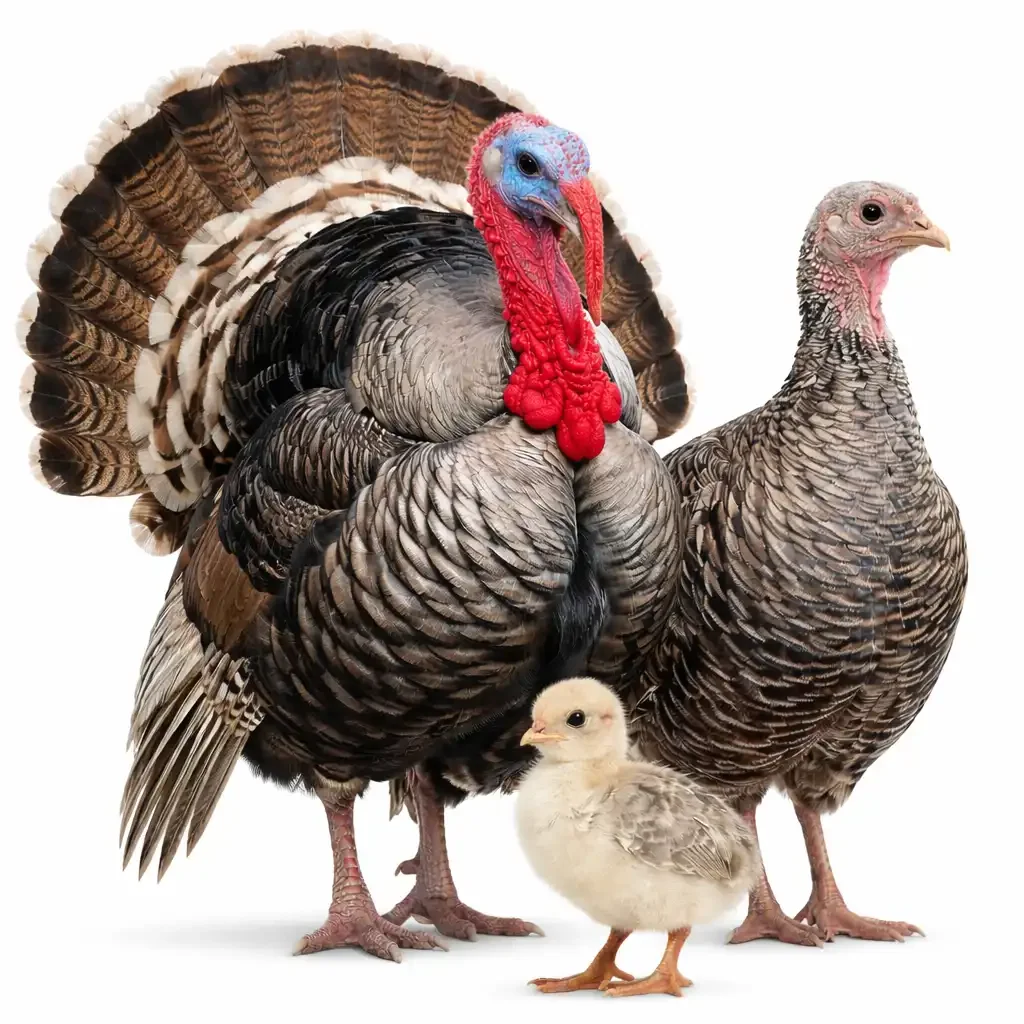
The plumage pattern of the Narragansett is one of the most distinctive and most historically significant of all the heritage turkey color patterns. The breed displays a complex, multi-toned pattern based on the black and gray colors of the wild turkey heritage combined with the domestic turkey's color genetics, producing a pattern that includes black, gray, tan, white, and chestnut tones arranged in the characteristic banded and barred pattern that runs across the feathers of the body, wings, and tail. The effect is a subtly beautiful, complex natural pattern that is more muted and naturalistic than the bold graphic black and white of the Royal Palm or the uniform metallic sheen of the Bronze, with a quality of earthy, organic beauty that reflects the breed's deep connection to the New England landscape and its wild turkey ancestry.
One of the most notable features of the Narragansett compared to the Standard Bronze, which shares some color genetics, is the substitution of gray or ashy tones where the Bronze displays the copper and brown tones produced by the bronze gene. This gray substitution is the genetic marker that distinguishes the Narragansett color pattern from the Bronze and gives the breed its characteristic cooler, more muted color palette. The tail fan of a displaying Narragansett tom shows the banded gray and tan pattern to dramatic effect, with the clean banding and the subtle variation of tones creating one of the most naturally beautiful display fans available from any heritage turkey breed.
Mature toms reach approximately 33 pounds and mature hens reach approximately 18 pounds, placing the Narragansett in the large heritage turkey size category appropriate for the premium whole bird holiday market.
Temperament and Behavior
The Narragansett has one of the most consistently positive temperament reputations of all the heritage turkey breeds, and this reputation is well earned by generations of selection by New England farmers who valued manageability alongside production performance. The breed is widely described as calm, gentle, and relatively easy to handle, with a baseline temperament that is noticeably less reactive and less flighty than some other heritage breeds of similar size. This calmness extends to the breed's interactions with people, with Narragansett turkeys often described as showing genuine curiosity and engagement toward their keepers rather than the wariness or avoidance that can characterize more reactive breeds.
The Narragansett is particularly noted among heritage turkey breeders for the quality of its maternal instincts. Hens of this breed have a well-established reputation as attentive, capable mothers that are willing to sit on nests and raise poults with minimal human intervention when given appropriate conditions. This maternal tendency is one of the breed's most practically valuable characteristics for homestead operations that want self-sustaining flocks with minimal dependence on incubator and artificial brooder management. A Narragansett hen that successfully raises a clutch of poults to independence demonstrates the complete natural reproductive capability that distinguishes genuine heritage breeds from the commercial varieties that have lost these instincts through generations of artificial management.
The breed's foraging ability is exceptional, with Narragansett turkeys covering ground actively and efficiently on range, seeking out insects, seeds, and plant material with the purposeful energy of birds whose foraging instincts remain fully intact. The combination of strong foraging ability and calm temperament makes the Narragansett one of the easiest heritage turkey breeds to manage in a free-range or managed pasture system.
Raising on a Homestead
Housing
Narragansett turkeys require housing appropriate for large heritage breeds reaching mature weights of 18 to 33 pounds. Provide a minimum of 6 square feet of indoor floor space per bird, with 8 square feet preferable for birds of this size and activity level. Roost bars must be robust and positioned at heights accessible to large birds without excessive jump height on the way down. Given the Narragansett's origins in the cold New England climate, the breed shows better cold tolerance than some heritage turkey breeds, but good ventilation, dry litter management, and shelter from wind and precipitation remain essential for all turkey housing regardless of breed cold tolerance.
Nest boxes for laying hens should be provided at one box per three to four hens with dimensions appropriate for the Narragansett's body size. The breed's good maternal instinct means that hens are more likely than some other breeds to actually use nest boxes for sitting, making appropriate nest box provision a meaningful management investment rather than a largely unused installation.
Feeding
Narragansett poults require the standard high-protein feeding program for heritage turkey poults. Begin with 28 to 30 percent protein turkey or game bird starter for the first six to eight weeks, transition to 20 to 22 percent protein grower feed through 14 to 16 weeks, and provide a finisher ration with 16 to 18 percent protein for the final growing period before processing. The large frame of the Narragansett means that adequate protein through the growing phase is important for developing the musculature that produces carcasses of full commercial potential.
Breeding stock maintained year-round benefits from a balanced maintenance ration with attention to vitamin E, vitamin A, and selenium levels that support the reproductive performance critical to conservation breeding programs.
Range and Foraging
The Narragansett's exceptional foraging ability makes outdoor range access not just beneficial but genuinely important for expressing the full production and behavioral potential of the breed. Narragansett turkeys on good pasture are among the most efficient and active users of range resources available from any heritage turkey variety, reflecting the centuries of selection in the New England managed range environment. The flavor complexity, fat distribution, and overall eating quality of Narragansett meat raised on pasture with genuine foraging opportunity is markedly better than the same birds raised in confined conditions with no range access.
Rotational pasture management that gives birds access to fresh ground regularly maximizes the foraging benefit and controls internal parasite buildup. A minimum of 25 to 30 square feet of outdoor range space per bird provides a baseline, with more space consistently improving behavioral health and production quality.
Brooding Poults
Narragansett poults require the same careful early brooding management as all heritage turkey poults. Maintain brooder temperature at 95 to 100 degrees Fahrenheit for the first week, reducing by 5 degrees each week until fully feathered at six to eight weeks. Monitor closely for starve-out vulnerability during the first critical days. Where hens with good brooding instinct are available, allowing Narragansett hens to naturally brood and raise their own poults is an option worth considering for this breed more than for many others, given the Narragansett's well-established maternal capability.
Meat and Production Value
The Narragansett's meat production value is among the highest of all the heritage turkey breeds and represents one of the most complete and genuinely commercial expressions of heritage turkey production potential available on a homestead. The breed's large body size, excellent muscling, active ranging lifestyle, and the extended 28 to 30 week heritage growing period combine to produce dressed carcasses of substantial weight and exceptional flavor quality.
A finished Narragansett tom produces a dressed carcass in the range of 18 to 23 pounds and a finished hen produces a dressed carcass of 10 to 14 pounds. These weights are fully appropriate for the premium Thanksgiving and holiday heritage turkey market, and the Narragansett's well-established historical reputation as one of the finest-flavored of all the heritage turkey breeds supports premium pricing in direct-to-consumer sales.
The flavor reputation of the Narragansett is genuinely distinguished in the heritage turkey community. The breed's New England origins and the centuries of selection in a managed range environment that shaped its genetics have produced a turkey that many heritage breed enthusiasts describe as among the finest-tasting of all the heritage varieties. The combination of active ranging lifestyle, strong foraging instinct that produces a varied and nutritionally complex diet, heritage genetics, and the extended growing period all contribute to a depth of flavor and richness of meat quality that represents heritage turkey production at its best.
The slightly darker, more complex plumage of the Narragansett does produce some pinfeather staining on the dressed carcass compared to white-feathered breeds, though less dramatic than the Bronze family's dark feathering. Appropriate scalding and picking technique and customer education about the natural appearance of heritage bird carcasses manages this presentation consideration effectively.
Conservation Status
The Narragansett is currently listed at Watch status by the Livestock Conservancy, indicating a global population of fewer than 5,000 registered breeding birds with fewer than ten primary breeding flocks. The Watch status represents a meaningful conservation improvement from the more critical population levels of previous decades, reflecting the success of dedicated heritage breed conservation efforts that have rebuilt the Narragansett population from the genuinely critical levels documented in the 1980s and 1990s.
This conservation success story is worth understanding in its context. The Narragansett's recovery from Critical to Watch status was not automatic or inevitable but resulted from the deliberate efforts of heritage breed conservation organizations, dedicated individual breeders, and the growing consumer interest in heritage food production that created market incentives for homestead operations to maintain and breed heritage turkey varieties. The Narragansett's current Watch status is a conservation achievement to be maintained through continued attention rather than a signal that conservation concern is no longer warranted.
For homestead keepers who maintain Narragansett breeding flocks, connecting with the Livestock Conservancy's Narragansett conservation program, maintaining detailed breeding records, and participating in the heritage turkey breeder networks that share breeding stock and genetic information contributes to the ongoing conservation work that has brought this historically important New England breed back from the edge of extinction.
Varieties and Color Patterns
The Narragansett is a single-variety breed with the distinctive gray-based banded and barred pattern as the only accepted color expression under the American Poultry Association Standard of Perfection. The breed standard describes the characteristic combination of black, gray, tan, white, and chestnut tones arranged in the banded pattern that runs across the feathers of the body, wings, and tail, with gray substituting where the closely related Bronze displays copper and brown tones.
The quality and consistency of the Narragansett pattern varies between individuals and breeding lines, with the most desirable conservation breeding birds displaying the cleanest, most well-defined banding with no color contamination from Bronze or other turkey variety genetics. The substitution of gray for the bronze or copper tones that appear in Bronze-influenced genetics is the most reliable indicator of color pattern purity in Narragansett birds. Birds showing bronze or copper tones in their plumage indicate Bronze genetic influence that dilutes the distinctive Narragansett pattern and should not be used in conservation breeding programs aimed at maintaining the authentic Narragansett color type.
Common Health Issues
Blackhead Disease
Blackhead Disease remains the primary health management concern for Narragansett turkeys as for all domestic turkey breeds. The protozoan Histomonas meleagridis transmitted through the cecal worm carried by chickens is rapidly fatal to turkeys and requires strict ground separation management between turkey and chicken flocks as the primary preventive approach. The Narragansett's historically managed range environment in New England was likely one where Blackhead Disease pressure was managed through natural ground rotation rather than deliberate disease management, but modern homestead operations keeping both chickens and turkeys must implement deliberate separation protocols.
Respiratory Infections
Good ventilation in housing, dry litter management, appropriate stocking density, and sourcing from health-tested flocks are standard preventive measures for the respiratory diseases that represent one of the most common health challenges in turkey management. The Narragansett's good cold tolerance does not confer specific respiratory disease resistance, and appropriate housing management remains important regardless of the breed's cold hardiness.
Parasites
Internal and external parasites are ongoing management considerations for the actively ranging Narragansett flock. Regular fecal monitoring and targeted deworming as indicated by results, combined with generous dust bathing areas for external parasite management, are standard care practices. Rotational pasture management reduces internal parasite buildup on heavily used ground and is particularly important for the Narragansett given its strong preference for active ranging.
Leg and Joint Health
Appropriate housing design with non-slip flooring, suitable roost heights, and adequate space maintains the leg and joint health of large heritage birds reaching mature weights of 18 to 33 pounds. Regular observation of individual bird movement and posture allows early identification of developing issues.
Reproductive Health
The Narragansett's good natural reproductive capability is one of its most valued practical characteristics, and maintaining this capability requires careful attention to the management conditions that support natural mating. Appropriate tom-to-hen ratios of one tom per six to eight hens, adequate space for natural mating behavior, and selection of breeding stock that demonstrates natural mating capability all contribute to maintaining the reproductive health and self-sustaining flock capability that distinguishes this heritage breed.
FAQ
Why is the Narragansett considered one of the best heritage turkey breeds for homesteads? The Narragansett's exceptional reputation for homestead suitability rests on a combination of characteristics that together create one of the most practically valuable heritage turkey packages available. The calm, manageable temperament makes daily management straightforward. The exceptional foraging ability reduces feed costs and contributes to superior meat flavor. The well-established maternal instinct enables natural brooding and poult rearing that reduces dependence on artificial management infrastructure. The large body size and genuine heritage flavor quality produce dressed carcasses that command premium pricing in direct-to-consumer markets. And the breed's deep historical connection to American agricultural heritage creates a compelling product story that resonates strongly with customers who value locally produced heritage food. No other heritage turkey breed offers quite the same combination of practical management advantages alongside premium production quality.
How does Narragansett meat compare to commercially available turkey? Narragansett turkey meat differs from commercial broad-breasted turkey in several meaningful ways that are immediately apparent to anyone who has tasted both. Heritage breeds including the Narragansett have a higher proportion of dark meat, better distribution of fat through the meat rather than concentrated in the skin, firmer meat texture resulting from the active lifestyle and longer growing period, and a richer, more complex flavor that reflects the varied diet of a ranging bird. Commercial broad-breasted turkey has been selected primarily for maximum white breast meat production in minimum time, producing a blander, softer, more uniform product that lacks the depth of flavor that heritage turkey enthusiasts find genuinely superior. The difference is sufficiently noticeable that customers who purchase Narragansett turkey once very consistently return for it the following year.
Is the Narragansett cold hardy? Yes, the Narragansett is one of the most cold-hardy heritage turkey breeds available, reflecting its origins in the New England climate where cold winters, wet springs, and variable weather conditions were part of the managed range environment in which the breed was developed over several centuries. Well-managed Narragansett flocks with access to dry shelter and protection from wind and precipitation handle cold winter conditions with minimal management intervention beyond the standard housing requirements. This cold hardiness makes the breed particularly well suited to homestead turkey production in cold winter climates where some other heritage breeds require more intensive winter management.
Can I let Narragansett hens raise their own poults? Yes, and the Narragansett's well-established reputation for good maternal instinct makes natural brooding and poult rearing a genuinely viable management option for this breed in a way that it is not for all heritage turkey varieties. Providing appropriate nest sites that are sheltered, secure from predators, and sufficiently private encourages hens to express their natural brooding behavior. Hens that demonstrate willingness to sit on a clutch and the attentiveness to successfully raise poults to independence are among the most valuable animals in a Narragansett conservation breeding program, and this maternal capability should be considered alongside production and color pattern quality in breeding selection decisions.
What is the historical significance of the Narragansett? The Narragansett is one of the oldest domesticated turkey breeds developed in North America, with origins in the colonial period of New England history that make it one of the most historically rooted American heritage breeds in any livestock category. The breed was a staple of New England farm life through the colonial and early national periods, providing the primary turkey meat supply for a region that had no direct access to the western range heritage turkey production centers that supplied much of the rest of the country. The Narragansett's deep connection to the agricultural heritage of New England, its documented history spanning more than three centuries of continuous development and use, and its formal recognition as a distinct American breed since 1874 make it one of the most historically significant domestic turkey breeds in the United States and a genuinely irreplaceable piece of American agricultural heritage.