
Royal Palm
Quick Overview
Common Name: Royal Palm, Majesty, King
Breed Type: Heritage Turkey
Origin: United States, Florida
Primary Use: Ornamental, Exhibition, Small-Scale Meat
Mature Tom Weight: 22 pounds
Mature Hen Weight: 12 pounds
Egg Production: Moderate, 80 to 100 eggs per year
Egg Color: Cream to light brown with brown speckling
Temperament: Active, alert, friendly, excellent foragers
Conservation Status: Watch (Livestock Conservancy)
Lifespan: 5 to 10 years
Breed History and Origin
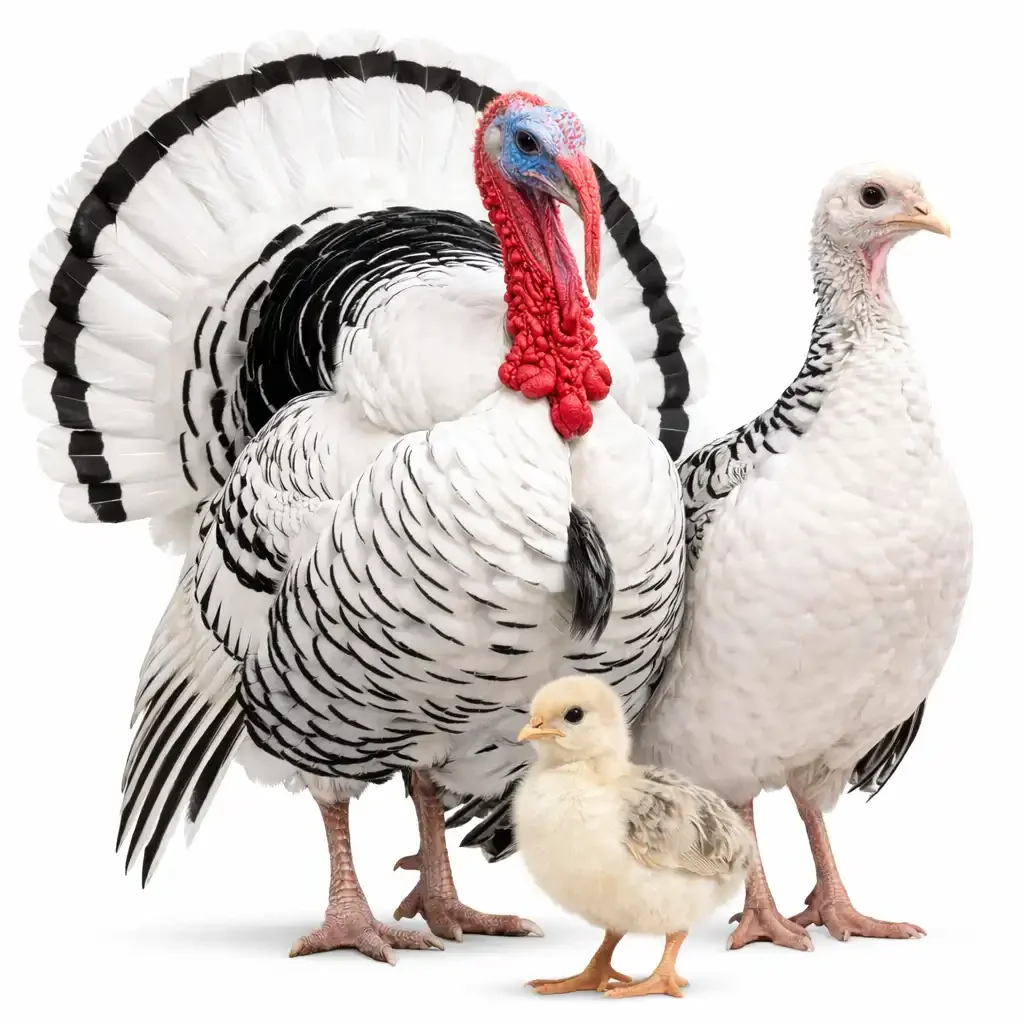
The Royal Palm is one of the most visually spectacular and most immediately recognizable of all the American heritage turkey breeds, with a striking black and white plumage pattern that has no equivalent among any other domestic turkey variety. The breed's history is somewhat informal compared to the deliberately developed breeds like the Beltsville Small White, with its origin commonly attributed to a flock of mixed-ancestry turkeys observed on a farm in Lake Worth, Florida in the 1920s that were producing birds with the distinctive black and white banded plumage pattern that now defines the breed. The Royal Palm appears to have emerged from crosses involving Black, Bronze, Narragansett, and possibly other heritage turkey varieties, with the distinctive color pattern emerging as a natural genetic expression from the mixed heritage of the founding flock.
The American Poultry Association admitted the Royal Palm to the Standard of Perfection in 1971, a relatively recent recognition compared to the 1874 admissions of the Bronze, Narragansett, White Holland, Slate, and other heritage breeds, reflecting the informal and undocumented nature of the breed's early history and the time required for a population with consistent, reproducible characteristics to develop sufficiently for formal recognition. The Standard of Perfection recognition established the black and white banded pattern as the defining characteristic of the breed and provided the formal description against which exhibition and conservation breeding birds are evaluated.
The Royal Palm has never been a commercially significant meat breed due to its relatively small mature size compared to the large heritage breeds that dominated nineteenth and early twentieth century commercial turkey production, and its small stature has actually been one of the factors in its survival through the era that saw most heritage breeds decline dramatically. Because Royal Palm turkeys were not primarily valued for commercial meat production, they were maintained by small-scale poultry enthusiasts, exhibition breeders, and homestead keepers who valued their ornamental beauty and active, engaging personality rather than their commercial production potential. This ornamental and exhibition niche provided a degree of insulation from the market pressures that devastated the commercial heritage turkey breeds.
Today the Royal Palm is listed at Watch status by the Livestock Conservancy, indicating a global population of fewer than 5,000 registered breeding birds with fewer than ten primary breeding flocks, which while less critical than the status of several other heritage turkey breeds in this series still represents a population level requiring active conservation attention.
Physical Characteristics
The Royal Palm is a small to medium heritage turkey with a light, active, well-proportioned body structure quite different from the broad, heavily muscled conformation of the larger meat heritage breeds. The body is neat and trim with a broad breast, a level back, and a clean, well-balanced appearance that reflects the breed's primary role as an ornamental and exhibition bird rather than a heavyweight meat producer. The overall impression is of a turkey that is visually spectacular without the physical bulk of the commercial or large heritage breeds.
The plumage is the defining and most immediately striking feature of the Royal Palm, creating one of the most visually dramatic appearances available from any domestic turkey. The base color is pure white, and across this white ground the feathers display a sharply defined black edging or banding that creates the characteristic black and white pattern recognized in the breed standard. The tail fan, which is particularly prominent in displaying toms, shows the black and white banding to maximum dramatic effect, with each white feather edged in a clear black band that creates a bold, graphic pattern of exceptional visual impact. The saddle, back, and wing feathers display similar black and white banding, and the overall effect of a Royal Palm tom in full display is one of the most spectacular sights available from any domestic poultry breed.
The head and facial skin display the standard turkey characteristics of caruncles, wattles, and snood, typically showing red to blue-white coloration that changes with the bird's emotional state. The beard of mature toms is black. The legs are pink to reddish, the beak is light horn to pink, and the eyes are dark brown. Mature toms reach approximately 22 pounds and mature hens reach approximately 12 pounds, placing the Royal Palm in the smaller heritage turkey size range similar to the Beltsville Small White.
Temperament and Behavior
The Royal Palm is consistently described as one of the most active, alert, and engaging of all the heritage turkey breeds, with a personality that combines genuine friendliness toward people with the vigorous, exploratory, high-energy behavioral style that reflects the breed's strong natural instincts. Royal Palms are widely regarded as excellent foragers, often cited as the most active and effective foragers among the heritage turkey breeds, with a drive to explore and exploit the range environment that makes them particularly well suited to free-range or pasture-based management systems.
The active, alert temperament that makes Royal Palms exceptional foragers also means they are more responsive to environmental stimuli and more likely to fly than some of the heavier, more sedentary heritage breeds. Their light body weight makes flight genuinely possible in a way that is not practical for the large heritage breeds, and homestead keepers should plan housing and fencing with the Royal Palm's flight capability in mind. Clipping flight feathers on one wing unbalances the bird and prevents sustained flight without harming the bird.
Toms are spectacular in full display, with the bold black and white tail fan creating an immediate visual impact that makes Royal Palm toms among the most impressive display animals in any homestead setting. The combination of active personality, striking plumage, and dramatic display behavior makes Royal Palms genuinely compelling birds to keep beyond their practical production value.
Royal Palms are generally considered good mothers among the heritage turkey breeds, with hens showing reasonable brooding instinct when given appropriate conditions. This maternal tendency is a practical advantage for homestead operations that want to allow natural hatching and brooding rather than relying entirely on incubator management.
Raising on a Homestead
Housing
Royal Palm turkeys require housing appropriate for their smaller body size and notably active temperament. Provide a minimum of 4 to 6 square feet of indoor floor space per bird, with the higher end of the range preferable for the behavioral health of these active birds. Roost bars should be provided at appropriate heights for smaller birds, recognizing that Royal Palms are more agile than heavy heritage breeds and can access higher roost positions that would be impractical for birds of 33 to 36 pounds.
The flight capability of Royal Palms requires more attention to housing security than is needed for heavier breeds that are physically incapable of sustained flight. Covered runs or appropriate fencing height of at least 6 feet is recommended for any outdoor area where Royal Palms are kept, or alternatively managing birds with clipped flight feathers as described above. The combination of small size and flight capability also increases predator vulnerability, making secure housing and predator protection particularly important for this breed.
Feeding
Royal Palm poults require the same high-protein feeding program appropriate for all heritage turkey poults. Begin with 28 to 30 percent protein turkey or game bird starter for the first six to eight weeks, transition to 20 to 22 percent protein grower feed through 14 to 16 weeks, and provide a finisher or maintenance ration appropriate to the intended use of the bird thereafter. For birds intended primarily for ornamental or exhibition purposes rather than meat production, a good quality maintenance ration after the growth phase maintains health without the higher protein levels needed during rapid development.
The active metabolism and high activity level of Royal Palms means they maintain body condition well on range with supplemental feeding, and they are generally efficient converters of forage and range resources relative to their body size.
Range and Foraging
The Royal Palm's exceptional foraging ability and strong natural instincts make outdoor range access particularly important for this breed. Royal Palms on good pasture are among the most active and effective users of range resources available from any heritage turkey variety, covering substantial ground, actively seeking insects and other protein sources, and making genuine nutritional use of their environment rather than simply wandering in the vicinity of feed dispensers.
The flight capability that requires attention in housing management is actually an advantage in free-range situations, as Royal Palms can more effectively escape ground predators than heavier breeds. The combination of active foraging, flight capability, and the alertness that characterizes the breed makes Royal Palms well suited to managed free-range systems where some degree of independent predator avoidance is part of the production model.
Brooding Poults
Royal Palm poults require the same careful early brooding management as all heritage turkey poults. Maintain brooder temperature at 95 to 100 degrees Fahrenheit for the first week, reducing by 5 degrees per week until fully feathered. Monitor closely for starve-out vulnerability during the first critical days using colored marbles in waterers and brightly colored feed to attract poults to resources. The somewhat smaller size of Royal Palm poults compared to larger heritage breeds means they are particularly vulnerable to chilling if brooder temperatures drop, making temperature management especially attentive during the first week.
Meat and Production Value
The Royal Palm's meat production value is more limited than the large heritage breeds due to its smaller mature size, and the breed is most honestly described as a small-scale meat producer rather than a primary commercial meat breed. A finished Royal Palm tom produces a dressed carcass of approximately 12 to 16 pounds and a finished hen produces a dressed carcass of approximately 8 to 10 pounds, placing it in the smaller heritage turkey size range suitable for small families or as a supplementary production bird alongside a primary large heritage breed flock.
The meat quality of the Royal Palm is genuine heritage turkey quality, with the active ranging lifestyle, strong foraging instinct, and 26 to 28 week heritage growing period producing the flavor complexity and texture that distinguishes heritage turkey from commercial alternatives. Many homestead keepers who maintain Royal Palms primarily for their ornamental and exhibition value find that the excess cockerels and spent breeding hens provide a meaningful supplementary meat harvest from the same birds kept primarily for other purposes.
The Royal Palm's small size and modest meat production potential are balanced in the homestead context by its primary value as an ornamental and exhibition bird. The breed generates income and value through exhibition competition, through the sale of breeding pairs and poults to other heritage turkey enthusiasts, through the agritourism and social media content opportunities that its spectacular appearance creates, and through its genuine conservation significance as a Watch status heritage breed. For homestead operations that value the full range of what a heritage breed can contribute beyond simple meat production, the Royal Palm offers a genuinely comprehensive value proposition.
Conservation Status
The Royal Palm is listed at Watch status by the Livestock Conservancy, indicating a global population of fewer than 5,000 registered breeding birds with fewer than ten primary breeding flocks. While this is less immediately critical than the Critical status applied to the Beltsville Small White, White Holland, and Slate in this series, the Watch designation still represents a population level that requires active conservation attention and that makes responsible homestead breeding programs a meaningful contribution to the breed's long-term security.
The Royal Palm's relatively better conservation status compared to some other heritage turkey breeds reflects in part the breed's ornamental and exhibition appeal that has maintained a community of dedicated enthusiasts through the decades of commercial turkey production that devastated primarily meat-oriented heritage breeds. Exhibition breeders who selected for the most perfectly marked black and white birds have maintained consistent selection pressure toward the breed standard throughout the twentieth century in a way that pure meat breeds did not benefit from.
Homestead keepers who maintain Royal Palms and breed toward the Standard of Perfection color pattern description contribute both to the overall population numbers and to the quality and consistency of the surviving gene pool. Connecting with the American Poultry Association's heritage turkey breeder network and the Livestock Conservancy's Royal Palm conservation program provides access to the best available breeding stock and the community support that makes long-term conservation breeding sustainable.
Varieties and Color Patterns
The Royal Palm is a single-variety breed with the distinctive black and white banded pattern as the only accepted color expression under the American Poultry Association Standard of Perfection. The breed standard describes pure white base color with sharply defined black edging on the feathers of the body, wings, and tail, creating the bold graphic black and white pattern that makes the Royal Palm instantly recognizable.
The quality of the pattern varies significantly between individuals and breeding lines. The most desirable exhibition and conservation breeding birds display the sharpest, cleanest definition between the white feather base and the black edging, with no smearing, bleeding, or irregular patterning at the feather edges. The tail fan of the tom, which is the most dramatically visible expression of the pattern in full display, should show clean, well-defined black bands against brilliant white feathers across the full spread of the fan.
Birds showing brown, bronze, or other color contamination in the plumage indicate genetic impurity from crossing with other turkey varieties and should not be used for conservation breeding toward the Royal Palm standard. Maintaining the clean black and white pattern requires consistent selection of breeding birds that display the best expression of the standard color description and avoiding any introduction of genetics from other turkey varieties that would dilute the distinctive patterning.
Common Health Issues
Blackhead Disease
Blackhead Disease is the primary health management concern for Royal Palm turkeys as for all domestic turkey breeds. The transmission pathway through cecal worms carried by chickens and the rapid, typically fatal progression of the resulting liver and cecal damage make ground management separation between turkey and chicken flocks the single most important preventive practice for any turkey operation. Royal Palms, like all domestic turkey breeds regardless of size or temperament, have no natural resistance to Histomonas meleagridis and require the same strict ground separation management as the large heritage meat breeds.
Predator Vulnerability
While not a disease issue, predator vulnerability represents one of the most significant practical health and safety management challenges specific to the Royal Palm. The breed's small size makes it more vulnerable to a wider range of predators than larger heritage breeds, and its flight capability, while providing some escape ability from ground predators, also creates exposure to aerial predators in free-range situations. Secure overnight housing, appropriate fencing, and predator deterrence management are particularly important for Royal Palm flocks.
Respiratory Disease
Good ventilation, dry litter management, appropriate stocking density, and acquisition from health-tested sources are the standard preventive measures for respiratory disease in all turkey breeds. The Royal Palm's active, high-metabolism nature means that birds showing the reduced activity and respiratory symptoms of developing illness are often more immediately noticeable than in more sedentary breeds, which can facilitate earlier detection and intervention.
Parasites
Internal and external parasites are ongoing management considerations for any heritage turkey flock with outdoor range access. The Royal Palm's active foraging behavior and wide-ranging movement increase exposure to internal parasites compared to more stationary birds. Regular fecal monitoring and targeted deworming as indicated by results maintain flock health without unnecessary chemical exposure. Generous dust bathing areas support natural external parasite management.
Nutritional Management
The Royal Palm's small body size and high activity level create a specific nutritional management consideration compared to larger, more sedentary heritage breeds. Royal Palms that are not given adequate range access or supplemental feeding to support their high activity metabolism can lose condition more rapidly than larger breeds with greater body reserves. Monitoring individual bird body condition through regular handling and adjusting feed levels based on observed condition maintains the health and productivity of these active, metabolically demanding birds.
FAQ
Is the Royal Palm primarily an ornamental breed or a meat breed? The Royal Palm is most accurately described as an ornamental and exhibition breed that also provides genuine heritage quality meat from a smaller carcass than the large heritage meat breeds. The breed's primary commercial and conservation value lies in its spectacular appearance, its exhibition potential, its role in homestead agritourism and social media marketing, and its significance as a Watch status heritage breed. The supplementary meat production from excess cockerels and spent breeding birds provides genuine table value, but homestead operations that keep Royal Palms primarily for meat production efficiency would be better served by one of the large heritage meat breeds like the Bourbon Red, Narragansett, or Bronze. Royal Palms excel in the combined ornamental, exhibition, and small-scale production role that makes them one of the most versatile and personally rewarding heritage turkey breeds available.
Can Royal Palm turkeys fly? Yes, Royal Palms are genuinely capable of sustained flight in a way that the heavier heritage turkey breeds are not. Their small body weight relative to their wing span makes flight physically practical, and the breed's active, alert temperament means birds are more inclined to use this capability than heavier, more phlegmatic breeds. Homestead keepers should plan housing and fencing with Royal Palm flight capability in mind, either providing covered runs or 6-foot minimum fencing, or managing birds with one wing's flight feathers clipped to prevent sustained flight. The same flight capability that requires housing management consideration provides some advantage in free-range situations where ground predator avoidance is part of the birds' survival strategy.
How do I breed for the best Royal Palm color pattern? Breeding for the cleanest, most well-defined Royal Palm black and white pattern requires consistent selection of breeding birds that display the sharpest definition between white feather base and black edging, the most complete and uniform coverage of the black banding across all the feathered areas described in the breed standard, and the absence of brown, bronze, or other color contamination that indicates genetic impurity. Pair toms and hens that both display excellent pattern quality, as offspring quality reflects both parents. Evaluate breeding candidates critically against the Standard of Perfection description and resist the temptation to use birds with good body conformation but poor pattern quality in conservation breeding programs where maintaining the standard color expression is the primary goal.
Are Royal Palms good mothers? Royal Palm hens are generally considered to show better brooding instinct than many other heritage turkey breeds, with hens that are willing to sit on nests and raise poults when given appropriate conditions. This maternal tendency is a practical advantage for homestead operations that want to incorporate natural brooding into their management program rather than relying entirely on incubator and artificial brooder management. Providing appropriate nest sites that are sheltered, secure, and appropriately private encourages hens to express their natural brooding behavior. Natural brooding by heritage turkey hens produces poults that learn foraging and ranging behaviors from their mother, which supports better long-term performance and behavioral health than incubator-raised birds managed entirely artificially.
Why does the Royal Palm have Watch rather than Critical conservation status? The Royal Palm's Watch status rather than the more urgent Critical status of several other heritage turkey breeds in this series reflects the breed's historical maintenance by a community of ornamental and exhibition breeders who valued it for its spectacular appearance throughout the decades that devastated primarily meat-oriented heritage breeds. While commercial turkey production displaced heritage meat breeds from the market almost entirely, the Royal Palm's ornamental value created a parallel conservation pathway through exhibition breeding communities that maintained population numbers at levels somewhat above the most critically endangered breeds. The Watch status is not a reason for complacency, as fewer than 5,000 registered breeding birds globally still represents a genuinely fragile population, but it does reflect the different conservation trajectory of a breed that was maintained for beauty and exhibition value as well as production utility.