
Tiger Bronze
Quick Overview
Common Name: Tiger Bronze, Stripey, Bronze
Breed Type: Heritage Turkey Color Variety
Origin: United States, developed from Standard Bronze stock
Primary Use: Meat, Exhibition
Mature Tom Weight: 33 pounds
Mature Hen Weight: 18 pounds
Egg Production: Moderate, 50 to 100 eggs per year
Egg Color: Cream to light brown with brown speckling
Temperament: Active, alert, moderately docile
Conservation Status: Watch (Livestock Conservancy, as part of Bronze population)
Lifespan: 5 to 10 years
Breed History and Origin
The Tiger Bronze is a color variety within the broader Bronze turkey family rather than a separately recognized breed in its own right under the American Poultry Association Standard of Perfection. Understanding this distinction is important for homestead keepers who encounter the name Tiger Bronze in breed listings, hatchery catalogs, and heritage turkey discussions, as the bird's heritage, management requirements, and conservation significance are all rooted in the larger history of the Bronze turkey family from which it comes.
The Bronze turkey is itself one of the oldest and most historically significant domestic turkey breeds in North America, with origins that trace back to the natural crosses between the domestic turkeys brought to North America by European colonists in the sixteenth and seventeenth centuries and the Eastern Wild Turkeys native to the continent. These crosses produced birds with exceptional vigor, hardiness, and the distinctive metallic bronze iridescence in their plumage that gave the Bronze family its name and that remains its most immediately recognizable characteristic. The Bronze was the dominant commercial turkey variety in the United States through most of the nineteenth century and into the early twentieth century, forming the backbone of American turkey production during the era when heritage breeds defined the standard of the industry rather than competing against it.
The Tiger Bronze represents a specific color pattern expression within the Bronze genetic background, characterized by the barred or striped feather patterning that gives the variety its evocative common name. Rather than the solid, uniformly iridescent bronze coloration of the standard Bronze variety, Tiger Bronze birds display feathers with darker barring or striping across the bronze ground color, creating a pattern that suggests the striped coat of a tiger and distinguishes these birds visually from standard Bronze specimens while sharing the same fundamental heritage genetics and management characteristics.
The precise origins of the Tiger Bronze color pattern within the Bronze population are not formally documented in the way that the development of recognized breeds is recorded in poultry historical literature. The barred patterning likely represents a naturally occurring color variation within Bronze populations that was selectively maintained by breeders who appreciated its distinctive visual character. Today the Tiger Bronze is offered by specialty hatcheries and heritage breed enthusiasts as a visually distinctive variant within the heritage Bronze turkey market, valued for both its striking appearance and its connection to the deep heritage of the Bronze turkey family.
Physical Characteristics
The Tiger Bronze shares the fundamental body structure of the Standard Bronze turkey, which is one of the largest and most impressively proportioned heritage turkey breeds available. The body is broad, deep, and well-muscled with a full, rounded breast, a strong level back, and the substantial, dignified frame that conveys genuine table bird potential. The overall conformation is that of a large, classically proportioned heritage turkey with the active, athletic bearing that distinguishes heritage breeds from the sedentary, top-heavy broad-breasted commercial varieties.
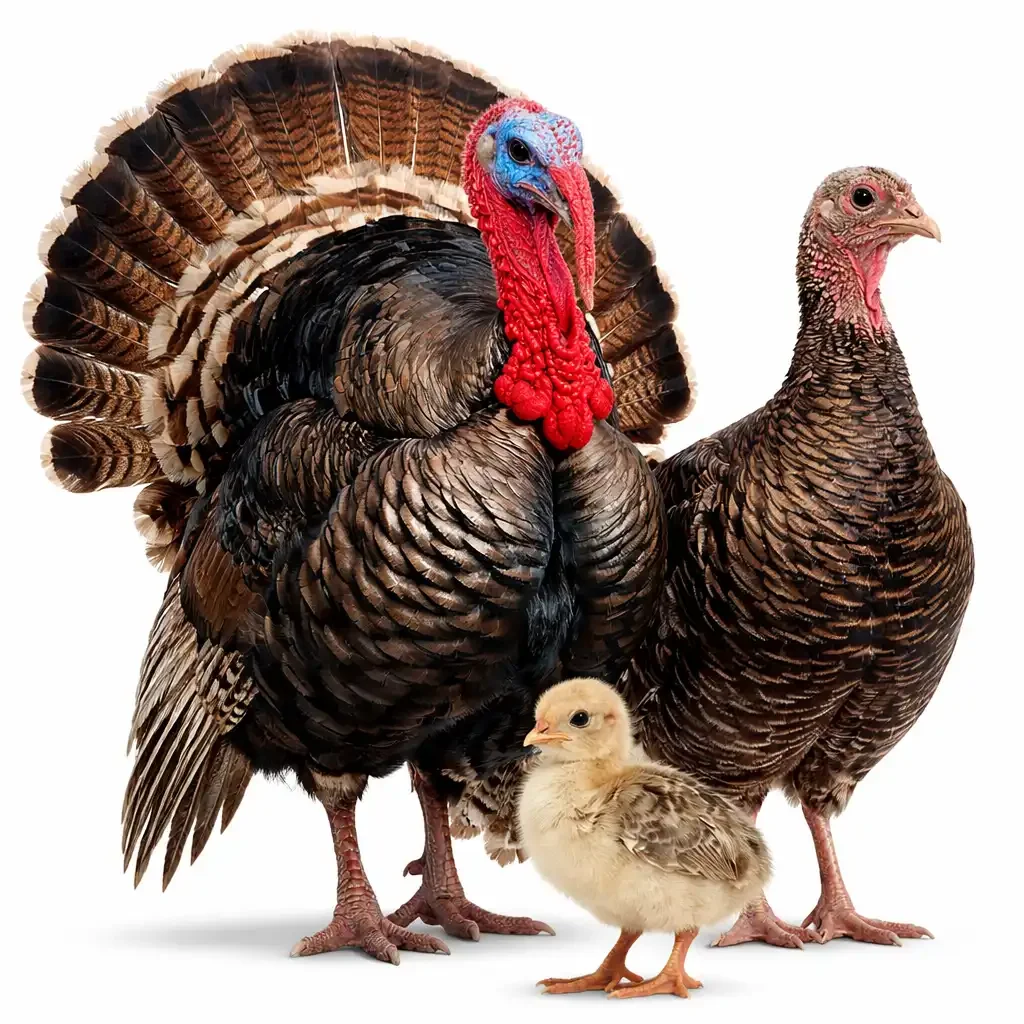
The defining characteristic that distinguishes the Tiger Bronze from the standard Bronze variety is the feather patterning. Where standard Bronze birds display the broad, uniform metallic bronze iridescence across their plumage, Tiger Bronze birds display darker barring or striping across the feathers, with the bronze or copper base color intersected by darker bars that create the striped, tiger-like visual effect from which the variety takes its name. The iridescent quality of the bronze ground color is retained in well-bred Tiger Bronze birds, creating a striking combination of the metallic sheen characteristic of the Bronze family and the bold patterning of the Tiger color variant.
The head and facial skin display the full complement of turkey characteristics including the snood, wattles, and caruncles that change color with the bird's emotional and hormonal state, flushing to vivid red during display and excitement and paling to blue-white during stress. The beard of mature toms is black and prominent. The legs and feet are dark, and the eyes are dark brown. Mature toms reach approximately 33 pounds and mature hens reach approximately 18 pounds under good heritage management conditions, placing the Tiger Bronze in the large heritage turkey size category.
Temperament and Behavior
The Tiger Bronze shares the temperament characteristics of the broader Bronze turkey family, which tends toward the active, alert end of the heritage turkey behavioral spectrum. Bronze turkeys generally express strong natural instincts including active foraging, vigorous ranging behavior, and the alert responsiveness to environmental stimuli that reflects the wild turkey heritage that is closer in the Bronze genetic background than in some other heritage breeds.
Toms are impressive in full display, with the bronze and tiger-striped plumage creating one of the most visually dramatic strutting presentations available from any heritage turkey variety. The combination of large body size, iridescent and barred plumage, and the full turkey behavioral display repertoire of fanned tail, lowered wings, and inflated snood makes a Tiger Bronze tom in full display one of the most spectacular sights in the homestead turkey yard. This same expressiveness means that breeding season management requires appropriate planning for the space and structure needed to manage large, actively displaying toms.
The breed forages with genuine enthusiasm when given range access, reflecting the wild turkey genetic contribution to the Bronze family. Tiger Bronze birds on pasture cover ground actively, seeking insects, seeds, and plant material, and this active ranging contributes to the complex flavor profile that characterizes Bronze turkey meat. Birds that are given inadequate space for their natural activity level can develop stress-related behavioral problems, making appropriate range access a management priority rather than an optional enhancement.
Raising on a Homestead
Housing
Tiger Bronze turkeys require housing appropriate for large heritage breed birds. Provide a minimum of 6 square feet of indoor floor space per bird, with 8 to 10 square feet preferable for birds of this size and activity level. Roost bars must be robust enough to support mature birds of 18 to 33 pounds and positioned at heights that allow comfortable access without jump heights that risk injury to large, heavy birds. The active nature of the Bronze family means that adequate space is particularly important for behavioral health, and crowded housing conditions create stress and management problems more readily in active heritage breeds than in the more sedentary commercial varieties.
Good ventilation without cold drafts is the essential housing climate management balance for any turkey breed. Bronze turkeys are hardy birds with better cold tolerance than some heritage breeds, reflecting the wild turkey genetic contribution to the family, but adequate ventilation remains essential for respiratory health regardless of cold tolerance. Wet, poorly ventilated housing with ammonia accumulation is damaging to turkey respiratory health across all breeds and varieties.
Feeding
Tiger Bronze poults require the same high-protein feeding program appropriate for all heritage turkey breeds. Begin with 28 to 30 percent protein turkey starter for the first six to eight weeks. The large frame of the Bronze family means that adequate protein during early development is particularly important for building the skeletal and muscular foundation that supports the mature weight these birds are capable of reaching. Transition to 20 to 22 percent protein grower feed through 14 to 16 weeks and then to a finisher ration with 16 to 18 percent protein in the final growing period before processing.
Breeding stock benefits from a balanced maintenance ration with adequate vitamin E, selenium, and vitamin A supporting reproductive performance. Fresh clean water available at all times is non-negotiable at every life stage.
Range and Foraging
Of all the heritage turkey breeds and varieties discussed in this series, the Bronze family most strongly rewards outdoor range access with genuine production benefits. The wild turkey genetic contribution to Bronze heritage gives these birds exceptional foraging ability and strong natural instincts that express themselves most fully in a managed range environment. Birds with access to good pasture, insect populations, and varied plant material produce a quality and depth of flavor in the finished carcass that is genuinely exceptional.
Rotational pasture management that moves birds to fresh ground regularly reduces parasite load, maintains pasture quality, and gives birds access to the variety of forage material that produces the most complex flavor profiles. A minimum of 30 square feet of outdoor range space per bird is a reasonable starting guideline, with more being consistently beneficial for behavioral health and production quality.
Brooding Poults
Tiger Bronze poults require the same careful brooding approach as all heritage turkey poults. Maintain brooder temperature at 95 to 100 degrees Fahrenheit for the first week, reducing by 5 degrees per week. The starve-out vulnerability of turkey poults during the first several days requires active management attention. Use colored marbles in waterers, brightly colored starter feed, and if necessary place a few chicks in the brooder to demonstrate eating and drinking behavior to turkey poults, which are slower than chicks to independently locate resources. Monitor the brooder flock closely during the first two weeks and intervene promptly for any poult showing signs of weakness or separation from the group.
Meat and Production Value
The Tiger Bronze, sharing the fundamental genetics of the Standard Bronze family, produces meat of the same exceptional quality that made Bronze turkeys the dominant American commercial variety through most of the nineteenth century. The combination of large frame, good muscling, active ranging lifestyle, and the extended 28 to 30 week heritage growing period produces a dressed carcass of substantial weight with the rich, complex flavor profile that distinguishes heritage turkey meat from the blander, less differentiated product of commercial broad-breasted varieties.
A finished Tiger Bronze tom produces a dressed carcass in the range of 18 to 24 pounds, and a finished hen produces a dressed carcass of 10 to 14 pounds. The Bronze family's reputation for exceptional flavor is well established in the heritage turkey community, with the combination of dark feather pigmentation, active metabolism, varied pasture diet, and longer growing period creating the deeper, more developed flavor that customers who experience it return for consistently.
The Tiger Bronze variety adds a marketing dimension to the production value that standard Bronze birds do not offer to the same degree. The striking tiger-striped plumage creates a visually distinctive live bird that generates significant customer interest and conversation, and the distinctive appearance provides a genuine product differentiation story that can support premium pricing above even the already-premium heritage turkey market. For direct-to-consumer operations where customer relationship and product story matter as much as production efficiency, the Tiger Bronze's visual distinctiveness is a genuine commercial asset.
The dark plumage of the Tiger Bronze, like the standard Bronze, does produce darker pinfeather staining on the dressed carcass compared to white-feathered heritage breeds. For homestead producers selling whole dressed birds, this is a presentation consideration that can be managed through careful scalding and picking technique and through customer communication that frames the darker skin as a natural characteristic of non-commercial heritage breeds rather than a quality defect.
Conservation Status
The Tiger Bronze is not separately tracked as a distinct breed by the Livestock Conservancy but falls within the broader Standard Bronze population, which is listed at Watch status, indicating a global population of fewer than 5,000 registered breeding birds with fewer than ten primary breeding flocks. The Watch designation is less critical than the Critical status applied to several other heritage turkey breeds in this series but still represents a population level that requires active conservation attention.
The Tiger Bronze color variant specifically represents an additional layer of genetic distinctiveness within the already rare Bronze population. Homestead keepers who maintain Tiger Bronze birds contribute to preserving this specific color expression within the Bronze genetic heritage in addition to supporting the broader conservation of the Bronze family. Maintaining careful breeding records, selecting for the characteristic tiger barring pattern in breeding stock, and connecting with other Tiger Bronze breeders helps preserve the variety's distinctive characteristics within the broader Bronze population.
The American Poultry Association, the Livestock Conservancy, and the Society for the Preservation of Poultry Antiquities all provide resources and community connections for heritage turkey breeders working to maintain Bronze and Tiger Bronze populations at viable levels.
Varieties and Color Patterns
The Tiger Bronze is itself a color variant within the Bronze turkey family, and understanding its relationship to the broader Bronze color spectrum is important for breeders working with these birds. The standard Bronze variety displays the classic broad metallic bronze iridescence across the plumage that has defined the family since the first crosses between domestic and wild turkeys created birds with this distinctive coloration. The bronze iridescence results from the structural properties of the feather barbules that create a metallic sheen across a brown to copper base color, creating the impression of burnished metal in good light.
The Tiger Bronze color pattern adds dark barring or striping across this bronze ground color, with the bars running across the width of individual feathers to create the striped effect that gives the variety its name. The quality and definition of this barring varies between individuals and breeding lines, with the most desirable Tiger Bronze birds showing clear, well-defined bars against a vivid bronze ground color that retains the characteristic metallic iridescence of the Bronze family.
Within Bronze populations more broadly, color variations including the standard Bronze, Narragansett-influenced color patterns, and the Tiger Bronze represent the natural range of expression within the genetic diversity of the Bronze family. Breeders who want to maintain the Tiger Bronze pattern distinctly should select consistently for the characteristic barring and avoid introducing genetics that would dilute or eliminate the striped pattern.
Common Health Issues
Blackhead Disease
Blackhead Disease remains the primary health threat for Tiger Bronze turkeys as for all domestic turkey breeds and varieties. The protozoan Histomonas meleagridis transmitted through cecal worms carried by chickens causes rapid and typically fatal liver and cecal damage in turkeys. Strict management separation between turkey flocks and chicken flocks, including access to separate ground with no possibility of cross-contamination, is the single most important preventive management practice for any turkey operation.
Respiratory Infections
Bronze turkeys generally show good respiratory hardiness compared to some heritage breeds, reflecting the wild turkey genetic contribution to the family. Nevertheless, good housing ventilation, appropriate stocking density, clean dry litter, and acquisition from health-tested sources remain important preventive management practices. Any bird showing respiratory symptoms should be isolated immediately.
External Parasites
The dense, richly patterned plumage of the Tiger Bronze can make early detection of external parasites including lice and mites more challenging than in lighter-feathered breeds, as infestations developing under the heavy feather cover may progress further before becoming visible during casual observation. Regular physical handling and thorough examination of feather bases at the vent, beneath the wings, and around the neck are important monitoring practices for Tiger Bronze birds. Providing generous dust bathing areas supports the birds' natural external parasite management behavior.
Leg and Joint Issues
Large heritage turkey breeds are susceptible to leg and joint problems when managed with inappropriate roost heights, slippery flooring, or overcrowded conditions. The active, ranging nature of Bronze turkeys generally supports better leg health than more sedentary birds, but appropriate housing design and management remain important preventive considerations for birds reaching mature weights of 18 to 33 pounds.
Parasites
Internal parasite management through regular fecal monitoring and targeted treatment as needed is standard practice for any heritage turkey operation with outdoor range access. The active ranging nature of Bronze turkeys, while beneficial for flavor and behavioral health, does increase exposure to internal parasites compared to fully housed birds, making monitoring particularly important for outdoor flocks.
FAQ
Is the Tiger Bronze a separate breed or a color variety? The Tiger Bronze is a color variety within the Bronze turkey family rather than a separately recognized breed under the American Poultry Association Standard of Perfection. The Standard of Perfection recognizes the Bronze turkey as a breed with specific color and conformation standards, and the Tiger Bronze represents a color variant within that broader genetic family characterized by the barred or striped feather patterning that gives it its distinctive appearance. For practical homestead management purposes this distinction makes little difference as the Tiger Bronze shares all the management requirements, production characteristics, and heritage values of the Standard Bronze family.
What makes the Tiger Bronze plumage pattern distinctive? The Tiger Bronze displays darker barring or striping across the feathers of the bronze ground color, creating a striped pattern that resembles the coat of a tiger and distinguishes these birds from standard Bronze turkeys with more uniform bronze iridescent plumage. The combination of the metallic bronze sheen characteristic of the Bronze family and the bold barred patterning creates one of the most visually striking appearances available from any heritage turkey variety. The pattern is most vivid in good light that activates the iridescent quality of the bronze ground color beneath the dark bars.
How does Tiger Bronze meat compare to other heritage turkey varieties? Tiger Bronze meat shares the quality characteristics of the broader Bronze turkey family, which is widely regarded as producing some of the richest and most flavorful heritage turkey meat available. The combination of active ranging lifestyle, longer 28 to 30 week growing period, varied pasture diet, and the Bronze genetic heritage creates a deeply flavored, well-marbled meat with a higher proportion of dark meat and better fat distribution than commercial broad-breasted alternatives. The specific Tiger Bronze color variant does not alter the fundamental meat quality characteristics of the Bronze family, so customers purchasing Tiger Bronze birds can expect the same exceptional flavor profile associated with heritage Bronze turkey production generally.
Can Tiger Bronze turkeys mate naturally? Yes. As a heritage breed variety within the Bronze family, Tiger Bronze turkeys are fully capable of natural mating. This is one of the most important distinctions between all heritage turkey varieties and the commercial broad-breasted types that have been selected for extreme breast development to the point where natural mating is physically impractical. Maintaining natural mating capability is both a conservation priority for heritage breed programs and a practical advantage for homestead operations seeking self-sustaining flocks that do not depend on artificial insemination programs.
How do I maintain the Tiger Bronze color pattern in a breeding program? Maintaining the distinctive tiger barring pattern in a breeding program requires consistent selection of breeding birds that display clear, well-defined bars against a vivid bronze ground color. Pair toms and hens that both show strong expression of the barred pattern, as the characteristic is more consistently maintained when both parents carry it clearly. Avoid introducing birds with solid bronze or significantly different color patterns into the Tiger Bronze breeding pool as this dilutes the distinctive patterning over subsequent generations. Keeping accurate records of breeding pairs and the color pattern outcomes of their offspring helps identify the most reliably pattern-producing combinations within your flock.