
Brangus
Overview
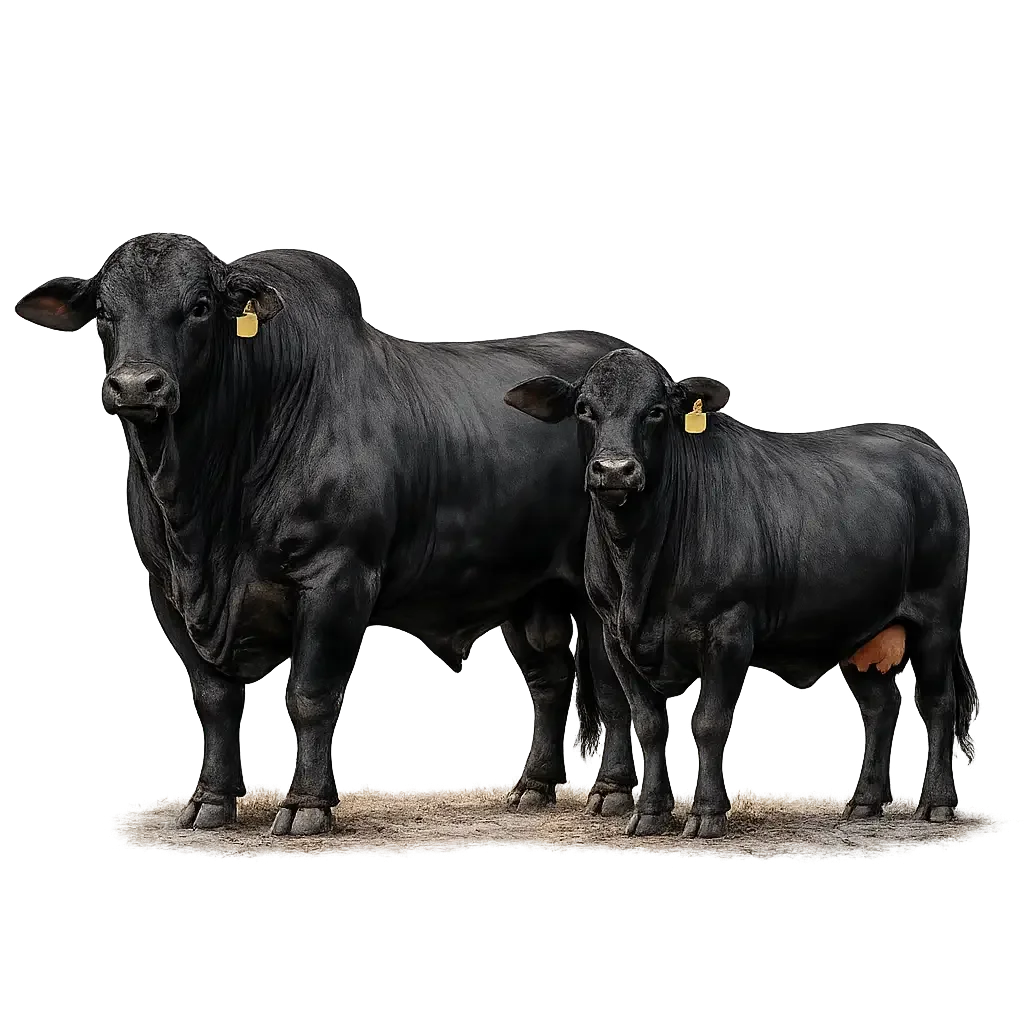
Brangus cattle are one of America's most successful composite beef breeds, combining the best qualities of Brahman and Angus cattle into a single package. Developed to provide heat tolerance and hardiness from Brahman genetics while maintaining the superior beef quality and carcass characteristics of Angus, Brangus cattle represent the ideal balance for ranchers in warm climates who refuse to compromise on meat quality. The breed consists of 3/8 Brahman and 5/8 Angus, a ratio carefully selected to optimize both environmental adaptability and beef production.
Origin & History
Origin: United States (primarily Louisiana, Oklahoma, and Texas)
Development Period: 1930s-1940s, formally recognized 1949
Foundation Breeds: 3/8 Brahman, 5/8 Angus (stabilized ratio)
Key Developers: Multiple ranchers experimenting with Brahman-Angus crosses in the American South
Recognition: International Brangus Breeders Association (IBBA) formed 1949
Development Goal: Create heat-tolerant cattle with Angus beef quality for Gulf Coast and Southern states
Color Varieties: Black Brangus (original) and Red Brangus (recognized separately)
Physical Characteristics
Color: Solid black (Black Brangus) or solid red (Red Brangus); no white markings allowed except small udder spots
Build: Moderate frame with well-muscled, balanced conformation
Weight: Bulls 1,800-2,400 lbs; Cows 1,000-1,400 lbs
Height: Bulls 5-5.5 feet at shoulder; Cows 4.5-5 feet
Distinctive Features:
Solid color with no white markings (breed requirement)
Naturally polled (hornless) - dominant trait
Smooth hair coat, slightly longer than Brahman but shorter than British breeds
Moderate frame size, neither extreme nor small
Well-muscled throughout with balanced beef conformation
Slightly more prominent brisket than Angus, less than Brahman
No visible hump (Brahman characteristic bred out)
Moderate ear size (larger than Angus, smaller than Brahman)
Reproduction & Breeding
Gestation Period: Approximately 285-290 days (intermediate between parent breeds)
Breeding Age: Heifers bred at 15-18 months with proper development
Calving: Excellent calving ease with low assistance rates
Calf Birth Weight: 75-90 lbs (moderate and manageable)
Calving Interval: 365 days achievable with good management
Fertility: Superior fertility in heat stress compared to British breeds
Breeding Season: Year-round capability; excel in summer breeding
Sexual Maturity: Bulls mature at 14-18 months (earlier than Brahman, similar to Angus)
Lifespan & Productivity
Average Lifespan: 12-18 years
Productive Life: Cows typically produce 10-15 calves in lifetime
Prime Production Years: 3-12 years of age
Longevity: Extended productive life from Brahman influence
Stayability: Excellent cow longevity and reproductive persistence
Milk Production
Purpose: Beef breed - milk primarily for calf rearing
Daily Production: 12-18 lbs per day (good for beef cattle)
Lactation Period: 8-10 months
Maternal Ability: Excellent mothers with strong milk production for calves
Milk Quality: Good butterfat content for calf growth
Udder Quality: Well-attached, functional udders
Calf Growth & Development
Weaning Weight: 500-650 lbs at 205 days (excellent hybrid vigor)
Daily Gain: 2.5-3.5 lbs per day on good feed
Market Weight: 1,100-1,300 lbs at 14-18 months
Feed Efficiency: Very good - combines Brahman foraging with Angus conversion
Hybrid Vigor: Significant heterosis results in 8-12% growth advantage over parent breeds
Vigor: Excellent calf vigor and low death loss
Temperament
Brangus cattle are generally docile and easy to handle, inheriting the calm temperament of Angus while avoiding the more excitable tendencies sometimes seen in Brahman cattle. They are intelligent and responsive to good handling, making them suitable for operations of all sizes. Most Brangus are gentle enough for family farms yet hardy enough for extensive range operations.
The breed demonstrates good maternal instincts without excessive protectiveness. Cows are attentive mothers but typically allow handlers to work with calves without aggressive behavior. Bulls are manageable with proper respect and facilities, generally calmer than Brahman bulls while maintaining breeding vigor. Early gentle handling produces tractable animals that work well in various management systems.
Meat Quality
Marbling: Good to excellent - inherits Angus marbling ability
Flavor: Excellent beef flavor, comparable to Angus
Tenderness: Very tender, ranks among top beef breeds
Grading: Typically grades Choice to Prime; superior to Brahman
Dressing Percentage: 62-65% (excellent yield)
Cutability: High percentage of retail cuts
Market Appeal: Excellent acceptance in quality beef markets
Carcass Quality: Combines Angus quality with Brahman efficiency
Feeding & Nutrition
Grazing: Excellent grazers on both quality and marginal forage
Feed Requirements: Efficient feed conversion on various diet types
Finishing: Finish at reasonable weights (1,100-1,300 lbs) with good quality
Water: 10-15 gallons per day (efficient in heat)
Mineral Needs: Standard beef cattle mineral program
Forage Utilization: Utilize wider variety of forages than Angus alone
Adaptability: Perform well on grass-fed or grain-finished programs
Health & Care
Hardiness: Very hardy with good disease resistance
Common Issues: Generally healthy; fewer issues than many breeds
Vaccinations: Standard cattle vaccination protocols
Parasite Control: Better parasite resistance than British breeds
Hoof Care: Minimal trimming needed; sound feet and legs
Climate Adaptation: Excel in hot, humid climates; tolerate cold better than Brahman
Disease Resistance: Improved resistance to heat-related diseases over Angus
Eye Pigmentation: Dark pigmentation reduces cancer eye incidence
Heat Tolerance & Adaptations
Heat Tolerance: Excellent - significantly better than Angus
Temperature Range: Perform well from 0°F to 100°F+
Summer Performance: Maintain gains during heat stress affecting British breeds
Coat: Smooth, sleek coat facilitates cooling
Skin: More heat-tolerant skin than British breeds
Humidity Tolerance: Excel in humid Gulf Coast conditions
Fertility in Heat: Breed successfully during summer months
Parasite Resistance: Better tick and fly resistance than Angus
Advantages
Combines Angus beef quality with Brahman heat tolerance
Excellent marbling and carcass quality
Superior heat tolerance for Southern climates
Strong hybrid vigor results in excellent growth and health
Naturally polled (hornless) eliminating dehorning
Good fertility and reproductive efficiency
Docile temperament easier to handle than Brahman
Excellent maternal ability and milk production
Efficient feed conversion on various diets
Good parasite and disease resistance
Maintain condition in heat when British breeds suffer
Strong market demand in appropriate regions
Disadvantages
More expensive initial purchase than commercial cattle
Require registered Brangus for breeding to maintain ratio
Cannot be recreated by simply crossing Angus and Brahman (stabilized breed)
May not perform as well as British breeds in cold northern climates
Slightly slower to mature than straight Angus in temperate conditions
Color restrictions (solid black or red only) limit some breeding flexibility
May not have quite as much marbling as top-end Angus in ideal conditions
Best Suited For
Gulf Coast and Southern United States
Subtropical and warm temperate climates
Operations prioritizing both quality beef and heat tolerance
Commercial cow-calf operations in warm regions
Ranches wanting quality beef without heat stress issues
Grass-fed beef programs in Southern states
Operations seeking efficient, easy-to-handle cattle
Quality-focused operations in humid climates
Feedlots in Southern states
Beginning farmers wanting productive, manageable cattle
Economic Considerations
Initial Cost: Moderate to high for registered breeding stock
Return on Investment: Excellent due to productivity and longevity
Market Demand: Strong in Southern states and warm climates
Carcass Value: Premium prices for quality beef
Maintenance Costs: Moderate - efficient and hardy
Veterinary Costs: Lower than British breeds in hot climates
Feed Costs: Efficient conversion reduces overall feed expense
Resale Value: Strong market for breeding stock
Hybrid Vigor Benefits
Growth Rate: 8-12% faster growth than parent breed average
Survival: Improved calf vigor and lower death loss
Fertility: Better conception rates and reproductive efficiency
Disease Resistance: Enhanced immune function from heterosis
Maternal Ability: Improved milk production and mothering
Longevity: Extended productive life in breeding herd
Adaptability: Better performance across varying conditions
Fun Facts
The 3/8 Brahman to 5/8 Angus ratio was carefully selected through decades of research as optimal
Brangus is one of the first composite breeds to be recognized as a true breed rather than a cross
The International Brangus Breeders Association is one of the largest beef breed associations
Brangus cattle can outgain straight Angus by 10-15% in hot, humid conditions
All Brangus must be naturally polled - horned animals cannot be registered
Red Brangus were developed from the same formula but using Red Angus instead of Black Angus
Brangus consistently rank in top percentiles for marbling among heat-tolerant breeds
The breed name combines "BR" from Brahman with "ANGUS" from Aberdeen Angus
Brangus have been exported to over 50 countries worldwide
They can breed successfully in summer heat when many Angus bulls become temporarily infertile
Combining hardiness with meat quality, this breed produces excellent results in the 'low and slow' sections described in our beef cuts guide.