
Simmental
Overview
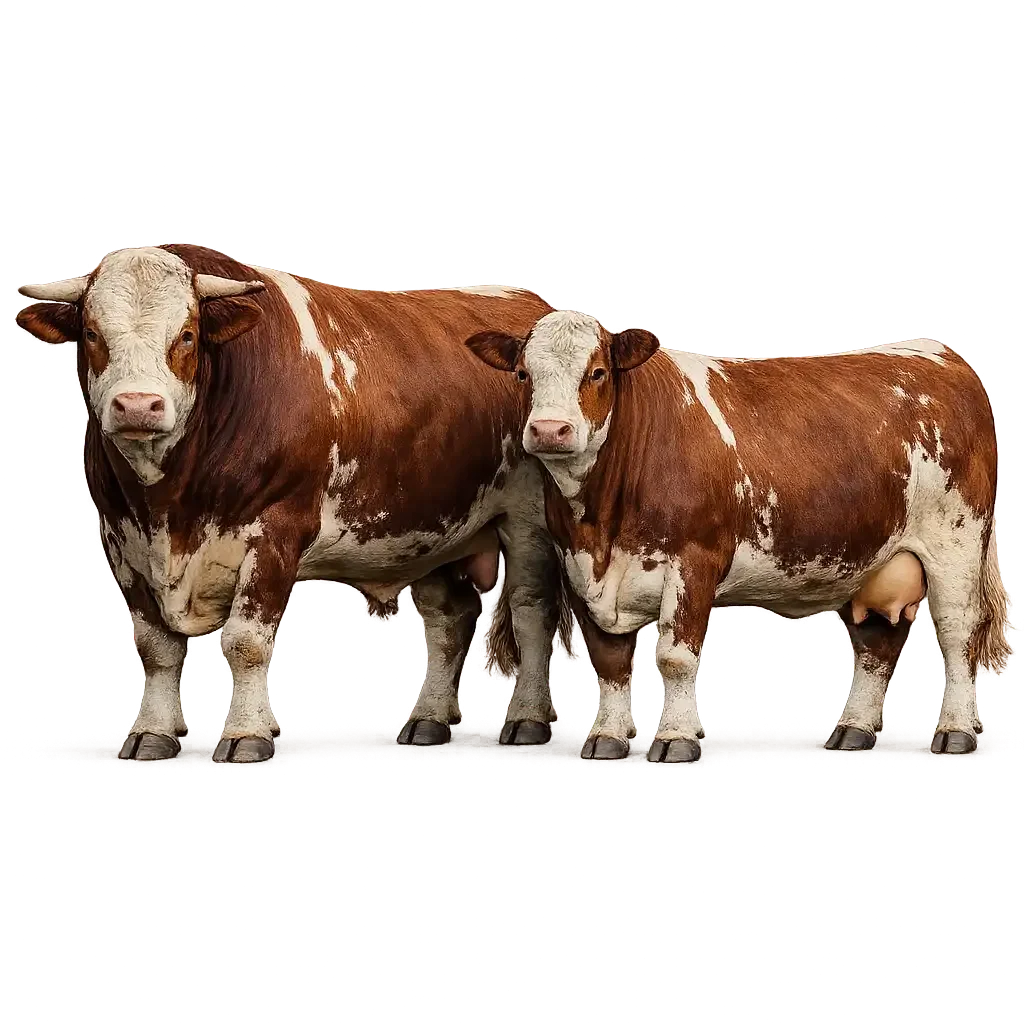
The Simmental (pronounced "SIM-en-tall") is one of the oldest and most widely distributed cattle breeds in the world, originating in the Simme Valley of Switzerland. This impressive breed is renowned for its exceptional size, rapid growth rates, and versatility as both a beef and dairy animal. Simmentals are characterized by their distinctive gold-and-white or red-and-white coloring and their massive, muscular frames that produce some of the largest and heaviest cattle in the beef industry.
Simmentals have gained tremendous popularity worldwide, particularly in North America, where they are valued for their outstanding performance in crossbreeding programs, superior growth rates, excellent maternal characteristics, and ability to produce large quantities of high-quality beef. The breed is the second-most popular beef breed globally and has been instrumental in improving beef production efficiency in numerous countries.
Origin & History
Origin: Simme Valley (Simmental) in the Bernese Oberland, Switzerland
Development Period: Middle Ages - one of the oldest breeds (recorded since 800s)
Original Purpose: Triple-purpose breed (milk, meat, draft power)
Foundation: Developed from large, spotted cattle native to Swiss Alps
Introduction to US: 1960s-1970s (relatively recent compared to British breeds)
North American Development: Modified to emphasize beef production traits
Global Distribution: Now found in over 100 countries on six continents
Current Status: Second-largest beef breed in the world by population
Physical Characteristics
Color: Gold/tan and white, or red and white (North American types)
Color Pattern: White face, white legs, white underbelly; colored sides and back
Build: Large-framed, heavily muscled, massive body
Weight: Bulls 2,300-3,000 lbs; Cows 1,500-2,000 lbs
Height: Bulls ~5.5-6 feet at shoulder; Cows 5-5.5 feet
Distinctive Features:
Extremely large frame - among the biggest cattle breeds
Heavy muscling throughout
Broad head with pigmented nose
Deep, wide body with excellent capacity
Strong skeletal structure
Long body length
Can be horned or polled (polled genetics available)
Impressive overall size and presence
Reproduction & Breeding
Gestation Period: Approximately 285-290 days (9.5 months)
Breeding Age: Heifers typically bred at 15-18 months (later than smaller breeds)
Calving: Generally good calving ease, especially in crossbred situations
Calf Birth Weight: 85-105 lbs (moderate to heavy, but manageable)
Calving Interval: 12-13 months optimal
Fertility: Very good conception rates and reproductive efficiency
Breeding Season: Year-round capability
Crossbreeding Value: Exceptional - widely used as terminal or maternal sire
Lifespan & Productivity
Average Lifespan: 15-20 years
Productive Life: Cows remain productive for many years
Prime Production Years: 3-12 years of age
Longevity: Good durability despite large size
Cow Retention: High percentage stay in herd due to productivity
Milk Production
Purpose: Dual-purpose breed (beef primary in North America)
Daily Production: 15-30 lbs per day (excellent for beef breed)
Lactation Period: 8-10 months
Maternal Ability: Outstanding mothers with abundant, rich milk
Butterfat Content: High butterfat supporting rapid calf growth
Dairy Heritage: Still used for dairy in Europe; beef-focused in Americas
Milking Ability: Among the best milking ability of all beef breeds
Calf Growth & Development
Weaning Weight: 600-800+ lbs at 6-8 months (exceptional)
Daily Gain: 3-4.5 lbs per day on quality feed (outstanding)
Market Weight: 1,300-1,600+ lbs at 14-18 months
Feed Efficiency: Very good - efficient converters despite size
Growth Rate: Among the fastest-growing cattle breeds
Muscle Development: Rapid muscle growth with good frame development
Temperament
Simmental cattle are generally docile and relatively easy to handle, though their large size requires proper facilities and respectful handling. They are intelligent and calm when properly managed, responding well to consistent, gentle treatment. Cows exhibit excellent maternal instincts and are protective of their calves but typically remain manageable. Bulls can be calm and workable but require strong facilities and experienced handlers due to their massive size and strength. Simmentals raised with regular human contact from birth are notably easier to handle. Their temperament makes them suitable for commercial operations with proper handling systems, though their size may be intimidating for beginning ranchers or small-scale operations.
Meat Quality
Marbling: Good to excellent intramuscular fat
Flavor: Excellent, rich beef flavor
Tenderness: Very good tenderness characteristics
Grading: Consistently achieves Choice and Prime USDA grades
Dressing Percentage: 62-68% (excellent carcass yield)
Ribeye Area: Large, impressive ribeyes
Carcass Weight: Exceptionally heavy carcasses - among the heaviest
Meat Yield: Very high total pounds of saleable beef per animal
Market Appeal: Premium pricing for size and quality
Feeding & Nutrition
Grazing: Excellent foragers despite large size
Feed Requirements: High due to size and growth rate
Finishing: Excellent on grain-finished programs; can be grass-finished
Feed Efficiency: Good efficiency relative to growth and size
Water: 15-30 gallons per day (higher due to size)
Mineral Needs: Standard beef cattle minerals; adequate calcium important
Forage Consumption: High intake capacity due to large frame
Health & Care
Hardiness: Very hardy and adaptable
Common Issues: Generally healthy; large size requires adequate nutrition
Vaccinations: Standard cattle vaccination protocols
Parasite Control: Regular deworming recommended
Hoof Care: Regular monitoring; strong feet but size creates more pressure
Climate Adaptation: Adaptable to various climates (temperate to cool best)
Cold Tolerance: Excellent - handles cold weather very well
Heat Tolerance: Moderate - less heat-tolerant than Brahman-influenced breeds
Disease Resistance: Good overall health and disease resistance
Advantages
Exceptional growth rates - among the fastest-growing cattle
Large frame produces heavy, high-value carcasses
Outstanding maternal characteristics and milking ability
Excellent meat quality with good marbling
Superior hybrid vigor when used in crossbreeding
Very good feed efficiency for size
High dressing percentages (62-68%)
Large ribeye areas and heavy muscling
Hardy and adaptable to various climates
Dual-purpose genetics (can be used for milk or beef)
Polled genetics available (no dehorning needed)
Excellent for terminal cross programs
Good fertility and reproductive efficiency
Longevity and productivity
Disadvantages
Very large size requires substantial feed and facilities
Higher birth weights can cause calving difficulties in some situations
Large size can be intimidating for inexperienced handlers
Requires stronger fencing and handling facilities
Higher feed costs due to size and intake
Less heat-tolerant than Brahman-influenced breeds
May be too large for small-acreage operations
Heavier cattle can cause more pasture damage in wet conditions
Best Suited For
Commercial beef production emphasizing growth and size
Crossbreeding programs (exceptional terminal or maternal sire)
Large-scale operations with adequate facilities
Feedlot finishing operations
Producers seeking maximum pounds of beef per animal
Cool to temperate climates
Operations with strong fencing and handling facilities
Hybrid vigor programs
Premium beef programs emphasizing size and quality
Experienced cattle managers
Economic Considerations
Initial Cost: Moderate to high for quality breeding stock
Return on Investment: Excellent due to rapid growth and heavy carcasses
Market Demand: Very strong - second-largest breed globally
Premium Pricing: Heavy carcass weights bring substantial returns
Feed Costs: Higher due to size, but efficiency offsets costs
Crossbreeding Value: High demand for Simmental bulls in commercial herds
Resale Value: Strong market for breeding stock
Per-Pound Value: Excellent total value per animal sold
Fun Facts
Simmental is one of the oldest cattle breeds, with records dating to the 9th century
The name comes from the Simme Valley (Simmental) in Switzerland
Simmental is the second-most populous cattle breed in the world
Originally a triple-purpose breed used for milk, meat, and draft power
Simmental bulls can weigh over 3,000 pounds at maturity
The breed is found in over 100 countries across six continents
Simmental-cross cattle dominate many commercial feedlots due to growth rates
In Europe, Simmentals are still widely used for dairy production
The breed's milk has high butterfat content, making it ideal for Swiss cheese production
Simmental calves can gain over 4 pounds per day on high-quality feed
The breed played a key role in developing many composite breeds
A Simmental can produce a carcass weighing over 1,000 pounds
A true dual-purpose breed that offers heavy muscling; see how its cuts are categorized in our Complete Guide to Beef Cuts.