
Black East Indian
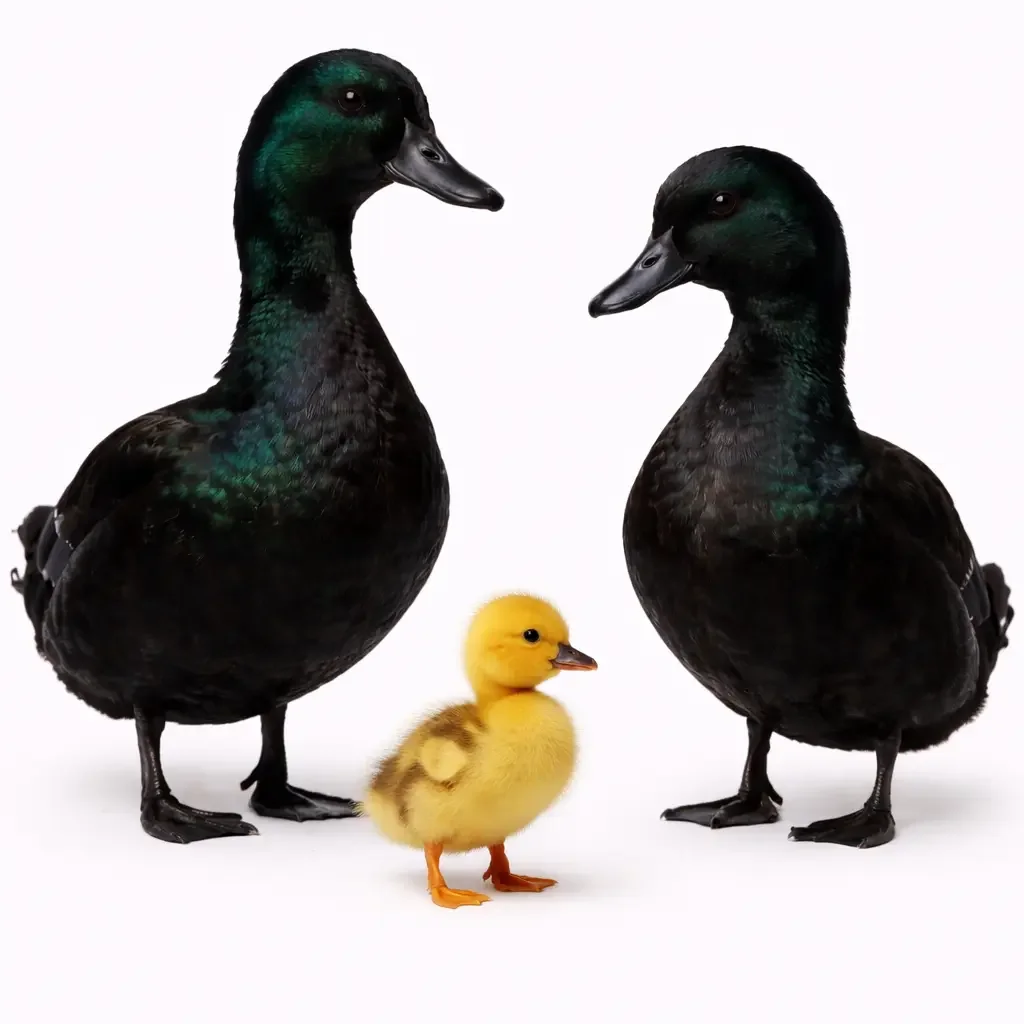
The Black East Indian Duck, also known simply as the East Indie or East Indies Duck, is the oldest bantam duck breed in existence, the most visually breathtaking small duck in the world, and the bird that was selected in 1943 by a committee of professional artists as the most beautiful specimen among five thousand birds of all varieties of land and waterfowl at the Boston Poultry Show. Its name is misleading: it has no documented connection to the East Indies, South America, or any geographic region its various historical names have implied. It was developed in the United States in the nineteenth century, almost certainly from the same extended black gene shared by the Cayuga Duck. What it lacks in egg production, meat utility, and practical farm application it more than compensates for with an iridescent beetle-green plumage of such intensity and beauty that it stopped professional artists in their tracks and has stopped people in their tracks at every exhibition since. This is a breed kept for one reason: it is one of the most beautiful living animals in the world.
Quick Facts
Class: Bantam (the oldest bantam duck breed)
Weight: Drakes approximately 1.7 to 2 pounds; hens approximately 1.5 to 1.7 pounds
Egg Production: 40 to 100 eggs per year; strongly variable by strain and individual; eggs start black or dark gray early in the season and fade to light gray or blue
Egg Color: Black to dark gray at the start of the season, fading to light gray or blue over the laying period
Egg Size: Small; bantam-proportioned
Primary Purpose: Exhibition; ornamental; pest control in gardens
Temperament: Generally shy and reserved; quieter than the Call Duck; docile and non-aggressive; becomes friendly with consistent gentle handling from young
Brooding: Moderate to good; hens can be attentive mothers when conditions allow natural nesting
Conservation Status: Very small global population; approximately 154 breeding individuals documented in the United States in the 2021 Livestock Conservancy Poultry Census; Watch category with potential future risk
APA Recognition: 1874 (listed as East Indies); British standard 1865
Country of Origin: United States; precise origin unknown
Year Developed: Likely early to mid-nineteenth century; documented in London by the Zoological Society in 1831 under the name Buenos Ayres Duck
Lifespan: 8 to 12 years; some individuals may reach 15
Image Section
Feature image: Black East Indian drake showing the full iridescent beetle-green sheen in direct sunlightSecondary image: Black East Indian hen showing characteristic all-black plumageThird image: Black East Indian duckling showing the jet-black down with early green sheen
Breed Overview
The Black East Indian Duck carries one of the most misleading names in domestic poultry. It has no documented origin in the East Indies, no connection to South America despite early names like Brazilian and Buenos Airean, and no connection to Labrador despite another historical name. The most widely accepted explanation for the exotic geographic naming is straightforwardly commercial: in nineteenth-century American and British poultry markets, exotic-sounding and foreign-attributed breeds commanded higher prices than breeds with plain domestic names. The bird was given an evocative geographic name to increase its market value, and the name stuck permanently despite bearing no relationship to any actual geography.
The breed's genuine origin is almost certainly in the United States, developed from the same extended black gene pool that produced the Cayuga Duck. Some historians have proposed that the black pigmentation entered the domestic Mallard lineage through the American Black Duck, the wild North American waterfowl whose all-dark plumage and genetic proximity to the Mallard could have contributed the extended black gene through natural crossing in early American duck-keeping. This hypothesis is plausible but undocumented, and the precise pathway remains one of American poultry history's unresolved questions.
What is documented is that the Zoological Society of London kept specimens of this breed in 1831 under the name Buenos Ayres Duck, making it one of the earliest documented bantam duck breeds on either side of the Atlantic. The breed was standardized in Britain in 1865 as one of four duck breeds included in the first British poultry standard, and admitted to the American Poultry Association Standard of Perfection in 1874 as the East Indies Duck.
In 1943, the breed's beauty received its most dramatic formal recognition when a committee of three professional artists was invited to select the most beautiful bird at the Boston Poultry Show from among five thousand specimens of all varieties of land and waterfowl. They selected a Black East Indian drake. The citation has been repeated in breed literature ever since, not as marketing but as the straightforward record of what happened when trained aesthetic judgment was applied to a comprehensive field of candidates.
The global population of the breed is very small. The 2021 Livestock Conservancy Poultry Census documented approximately 154 breeding individuals in private American flocks. International populations in Europe and Australia are similarly constrained. The breed faces the characteristic risks of small-population genetics: reduced diversity, potential inbreeding effects, and competition for breeder attention from more widely kept bantam duck breeds like the Call Duck.
Plumage and Appearance
The Black East Indian Duck's plumage is the reason the breed exists. At rest or in flat light, the bird appears uniformly jet black: black feathers, black bill, black legs and feet. In direct sunlight or bright artificial light, the feathers reveal an iridescent sheen of beetle-green, emerald, blue, and purple that shifts with angle and light quality in a display of optical complexity that no other commonly kept domestic duck can replicate. The best show-winning birds carry this iridescent sheen not only on the visible body surfaces but under the wings as well, which judges specifically evaluate in competition. The British Waterfowl Association notes that the very best exhibition birds display a green sheen even under the wings, a characteristic that distinguishes genuinely well-bred birds from those with diluted color genetics.
The iridescence is not produced by pigment in the conventional sense but by the same light-diffraction mechanism responsible for iridescent colors in wild waterfowl speculums and many other birds. The base color is black, and the green-to-purple sheen is a structural optical effect produced by the arrangement of melanin granules within the feather microstructure. The quality of this iridescence varies between individuals and bloodlines and is one of the primary selection criteria in exhibition breeding programs.
Both sexes are entirely black in healthy, pure-bred birds. Drakes typically retain this pure black plumage throughout their lives. Hens, sharing the same extended black gene dynamics as the Cayuga Duck, often develop white feathers beginning in their second year of life and progressively over subsequent molts. This whitening in hens is a known characteristic of the extended black gene and cannot be eliminated through selective breeding in either the East Indian or the Cayuga. Drakes that develop white feathers should not be used for breeding, as this indicates a dilution of the gene expression that reduces color quality in offspring. Hens that develop white feathers are still genetically pure and can produce solid black ducklings when mated to a correct drake.
The body is bantam in every dimension: compact, rounded, low-set, with short legs and a small head carrying a proportionally short, dark bill. The body carriage is roughly horizontal, giving the bird a different impression from the more upright Call Duck stance.
Egg Production and the Dark Egg Characteristic
The Black East Indian's egg production is the breed's most surprising attribute for keepers who discover it without prior knowledge. The eggs laid early in the laying season carry a dark, sooty bloom on the shell surface that makes them appear black or very dark gray at first examination. This dark bloom, like the Cayuga's black egg bloom, is a surface deposit rather than a true shell pigmentation and fades as the season progresses. By mid-season the eggs are light gray; by late season they are off-white, pale blue, or occasionally white. The progression from dark to light across a single laying season exactly mirrors the Cayuga's egg color transition, reflecting the shared extended black genetics of the two breeds.
Total egg production is modest. Most hens in production lines lay 40 to 100 eggs per year, with the range driven significantly by individual genetics and strain quality. Some hens in well-managed lines reach the upper end of this range; heavily exhibition-bred birds or small-framed individuals may lay fewer. The eggs are small, proportional to the bantam body, and suitable for home consumption and baking despite their novelty size.
The breed is not managed for egg production in any practical sense. Homesteaders who want the dark egg novelty alongside meaningful laying numbers are better served by the full-sized Cayuga, which produces the same seasonal black-to-white color progression in a larger egg at 100 to 150 per year.
The 1943 Boston Poultry Show
The 1943 Boston Poultry Show selection is worth dwelling on briefly because it is not a marketing claim or a breeder's promotional statement. It is a documented historical record. Three professional artists were given a specific aesthetic assignment: select the most beautiful bird from five thousand specimens representing all varieties of land and waterfowl. Their selection was the Black East Indian drake.
The significance is not that the bird wins every beauty competition, or that beauty in animals is objectively measurable. The significance is that when aesthetic judgment was brought to bear on a comprehensive field of domestic and wild poultry by people trained to evaluate visual beauty as a professional discipline, the Black East Indian drake was their unanimous conclusion. For a breed kept primarily for ornamental purposes, this is the most relevant endorsement possible.
Temperament and Behavior
The Black East Indian Duck is generally quieter, shyer, and more reserved than the Call Duck, which is itself somewhat quieter than standard domestic ducks. This comparative quietness is a practical attribute in sensitive settings, as the breed does not produce the Call Duck's penetrating vocalization or the persistent quacking of standard domestic ducks. Hens are quiet by domestic duck standards; drakes are essentially silent.
The breed's natural shyness means it benefits from calm, consistent handling from as early an age as possible. Birds raised from ducklings with regular gentle human interaction become comfortable and friendly with their keepers, while birds acquired as adults without prior handling experience can remain reserved and difficult to approach. Experienced keepers recommend thinking of the management style as somewhere between fully domestic and semi-wild, providing appropriate habitat with minimal disturbance and allowing the birds to acclimate at their own pace.
The breed is non-aggressive toward other birds and humans. It integrates well into mixed-species settings with other non-aggressive breeds of similar or larger size. Because of its small size and relatively calm disposition, it is vulnerable to bullying by more aggressive breeds in mixed-flock situations and should be kept with birds that match its temperament profile.
Drakes are noted by keepers as particularly attentive to their hens and to ducklings, showing protective behavior toward the flock that is more pronounced than in many other domestic duck breeds.
Flight Capability and Confinement
The Black East Indian Duck is a capable flier, particularly in birds whose wings have not been clipped, and this flight capability is one of the most significant management considerations for the breed. Unlike virtually all standard-sized domestic ducks, which cannot sustain meaningful flight due to body weight, the bantam East Indian's light frame allows true flight when startled, when the birds are exploring unfamiliar environments, or simply when they choose to move between locations.
Covered runs or wing clipping are required for reliable confinement. The breed is sometimes described as semi-wild in its management requirements because its flight capability means that unconfined or inadequately housed birds may disperse to neighboring properties, roosting sites, or water features at considerable distance. New birds in particular should be wing-clipped before release into any open area, as the first days in a new environment are when escape-flight attempts are most likely.
The flight capability, while a management challenge, also provides the breed with a genuine predator defense advantage: birds that are threatened by a ground predator can achieve elevated roosting positions on trees, structures, or rooflines that are inaccessible to the predator. This self-preservation capability partially offsets the increased aerial predator risk from the breed's small size.
Pest Control and Garden Utility
Despite being primarily an ornamental breed, the Black East Indian Duck provides meaningful garden pest control as a secondary practical benefit. Its small bantam size makes it one of the most garden-compatible of all domestic ducks: a one to two-pound bird foraging in a vegetable bed or orchard row causes essentially no soil compaction, no meaningful plant damage, and covers ground efficiently for its size.
Insects, slugs, snails, and small invertebrates are hunted with active engagement. The breed's light weight and relatively wild foraging character mean it works through habitat more thoroughly and with less disturbance than heavier breeds that move more slowly and destructively through sensitive planting areas.
Brooding and Natural Reproduction
The Black East Indian Duck retains a more complete brooding instinct than many domestically managed breeds, reflecting its relatively recent domestication history and the semi-wild management approach that many keepers use. Hens can go broody, incubate their own eggs through the twenty-eight-day incubation period, and raise ducklings successfully with appropriate nesting habitat and minimal disturbance during the brooding period.
Keepers who provide natural nesting cover and avoid excessive disturbance during the brooding period report good natural hatch rates and attentive maternal behavior. This natural reproduction capability is consistent with the breed's semi-wild character and is one of its genuine practical advantages for homesteaders who want self-sustaining ornamental flock management without full incubator dependence.
Climate Adaptability
The Black East Indian Duck is described as hardy for its size and tolerates a range of climates with appropriate management. Cold and wet conditions are handled adequately with basic wind-protected shelter and access to unfrozen water. Summer heat management requires shade and cool water access as with all domestic ducks.
The breed's small body mass means it is somewhat more vulnerable to heat stress at sustained high temperatures than larger, more insulated breeds, and more vulnerable to cold stress at sustained extreme cold than cold-adapted heavy breeds. Standard management practices address both extremes adequately for a healthy, well-conditioned bird.
Housing and Management
The Black East Indian Duck requires the least floor space of any domestic duck in this directory. Two to three square feet of indoor space per bird and four to six square feet of outdoor space is adequate. The breed's small size, combined with its flight capability, means that covered runs or regular wing clipping are the primary housing design considerations rather than floor space management.
Water access for swimming and bathing is used enthusiastically and is specifically noted as important for maintaining the quality of the breed's iridescent plumage. Without regular immersion and preening access to clean water, feather condition declines and the iridescent sheen that defines the breed's visual appeal is compromised. A clean tub or pool sized for bantam ducks, changed regularly, is sufficient.
Exhibition and Breeding Standards
The Black East Indian is among the most competitive and technically demanding exhibition duck breeds. Judges evaluate the quality and extent of the iridescent green sheen, the pure blackness of the base plumage with no brown penciling or white patches in show-quality birds, the correct compact bantam body type, the shortness and darkness of the bill, and the overall impression of size, proportion, and color quality.
The requirement for under-wing iridescence in the highest-scoring birds reflects the genuine difficulty of breeding truly pure, high-quality exhibition East Indians. Impure birds show brown penciling under the wings and on the throat, markers of diluted extended-black genetics that experienced judges identify immediately. Maintaining a breeding program that consistently produces under-wing sheen requires careful selection of breeding pairs over multiple generations.
Pros and Cons
Pros
The oldest bantam duck breed in existence; an animal with nearly two centuries of documented ornamental history
Selected as the most beautiful bird among five thousand specimens by a committee of professional artists in 1943; a documented aesthetic endorsement without parallel in domestic poultry
The iridescent beetle-green plumage is the most visually dramatic of any commonly available domestic duck breed
Very quiet compared to other domestic ducks; shyer and less vocal than even the Call Duck
Lays dark eggs at the start of the season that fade from black to light gray to blue, sharing this characteristic with the larger Cayuga
Small bantam size requires minimal space, feed, and infrastructure relative to standard-sized breeds
Flight capability provides genuine predator defense for a small bird
Retains natural brooding instinct; capable of self-sufficient flock reproduction with appropriate management
Garden pest control is effective given the breed's active foraging and minimal plant-damage footprint
Cons
Primarily an ornamental breed; no practical meat utility and only 40 to 100 small eggs per year
Flight-capable; covered runs or wing clipping required for reliable confinement
Very small global population with approximately 154 breeding individuals in the United States; sourcing quality stock is genuinely difficult
Natural shyness requires patient, consistent handling to develop domesticity; not immediately tractable like calm heavyweight breeds
Hens develop white feathers with age as a normal genetic process that cannot be eliminated through selection
Aerial predator risk is elevated due to bantam size
Exhibition breeding for perfect iridescence and pure color standards is technically demanding
Profitability
The Black East Indian Duck's profitability is built almost entirely on exhibition and breeding stock sales rather than production output. A well-bred drake with documented show quality and confirmed under-wing iridescence commands prices that reflect the difficulty and commitment required to produce such a bird. Breeding pairs from proven exhibition bloodlines are among the most expensive domestic ducks available per unit, given the combination of small global population, technical breeding demands, and the genuine rarity of top-quality specimens.
Dark early-season eggs from East Indian hens have novelty value at direct-market sales where customers who have already encountered the Cayuga's dark eggs find the smaller bantam-version version of the same phenomenon interesting and collectable. Hatching eggs from pure, proven Black East Indian lines carry significant premium given the breed's critical scarcity.
Comparison With Related Breeds
Cayuga Duck: The Cayuga is the closest genetic relative and the bird that shares the Black East Indian's extended-black gene and seasonal dark-to-light egg color progression. The Cayuga is a standard-sized breed at seven to eight pounds, producing 100 to 150 large eggs per year and meaningful meat at table weight. The Black East Indian is the bantam version of the same visual aesthetic at one to two pounds, producing 40 to 100 small eggs per year with no meat utility. For homesteaders who want the extended-black plumage and dark egg character in a production-capable package, the Cayuga is the correct choice. For those who want the most concentrated expression of that aesthetic in the smallest possible body with the most dramatic iridescence, the East Indian is unmatched.
Call Duck: The Call Duck is the Black East Indian's primary competitor in the bantam duck exhibition world. Both breeds are bantam, both are primarily ornamental, and both have devoted exhibition communities. The Call Duck is louder, more color-diverse, more widely available, and the dominant show duck in most competitive venues. The Black East Indian is quieter, rarer, available in only one color, and the choice for keepers who prioritize the most dramatic plumage character over color variety and show frequency.
Black Scoter (wild): The only wild duck in the series with superficially similar all-black plumage. The Black Scoter is a sea duck of similar color impact to the East Indian in its all-black appearance, though the orange bill knob rather than the iridescent green sheen is its primary distinctive feature. The comparison is one of aesthetic kinship rather than genetic relationship.
Final Verdict
The Black East Indian Duck is the duck world's purest expression of living beauty as the reason to keep an animal. There is no production justification for this breed that outweighs its maintenance investment. What there is, instead, is the documented judgment of trained aesthetic professionals who looked at five thousand birds and chose it. And the experience, available to anyone who keeps them, of watching a Black East Indian drake catch a shaft of direct sunlight and reveal the full depth of the beetle-green iridescence under its wings. For homesteaders who want that experience in their yard, on their pond, or at the exhibition table, the Black East Indian is worth the effort it takes to find and keep.
Frequently Asked Questions
Does the Black East Indian Duck actually come from the East Indies? No. Despite the name, the breed has no documented connection to the East Indies, South America, or any other geographic region implied by its various historical names. It was developed in the United States in the nineteenth century. The exotic name was likely used to increase the bird's market value in an era when foreign-attributed breeds commanded premium prices.
Do Black East Indian ducks lay black eggs? Yes, early in the laying season. The first eggs of the season carry a dark sooty bloom on the shell surface that makes them appear black or dark gray. This bloom fades through the season to light gray and eventually blue or off-white. The pigmentation is only on the shell surface and can be partially wiped off.
Why was the Black East Indian chosen as the most beautiful bird at the 1943 Boston Poultry Show? A committee of three professional artists was assigned to select the most beautiful bird among five thousand specimens of all varieties of land and waterfowl. They selected a Black East Indian drake. The breed's iridescent beetle-green plumage, compact bantam form, and pure black coloration were cited in the selection. This is a documented historical record rather than a marketing claim.
Can Black East Indian ducks fly? Yes. Unlike most standard-sized domestic ducks, the bantam East Indian is light enough to fly effectively when not wing-clipped. Covered runs or wing clipping are required for reliable confinement.
How rare are Black East Indian ducks? Very rare. The 2021 Livestock Conservancy Poultry Census documented approximately 154 breeding individuals in private American flocks. Global populations are similarly constrained. The breed is one of the smallest domestic duck populations documented.
Do Black East Indian hens develop white feathers with age? Yes. Like the Cayuga Duck, Black East Indian hens often develop white feathers beginning in their second year as a normal characteristic of the extended black gene. This whitening is not a sign of disease or cross-breeding. Drakes that develop white feathers should not be used for breeding; hens that whiten with age are still genetically pure and produce solid black offspring.