
Cayuga Duck
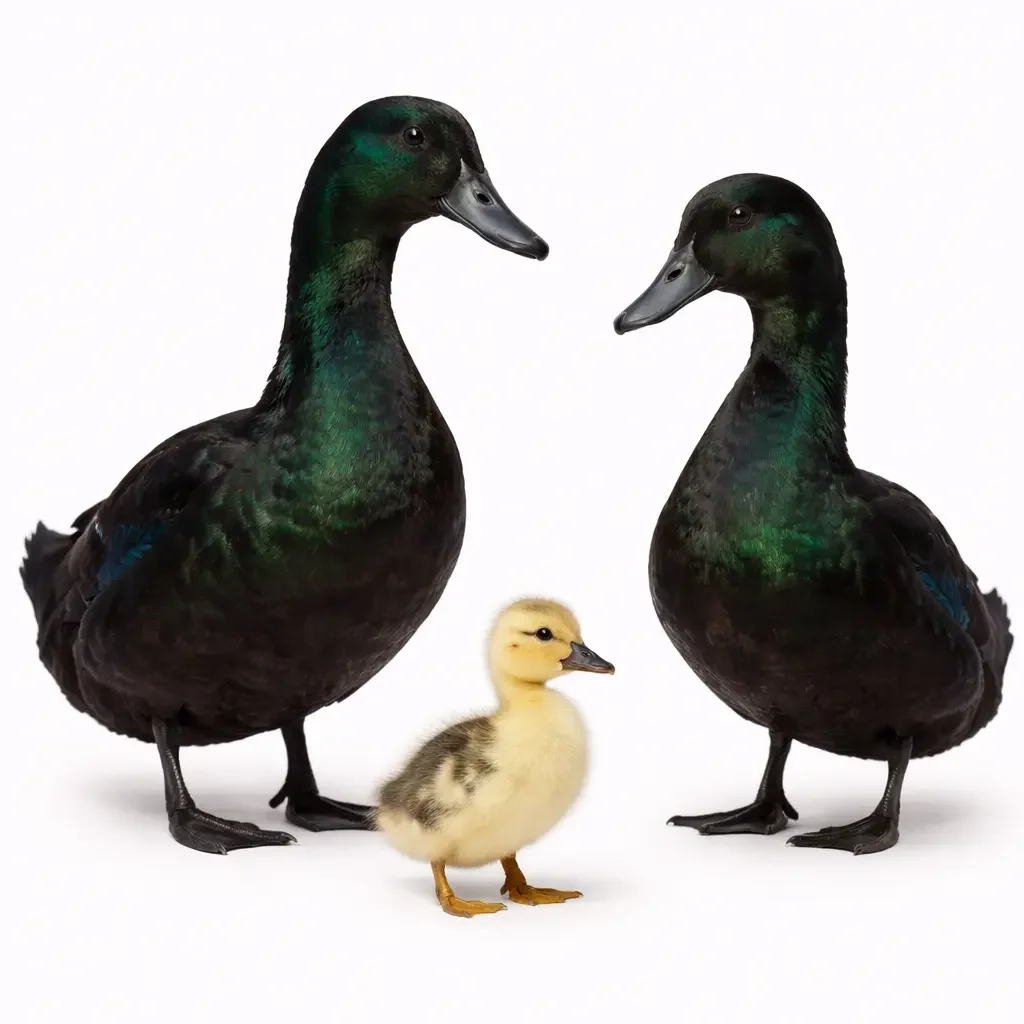
The Cayuga Duck is America's native heritage duck breed, the only domestic duck developed in the United States that holds a place in the country's agricultural and natural history, and the only duck in existence that lays black eggs. Those black eggs, deepest at the start of the laying season and lightening gradually through charcoal, gray, olive, and ultimately white as the season progresses, are perhaps the most visually arresting product any domestic duck produces. They are also the most reliable indicator of the Cayuga's character as a breed: distinctive, surprising, deeply pigmented, and unmistakably its own thing. The Cayuga was the dominant meat duck in North America before the Pekin displaced it in the 1890s. It is now a Watch breed that is recovering, found increasingly in backyard flocks and homesteads across the country, kept by people who have discovered that beauty and utility need not be in tension, and that an American original still has plenty to offer a working farm.
Quick Facts
Class: Heavyweight
Weight: Drakes 7 to 8 pounds; hens 6 to 7 pounds
Egg Production: 100 to 150 large eggs per year; some sources cite up to 160 in productive hens
Egg Color: Black at the start of the season, fading through charcoal, gray, olive, and white as the laying season progresses; one of the only domestic ducks to lay black eggs
Egg Size: Large; 70 to 90 grams per egg
Primary Purpose: Dual purpose (eggs and meat); exhibition; ornamental
Temperament: Calm, docile, easily tamed when handled from young; quiet relative to most domestic ducks; hens can be seasonally chatty
Brooding: Variable; some hens go broody and can be good mothers; incubator recommended for reliable hatching
Conservation Status: Watch (The Livestock Conservancy); upgraded from Threatened in 2020
APA Recognition: Accepted 1874; one of the original breeds in the first edition of the American Standard
Country of Origin: United States (Cayuga County, New York, Finger Lakes region)
Year Developed: Approximately 1840s; APA recognized 1874
Lifespan: 8 to 12 years
Image Section
Feature image: Cayuga duck showing beetle-green iridescent sheen on black plumage in direct sunlightSecondary image: Cayuga duck eggs showing the seasonal progression from black to olive to whiteThird image: Cayuga pair on a farm pond
Breed Overview
The Cayuga Duck is the only domestic duck breed that can genuinely claim American origin, and its history is as murky and contested as American frontier history often is. The most widely accepted account traces the breed to the Finger Lakes region of upstate New York, specifically Cayuga County, in the 1840s. A miller named John S. Clark is credited with introducing black ducks to the area around Cayuga Lake, where the birds became popular as table birds and were noted for their egg production. The birds were named for the indigenous Cayuga people of the region, a naming practice common in nineteenth-century American natural history and agriculture. By 1874, the Cayuga was accepted into the American Poultry Association's first edition of the Standard of Perfection, establishing it as one of the earliest formally recognized American breeds.
Alternative origin stories exist and none can be definitively ruled out. One account suggests the Cayuga descends from a small population of wild black ducks native to Cayuga County that were captured and domesticated by local farmers. Another proposes an English origin, noting that a Black Duck breed was common in Lancashire, England, in the 1860s and that the Cayuga closely resembles it, with the possibility that the English birds arrived in America through immigration. A third theory points to the Putian Black Duck of China, which shares the Cayuga's black plumage, black bill and feet, and similar egg characteristics. The Cayuga drake's curly tail feather, present in all Mallard-derived domestic ducks, confirms the breed's Mallard lineage regardless of which specific black duck population contributed to its development.
What is not disputed is the Cayuga's commercial importance in the late nineteenth century. Before the Pekin arrived in the United States in 1873, the Cayuga was the preeminent domestic meat duck in North America. Duck farms in New York raised Cayugas in large numbers for urban markets, valued for their size, their rich-flavored meat, and their egg production. The Pekin's arrival, with its superior growth rate, white plumage that dressed more cleanly, and larger carcass, displaced the Cayuga from commercial production within two decades. The Cayuga's population declined sharply through the twentieth century and was listed as Threatened by the Livestock Conservancy for many years. Growing interest in heritage breeds, particularly among backyard keepers attracted to the breed's extraordinary appearance and the novelty of its black eggs, drove a population recovery that earned the breed an upgrade to Watch status in 2020.
Plumage and Appearance
The Cayuga's plumage is one of the most extraordinary in domestic waterfowl. At first glance, the bird appears entirely black: black feathers, black bill, black shanks and feet, black nails. In poor light or overcast conditions, the visual impression is one of deep, uniform darkness. But under direct sunlight or bright artificial light, the feathers reveal an iridescent sheen of beetle-green that sweeps across the neck, back, wings, and flanks in shifting patterns of emerald, blue, and purple depending on the angle of light. The wingtips can shimmer from green to purple in a single movement. The effect is dramatic and unlike anything else in the domestic duck yard.
This iridescent quality is produced by the interaction of light with the melanin structure of the feathers rather than by pigment in the conventional sense. It is the same optical mechanism responsible for the iridescent colors of Mallard speculums and many wild waterfowl, but the Cayuga's all-black base makes the effect more dramatic than it would appear on a colored or white-based plumage.
Both sexes are black in plumage, which makes sex determination by color impossible. The most reliable sex marker is the drake's curled tail feather, which develops at maturity around five to six months of age. Voice is also a reliable indicator: hens produce a louder, more typical duck quack, while drakes produce a quieter, raspier sound. The sex determination methods used for other breeds, such as the Welsh Harlequin's bill color at hatch, do not apply to the Cayuga.
As Cayuga hens age and molt through successive seasons, they progressively develop white feathers among their black plumage. This whitening process typically begins in the first or second year and accelerates with age. By four to six years, some hens are substantially white across parts of the body, and older individuals can become predominantly or entirely white. Drakes show this pattern less dramatically and generally retain darker plumage longer. The white feathers that appear during molting are responsible for the beetle-green iridescent sheen in the black feathers: the gene interaction that produces white feathers when expressed partially also enhances the iridescence in the black feathers where the gene is incompletely expressed. Selectively breeding against white-feathered birds removes this genetic interaction and produces less iridescent, browner-black offspring rather than the true jet-black iridescent standard. Breeders should not cull hens for developing white feathers as a normal part of aging.
The Black Eggs
The Cayuga's black eggs are its most unique production attribute and the single most attention-getting feature in any direct-market context. No other commonly available domestic duck lays black eggs, and very few domestic poultry of any species produce them. The black color is not a true black shell pigment but rather a dark bloom, or cuticle, applied over the surface of the egg during the final stages of laying. This bloom can be partially wiped off, revealing the greenish or gray shell beneath.
The color is most intense at the very start of the laying season, typically late winter or early spring. The first eggs of the season are the darkest, sometimes appearing virtually black. As the season progresses and the hen depletes her supply of the pigment that creates the bloom, subsequent eggs are lighter: charcoal, then gray, then olive or greenish-blue, then pale blue, and finally white by late in the laying season. A single hen's eggs across one season thus document a complete color transition from black to white, which is one of the more visually remarkable progressions in domestic poultry egg production.
The nutritional and culinary quality of the eggs is identical regardless of shell color. The dark bloom is surface only and does not affect the egg's interior, flavor, or baking performance. Buyers at farmers markets who encounter black duck eggs for the first time reliably stop, ask questions, and often purchase on the strength of the novelty alone.
Egg Production
The Cayuga's egg production is moderate rather than exceptional: 100 to 150 large eggs per year in well-managed hens, with productive individuals in some bloodlines reaching 160. This output is sufficient for a family egg supply and meaningful farmers market revenue, though it places the breed well below dedicated laying breeds like the Khaki Campbell or Welsh Harlequin in total annual volume.
The breed is a seasonal layer that typically does not produce through fall and winter, resuming in late winter or early spring when daylight hours increase. This seasonality means the Cayuga is best managed alongside a laying breed that produces more consistently through the darker months if year-round egg supply is a goal.
Broodiness in the Cayuga is variable. Some hens go broody and make reliable, attentive mothers; others show little brooding instinct. Keepers report a range of brooding behavior within the breed, with some hens successfully raising their own ducklings and others laying faithfully with no interest in sitting. An incubator is the reliable tool for hatching and should not be excluded from the management plan even for keepers who hope for natural broodiness.
Meat Quality
The Cayuga's meat quality is the breed's historic claim to fame and remains one of its strongest practical attributes. The meat is consistently described as rich, beefy, and intensely flavored, with a deep red color and a complex taste profile that Slow Food USA has documented as producing succulent results despite the breast being somewhat smaller than commercial meat breeds. The flavor is more pronounced and distinctive than commercial Pekin, appealing to consumers who find standard supermarket duck bland and to chefs who want a heritage duck product with genuine character.
The primary challenge in processing Cayuga for meat is the dark plumage. Black pinfeathers leave visible dark stubs in the skin of the plucked carcass, which affects the visual presentation of the finished bird. Some processors resolve this by skinning the duck rather than plucking, which eliminates the pin feather issue entirely and produces a clean, lean presentation at the cost of the skin. For direct-market sales where the whole roasted duck with crisp skin is the premium product, this is worth discussing with buyers before processing. For restaurant sales and home consumption where skinning is acceptable, the processing challenge is not a significant obstacle.
Best Preparations
The Cayuga's richly flavored, deep red breast meat suits preparations that highlight its intensity rather than trying to neutralize it. Whole roasting at high heat with simple seasoning showcases the heritage flavor without competition. Pan-searing the breast to medium-rare produces the best texture and allows the natural beefy character to carry the dish. Braised Cayuga legs and thighs in red wine or a rich stock over low heat make outstanding use of the well-developed dark meat. The intense flavor also suits duck rillettes, duck confit, and any preparation where richness and complexity are assets rather than challenges to manage.
Temperament and Behavior
The Cayuga is one of the calmer and more tractable domestic duck breeds, consistently described as gentle, docile, and easily tamed when handled from duckling age. Hand-raised birds often follow their keepers around the yard, come when called, and accept handling without the chronic anxiety of more nervous breeds. The Cayuga's temperament makes it suitable for families with children and for mixed-species flocks where a calm anchor breed is beneficial.
Noise level is generally lower than many domestic ducks, though individual variation exists and experienced keepers note that some hens are quite vocal. The Cayuga is not a silent breed by any standard, but it is quieter on average than the Pekin or Khaki Campbell, making it a reasonable choice for suburban and semi-rural settings where noise management matters.
The breed is seasonally aggressive when hens are sitting on eggs or protecting ducklings, which is normal maternal behavior and resolves once the brooding period ends.
The Cayuga focks well, with members of the flock staying together and moving as a group in a way that makes herding manageable. The breed has been used in dog herding trials alongside Indian Runners for this reason.
Cold Hardiness
The Cayuga is recognized by the Livestock Conservancy as one of the hardiest of domestic duck breeds, specifically noted for its tolerance of the harsh winters of the northeast United States where it was developed. The Finger Lakes region of New York experiences genuine winter conditions including heavy snowfall, sustained below-freezing temperatures, and prolonged periods of ice and cold, and the Cayuga's population was selected for productive performance in those conditions over generations.
For Midwest homesteaders, this cold hardiness is a genuine practical advantage. The Cayuga requires standard winter management of wind-protected housing and access to unfrozen water but does not need supplemental heating or intensive cold weather management beyond what any domestic duck requires. It remains active in snow and cold in ways that breeds from warmer climates do not.
Summer heat requires standard management of shade and cool water access but does not present special challenges for the breed.
Foraging and Pasture Performance
The Cayuga is an active and capable forager that supplements its diet meaningfully with insects, slugs, snails, worms, and plant material when given adequate outdoor access. At seven to eight pounds, it carries more body mass than lightweight foraging breeds, meaning it covers somewhat less ground per unit of foraging energy, but its size and frame give it better cold-weather foraging endurance than smaller breeds.
The breed's calm movement style makes it a good garden forager that does not cause excessive plant disturbance or soil compaction relative to its body weight. Slugs, snails, and ground-dwelling insects are hunted with genuine enthusiasm, and the breed's foraging contribution to pest control is meaningful on managed homestead properties.
The breed is not a reliable flier in most management contexts. Some individuals can achieve short-distance flight when startled, particularly younger and lighter birds, but the breed is generally considered non-flying for practical confinement management purposes. Wing clipping for any birds that test fencing limits is standard for new adults brought to a property.
Aging and the White Feather Transition
The progressive whitening of Cayuga hen plumage with age is one of the breed's most distinctive and sometimes misunderstood characteristics. New keepers who are not prepared for this transition sometimes assume that white feathers indicate disease, parasites, stress, or cross-breeding with a white duck. None of these are the cause. The whitening is a normal, breed-specific aging process driven by the genetics of the black and white plumage interaction in the Cayuga genome.
The rate and extent of whitening varies between individuals. Some hens begin showing scattered white feathers in year two; others remain predominantly black through year four or five. By six to eight years, many hens are substantially white across the body. Drakes whiten more slowly and less completely, often retaining more black plumage through their productive years.
This aging visual change is worth communicating honestly to buyers of Cayuga ducks, particularly those who are acquiring the birds for their ornamental black appearance. A hen purchased at one year for her dramatic all-black plumage will look very different at five years. This is not a flaw but a feature of the breed's natural life history.
Pros and Cons
Pros
The only domestic duck in the United States with a genuinely American origin and heritage
The only commonly available domestic duck that lays black eggs; the most visually distinctive egg production of any domestic duck
Extraordinary iridescent beetle-green plumage in direct sunlight; one of the most beautiful domestic ducks in existence
Recognized as one of the hardiest domestic duck breeds; specifically cold-hardy for Midwest winters
Calm, docile, easily tamed temperament suitable for families and beginners
Rich, beefy, intensely flavored meat that experienced cooks consistently rank among the finest heritage duck
APA recognition from 1874; one of the oldest American poultry standards
Conservation Watch status; keeping quality Cayugas supports continued breed recovery
Quiet relative to many domestic ducks; suitable for suburban and semi-rural settings
Cons
Egg production of 100 to 150 per year is moderate rather than high; not a primary laying breed
Seasonal layer that does not produce through fall and winter
Dark plumage creates pin feather challenges when plucking: processing requires either careful plucking or skinning
Plumage whitens with age in hens; birds change significantly in appearance over their productive life
Broodiness is variable rather than reliable; incubator investment recommended
Watch breed status means quality birds require more sourcing effort than commercial breeds
Egg volume is meaningfully lower than Welsh Harlequin, Khaki Campbell, or Golden Cascade
Profitability
The Cayuga's most distinctive profitability asset is the black egg, which is without peer in the domestic duck egg market for novelty and customer attention. Black duck eggs at a farmers market create immediate stopping power and conversation that no other egg in the market achieves. Premium pricing of three to five times the standard egg price is sustainable for the darkest early-season eggs, which are genuinely rare and visually spectacular. The color progression through the season from black to olive to white provides a natural marketing narrative that engaged direct-sale customers find compelling.
Whole dressed Cayuga at premium heritage pricing suits restaurant relationships and informed direct buyers who understand and are willing to pay for heritage duck quality. The rich, beefy meat appeals specifically to buyers who find commercial Pekin underwhelming, and this market niche can sustain meaningful per-bird premium pricing.
Hatching eggs and ducklings from quality Cayuga bloodlines command steady demand from the growing community of heritage breed homesteaders. The breed's Watch conservation status and its association with American poultry heritage adds a provenance narrative that resonates with conservation-minded buyers.
Comparison With Related Breeds
Pekin Duck: The Pekin displaced the Cayuga as America's dominant meat duck in the 1890s through superior growth rate, feed efficiency, and the commercial advantage of white plumage for a clean-dressing carcass. The Cayuga produces superior meat flavor in the heritage tradition, lays black eggs that command premium market attention, and carries a conservation story and American heritage narrative that the Pekin cannot offer. For homesteaders choosing between the two, the Cayuga is the quality-and-character choice; the Pekin is the volume-and-efficiency choice.
Rouen Duck: The Rouen is the closest comparison in the heritage heavyweight meat duck category. Both breeds produce outstanding eating quality that surpasses commercial Pekin in flavor complexity. The Rouen's dressed carcass is larger at nine to ten pounds; the Cayuga's is somewhat smaller. Both breeds have dark feathering challenges when plucking, though the Rouen's dark plumage is less extreme than the Cayuga's all-black. The Cayuga's unique black eggs and American heritage differentiate it clearly in direct market contexts. See the Rouen guide for a full comparison.
Muscovy Duck: The Muscovy produces the leanest and most intensely flavored domestic duck meat and is the Cayuga's primary competition for the premium heritage meat market. Both are authentic heritage ducks with complex flavor profiles, both suit the customer who finds commercial Pekin uninteresting, and both are managed primarily for quality rather than volume. The Cayuga lays more eggs in a season; the Muscovy produces more meat per bird and self-sufficiently raises its own offspring. Both deserve a place in a comprehensive heritage homestead.
Black Scoter (wild): The only wild duck in the series with a superficially similar all-black appearance. The Black Scoter is a sea duck with a bright orange bill knob and white wing patches that distinguish it clearly from the domestic Cayuga, which has a dark bill and no wing patches. The comparison is primarily relevant for identification purposes in settings where both wild and domestic black birds might be present.
Final Verdict
The Cayuga Duck is America's own, and it deserves far more recognition than its quiet transition from commercial prominence to heritage breed recovery has given it. Its black eggs are unlike anything else a domestic duck produces. Its iridescent plumage is among the most beautiful in agricultural poultry. Its cold hardiness suits the Midwest perfectly. Its meat quality represents what American heritage duck tasted like before commercial production standardized the category around the Pekin. And its recovery from Threatened to Watch status reflects the efforts of a dedicated community of keepers who recognized that an American original was worth saving. For homesteaders who want something that is beautiful, productive, historically significant, and distinctly American, the Cayuga delivers all of it.
Frequently Asked Questions
Do Cayuga ducks really lay black eggs? Yes, at the start of the laying season. The first eggs of the season are the darkest, sometimes appearing virtually black. The color is a dark bloom applied to the shell surface and can be partially wiped off. As the season progresses, eggs lighten from charcoal through gray and olive to white by late season.
Why do Cayuga hens turn white as they age? Whitening of plumage is a normal aging process in Cayuga hens driven by the genetics of the black and white plumage interaction specific to this breed. It is not a sign of illness, stress, or cross-breeding. Most hens begin showing some white feathers by year two and become progressively lighter with successive molts.
Is Cayuga duck meat good to eat? Yes, and consistently rated as one of the finest heritage duck meats available. The meat is rich, beefy, deeply flavored, and a deep red color. The main processing challenge is dark pinfeathers in the plucked carcass; many processors skin rather than pluck to avoid this.
How cold-hardy are Cayuga ducks? The Cayuga is recognized by the Livestock Conservancy as one of the hardiest domestic duck breeds. It was developed in the Finger Lakes region of New York where harsh winters are normal, and it performs well in Midwest winter conditions with standard management.
Are Cayuga ducks rare? They were listed as Threatened by the Livestock Conservancy, meaning very low population numbers. In 2020 they were upgraded to Watch status, indicating meaningful population recovery. They are still less common than commercial breeds and require more effort to source than Pekin or Khaki Campbell.
Can Cayuga ducks fly? Most adults cannot sustain meaningful flight due to their body weight, but some individuals, particularly when young or startled, can achieve short distances. Wing clipping for new adults brought to a property is recommended until the birds are settled.