
Crested Duck
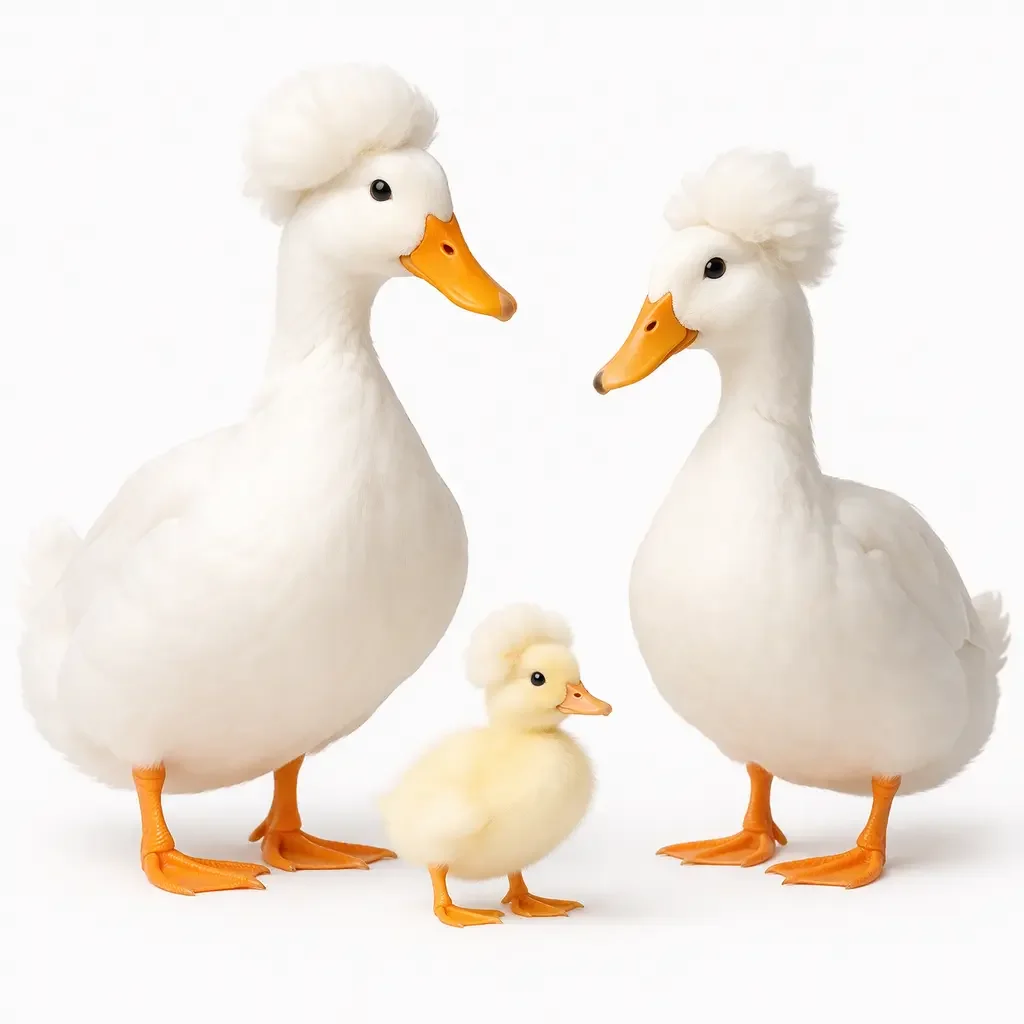
The Crested Duck is the most immediately recognizable domestic duck in any yard, and the one most likely to make visitors stop and look twice. The pompom of feathers riding on the top of its head, varying in birds from a modest tuft to an impressively globular spray thirteen centimeters in diameter, is not a hat or an accessory: it is the visible expression of a genetic mutation affecting skull development that has been documented in Dutch paintings since the seventeenth century. The Crested is ancient, beautiful, calm, moderately productive, and biologically fascinating in a way that few domestic animals can claim. It also carries a breeding complexity that every prospective keeper must understand before acquiring birds: the crest gene is semi-lethal when homozygous, which means that breeding two crested birds together always produces eggs that will not hatch at a predictable rate, and always produces some ducklings without crests. Understanding this is not a reason to avoid the breed. It is simply the entry requirement for keeping it honestly.
Quick Facts
Class: Medium-weight (sometimes listed as light)
Weight: Drakes 7 to 7.25 pounds; hens approximately 6 pounds. Bantam Crested: drakes 2.5 pounds, hens 2 pounds
Egg Production: 100 to 150 large white eggs per year; some sources note up to 200 in productive individual hens
Egg Color: White
Egg Size: Large; 80 to 90 grams per egg
Primary Purpose: Exhibition; ornamental; dual purpose (eggs and meat)
Temperament: Calm, friendly, docile; can be initially nervous with strangers; bonds well with keepers when handled regularly
Brooding: Poor; hens rarely go broody and will not typically incubate their own eggs; incubator required
Conservation Status: Not on Livestock Conservancy priority lists; moderately available in the United States
APA Recognition: White Crested accepted 1874; Black Crested accepted 1977; Bantam Crested Miniature accepted 1997
Country of Origin: Probable East Indies origin; developed in the Netherlands; documented in Europe since the seventeenth century
First APA Documentation in US: 1853 (D.J. Browne)
Lifespan: 8 to 12 years
Image Section
Feature image: White Crested duck showing the full globular feather pompom on top of the headSecondary image: Black Crested duck showing the dark plumage and contrasting white crestThird image: Flock of mixed-color Crested ducks on a farm pond
Breed Overview
The Crested Duck has one of the longest documented histories of any domestic duck breed. Dutch Golden Age painters including Melchior d'Hondecoeter and Jan Steen depicted crested ducks in their seventeenth-century avian landscapes, and the breed was almost certainly present in European domestic flocks before those paintings were made. The breed's probable origin in the East Indies aligns with the same Dutch maritime trade networks that brought the Hook Bill to Europe around the same period, and the two breeds share a similar documentary trail through the art and natural history literature of seventeenth-century Netherlands.
The White Crested was added to the American Poultry Association's Standard of Perfection in 1874, making it one of the earliest duck breeds formally recognized in the United States and one of the oldest breeds in the APA's history. The Black Crested variety followed in 1977, and the Bantam Crested Miniature, developed in the United Kingdom by John Hall and Roy Sutcliffe, was accepted in 1997. The breed can appear in any color, since the crest gene is not linked to plumage color and can express in birds of virtually any genetic background, but only White and Black are APA-recognized in standard size in the United States.
The Crested's defining characteristic, the crest of feathers on the head, results from a genetic mutation first described in molecular terms as a G-to-A substitution in the 5-prime untranslated region of the TAS2R40 gene. This mutation reduces the gene's expression and leads to incomplete cranial closure during development, creating a gap in the skull that is filled with adipose tissue. The feathers that grow over this gap form the visible crest. Approximately 82 percent of crested individuals develop intracranial lipomas associated with this skull defect, which are generally benign in most birds but represent a genuine structural vulnerability at the top of the skull.
The inheritance of the crest is autosomal dominant and semi-lethal in the homozygous form. Birds that carry one copy of the crest gene (heterozygous) are crested. Birds that carry two copies (homozygous) do not survive to hatch: the embryos die. This genetic reality means that in matings between two crested birds, approximately 25 percent of fertile eggs will not hatch due to homozygous lethality, and of those that do hatch, some will not develop a crest because they inherited no crest gene at all.
The Crest Gene: What Every Keeper Must Know
The crest genetics are the single most important piece of information for anyone considering breeding Crested ducks, and they deserve a clear, honest explanation before any other discussion of the breed's attributes.
When two crested birds are bred together, the expected outcome across a clutch of fertile eggs is roughly: 25 percent die in the egg (homozygous lethal), 50 percent hatch as crested birds (heterozygous), and 25 percent hatch as non-crested birds. In practice, observed data suggests crests appear in approximately 30 to 40 percent of hatched ducklings from crested-to-crested pairings, and the 25 percent hatch failure rate from the homozygous lethal is a real and consistent reduction in hatch rate that keepers should budget for.
When a crested duck is bred to a non-crested bird, the expected outcome is approximately half crested and half non-crested ducklings, with no egg mortality from the homozygous lethal because a non-crested bird carries no crest gene to pass on. Hatch rates from crested-to-non-crested pairings are normal.
The practical implications for homesteaders are straightforward: breeding Crested ducks together consistently produces a meaningful percentage of non-crested ducklings, a meaningful number of eggs that do not hatch, and a range of crest sizes in the birds that do hatch with crests. For exhibition breeders seeking perfectly centered, large, symmetrical crests, this produces a selection challenge. For production-oriented homesteaders who want crested birds for their ornamental value in a working flock, the breeding outcomes are manageable with realistic expectations.
The non-crested ducklings produced by crested breeding programs carry no crest gene and are essentially plain white or colored ducks. These birds can be kept as utility birds alongside their crested flock mates or sold as production birds, and they make perfectly good laying and meat ducks despite their ornamentally unremarkable appearance.
Plumage and Appearance
The Crested Duck's most immediate feature is the crest itself, which can range from a modest feather tuft to a fully developed spherical pompom of impressive diameter. Show-quality crests are centered on the skull just behind the eyeline, symmetrical, full, and well-rounded. Asymmetrical crests, side-tilted crests, and small or irregular crests are disqualifying or penalized features in exhibition settings. In production flocks where crest size and symmetry matter less than egg output and practical management, the range of crest expression is simply part of the breed's visual character.
The APA-recognized standard sizes come in White and Black. White Crested ducks are entirely white-feathered with orange bills and legs, making the crest particularly visible and dramatic against the clean white body. Black Crested ducks carry richly dark plumage that offsets the crest differently, with a more subtle contrast. Additional colors including blue, buff, and others appear in the broader population but are not APA-recognized in standard size.
The body is medium-weight and well-rounded with a broad, deep chest and a horizontal carriage. The neck is straight and medium-length. The overall impression is a substantial, well-built duck whose ornamental crest adds dignity and visual interest without making the bird appear fragile or impractical.
The Bantam Crested Miniature is a smaller version with the same crest characteristic, recognized by the APA in 1997, and particularly popular in exhibition circles where the breed's ornamental qualities are showcased in a more manageable small package.
Egg Production
The Crested Duck's egg production is solid for a primarily ornamental breed but falls below the top-producing dual-purpose breeds in this directory. Quality hens produce 100 to 150 large white eggs per year, with productive individual birds in some bloodlines approaching 200. This output is sufficient to supply a family with fresh duck eggs through the laying season and to generate meaningful income in a direct-sales context, though it places the breed well below the Welsh Harlequin or Khaki Campbell as a dedicated egg-production choice.
Eggs are large, white, and weigh approximately 80 to 90 grams. They are suitable for all culinary applications and carry the same nutritional advantages as all large duck eggs compared to chicken eggs.
The breed lays through cold winters more consistently than some seasonal breeds, providing reasonable year-round production continuity in Midwest climates with appropriate management.
Broodiness is rarely observed in Crested ducks. Hens will lay eggs but are not reliable sitters, and keepers who want to hatch Crested ducklings need an incubator. The 25 percent hatch rate reduction from crested-to-crested matings must be factored into incubator planning: set more eggs than you need crested ducklings from, accounting for the homozygous lethal losses.
Meat Quality
The Crested Duck grows to table weight in eight to ten weeks, a practical development rate that suits homestead meat production timelines well. Drakes at seven to seven and a quarter pounds provide a substantial carcass. The meat is described as tender, lean, and flavorful, with a lighter fat content than commercial Pekin. The white plumage of the White Crested variety produces a clean-dressing carcass with minimal visible pin feather pigmentation.
The breed is not a primary meat breed in the commercial sense: it does not match the Pekin's growth speed or feed efficiency, and it lacks the heritage meat quality cachet of the Rouen or Saxony. For homesteaders who keep Crested ducks primarily for their ornamental and egg-laying value, the meat from surplus drakes and non-crested ducklings from breeding programs provides a practical secondary benefit.
Best Preparations
Crested Duck meat suits whole roasting at high heat, pan-searing to medium, and braising for leg and thigh quarters. The lean meat benefits from medium cooking rather than well-done preparation. Standard duck preparation approaches work well with the breed's clean, mild flavor profile.
Temperament and Behavior
The Crested Duck is consistently described as calm, friendly, and docile when socialized from duckling age. It is not the most outgoing or people-seeking breed in the domestic duck directory, but it is comfortable around its keepers, handles daily management routines without chronic stress, and bonds genuinely with those who interact with it consistently and calmly. Initial caution around strangers is normal and softens with regular exposure.
The breed's calm temperament makes it suitable for family settings including children, and it integrates well into mixed-breed flocks with other docile breeds. It is not prone to bullying smaller breeds or being significantly bullied by larger ones when flocks are appropriately managed.
The Crested Duck is generally one of the quieter domestic duck breeds, with hens producing standard female quacking at moderate volume rather than the persistent loud calling of the most excitable breeds. This makes it practical for suburban settings where noise management matters.
The breed does not fly in any meaningful sense. Standard perimeter fencing without netting is adequate for confinement.
Foraging and Pasture Performance
Crested Ducks are active foragers that perform well on pasture and in garden settings. Their medium body weight makes them a reasonable compromise between the high foraging intensity of lightweight breeds and the reduced mobility of very heavy ones. They hunt insects, slugs, snails, and invertebrates with genuine engagement and reduce feed costs meaningfully in managed free-range systems.
The crest itself raises a practical management question in wet or muddy conditions: crests can become waterlogged, muddy, or matted in environments with heavy moisture exposure, which can obscure vision and create discomfort for the bird. In show birds, crest condition management is a regular part of exhibition preparation. In production flocks, most keepers note the crest manages itself without intervention in typical outdoor conditions, but very wet or muddy environments may require occasional attention.
Climate Adaptability
The Crested Duck is considered tolerant of both heat and cold, performing adequately across a wide range of climates including the Midwest's seasonal extremes. Standard management support of shade and cool water in summer and wind-protected housing with unfrozen water access in winter maintains welfare and production continuity. The breed does not show particular vulnerability to either end of the Midwest climate spectrum.
Housing and Management
Crested Ducks require standard domestic duck housing scaled for their medium body weight. Four to five square feet of indoor floor space per bird and ten square feet of outdoor run space provides adequate baseline conditions. The breed's calm and relatively undemanding nature means it tolerates a range of housing situations without the vocalization or stress responses of more excitable breeds.
Water access for swimming and bathing is used consistently by the breed and supports feather and crest maintenance. A stock tank, trough, or pond all serve the purpose. In show birds, access to clean swimming water before exhibition is important for presenting the crest in good condition.
Breeding Considerations
The crest gene's semi-lethal homozygous character creates specific management considerations for breeding programs. The key practical guidelines are:
Cross crested-to-non-crested when possible to avoid the 25 percent hatch failure rate and produce both crested and non-crested ducklings in a 50/50 ratio with normal hatch rates overall. Cross crested-to-crested only when show-quality breeding is the goal and the reduced hatch rate is an acceptable trade-off for the selection pressure on crest quality. Never breed two homozygous crested birds that lack the recessive non-crested gene in their ancestry, as this intensifies the hatch failure rate further.
For exhibition breeders, selecting birds with the most centered, largest, and most symmetrical crests as breeding stock and accepting the crest gene's breeding mathematics as a cost of doing business is the standard approach.
For production-oriented homesteaders, maintaining a non-crested breeding line alongside the crested line and rotating crosses reduces the hatch rate penalty while still producing crested offspring.
Pros and Cons
Pros
One of the most visually distinctive and immediately recognizable domestic duck breeds in existence
Calm, friendly, docile temperament suited to families, beginners, and mixed-breed flocks
Moderate egg production of 100 to 150 large white eggs per year; reasonable for a primarily ornamental breed
Grows to table weight in eight to ten weeks; practical for homestead meat production
Among the oldest APA-recognized domestic duck breeds with documented history since the seventeenth century
White Crested variety dresses cleanly with minimal pin feather pigmentation
Available from multiple hatchery sources; not a rare or difficult-to-source breed
Year-round egg laying in most management conditions
Non-flying; standard fencing is adequate for confinement
Two size options: standard and bantam, with the bantam particularly suited to smaller properties
Cons
Crest gene is semi-lethal in homozygous form: breeding two crested birds together reduces hatch rate by approximately 25 percent
Breeding two crested birds always produces some non-crested offspring (approximately one-third of hatched ducklings)
Egg production is below dual-purpose leaders like Welsh Harlequin or Golden Cascade; not a primary laying breed
Broodiness is rare; incubator required for all hatching
Crest can become matted or waterlogged in very wet conditions; occasional management attention needed for show birds
Approximately 82 percent of crested individuals develop intracranial lipomas from the skull gap, a benign but notable structural characteristic
Exhibition breeding for perfect crest symmetry and size is technically demanding and produces significant variability
Profitability
The Crested Duck's profitability profile is built primarily on its ornamental value and the premium that distinctive appearance commands in direct-market contexts. White Crested ducks at a farmers market table or farm stand attract immediate attention and customer interest that no plain-white or standard-colored breed generates at the same level. This visual distinction supports premium pricing for hatching eggs, ducklings, and live birds from keepers who present the breed well.
Duck eggs from Crested hens sell at standard duck egg premium over chicken eggs. The volume at 100 to 150 eggs per year is moderate rather than high, meaning the Crested is best positioned as a secondary flock addition alongside higher-production breeds rather than as the primary laying breed in a production-focused operation.
Hatching eggs and ducklings carry added interest given the genetic unpredictability of crest expression. Buyers who understand the crest genetics accept the variability as part of the breed's character, and the visual novelty of crested ducklings is a genuine market draw.
Comparison With Related Breeds
Pekin Duck: The Pekin is the production standard that the Crested is often compared to in discussions of practical utility. The Pekin grows faster, lays more eggs, and produces more meat per bird with greater feed efficiency. The Crested offers visual distinctiveness and calmer behavior at a similar body weight but cannot match the Pekin on any production metric. For homesteaders who want a dual-purpose duck that draws attention and provides moderate production without the full production commitment of a dedicated laying breed, the Crested fills a niche the Pekin does not.
Rouen Duck: The Rouen shares the Crested's dual-purpose profile at a larger body weight and with superior heritage meat quality. The Rouen's Mallard plumage is beautiful and ornamentally significant in its own right but does not carry the immediate visual novelty of the Crested's pompom. Both breeds are APA-recognized, calm, and appropriate for beginner keepers. The Rouen outperforms in meat yield; the Crested outperforms in visual distinction and is more widely available.
Call Duck: The Call Duck is the bantam ornamental duck par excellence, kept primarily for its small size, charm, and distinctive appearance. The Crested Miniature occupies a similar ornamental space in the bantam category. The Call Duck is considerably smaller and does not provide meaningful egg or meat production. The Crested in standard size offers the ornamental character of the crest alongside a practical production profile that the Call Duck cannot match.
Bali Duck: The Bali Duck, also known as the Indonesian Crested, is a separate crested duck breed from Bali with a different body type and breeding history. The Bali carries the same crest mutation but on an Indian Runner-type upright body rather than the horizontal carriage of the Crested. Both breeds are crested; the body type, egg production, and management requirements differ.
Final Verdict
The Crested Duck is the showstopper of the domestic duck world: no breed generates more immediate visual attention or more visitor questions at a farm stand or open farm day. Its four-century documented history, its APA recognition as one of the earliest formal duck standards, its calm and manageable temperament, and its honest dual-purpose capability make it a genuinely worthwhile addition to a homestead flock for keepers who understand and accept the crest gene's breeding mathematics. It is not the right breed for homesteaders whose primary goal is maximum egg production or rapid meat output. It is the right breed for homesteaders who want a visually magnificent, historically significant, and productively useful duck that earns its keep in the egg basket, at the table, and in the conversation it starts with every person who sees it for the first time.
Frequently Asked Questions
Why does the Crested Duck have a crest on its head? The crest results from a genetic mutation that causes incomplete closure of the skull during development. The gap fills with fatty tissue, and feathers grow over it to form the visible crest. The mutation is an autosomal dominant gene called the crest gene (Cr).
Can I breed two Crested ducks together? Yes, but breeding two crested birds together reduces hatch rate by approximately 25 percent due to the homozygous lethal effect of the crest gene, and produces approximately one-third non-crested ducklings in the hatch. For better hatch rates and to maintain production from the flock, crossing one crested bird with a non-crested bird of the same or complementary breed produces normal hatch rates and approximately half crested offspring.
How many eggs do Crested ducks lay per year? Quality hens produce 100 to 150 large white eggs per year. Some productive individuals approach 200. The breed is a moderate producer suited to mixed flocks rather than primary egg production operations.
Are Crested ducks good for beginners? Yes for general management, with the important caveat that beginners must understand the crest gene's breeding implications before attempting to hatch eggs. Day-to-day care, housing, and feeding are straightforward and comparable to any other domestic duck.
Do Crested ducks have health problems from the skull gap? Approximately 82 percent of crested individuals develop intracranial lipomas in the skull gap, which are generally benign fatty masses that do not typically cause clinical health problems in most birds. The skull gap does create a physical vulnerability at the top of the head that keepers should be aware of, though management under normal conditions does not require special attention to this structure.
Are Crested ducks available in colors other than white? Yes. The crest gene can express in any color background since it is not linked to plumage color. Only White and Black are APA-recognized in the United States for standard size, but crested ducks in buff, blue, gray, and other colors exist in non-standard populations.